



Picking between two collectible doll lines forces a trade-off between display appeal, accessory fit, storage space, and the cost of delivering an intact retail box to a customer. When buyers weigh Meki Fluffy Goodnight against Final Blessing, the 1/6-versus-1/8 question matters—but only after the exact versions and package contents are confirmed in writing.
The supplied information does not establish which series uses which scale, their actual dimensions, materials, or selling format. This guide therefore separates general scale-selection logic from product details that need supplier verification. Use it to compare quotes without treating a title, promotional photograph, or scale label as a complete specification.
Confirm Which Meki BJD Dolls Each Quote Actually Covers
Start by asking suppliers to identify Fluffy Goodnight and Final Blessing by their full product names, edition or version, and item codes. Similar-looking listings can differ in included clothing, accessories, or packaging. Request photographs of the actual retail box alongside the product specification sheet.
Do not automatically assign 1/6 to one series and 1/8 to the other based on listing order. Have the supplier write the stated scale and measured standing height against each quoted item. Stylized doll proportions mean a scale label alone does not establish usable dimensions.
- Construction: Confirm the body material, joint mechanism, and which parts are removable. The BJD label should not be treated as proof of a particular material or stringing system.
- Purchase format: Ask whether the quote covers a selectable doll, a random sealed unit, an assortment, or a complete set.
- Included contents: Separate the doll, outfit, shoes, optional parts, stand, and display props into a line-by-line list.
- Supply documentation: Request invoices identifying the goods and supporting sourcing documentation where appropriate.
A quote that leaves the version or contents unclear is not ready for price comparison. Resolve those gaps before discussing a larger order.
How 1/6 and 1/8 Formats Fit Different Retail Shelves
At comparable proportions, a 1/6 format represents a larger doll than a 1/8 format. However, actual height, head size, clothing volume, and stand footprint determine real shelf use. Ask for dressed dimensions and packaged dimensions rather than estimating them from product photos.
A specialist doll retailer may prioritize articulation and accessory compatibility. A gift shop may prioritize presentation and a complete-looking outfit. An online seller needs accurate dimensions and repeatable parcel packing, while a convention seller must weigh display impact against transport space.
| Buyer check | For a quoted 1/6 format | For a quoted 1/8 format | Decision rule |
|---|---|---|---|
| Display footprint | Measure the dressed doll with its stand. | Check whether hair or clothing offsets the smaller body. | Compare usable shelf positions, not scale labels alone. |
| Customer handling | Test posing and balance on the intended display surface. | Check access to smaller joints and removable parts. | Choose the format staff can demonstrate safely. |
| Accessory fit | Obtain body and foot measurements. | Obtain the same measurements; do not assume cross-fit. | Approve accessory bundles only after a fit test. |
| Retail presentation | Confirm which visible props are included. | Check whether the outfit feels complete without add-ons. | Compare the sellable package, not styled photography. |
| Parcel requirements | Measure the protected shipping package. | Check whether a large presentation box limits savings. | Use packed dimensions and weight for freight quotes. |
| Inventory space | Request carton dimensions and units per carton. | Request identical data for a fair comparison. | Calculate storage space per sellable unit. |
| Listing workload | Document height, contents, and posing limitations. | Include close-ups that communicate smaller details. | Favor specifications your team can describe accurately. |
For a convention-focused assortment, compare these space requirements with the planning considerations in this guide to small collectibles for anime convention sellers. That comparison is about channel fit, not proof that either Meki series is the better choice.

For ecommerce, review your online anime merchandise assortment before adding a doll line that needs more detailed photography, measurements, or protective packing.
Test Clothing Fit and Articulation Before Building Bundles
Matching scale labels do not guarantee interchangeable clothing, shoes, heads, or hands. Shoulder width, torso shape, foot profile, and attachment systems can differ. If accessory sales are part of the buying case, request the relevant measurements and test the exact combination with a sample.
Use that sample to check the poses needed for your listing photographs or store display. Do not force joints beyond their intended range. Ask for handling instructions, especially before removing parts or changing outfits.
- Inspect visible surfaces for scratches, uneven decoration, stains, and seam issues.
- Check whether the doll holds the intended pose with any supplied support.
- Test clothing closures without stretching seams or stressing removable parts.
- Confirm that dark fabrics do not leave visible transfer onto lighter surfaces during the sample evaluation.
- Record loose accessories against the agreed contents list.
If both series remain candidates, request the same measurement sheet and sample checklist for each. A side-by-side review is more useful than two unrelated promotional videos. For a comparable multi-format evaluation of plush and figure lines, see this four-series comparison for retail buyers.
Protect the Meki Retail Box, Not Just the Doll
A doll can arrive intact while its crushed presentation box becomes unsuitable for gift sales. Define acceptable retail-box condition separately from product condition, and ask how the head, hands, joints, and loose accessories are secured inside.

Request photographs of the internal tray, the closed retail box, and the packed shipping carton. Check for movement inside the tray, pressure on delicate decorations, and accessories that could rub against finished surfaces. For ecommerce, test the parcel packaging you will actually use rather than relying only on the inbound wholesale carton.
Before payment, agree on how shortages, missing accessories, damaged boxes, and product defects will be documented and reviewed. Ask what evidence is required and what remedies may be available; do not assume replacements or credits are automatic.
Verify the intended age grading, warnings, labeling, and applicable product requirements for your destination market. A collectible designation does not by itself settle legal classification or safety obligations. Request documentation tied to the exact item and consult a qualified local adviser when requirements are unclear.
Why a Lower Doll Price May Produce a Worse Opening Order
Compare Fluffy Goodnight and Final Blessing at the same purchasing level: per sellable doll, with equivalent contents and clearly stated delivery terms. A unit quote excluding an outfit or stand is not directly comparable with a complete package.
Build a landed-cost worksheet that includes goods, freight, insurance where applicable, duties and taxes as relevant, clearance charges, payment fees, and onward delivery. Keep local packing and fulfillment costs visible as well. Ask an accountant how recoverable taxes should be treated in your comparison.
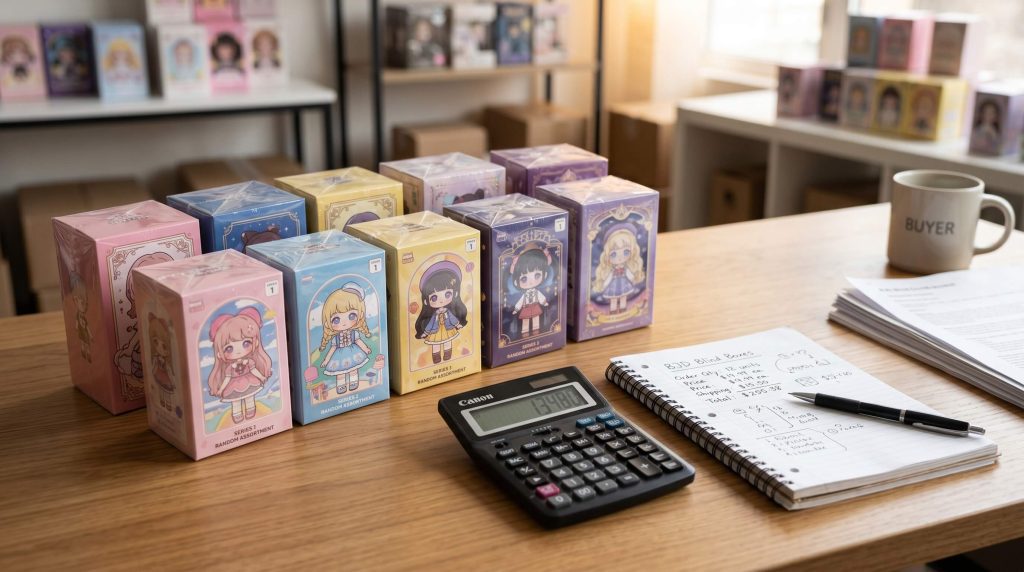
Confirm MOQ separately from inner-pack and master-carton quantities. Ask whether the MOQ applies per series, version, assortment, or total order, and whether mixed cartons are permitted. If the product is randomized, obtain the written assortment terms rather than assuming a carton guarantees distinct designs.
For example, a retailer planning a 24-unit test might compare an even 12-and-12 split between the two series with a more focused purchase of one. That is a planning scenario, not a stated supplier MOQ. The feasible split depends on confirmed case packs, demand, and freight economics.
A smaller format does not automatically cost less to ship: box dimensions and protective packaging may determine the charge. For cash-constrained testing, apply the budget-allocation approach discussed in blind box assortment planning for small stores, while verifying the Meki selling format independently.
When a Meki Launch Date Is Too Uncertain to Advertise
Ask suppliers to separate goods readiness, dispatch preparation, transport, and potential customs processing. An estimated transit duration is not an arrival commitment, and a sample being available does not establish availability of the full order.
For a coordinated launch, document when availability will be reconfirmed and whether split shipments are acceptable. Ask whether a reorder will use the same item code, contents, packaging, and assortment terms. Record any substitution approval process.
- Pause for identity gaps: Photos show one version but the quotation names another.
- Pause for freight gaps: A shipping quote lacks carton dimensions, weight, or delivery terms.
- Pause for assortment gaps: A supposed complete set has no written contents definition.
- Pause for unsupported claims: Safety or sourcing claims are not backed by item-specific documentation.
Plan replenishment from observed sales and confirmed replenishment time. Keep sample, damaged, and display units separate from available retail stock so your reorder trigger reflects what can actually be sold.
Send One Comparable Brief for Fluffy Goodnight and Final Blessing
Request separate quote lines for each series using identical fields. This makes missing information visible and prevents a low headline price from concealing a different package or shipping basis.
Please quote Meki Fluffy Goodnight and Final Blessing separately. For each, confirm the version and item code, stated scale, measured height, construction, included outfit and accessories, and selling format. Please provide MOQ, inner-pack and carton quantities, mixed-order options, retail-box and carton dimensions, gross weight, availability status, estimated dispatch timing, delivery terms, and freight basis. Include actual packaging photographs, relevant destination-market documentation, sample terms, and the process for reviewing damage or shortages.
Add your destination postal code, sales channel, intended quantity, preferred delivery window, and whether you need display samples. State any accessory compatibility or retail-box condition requirements explicitly.
Before committing funds, request a written quote for both series and resolve every blank specification. Select the order that fits your customers and operating costs—not simply the scale or photograph you prefer.
ЧАСТО ЗАДАВАЕМЫЕ ВОПРОСЫ
Which Meki series is 1/6 and which is 1/8?
The supplied information does not verify that mapping. Ask the supplier to confirm the scale, actual height, and item code for each quoted version of Fluffy Goodnight and Final Blessing.
Can 1/6 and 1/8 BJD dolls share accessories?
Do not assume compatibility. Check body measurements, foot dimensions, and attachment systems, then test the exact clothing, shoes, or parts before advertising a bundle.
Is a 1/8 doll always cheaper to ship?
No. Freight depends on packed dimensions, weight, route, and shipping terms. Compare protected retail packages and master cartons rather than scale labels.
Are these Meki series sold as blind boxes?
The supplied information does not confirm their selling format. Ask whether each quote covers a selectable doll, random sealed unit, assortment, or complete set, and request written contents terms.
What should buyers confirm before a first wholesale order?
Confirm exact items, contents, MOQ, case packs, sample condition, packaging, landed-cost inputs, estimated dispatch timing, applicable documentation, and the process for handling shortages or damage.
Before You Choose a Meki Series
Choose Fluffy Goodnight or Final Blessing only after the quoted versions pass the same checks. Verified dimensions, a satisfactory sample, clear contents, and comparable delivered costs provide a stronger buying basis than unconfirmed assumptions about 1/6 and 1/8 formats.