






In the art toy industry, the inclusion of a “chase” or secret figure is the primary driver of repeat purchases and secondary market hype. However, for wholesale buyers, understanding the mathematical production ratios behind these figures is a strict operational requirement. Miscalculating case ratios can lead to mismanaged inventory expectations and lost opportunities for high-margin upsells.
Based on wholesale distribution structures, buying a single display case does not guarantee a chase figure. Retailers must understand the relationship between standard display cases and master cartons. In this guide, we will break down the math behind 1/72 and 1/144 production ratios, evaluate the financial risk of ordering master cartons, and establish practical in-store merchandising strategies to capitalize on chase pulls.
The Math Behind the Mystery: Deciphering Case Ratios
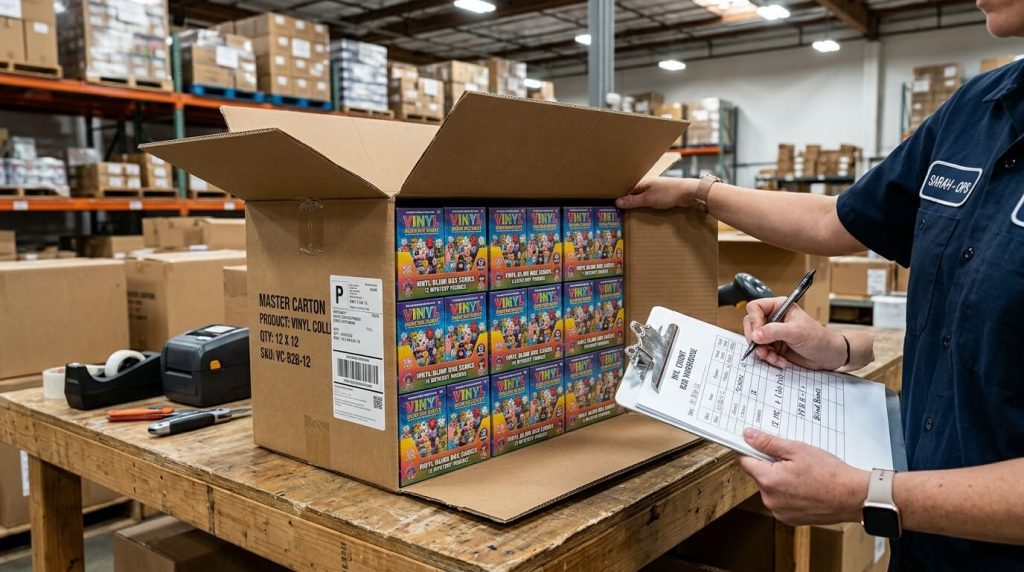
To forecast inventory accurately, retailers must first understand the structural packaging of art toys. A standard blind box series typically features 12 standard designs. Therefore, a standard Display Case contains 12 individual blind boxes. A Master Carton is the large shipping box that contains multiple display cases (usually 12 cases, totaling 144 individual boxes).
Interpreting Published 1/144 Odds
A published 1/144 figure normally describes odds: each unit has the stated chance under the manufacturer’s rules. It does not by itself mean exactly one Secret is packed in every 144-unit master carton. Treat it as a fixed carton allocation only when the manufacturer documents that packing rule for the exact series and carton configuration.
Interpreting Published 1/72 Odds
A published 1/72 figure indicates higher per-unit odds than 1/144, but it still does not guarantee two Secrets in a 144-unit carton or one in every six display cases. Separate probability from fixed allocation unless the manufacturer publishes product-specific carton rules.
Wholesale Sourcing Strategy: Single Cases vs. Master Cartons
For independent retailers, deciding whether to purchase individual cases or commit to a full master carton dictates the store’s cash flow and secondary market strategy.
The “Mixed Assortment” Approach (Lower Capital Risk)
For smaller boutiques or first-time buyers, tying up capital in a large quantity of one series can create inventory risk. A varied test order may diversify the shelf, but it also reduces exposure to any one series’ Secret odds. Choose quantities from your budget, product-specific case rules, and local demand rather than assuming a chase guarantee at carton level.
The Master Carton Approach: Odds and Allocation
High-volume retailers may purchase by the master carton for handling efficiency or inventory depth. Do not book a Secret as a guaranteed asset from 1/144 odds alone. Model the carton using the published probability, and recognize a fixed Secret allocation only when the manufacturer documents it for that exact series and carton.
In-Store Operating Procedures for Chase Figures

If your store stocks blind boxes, managing how customers interact with the inventory is just as important as how you buy it. The existence of high-value chase figures inevitably attracts “box searchers.”
1. Preventing Box Searching and Weighing
Dedicated collectors often attempt to find chases by bringing digital scales to the store, shaking boxes to listen to the rattle, or aggressively squeezing the packaging. This behavior damages the outer cardboard and alienates casual shoppers. Store managers must establish a firm, polite policy prohibiting scales and excessive handling. Read our comprehensive retail SOP on how to handle box searchers to protect your inventory integrity.
2. Creating a “Wall of Fame”
When a customer successfully pulls a chase figure in your store, it presents a significant marketing opportunity. It is a highly effective merchandising strategy to take a Polaroid photo of the customer with their chase figure and pin it to a designated board near the register. Creating a Wall of Fame proves to your customer base that your store carries “lucky” (unsearched) cases, driving repeat foot traffic and building local community trust.
Financial Modeling: The Value of the Chase
Understanding the secondary market value of a chase allows retailers to manage their cost of goods sold (COGS) more dynamically.
| Purchasing Strategy | Capital Exposure | Secret Treatment | Planning Consideration |
|---|---|---|---|
| Single Display Case | Quote-specific | Use the exact series’ published odds and case rules. | Lower quantity can support assortment testing. |
| Multiple Display Cases | Quote-specific | More units increase opportunities but do not create a fixed allocation. | Balance inventory depth with SKU diversity. |
| Master Carton | Quote-specific | Not guaranteed by 1/72 or 1/144 odds alone; verify documented carton packing. | Useful for volume handling only when demand and cash flow support it. |
*Note: Capital outlay estimates are for modeling purposes. Buyers should request a custom wholesale quote for exact carton pricing.
Часто задаваемые вопросы (FAQ)
What happens to the standard figure that the chase replaces?
In a display case that contains a chase, the secret figure randomly replaces one of the standard base designs. This means the buyer of that specific case will receive 11 standard designs and 1 chase figure, leaving them short one regular design to complete the base set.
Should a retailer pull the chase figure to sell it separately?
This is a contentious issue. While opening cases to find the chase yields a high-margin single sale, it destroys trust with your local customer base if they realize they cannot win the chase organically. It is generally safer for local retail longevity to leave the cases sealed. If you wish to sell confirmed chases, order a separate master carton specifically dedicated to inventory liquidation and online resale.
Are chase figures physically different from standard figures?
Yes. Chase figures usually feature premium manufacturing upgrades that standard figures lack. This often includes flocked (velvet-like) textures, metallic or pearlescent paint, translucent resin parts, or complex internal lighting mechanisms. This physical difference justifies the secondary market hype.
Where can independent stores source full, untampered master cartons?
When sourcing master cartons, request the exact SKU, carton configuration, visible seal condition, invoice, product identifiers, and the manufacturer’s published Secret odds or allocation rules. Visible seals are tamper evidence rather than proof of an entirely unsearched chain, and neither domestic nor overseas fulfillment changes the product’s documented odds.
Mastering the mathematics of production ratios allows retailers to transition from simply stocking toys to strategically managing asset portfolios. If you are preparing to order your first master carton to secure a chase figure, reviewing our B2B catalog is the practical next step to finding the right series.