



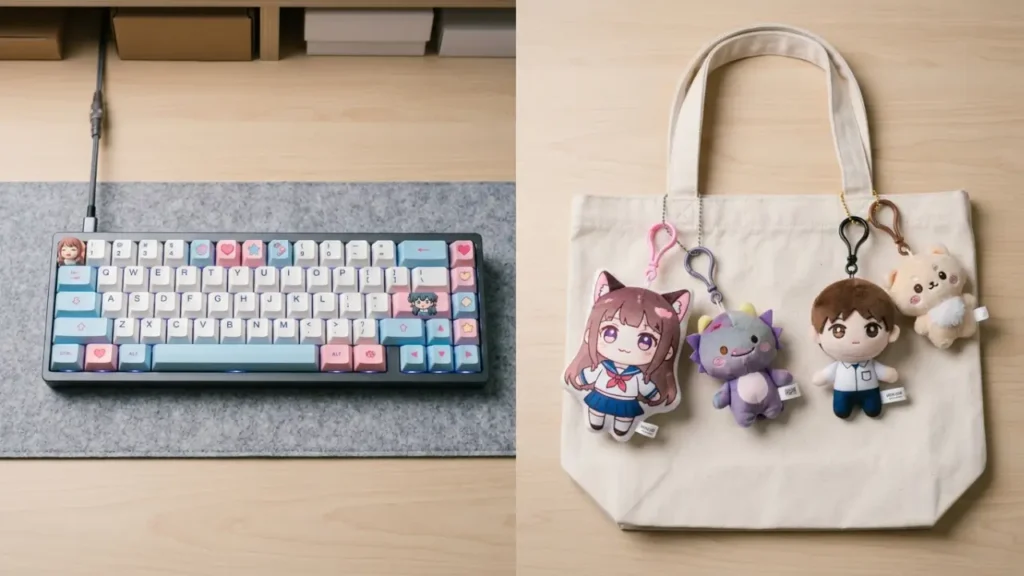
Deciding between a desk accessory and a bag accessory is really a decision about how your customers use merchandise. When you compare Alien Stage Mechanical Keycaps with plush pendants, the key is to separate character interest from purchase intent: a fan may love the artwork but own no compatible keyboard, while another may prefer a practical desk collectible over something carried outside.
The better opening order depends on your audience, display space, support capacity, and delivered cost. No SKU specifications or supplier terms are provided here, so treat the comparison below as a purchasing framework—not confirmation of either line’s materials, compatibility, licensing, or availability.
Which Customers Will Use a Keycap or Carry a Plush Pendant?
Start with existing transactions rather than social engagement. Review whether customers already buy keyboard accessories, desk collectibles, bag charms, or soft gifts. Those purchases are stronger evidence than likes on a character announcement.
- Anime stores with gaming or desk-setup customers: Keycaps may fit naturally, provided staff can explain the verified mounting system and intended use.
- Gift shops and accessory-led retailers: Plush pendants may suit customers who want a visible character accessory without checking keyboard specifications.
- Convention sellers: Compare the selling explanation and display footprint. Keycaps may need a demonstration unit; plush pendants may need hanging space.
- Online specialist stores: Choose the format you can document accurately with dimensions, close-ups, compatibility notes, and packaging photographs.
Ask one simple question before selecting a lead format: “Would you use this on a keyboard, display it on a desk, or attach it to a bag?” If most interested customers choose display only, evaluate the keycap as a collectible rather than assuming functional keyboard demand.
For a broader assortment decision, the Alien Stage AAHS versus Rabbit comparison can support a separate review of product-line fit. Do not assume those lines share the specifications of the items you are quoting here.
What to Verify on Alien Stage Mechanical Keycaps Before Comparing Plush
A product name is not a specification sheet. Confirm whether the quoted keycap is a functional replacement key, a standalone switch-mounted collectible, or another accessory format. For plush pendants, establish whether attachment hardware is included and how the item is meant to be carried.
Use this table to request comparable evidence for both formats before approving listings or purchase quantities.
| Buying question | Mechanical keycaps | Plush pendants | Decision rule |
|---|---|---|---|
| What is the actual use? | Confirm replacement-key, display, or standalone function. | Confirm intended attachment and carrying use. | Buy for a use your customers already understand. |
| Will it fit? | Request stem interface, key size, height, and clearance details. | Request body dimensions, hardware opening, and assembled weight. | Do not publish fit claims from appearance alone. |
| What is included? | Check whether a switch, base, or other pictured accessory is included. | Check whether the clasp, loop, or chain is included. | Separate sale contents from photography props. |
| How is the finish evaluated? | Inspect sculpt edges, decoration, underside, and fit consistency. | Inspect seams, embroidery, stuffing distribution, and loose fibers. | Approve a sample against written acceptance points. |
| How is it displayed? | Check boxed footprint and demonstration requirements. | Check hanging clearance and packaging protection. | Measure the fixture before setting order quantity. |
| How is the assortment sold? | Confirm selected designs or sealed random units. | Confirm selected designs or sealed random units. | Never assume a case gives a complete set. |
| What triggers a return? | Potential incompatibility, interference, or misunderstood function. | Potential attachment failure, seam damage, or size mismatch. | Address likely objections in product information. |
| What affects freight? | Protective packaging and packed weight require confirmation. | Carton volume and permitted compression require confirmation. | Compare actual packed-carton specifications. |
For keycaps intended for typing, request evidence of fit on the stated interface and check neighboring-key clearance. For pendants intended for bags, inspect the attachment point as well as the decorative body.
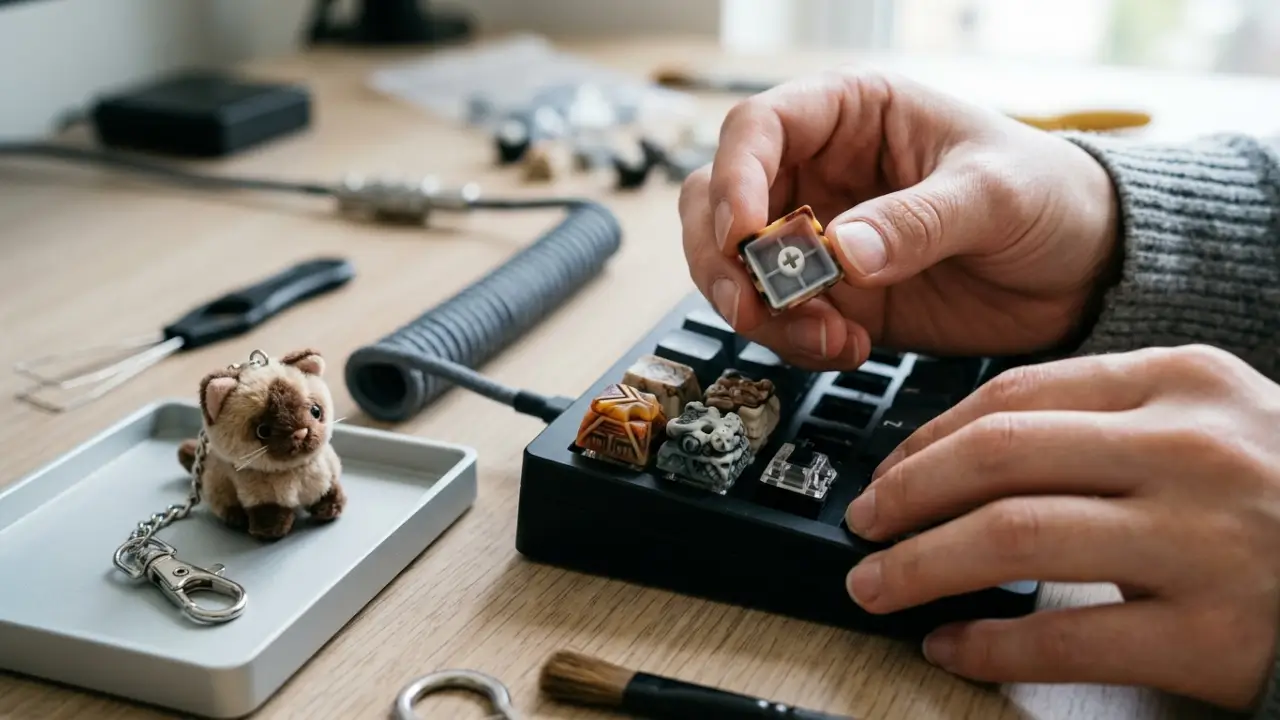
A useful sample review should reproduce the advertised use. A desk photograph cannot establish keyboard compatibility, and a hanging photograph cannot establish attachment durability.
Build a Trial Order Around Case Packs, Not Equal Quantities
Ordering equal unit counts can create an uneven test when packaging sizes, case quantities, and display requirements differ. Ask for the MOQ per SKU, inner-pack quantity, master-carton quantity, and whether formats or designs can be combined toward an order minimum.
If either line uses blind-box distribution, request written clarification of assortment rules. Distinguish “assorted designs” from “complete set,” and ask whether any stated distribution applies to an inner box or a master carton. Do not advertise duplicate-free cases or special-edition odds without support.
Planning example: A retailer might allocate two compatible case packs to the format supported by existing sales and one case pack to the less-proven format. This is a test structure, not a recommended MOQ. Compare sell-through by opening units, display space, and cash committed—not just total pieces sold.
Give both formats comparable visibility during the trial and record the questions that prevent purchases. Repeated fit questions point to a keycap information problem; repeated comments about bulk may point to pendant size or display issues.
For fixture planning, review these small anime accessory options for limited shelf space. Before committing to cartons, ask the supplier for a side-by-side specification sheet and samples of both formats where available.
Why the Lower Unit Quote May Not Be the Better Buy
Compare costs at the same delivery basis. A keycap quote excluding protective retail packaging is not equivalent to a pendant quote that includes individual packaging. Confirm currency, payment terms, delivery terms, and exactly what each quoted unit contains.
Estimated landed cost per sellable unit equals merchandise, freight, insurance where applicable, destination charges, duties, nonrecoverable taxes, and required preparation costs, divided by expected sellable units. Use documented costs and clearly identified planning assumptions rather than treating all purchased units as automatically sale-ready.
Do not assume keycaps always ship more cheaply because they look smaller. Protective boxes may add volume. Plush pendants may be bulky, and compression may affect presentation. Ask for packed-carton dimensions and gross weight, then obtain a freight estimate using those figures.
Separate order preparation, dispatch, transit, customs clearance, and receiving time. Ask when the quoted dispatch window begins and whether it depends on production or release allocation. For unreleased items, use this anime blind box pre-order evaluation guide to structure follow-up questions.
Set reorders from observed sales and the confirmed replenishment window. Keep a popular format on review if its next shipment would arrive after your planned event or promotion.
Inspect the Parts Customers Will Touch and Carry
Use separate inspection criteria rather than a single “good quality” approval. Request photographs of retail packaging, product undersides, attachment details, and carton protection. Where feasible, compare samples with the specifications intended for your listing.
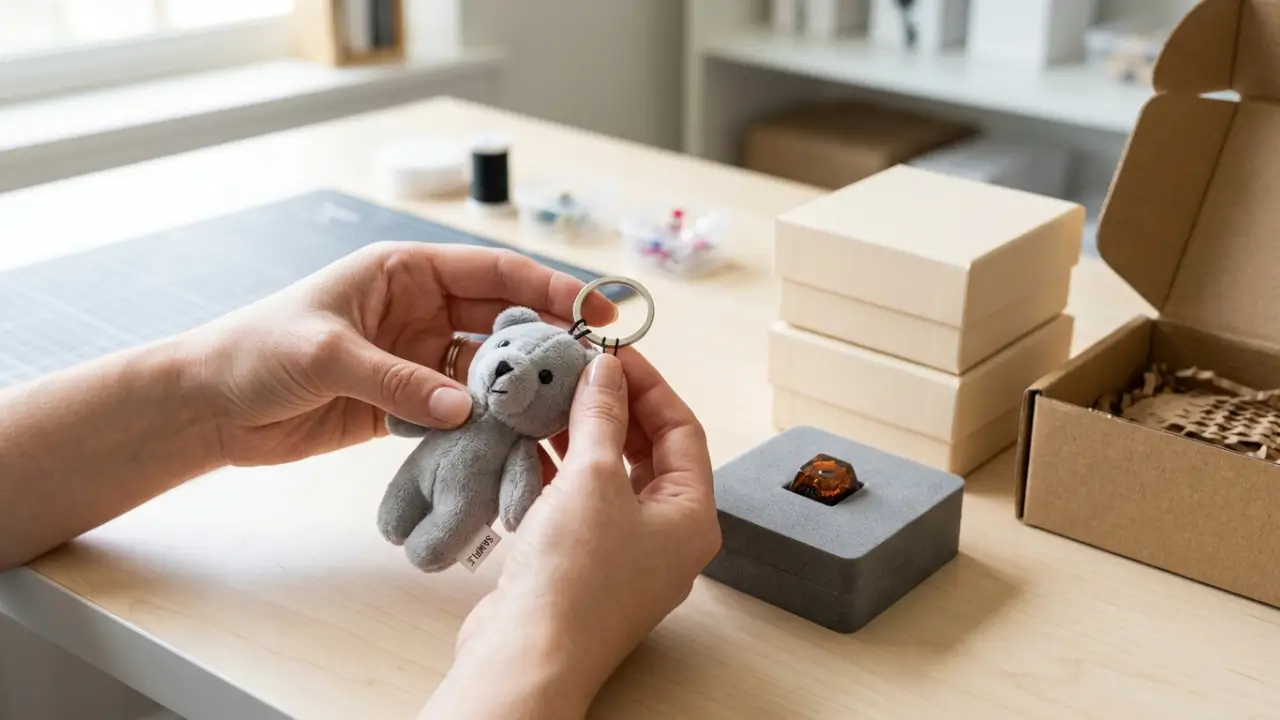
For functional keycaps, inspect stem condition, seating, removal, edge finish, and interference during intended use. Confirm material and care guidance rather than describing an unspecified item as resin, metal, or washable.
For plush pendants, inspect seam closure, loose threads, embroidery alignment, attachment stitching, clasp operation, and shape recovery after unpacking. Agree on evaluation methods with the supplier; an informal handling check is not a substitute for applicable safety testing.
Confirm how each format is protected from scuffing, crushing, moisture, and packaging damage. Ask what evidence a damage claim requires and whether remedies address damaged retail boxes as well as damaged products.
For character merchandise, request documentation supporting authenticity and authorized distribution as applicable. Buyers should verify destination-market requirements for age grading, small parts, labeling, traceability, and relevant materials. Collector-oriented marketing alone does not establish an exemption from toy or consumer-product rules.
Pause the purchase if the seller claims universal keyboard compatibility without specifications, substitutes generic plush photos for the quoted SKU, promises complete assortments without a written basis, or supplies documents that cannot be tied to the product. Resolve those gaps before payment.
Request Two Quotes With the Same Evidence Requirements
Send the same commercial brief for both formats so you can distinguish product fit from differences in quote presentation. Include:
- Destination country, sales channel, customer profile, and intended launch window.
- Exact series, SKU references, product photos, and requested quantities.
- Confirmed function, materials, dimensions, included components, and compatibility where relevant.
- MOQ, case quantities, mixed-order rules, and assortment basis.
- Unit price, currency, delivery terms, payment terms, and quote validity.
- Retail packaging, carton dimensions, gross weight, and dispatch basis.
- Sample availability, applicable documentation, inspection criteria, and defect-resolution procedure.
Please quote the specified Alien Stage keycaps and plush pendants separately for our destination market. Confirm exact SKUs, intended use, case packs, assortment rules, packaging, and packed-carton measurements. Identify any unconfirmed specifications or availability conditions, and provide supporting product photographs before we approve an order.
Request comparable written quotes and sample terms before placing your opening order. Choose the format with clearer customer demand, verified product information, and an acceptable delivered-cost model—not simply the lower headline price.
FAQ
Are mechanical keycaps or plush pendants better for an anime store?
Keycaps may suit customers interested in keyboards and desk setups; plush pendants may suit bag-accessory and gift shoppers. Use existing sales, customer questions, and a controlled trial to choose your lead format.
Will Alien Stage mechanical keycaps fit every mechanical keyboard?
Do not assume universal compatibility. Confirm the exact SKU’s function, stem interface, key size, height, and clearance. Some keycap-style merchandise may be intended for standalone display rather than keyboard installation.
Should a first order include both formats?
A mixed trial can be useful if supplier minimums, case packs, and your budget allow it. Weight the order toward demonstrated demand and compare sell-through relative to units, space, and cash committed.
Are plush pendants more expensive to ship than keycaps?
Not necessarily. Compare packed-carton dimensions, gross weight, protective packaging, and delivery terms. Product size alone does not establish the freight cost per sellable unit.
Does a sealed case guarantee a complete character set?
No guarantee should be assumed. Ask for SKU-specific assortment rules and written confirmation of whether completeness or duplicate restrictions apply to the quoted case configuration.
Before You Choose Your Lead Format
Lead with keycaps when desk-use demand and compatibility can be demonstrated. Lead with plush pendants when carrying use, attachment quality, and gift presentation fit your customers. If neither case is clear, resolve the specification gaps and run a case-pack-aware trial before expanding.