






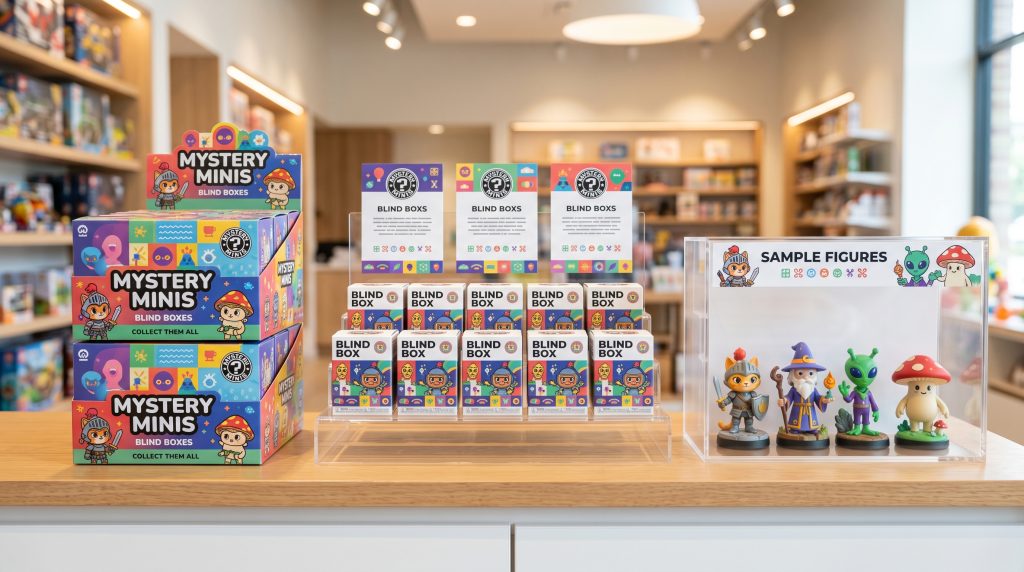
For retailers, the sealed vs random blind box decision is not only about packaging. It affects how fast inventory turns, how collectors shop, how much space the line needs, and how easily staff can explain the offer at checkout. A mall kiosk may prefer fast-moving single boxes near the register, while an anime store may need sealed whole sets for customers trying to complete a series. A museum gift shop may want a safer mix with clear display rules and limited SKU complexity.
This guide compares sealed whole sets and random blind boxes from a wholesale buying angle. If you are still building your overall sourcing process, start with this wholesale blind box buying guide for retailers, then use the points below to decide how to split your next order.
Decide whether your store needs reliable set completion or impulse turnover
A sealed whole set usually refers to a full-series purchase format where the buyer expects a complete assortment in one sealed unit or case configuration. The exact packing rule can vary by brand, factory, and series, so retailers should confirm whether the unit includes all regular designs, whether duplicates are possible, and how chase or secret figures are handled. A random blind box is typically sold as an individual sealed box where the customer does not know which character is inside.
| Decision factor | Sealed whole set | Random single boxes |
|---|---|---|
| Buyer type | Collectors seeking complete sets and predictable assortment | Impulse buyers and surprise-driven shoppers |
| Turnover speed | Steadier when full-set demand is strong | Faster for low-commitment trial purchases |
| Display space | Needs clearer full-set presentation space | Fits smaller counters and compact displays |
| Resale model | Supports bundle sales and premium positioning | Supports single-item sales and repeat draws |
| Restock predictability | Easier assortment planning and fewer duplicate concerns | Less predictable character mix and demand balance |
The buying question is simple: are your customers shopping to complete a collection, or are they shopping for a surprise purchase? If your store receives questions like “Do you have the full set?” or “Can I buy the whole series sealed?” then sealed whole sets deserve space in the order. If most sales happen because customers pick up one box at the counter, random singles may turn faster.
- Anime stores: often need both formats because collectors may buy full sets, while casual fans buy one or two singles.
- Gift shops: usually benefit from random singles that fit gifting, souvenirs, and low-friction checkout decisions.
- Kiosks and pop-up stores: often prioritize easy display, quick explanation, and repeat impulse purchases.
- Hobby and collectible stores: can use sealed whole sets to serve repeat collectors and reduce customer frustration around duplicates.
Order sealed whole sets when collectors ask staff to complete a series
Sealed whole sets make the most sense when your customer base understands character lines, follows releases, and values completion. In these stores, a buyer may not want to gamble on multiple random boxes. They may prefer to purchase the whole set at once, especially for PVC figures, anime-themed collectibles, designer toys, or authentic-style character assortments.
For an anime store, sealed sets can support higher-intent purchases. Staff can explain the series, show the full lineup, and reserve sealed formats for customers who ask for completion. For a hobby store, sealed sets can reduce complaints from collectors who dislike duplicates. For a gift shop, however, sealed sets may be slower unless the design theme has strong local appeal or the store already has collector traffic.
Before placing a sealed whole set order, ask your supplier for the case or set configuration in writing. Confirm whether the sealed set contains all regular characters, whether any hidden character is separate from the regular lineup, and whether the outer packaging identifies the set format. This matters because retail staff need a clear script. If employees cannot confidently explain what the customer is buying, sealed sets can create confusion at the point of sale.
Retailers sourcing figure-based lines can review category examples in the PVC blind box wholesale assortment to compare how different character series may suit collector-heavy shelves versus impulse displays.
Buy random single blind boxes when kiosks and gift shops need fast shelf movement
Random single blind boxes work best when the sales environment depends on discovery and repeat small purchases. A kiosk near a cinema, arcade, mall walkway, or tourist area may not have time to educate every shopper about the full series. The customer sees the packaging, understands the surprise mechanic, and buys one box. That makes random singles easier to sell in high-footfall locations.
Gift shops also benefit from random singles because they are simple to merchandise. A customer can buy one as a small gift without committing to a full series. Bookstores, stationery shops, toy corners, and lifestyle boutiques can use singles near the cashier, on a tabletop display, or beside related categories such as plush, keychains, stickers, or desk accessories. For stores building a softer giftable display, compare themes in the plush blind box wholesale category before deciding whether the line belongs at checkout or in a gift wall.
The main risk is duplicate fatigue. If customers return and repeatedly pull the same design, they may stop buying the line. Retailers can manage this with a fixed rotation rule: review each blind box series on the same weekday every week, move the slowest-facing series out of the primary checkout position at the end of the review cycle, and replace it with a different theme before customers see the same display too many times. Stores with a strong local collector community can also host trading moments, post “customer pulls” on social media, or keep a visible checklist so buyers know what remains in the series.
- Choose random singles when staff have limited time to explain the product.
- Choose random singles when the item is sold as an add-on at checkout.
- Choose random singles when you are testing a new character theme or art style.
- Avoid overcommitting to random singles if your customers frequently request complete sets.
Plan display space differently for sealed cases, opened samples, and singles
The sealed vs random blind box choice changes how you use display space. Random singles need open, reachable displays. They should be easy for customers to pick up, shake less, compare artwork, and bring to the counter. Sealed whole sets may be better placed behind the counter, in a locked case, on a collector shelf, or as a “full set available” sign attached to a sample display.
For many retailers, the best approach is to open one sample set for display and keep sellable units sealed. This lets shoppers see the figure quality, size, paint detail, and character lineup without damaging sale inventory. If opening samples is not practical, place the official lineup card or shelf talker directly at the front-right edge of the tray or shelf where customers first reach for the box, and keep the sealed selling units immediately behind it. The card should answer three staff questions at a glance: whether the item is a random single, whether a sealed whole set is available, and whether secret or chase characters are part of the series.
A kiosk may dedicate most space to random singles because every centimeter needs to sell. An anime store can afford a deeper display with sample figures and series checklists. A gift shop may display only one or two series at a time to avoid visual clutter. If you carry too many similar blind box lines together, shoppers may browse longer but buy less because the choice becomes unclear. Stores that sell doll-style or plush collectible formats can also compare display depth against the BJD and MJD plush blind box category before deciding whether samples need a locked case, a shelf riser, or a counter tray.
Staff training matters as much as shelf placement. Employees should know which products are sold as random singles, which are sealed whole sets, and whether a customer can request an unopened case or full-series format. Clear labeling prevents disputes and improves trust with repeat buyers.
Match MOQ, reorder timing, and shipping mode to your sealed vs random blind box mix
Your order structure should follow the sales role of each format. Random singles are often used to test a design theme, so buyers may want a controlled opening order before expanding. Sealed whole sets may require more careful planning because the unit structure can affect how many complete sets you receive and how easily you can replenish them. Do not assume every series has the same packing logic.
Before confirming an order, request the MOQ, case pack, carton quantity, restock availability, and whether the supplier can support the same series again later. The goal is not to chase the largest order; it is to buy enough to keep the display credible without trapping cash in slow-moving characters.
Copy-paste supplier question: “For this SKU, how many complete regular sets ship per carton, and does the chase or secret figure sit inside that complete regular set count or outside it? Please confirm the case pack, carton quantity, and how the sealed whole set is defined for this series.”
Shipping decisions also change with format and urgency. If a trend is already selling in your store, faster transport may protect revenue. If you are building seasonal stock or opening a new location with a planned launch date, slower consolidated shipping may be easier to schedule. Match the method to your launch calendar, stockout risk, and storage capacity.
- For testing: prioritize assortment clarity, small display footprint, and reorder options.
- For proven sellers: prioritize stable supply, carton planning, and launch timing.
- For seasonal gifting: prioritize arrival windows and packaging condition.
- For collector launches: prioritize full-series availability and staff communication.
Set resale and markdown rules before you split sealed sets into singles
Some retailers buy sealed whole sets and then split them into random singles or individual character resale. This can work, but it needs rules before the stock arrives. If the sealed unit is valuable because it is complete, splitting it may reduce appeal for collectors. If the store has more casual traffic, splitting can make the product easier to sell one unit at a time.
Anime stores and collectible shops should be careful with this decision. A complete sealed set may sell to one serious buyer, while loose individual figures may take longer and create uneven leftovers. Common characters may remain after popular designs sell out. If staff open boxes to identify characters, the product is no longer a sealed blind box, and the merchandising message must change. Do not sell opened or identified items as random sealed products.
Gift shops may not need a resale strategy for individual characters because the surprise is the main value. Kiosks may avoid opening stock entirely because speed and simplicity matter more than character-by-character pricing. Hobby stores, however, may use opened samples or identified figures in a display case if their customers actively trade and collect.
Markdown planning should be decided early. If a series slows down, will you bundle remaining singles, move them to a checkout offer, pair them with related merchandise, or hold them for a themed event? Having a plan prevents old series from blocking new arrivals.
Example markdown trigger, adjust to your store: if a blind box series has not reached your internal sell-through target after six full trading weeks, stop giving it the primary display position and choose one action for the next review cycle: bundle remaining singles, move the series to a checkout offer, or pair it with related merchandise. This is a planning threshold, not a guarantee of sales performance.
Request assortment details before placing your next sealed vs random blind box order
The best buying decision comes from matching the format to the store’s customer behavior. Choose sealed whole sets when completion, collector trust, and full-series display matter. Choose random single blind boxes when you need impulse sales, easy gifting, and fast shelf interaction. Use both when your store serves collectors and casual shoppers at the same time.
Before ordering, ask for product images, series lineup, set or case configuration, carton details, available stock status, and reorder expectations. Confirm how the supplier defines “sealed whole set” for that specific SKU. Also decide where the product will sit in your store, what staff will say to customers, and how you will handle slow-moving leftovers.
For a retailer, the sealed vs random blind box choice should be made before the purchase order, not after cartons arrive. A clear plan helps you protect display space, reduce customer confusion, and turn inventory in the format your shoppers actually want.
Need help choosing the right sealed whole set and random blind box mix for your store? Send your target category, store type, and order plan through the wholesale blind box quote request, and our team will help you review suitable assortment options.

