







Character appeal alone does not decide whether a beauty accessory earns its shelf space. Before committing to a purchase order, a buyer needs to know what the item actually does, how it is packed, whether its construction suits the intended shopper, and how freight reshapes the real unit cost. For anyone assessing a Baby Three hair brush, those details matter far more than the product photography or the strength of the series name.
This guide treats the Baby Three Comb Your Hair brush as a retail sourcing decision. Because dimensions, materials, case quantities, licensing documentation, and market-specific compliance information were not supplied, treat every point below as something to confirm with the seller in writing before an order is approved.
Where a Character Hair Brush Fits in Your Assortment
The first decision is not how many units to buy. It is whether the brush has a clear role on the shelf at all. A character hair brush can interest collectible retailers, beauty accessory stores, gift shops, online character-merchandise sellers, and lifestyle boutiques, but each channel needs a different merchandising plan.
- Collectible and character stores: Position the brush as a functional extension of a Baby Three display rather than assuming figure buyers will automatically add it to the basket.
- Beauty and accessory retailers: Compare brush construction, grip, portability, and packaging with non-character alternatives at the same retail tier.
- Gift shops: Check whether the packaging is presentable without extra wrapping and whether the product’s purpose is understandable at a glance.
- Online sellers: Request dimensions, weight, packaging views, and close-up images so the listing can answer practical questions and support a fulfillment-cost estimate.
- Pop-up and event sellers: Favor compact display arrangements and verify whether individual units can stand, hang, or stack securely.
Retailers already carrying larger Baby Three items can use the Baby Three Sweet Dream 400% figure sourcing guide to compare the inventory and display demands of a large collectible against those of a smaller functional accessory. Give the two products separate sales forecasts even though they share character recognition.
Confirm What “Comb Your Hair” Includes Before Comparing Quotes
Names and front-facing photos can hide material and packaging differences. Ask each seller to complete the same specification sheet. If one quote lacks the brush size or package format, it is not yet comparable with a more detailed offer.
| Specification | What to request | Why the buyer needs it |
|---|---|---|
| Brush format | Full-size, compact, folding, vented, cushioned, or another construction | Determines use case, display message, and customer expectations |
| Dimensions and weight | Product and retail-package measurements | Affects shelf capacity, parcel fees, and carton calculations |
| Body material | Material declaration for handle, back, cushion, and decorative components | Helps assess durability, care instructions, and compliance questions |
| Bristle or pin design | Material, tip shape, flexibility, row layout, and attachment method | Allows buyers to evaluate comfort and likely failure points |
| Design assortment | Available variants and whether selection is open, assorted, or random | Changes listing accuracy and assortment risk |
| Individual packaging | Box, blister, bag, sleeve, insert, seals, and hanging provision | Influences gift readiness, tamper visibility, and display method |
| Case configuration | Units per inner pack and master carton, plus assortment breakdown | Supports quantity planning and receiving checks |
| Product documentation | Available labeling, material, authorization, and test documents | Helps the importer review destination-market requirements |
Also confirm whether “brush” and “comb” are being used interchangeably. Product listings, invoices, customs descriptions, and consumer-facing copy should identify the physical item consistently.
Use Case Packs to Set a Safer First Baby Three Order
MOQ and case quantity are different questions. A supplier may state a minimum order while the shipping carton requires another quantity, or different designs may be packed in fixed ratios. Ask for the minimum purchase, inner-pack quantity, master-carton quantity, assortment policy, and whether partial cartons are possible.
As a planning example, a retailer considering 72 units could allocate 24 to an online channel, 24 to a primary store, 12 to a secondary location, and 12 as replenishment stock. This is not a recommended order quantity; it is a method for testing whether every unit has an intended sales channel before purchasing.
For multiple designs, calculate units by variant rather than only total units. An assorted carton can create slow-moving designs even when overall sales look acceptable. Ask whether the assortment is fixed and whether the supplier identifies each design on the outer carton.
Before requesting a final quote, prepare one worksheet listing the desired quantity, sales channels, design preference, destination, and packaging requirements. That brief gives the seller a far better chance of returning a usable answer instead of a rough estimate.
Why Brush Packaging Can Control the Landed Unit Cost
The lowest product quote is not necessarily the lowest-cost purchase. Retail boxes, protective inserts, and empty space affect carton volume, while decorative components may need protection against rubbing or crushing. Compare costs at the same delivery scope and currency.
A buyer-side landed-cost estimate may include:
- quoted product cost;
- individual packaging or labeling charges, if separately quoted;
- inspection or sampling expense;
- origin transport and export-related charges;
- international freight and insurance where applicable;
- destination duties, taxes, brokerage, and local delivery;
- a reasonable allowance for damaged or commercially unsellable units.
Request master-carton dimensions, gross weight, net weight, and units per carton before comparing air, courier, or sea options. Obtain destination-specific customs advice rather than assuming a duty rate or product classification. For margin planning, divide the estimated total landed order cost by the number of saleable units, not merely the number ordered.
Protect the Bristles, Decorative Parts, and Gift-Ready Boxes
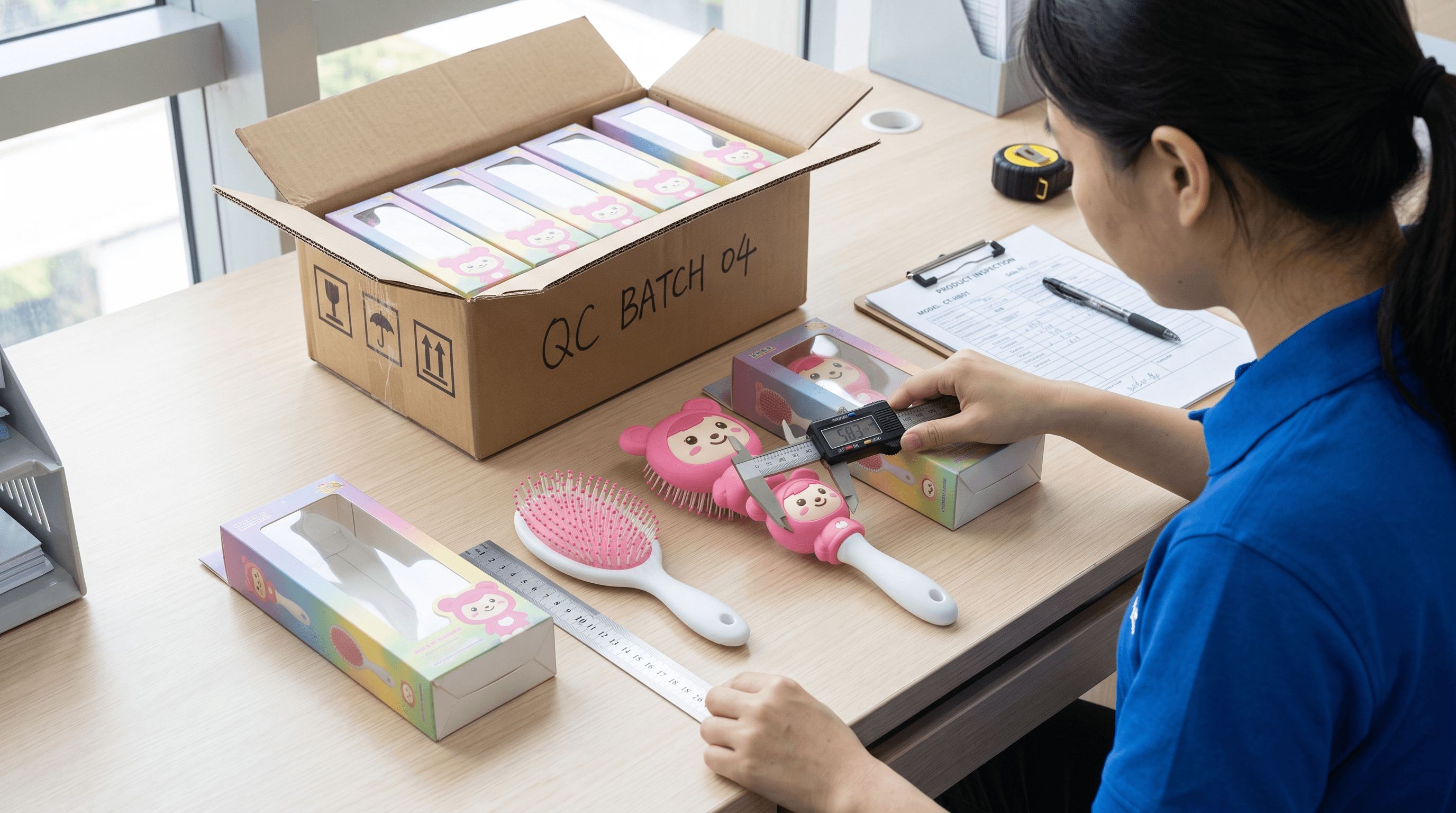
Hair brushes have different inspection points from static figures. Pins or bristles can bend, cushions may lift, printed surfaces can scratch, and decorative parts may loosen. Retail packaging can also arrive crushed even when the brush itself remains usable.
Ask for pre-order samples or representative product evidence where practical, then document the approved reference. A basic receiving or pre-shipment checklist can cover:
- Compare product and package dimensions with the approved specification.
- Check that bristle or pin rows are complete, aligned, and securely seated.
- Examine tips and edges for rough areas that could affect normal handling.
- Apply gentle, appropriate handling to the grip and decorative components to identify looseness.
- Review printed decoration for smudging, misalignment, or abrasion.
- Check retail boxes, windows, seals, barcodes, and assortment markings.
- Count designs by inner pack and master carton against the packing list.
Requirements for consumer products, chemical substances, labeling, age grading, intellectual property, and importer identification vary by destination. Ask what documentation the seller can provide, then independently verify what your sales market requires. Do not treat character styling as proof that an item is intended for children.

Plan Reorders Around Sales Velocity, Not Character Popularity
Break lead time into stages: confirmation, production or order preparation, inspection, origin handling, international transit, and destination clearance. Ask the seller which stages are included in any stated schedule and what event starts the clock. Do not assume availability or dispatch timing until it is confirmed in writing.
As a planning reference, a retailer may review sales after the first 25%, 50%, and 75% of a test order has sold. At each point, record weekly unit sales, variant imbalance, returns, damage, and customer questions. Reorder timing then follows from remaining weeks of stock compared with the supplier’s newly confirmed replenishment window.
Functional accessories may also sell differently from display collectibles. Retailers comparing character-driven inventory strategies can review this Labubu stocking comparison, while stores building a broader cute or alternative assortment may find the positioning questions in the witchy kawaii assortment guide for Ninita useful. Use those comparisons for planning logic, not as evidence that different properties will produce the same demand.
When a Baby Three Brush Quote Is Not Ready for Approval
Pause the order if the supplier cannot identify the exact product variant, avoids providing package dimensions, changes the unit description between messages, or quotes a total without explaining the delivery term. Other warning signs include unclear assortment ratios, mismatched sample and bulk specifications, unreadable documentation, pressure to pay before essential details are written down, or unexplained substitutions.
Send the same inquiry to every candidate so price differences can be traced to actual differences in product, packaging, quantity, or shipping scope.
Quote request template
Product: Baby Three Comb Your Hair brush
Requested quantity: [quantity or quantity range]
Destination: [city, country, postal code]
Please confirm: exact item or variant, product dimensions and weight, materials, bristle or pin construction, individual packaging, units per inner pack and master carton, carton dimensions and weight, assortment policy, MOQ, quote validity, payment terms, available documentation, estimated preparation or lead-time basis, and shipping term.
Please also provide current product and packaging images and state whether a sample can be reviewed before the main order.
Compare responses line by line. A more complete quote may reveal costs or limitations that a shorter, apparently cheaper quote has left out.
Before approving stock: send a complete specification and destination brief, request a written quotation, and resolve every blank field affecting product identity, packaging, landed cost, compliance review, or delivery planning. Do not authorize an order from a promotional image alone.
FAQ
Is the Baby Three Comb Your Hair product a functional brush or a collectible?
Buyers should confirm the exact construction and intended use with the seller. Request dimensions, material details, close-up images, packaging information, and any available usage or age-grading information rather than inferring function from the product name.
What should I ask about the minimum order quantity?
Ask for the MOQ, units per inner pack, units per master carton, design assortment ratio, and whether mixed designs or partial cartons are allowed. These details show the practical commitment more clearly than MOQ alone.
How should retailers compare Baby Three hair brush quotes?
Compare the same item specification, quantity, packaging, assortment, currency, shipping term, carton data, documentation scope, and destination. Estimate landed cost per saleable unit before deciding which quote is lower.
Which quality points matter most for a character hair brush?
Check bristle or pin alignment, tip finish, attachment strength, grip construction, decorative-part security, print quality, package condition, barcode accuracy, and carton assortment. Agree on inspection criteria before the main order where practical.
When should a retailer reorder the brush?
Base the decision on weekly sales, remaining saleable stock, variant balance, observed damage or return rates, and a newly confirmed replenishment schedule. Character popularity alone is not a reliable reorder trigger.
Before You Place the First Brush Order
The strongest buying decision connects product construction with retail use, case quantity, packaging protection, landed cost, and replenishment timing. Confirm the Baby Three Comb Your Hair specification in writing, test your assumptions with a controlled first allocation, and keep records that make the next quote or reorder easier to evaluate.

