


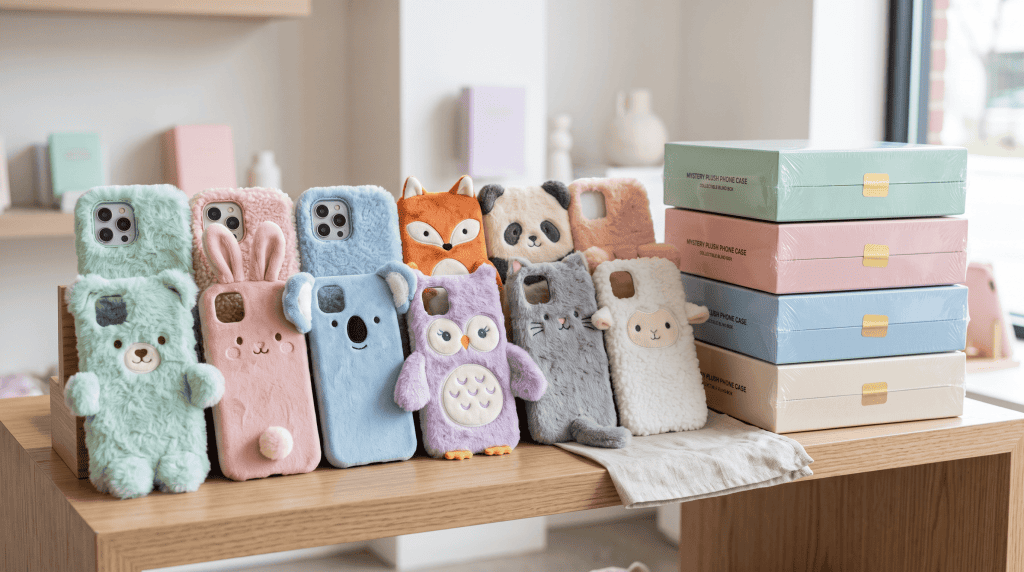
Buyers of this category face two merchandising problems at the same time: the product has to deliver a satisfying surprise, but it also has to fit the customer’s actual phone. That is why attractive character photos are not enough when you compare plush phone case wholesale offers. Device compatibility, assortment structure, case quantity, packaging protection, and replenishment options can decide whether the line sells smoothly or generates avoidable returns.
This guide explains how to qualify the format, compare quotations, and prepare a first order without assuming unsupported details about minimums, availability, or delivery schedules.
Which Retailers Can Make the Plush Case Format Work?
Plush phone case blind boxes may suit gift shops, collectible stores, anime and kawaii retailers, phone-accessory sellers, lifestyle boutiques, and online stores with customers who accept surprise designs. Each buyer, however, needs a different assortment strategy.
- Phone-accessory stores: Prioritize clearly labeled device models and easy fit verification at the point of sale.
- Collectible retailers: Ask whether the assortment has named designs, rarity information, or a complete-set purchasing option.
- Tiendas de regalos: Review presentation, gift readiness, and whether the retail price can absorb the product’s dimensional shipping cost.
- Vendedores en línea: Prepare accurate compatibility notes and product photography that preserves the surprise without hiding essential fit information.
- Pop-up and event sellers: Favor a focused range that staff can explain quickly rather than too many device variants.
A useful decision rule is to keep the design blind but not the compatibility. Customers should be able to identify the supported phone model before purchase, even when the plush character or color remains concealed.
How to Evaluate Plush Phone Case Wholesale Assortments
Request a specification sheet and assortment breakdown before comparing unit prices. The following table turns a visual product pitch into buying questions that can be answered and documented.
| Punto de evaluación | Qué hay que confirmar | Por qué afecta al orden |
|---|---|---|
| Product format | Full protective case, case with plush attachment, removable accessory, or decorative cover | The format changes fit expectations, packaging volume, and customer instructions. |
| Device compatibility | Exact phone models supported and how each model is marked | Ambiguous fit information can cause returns and unsellable inventory. |
| Blind element | Whether design, color, accessory, or another feature is randomized | Buyers need to explain what is known and what remains a surprise. |
| Series assortment | Regular designs, possible special designs, and carton distribution information | This helps retailers plan displays and customer expectations without promising outcomes. |
| Cantidad por caja | Units per inner pack and master carton, separated by phone model where applicable | Case structure determines how much inventory is committed to each device. |
| Materiales | Case body, plush fabric, filling, adhesive, hardware, and removable components | Material details support quality review and destination-market checks. |
| Packaging dimensions | Individual box and master-carton measurements and weights | Bulky plush elements may make freight cost significant relative to product value. |
| Brand and artwork status | Brand owner, licensing basis where applicable, and permitted sales channels | Buyers should avoid merchandise with unclear intellectual-property provenance. |
| Reorder consistency | Whether later orders can match the same device and series assortment | Consistency matters when customers return to complete a series. |
Retailers comparing this category with conventional character collectibles can also review the assortment questions in the Guía para compradores de cajas sorpresa de Cupa. The product format differs, but the principles of series clarity and case-level planning still apply.
Keep Phone Compatibility Out of the Mystery
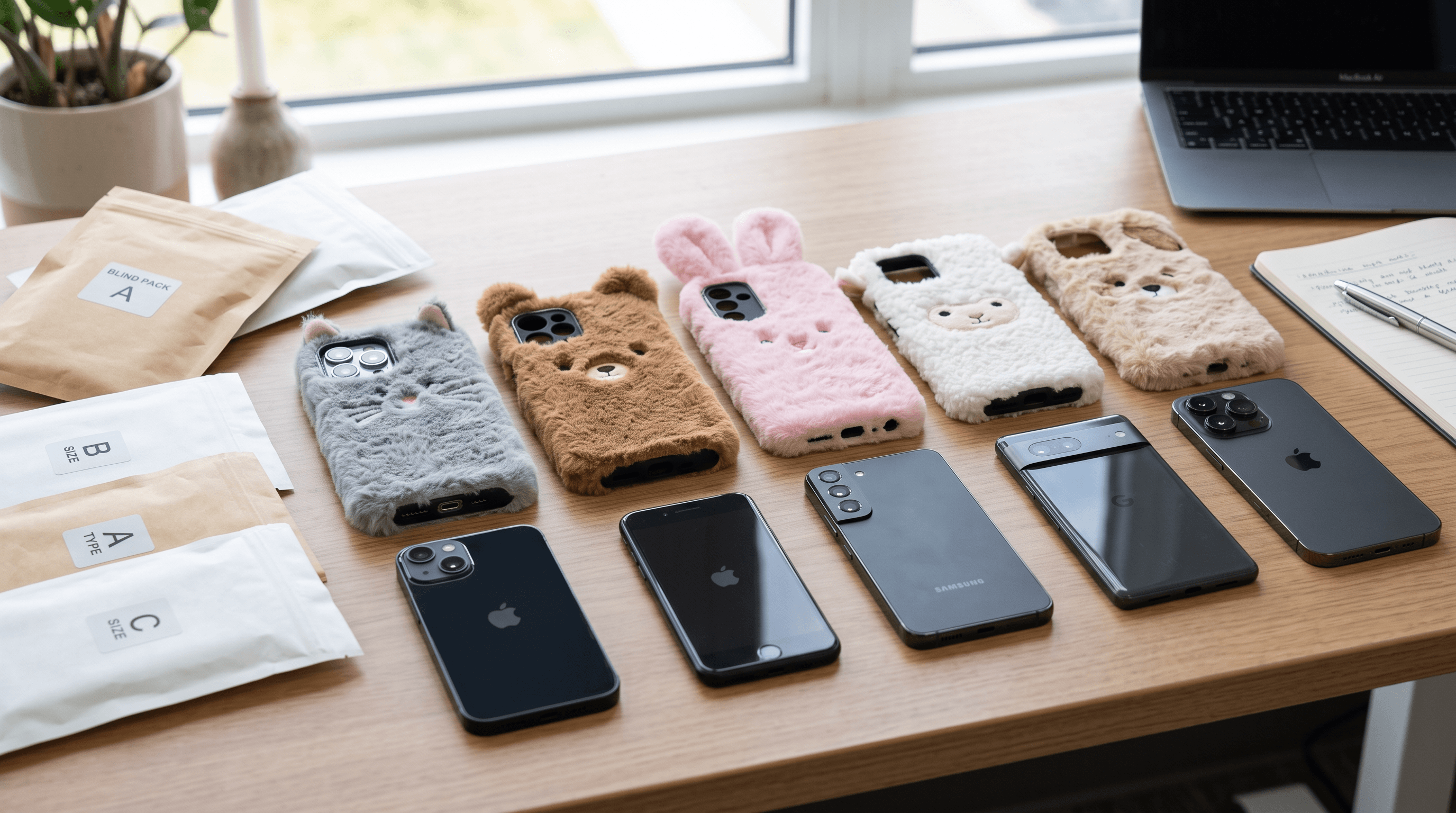
Phone fit is the single most important specification to confirm. Do not rely on broad labels such as “large phone” or “recent model.” Ask for the exact model name, compatible dimensions, camera opening, button alignment, charging-port access, and any limits associated with wireless charging or accessory use.
Request photos of the case installed on the intended device model, including the back, camera opening, side buttons, and bottom ports. If samples are available, test installation and removal without stretching or damaging the plush component.
A practical fit-check sequence
- Match the supplier’s model code to the phone name used in your sales market.
- Check camera and button alignment on a physical sample when practical.
- Confirm whether the plush element interferes with grip, pockets, stands, mounts, or charging.
- Verify that the outer package displays compatibility without revealing the blind design.
- Prepare a store policy for opened blind boxes and incorrectly selected phone models.
A warning sign is a quotation that lists only character designs while omitting phone models. Ask the supplier to separate design assortment from device assortment before paying or forecasting sales.
Why Case-Pack Math Matters More Than the Headline MOQ
A minimum order quantity does not show how inventory will be distributed. Ask whether the minimum applies to the entire series, each phone model, each carton, or each combination of model and assortment. Also confirm whether mixed-device cartons are possible and whether mixing changes the quotation.
As a planning example, a retailer may want four device variants, two merchandising groups, and 12 units per combination. That produces 96 units before safety stock or display stock is added. This is not a suggested supplier minimum; it simply shows how device fragmentation can expand an order quickly.
Compare the proposed allocation with your own sales data. A model representing a small share of current accessory sales should not automatically receive the same quantity as the leading model. For a first test, buyers often concentrate on fewer compatible devices and use sales results to guide expansion.
Calculate landed cost per saleable unit
Use the complete delivered cost rather than the quoted product price alone:
Fórmula de planificación: product cost + packaging charges + inspection expense + freight + insurance + customs-related charges + local delivery, divided by the number of saleable units.
Customs treatment and taxes depend on the product construction and destination. Buyers should verify classification, import requirements, and applicable charges with qualified local professionals rather than assuming a phone case and a plush collectible will be treated identically.
If you are shortlisting offers, request carton dimensions and gross weight now. Those two fields let you add a freight estimate before an inexpensive unit quote quietly becomes an expensive landed order.
Protect Plush Surfaces and Blind Packaging in Transit
Plush elements can be compressed, marked, or deformed, while blind-box packaging can arrive crushed even when the case itself remains usable. Ask how the product is restrained inside the individual package and how retail boxes are arranged inside the master carton.
- Review stitching, seams, pile consistency, loose fibers, odor, stains, and attachment security.
- Check the case body for warping, sharp edges, surface marks, and inaccurate openings.
- Inspect removable hardware or decorations for looseness and unclear assembly.
- Confirm that barcode or model labels do not disclose the hidden design unintentionally.
- Ask how cartons resist compression and moisture during normal handling.
- Agree on how defects, damaged retail boxes, and assortment discrepancies will be documented.
For an example planning inspection, a buyer might review outer cartons first, then retail-box condition, model labels, blind assortment records, and a sample of installed cases. The inspection scope should reflect order size and risk rather than relying on a generic pass/fail statement.
Labeling, material, consumer-product, age-grading, and small-component requirements vary by market and intended use. Buyers should request available product documentation and independently verify what is required in the destination country. A decorative phone accessory should not automatically be treated as compliant for children merely because it uses plush material.

Build the Reorder Date Backward from Sales Coverage
Dimensional products can consume more freight space than rigid phone cases, so shipping method and carton volume deserve early attention. Ask for the production or preparation estimate, carton-ready date, shipping options, transit estimate, and time needed for customs clearance and local delivery. Treat each as a separate part of the schedule.
Use weekly sales by phone model to set a reorder trigger. As a planning example, if inbound replenishment may consume several sales cycles, start the review before inventory reaches one cycle of coverage. Add a buffer for inspection, customs variability, and demand spikes, but avoid presenting an estimated date to customers as guaranteed.
Blind assortments also require design-level monitoring. One phone model may sell steadily while the remaining carton mix becomes less attractive. The comparison logic in this Labubu stocking comparison can help retailers think through demand concentration and avoid inventory decisions based only on social attention.
When Plush Phone Case Quotes Are Not Yet Comparable
Two quotes are not comparable until they describe the same product format, device allocation, blind assortment, packaging, trade terms, and quality expectations. A low figure with missing carton data or vague compatibility can create more risk than a fully documented offer.
Quote red flags to resolve
- The supplier cannot provide exact compatible phone models.
- The quotation does not state units per carton or whether device models can be mixed.
- Product photos and the written material specification conflict.
- Special-design probabilities or assortment claims are made without an explained basis.
- Brand ownership or permission to sell branded artwork is unclear.
- Payment is requested before product, packaging, and shipping specifications are documented.
- The supplier avoids questions about defective units or damaged retail packaging.
For another approach to documenting a collectible purchase, see the UpSetDuck sourcing guide. Use its framework for comparison while adapting every question to phone fit and plush construction.
Inquiry template for a usable quotation
Please quote the plush phone case blind-box series for delivery to [city and country]. Provide the exact compatible phone models, blind assortment structure, units per inner pack and master carton, minimum order basis, available mixing rules, material specifications, individual and carton dimensions, gross weight, packaging method, preparation estimate, trade terms, and payment terms. Please also identify available samples or product documents and explain the process for reporting fit defects, assortment discrepancies, or damaged packaging.
Before approving an order, request a written quotation that answers every applicable point above. A complete inquiry makes supplier responses easier to compare and gives freight providers enough information to prepare a more useful estimate.
PREGUNTAS FRECUENTES
What specifications should I request for plush phone case blind boxes?
Request exact compatible phone models, case and plush materials, attachment method, blind assortment details, units per carton, packaging dimensions, carton weight, labeling, and available product documentation.
Should the phone model itself be hidden inside the blind box?
Generally, compatibility should be visible before purchase even when the character or color is concealed. Hiding the phone model can increase selection errors, returns, and customer dissatisfaction.
How should I calculate a first wholesale order quantity?
Start with sales demand by phone model, then apply the supplier’s case-pack and mixing rules. Use a small planning matrix by device and assortment rather than dividing units equally without supporting sales data.
What packaging checks are important for plush phone cases?
Check retail-box strength, internal restraint, plush compression, moisture protection, model labeling, barcode placement, carton packing, and whether labels accidentally reveal the hidden design.
How can I compare two wholesale quotations accurately?
Normalize the phone models, assortment, unit count, packaging, trade terms, freight assumptions, and defect process. Compare estimated landed cost per saleable unit rather than product price alone.
Before You Place the First Order
The strongest purchasing decision combines collectible appeal with accessory-level precision. Confirm the device fit, define exactly what is blind, map each carton to likely demand, estimate landed cost, and document quality expectations before payment.
Send suppliers the same specification-based inquiry and compare their responses line by line. A quotation that clearly identifies compatibility, assortment, packaging, quantities, and delivery assumptions is far more useful than a price sheet built around product photos alone.