



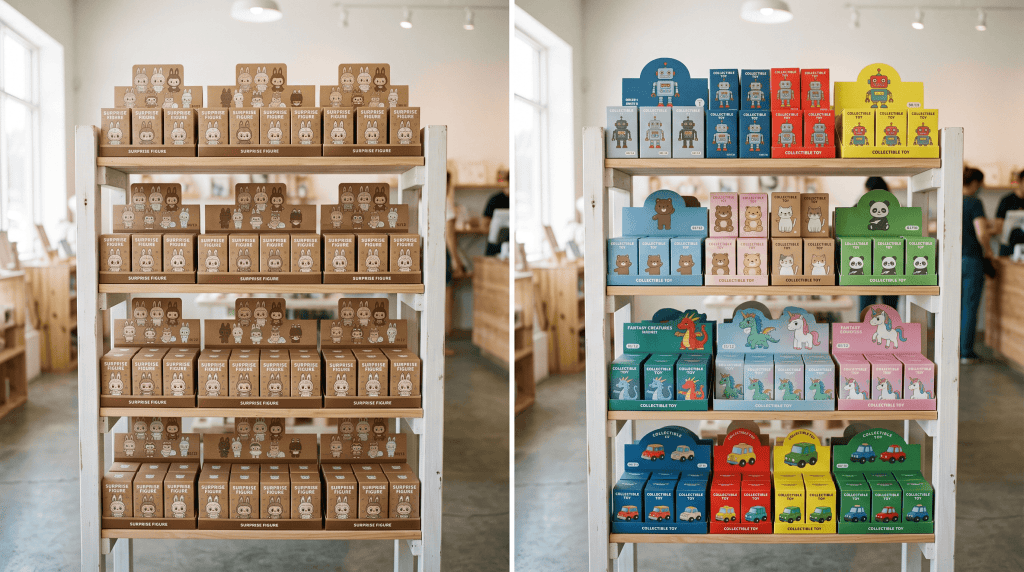
Shelf space and purchasing cash are limited, so every new collectible series competes with products already earning their place in the store. Choosing an assortment is therefore not simply a question of which characters look appealing. The decision affects case quantities, display clarity, cash tied up in slow variants, shipping cost, and the ability to reorder before customer interest moves elsewhere.
A single-brand assortment concentrates inventory in one recognizable world, while a multi-brand assortment spreads the bet across different characters, formats, and customer tastes. Neither structure is automatically safer. The right choice depends on store traffic, audience knowledge, available display space, supplier terms, and how quickly you can read and act on sales data.
Which Approach Fits Your Store’s Traffic and Space?
Single-brand buying usually suits retailers with evidence that customers already recognize a particular character, aesthetic, or collectible format. It can create a stronger shelf story and make staff recommendations easier. The risk is concentration: if the selected series underperforms, a larger share of the open-to-buy budget remains tied to one concept.
Multi-brand buying can serve gift stores, anime retailers, lifestyle boutiques, and online shops whose audiences have varied tastes. It provides more opportunities to test themes, but shallow quantities can make each series look incomplete or disappear before meaningful sales patterns emerge.
| Buyer situation | Single-brand approach | Multi-brand approach | Buyer action |
|---|---|---|---|
| Known local fan base | Builds depth around demonstrated demand | May dilute the strongest opportunity | Review past character or series sales |
| New store without sales history | Creates a clear identity but concentrates risk | Tests more customer preferences | Start with a documented test allocation |
| Very limited shelf space | Can produce a cleaner display | May look fragmented if too many lines are shown | Measure usable facings before ordering |
| Gift-led customer traffic | Works if the brand has broad gifting appeal | Offers more price, color, and theme choices | Group products by recipient or occasion |
| Collector-led customer traffic | Supports repeat purchases within a series | Supports discovery across several fandoms | Ask whether buyers collect sets or individual designs |
| Restricted purchasing budget | Fewer setup costs but greater concentration | Risk is spread, subject to order minimums | Compare committed units, not just brand count |
| Fast-changing trend demand | Can react strongly to one proven line | Reduces dependence on one trend | Set review dates and reorder triggers |
Distinguish brand variety from format variety. A shop may carry several series but still offer only standard figures. Comparing formats such as fridge magnets versus bag charms can reveal whether customers want display collectibles, wearable accessories, or practical gifts.
Build an Opening Order That Produces Useful Evidence
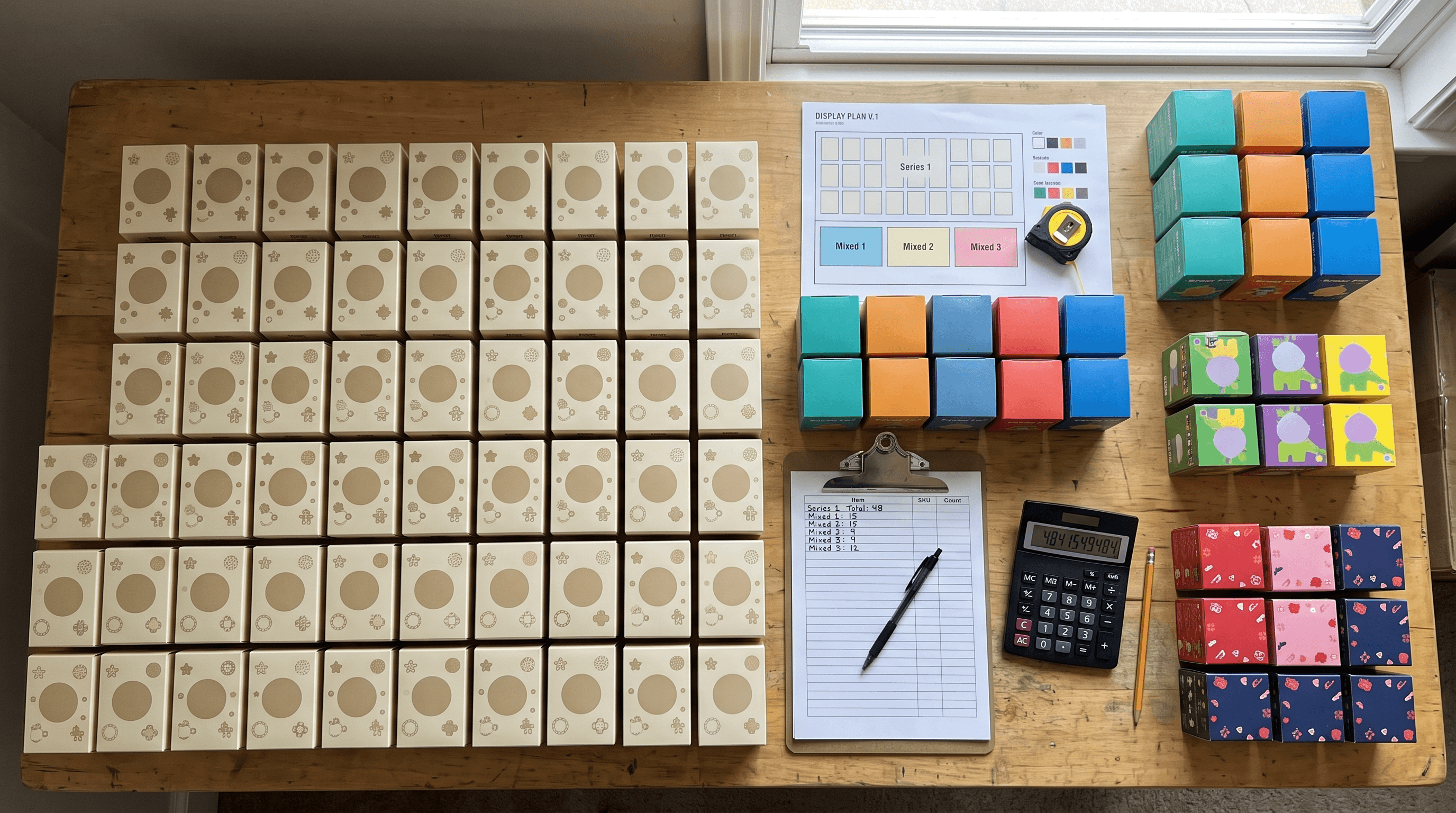
The first order should be large enough to produce a readable sales signal but small enough to limit exposure. Before comparing quotations, ask for the minimum order requirement, units per inner pack, units per case, whether mixed series are permitted, and whether the quoted quantity refers to individual boxes or sealed display cases.
For example, a retailer planning 24 test units might compare three structures: 24 units from one series, 12 units from each of two series, or eight units from each of three series. These are planning examples rather than recommended order quantities. Actual options depend on the supplier’s case configuration and mixing policy.
- Use one series when existing sales data supports the theme and the display can give it adequate visibility.
- Use two complementary series when testing a controlled difference, such as cute versus darker styling.
- Use three or more series only when each receives enough units and merchandising space to generate meaningful feedback.
Do not assume a supplier can break sealed cases or combine unrelated products to meet a target quantity. A mixed-carton option may also affect packaging condition, assortment integrity, or per-unit handling cost. Confirm these points in writing before using a quote in the buying plan.
When assessing depth within one brand, compare series rather than treating the brand as a single demand signal. The Have a Seat versus Big Into Energy stocking guide illustrates how two lines tied to the same character can still require separate decisions about format, audience, and inventory.
Read the Landed Cost, Not Just the Unit Quote
A lower unit quote does not necessarily create a lower retail risk. Compare the landed cost of each order structure: product cost, freight allocation, import charges where applicable, payment or handling fees, and the cost of damaged or unsellable packaging. Verify customs, tax, labeling, and import requirements for your destination market rather than assuming the supplier’s domestic process applies.
Single-brand orders may concentrate freight across more units of the same product, but they also concentrate markdown exposure. Multi-brand orders may spread demand risk while creating more case-pack constraints and less efficient cartons. Ask for carton dimensions, gross weight, case quantities, and packing arrangement so freight comparisons use the same assumptions.
Use this simple planning logic for each assortment:
- Calculate estimated landed cost per sellable unit.
- Record the number of units committed to each series.
- Estimate how much cash remains unavailable until those units sell.
- Model a slower-sales scenario rather than relying only on full sell-through.
- Compare the cost and feasibility of replenishing a winner.
Request comparable quotations for a single-brand and multi-brand basket before selecting the final mix. Include the same destination, shipping basis, quantity definition, and packaging requirements in both requests; otherwise, a price difference may reflect freight or packing assumptions rather than product economics.
Protect Display-Ready Boxes From Purchase Order to Shelf
Blind boxes often depend on packaging for merchandising and gift appeal. Product contents can be intact while crushed corners, torn seals, fading, moisture marks, or labels placed over important artwork make the item difficult to sell at the intended position.
Before approving an order, ask how individual boxes, display trays, and outer cartons are packed. Request current product and packaging photos where available, and confirm whether the quotation covers sealed cases, loose units, or another packing condition. If assortment ratios or hidden designs matter to the buying decision, ask how the series configuration is described without assuming that every case contains a specific result.
- Confirm product name, series, version, size or format, and unit count.
- Check whether packaging language and required consumer information suit the destination market.
- Ask how cartons are protected against compression and internal movement.
- Define the process for documenting shortages, visible damage, or mismatched items.
- Inspect carton condition, item identity, quantity, seals, and representative units on arrival.
Requirements for toys, collectibles, magnets, accessories, age labeling, and consumer warnings can differ by market and product construction. Obtain relevant product information and verify applicable legal or marketplace requirements independently.
Format-specific research can prevent an assortment from becoming visually varied but commercially repetitive. For instance, the comparison of vinyl-face plush and standard plush blind boxes highlights construction and merchandising differences that may matter even when both products target plush buyers.

Use Early Sales Signals Before Expanding the Brand Mix
Revenue alone does not explain why an assortment is working. Track each series by units received, units sold, weeks available, customer questions, repeat purchases, and stockouts. Also note display position and promotional activity; a line placed at checkout should not be compared casually with one located on a lower shelf.
As a planning example, a retailer might review performance after the first quarter of the test quantity sells, again around the halfway point, and before the remaining stock falls below the quantity needed to cover a normal replenishment cycle. These are review checkpoints, not universal reorder thresholds.
Use decision rules rather than intuition:
- Reorder a series when sales are repeatable, remaining stock can cover expected demand, and replenishment is feasible.
- Hold when a short selling period or weak placement makes the data inconclusive.
- Reduce exposure when interest requires repeated discounting or one design preference leaves the broader series stagnant.
- Add another brand when customer requests reveal an unmet theme, format, or price position.
A niche series should not be rejected merely because it sells more slowly than a highly recognized character. It may attract a valuable audience or provide differentiation. Still, validate the fit using concrete signals. A focused resource such as the Ninita buying guide for anime retailers can help assess whether a specific aesthetic aligns with the store before adding another brand.
Warning Signs That Make an Assortment Quote Hard to Trust
Problems often begin with ambiguous specifications rather than an obviously unreasonable price. Pause the comparison when a quotation changes product versions without explanation, mixes unit and case pricing, omits packing quantities, or cannot identify what is included.
- The series name or product format differs between the photo, invoice, and message.
- The minimum order is stated without clarifying whether it applies per SKU, per series, or across the order.
- Freight is quoted without destination details, carton information, or a stated shipping basis.
- Packaging condition is described vaguely despite the importance of retail-ready boxes.
- Availability or dispatch language is treated as a fixed promise without written confirmation.
- The buyer is pressured to pay before specifications and quantities are documented.
Another common mistake is counting brands instead of customer choices. Six similar figure lines may provide less useful variety than three deliberately selected products serving distinct gifting, collecting, and accessory needs. Map every proposed series to a customer use case before approving it.
Send a Quote Request That Separates Depth From Variety
A comparable inquiry should let the supplier identify both the preferred plan and acceptable alternatives. Prepare the following information:
- Exact product or series names and requested formats
- Preferred quantity by series, plus whether alternatives are acceptable
- Request for MOQ, units per display, case quantity, and mixed-order rules
- Packaging condition and any retail-display requirements
- Destination country or postal region for freight estimation
- Requested carton count, dimensions, gross weight, and shipping basis
- Current estimated preparation or dispatch timing, without assuming availability
- Product documentation needed for the destination market
- Process for reporting quantity discrepancies or transit damage
Inquiry template: Please quote the listed blind box series by individual unit and by available case configuration. For each series, confirm the minimum order, units per display or case, whether mixed-series ordering is possible, packaging condition, carton details, and estimated order preparation timing. Please also provide freight options to the stated destination and identify any product or packaging documentation available for buyer review.
Request two versions when undecided: one quotation that builds depth in the leading brand and another that divides the budget among selected brands. Compare landed cost, committed units, display requirements, and replenishment practicality—not only the invoice total.
Before paying for stock, send a written assortment request and ask for every quantity, version, packing condition, and freight assumption to be confirmed on the same document. That record makes quote comparison easier and reduces the chance that a visually appealing mix becomes an operationally awkward order.
PREGUNTAS FRECUENTES
Is a single-brand blind box assortment safer for a small retailer?
Not automatically. It can simplify merchandising and support repeat collecting, but it concentrates purchasing risk in one brand or series. Use sales history, customer requests, and case-pack exposure to judge whether that concentration is justified.
How many brands should a first blind box test include?
There is no universal number. Include only as many brands as the budget and display space can support with meaningful quantities. A smaller, documented test across two or three distinct concepts may produce clearer evidence than many shallow lines.
Can different blind box series usually be mixed to meet an MOQ?
Mixing rules depend on the supplier and product configuration. Buyers should ask whether the minimum applies per item, per series, per case, or across the total order, and confirm whether mixed cartons affect packaging or price.
What should retailers compare besides wholesale unit price?
Compare landed cost, case quantity, packaging condition, freight assumptions, cash committed per series, display space, expected sell-through, and the feasibility of reordering a winner.
When should a retailer reorder a successful blind box series?
Set a trigger using recent sales velocity, remaining sellable stock, and the supplier’s currently confirmed replenishment timing. Review the trigger regularly because demand and availability can change.
Final Thoughts: Choose a Test You Can Measure
The strongest assortment is not necessarily the one with the most brands or the deepest case count. It is the one designed around identifiable customers, comparable purchasing terms, usable shelf space, and clear review points.
Choose single-brand depth when evidence supports concentrated demand. Choose multi-brand breadth when the store needs discovery and controlled testing. In either case, document the series mix, landed-cost assumptions, packaging requirements, sales checkpoints, and reorder conditions before committing the budget.