






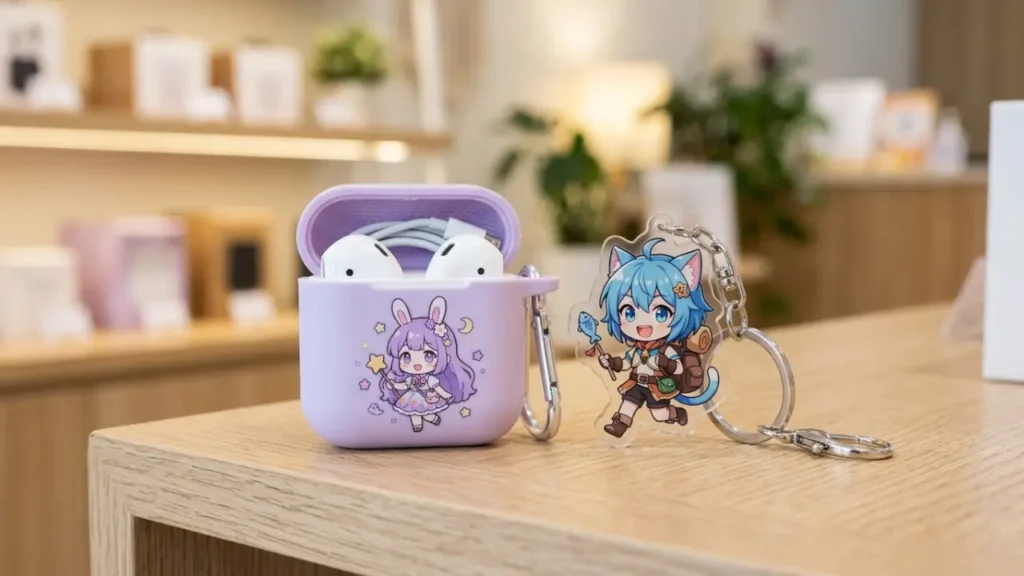
Limited display space makes a small buying mistake expensive: an attractive item can still tie up cash if shoppers do not understand its purpose or want its character. Deciding between two anime accessory formats means comparing demand, usable retail space, and contribution after delivery—not just the supplier’s unit quote.
There is no universal sales winner without store-level data. Acrylic keychains are a sensible first test for character-led impulse purchases; silicone earphone pouches merit testing where shoppers want a useful gift or storage accessory. Those are buying hypotheses, not proven sales rankings. Here is how to decide which deserves a larger order.
Which anime accessory fits your shoppers’ reason to buy?
Start with the purchase occasion. A convention visitor looking for a favorite character has a different decision process from a gift-store customer looking for something useful.
- Fandom shops and convention sellers: Test acrylic keychains when visible artwork is the main attraction. Confirm that packaged designs remain easy to identify from a peg or basket.
- Tiendas de regalos y estilo de vida: Test silicone pouches when staff can demonstrate storage capacity and closure operation at the counter. Do not imply universal earphone-case compatibility.
- Checkout displays: Compare actual packaged dimensions and hanging arrangements. A bulky pouch may occupy space that could hold several flatter items, but packaging—not material—determines the real difference.
- Tiendas online: Compare photography needs, shipping charges, and likely customer questions. Pouches need internal dimensions; keychains need clear artwork, scale, and hardware photos.
Keep character appeal separate from product format. A popular design on a keychain versus an unfamiliar design on a pouch tests two variables at once. Where possible, compare similar artwork themes, audience appeal, and promotional exposure so the format—not the character—is what you are actually measuring.
Put pouch utility and keychain presentation side by side
Request physical samples and packaging specifications before ranking either format. Material names alone do not establish durability, finish, or saleability.
| Buying criterion | Silicone earphone pouch | Acrylic keychain | Buyer action |
|---|---|---|---|
| Purchase motivation | Storage function plus character appeal | Visible artwork and decorative use | Ask shoppers whether function or design drives interest. |
| Dimensiones | Internal space, opening, and wall thickness matter | Artwork size, thickness, and attachment length matter | Request measured specifications, not only lifestyle images. |
| Superficie de la pantalla | Depth may limit units per facing | Flat formats may suit peg displays | Measure the packaged item on your actual fixture. |
| Likely inspection points | Closure fit, deformation, lint pickup, decoration adhesion | Scratches, edge chips, print alignment, loose hardware | Record sample acceptance criteria with photographs. |
| Embalaje | Needs shape protection and a visible use case | Needs surface protection and visible artwork | Check whether retail packs remain presentable after handling. |
| Assortment flexibility | Shape and color options can create separate variants | Character artwork can create many separate SKUs | Confirm design-level minimums and carton composition. |
| Customer information | Fit, capacity, cleaning, and closure instructions | Dimensions, printed sides, attachment type, protective film | Resolve likely questions before writing product listings. |
| Reorder risk | Winning shapes or colors may need separate replenishment | Popular characters may sell unevenly | Ask whether individual variants can be reordered. |
Use identical comparison conditions: packaged versus packaged, equivalent order quantities, and the same delivery basis. Comparing a loose keychain with a gift-packed pouch produces a misleading cost result.
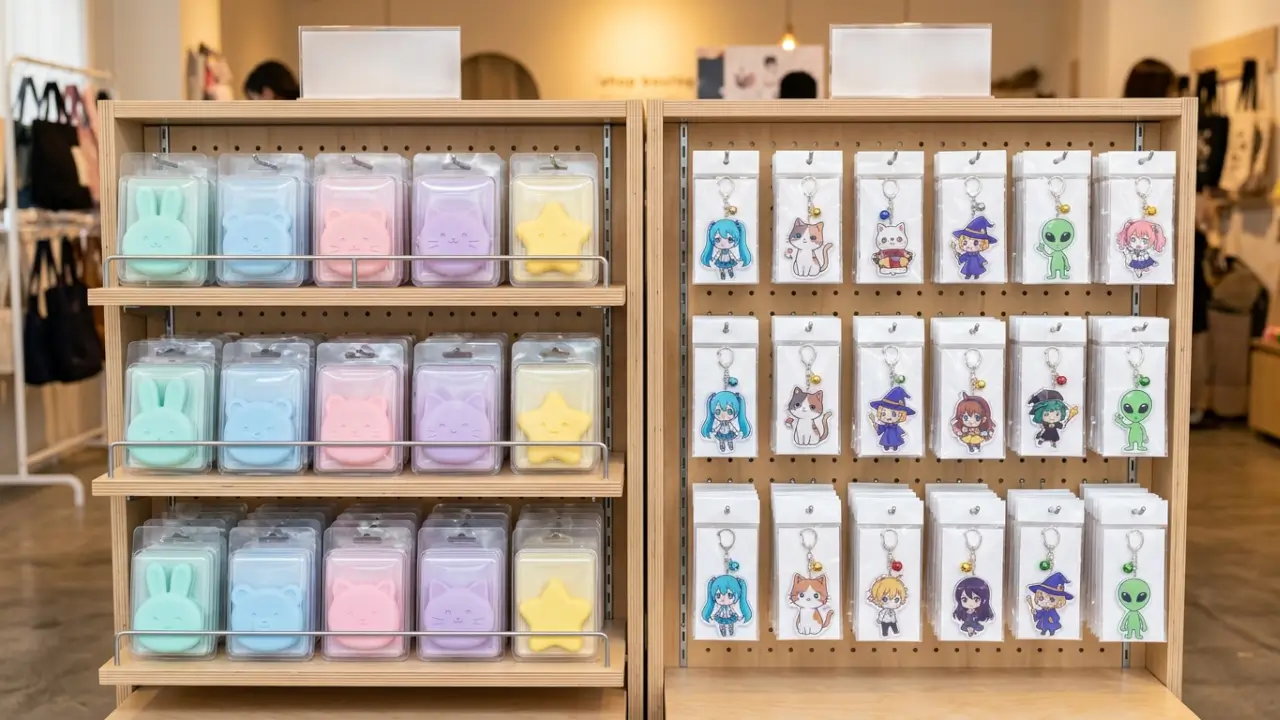
For compact fixtures, the guide to small anime accessories for limited shelf space can help frame assortment and display decisions. Keep open-selection accessories separate from blind-box formats when interpreting customer behavior.
Test sales per facing before declaring a winner
Define what “sells better” means before ordering. Unit velocity, contribution, and return frequency can point to different winners. A keychain may move more units while a pouch contributes more per sale; neither outcome is established until you measure it.
Example test plan: A retailer might trial 24 units of each format across a comparable number of designs, if the supplier’s case packs allow it. Give each format similar visibility, track the same selling period, and record promotions or stockouts that could distort results.
- Sell-through: Units sold divided by units available during the test. Use a consistent method for receipts and returns.
- Contribution per unit: Net selling revenue minus landed unit cost and variable selling expenses.
- Contribution per facing: Total contribution divided by the display facings used over the same period.
- Demand by design: Identify whether one character accounts for most sales.
- Customer friction: Log fit questions, damaged packaging, returns, and requests for unavailable variants.
Do not automatically reorder the format with the most sales. Favor the option that meets your cash-return and space-productivity targets without unacceptable complaints. If results depend on one character, replenish that design rather than the entire assortment where possible.
Before committing to a carton order, ask the supplier for a sample proposal and a packaged-dimension comparison. Those two inputs can make the first buying decision substantially clearer.
Why case packs can reverse the cheaper accessory quote
Ask whether the minimum order applies per order, format, character, color, or packaging version. A low unit quote loses appeal if the required assortment includes variants your customers are unlikely to buy.
Request the inner-pack quantity, master-carton quantity, fixed or selectable design mix, and rules for repeat orders. For custom artwork, distinguish any setup or tooling charges from recurring product and packaging charges. Do not assume silicone construction or acrylic printing implies a particular customization process.
Landed unit cost should account for merchandise, packaging, applicable setup allocation, freight, insurance where used, destination charges, and applicable duties or nonrecoverable taxes. Divide by the quantity realistically available for sale, with a documented allowance for damage rather than an invented supplier defect rate.
Obtain carton dimensions and gross weight for both proposals. Freight may be affected by dimensional weight as well as actual weight, depending on the service. Confirm the delivery term and named destination so that one quote does not hide charges included in another.
Replenish proven designs, not yesterday’s full assortment
Separate production or order preparation, transit, customs clearance, and receiving time when planning availability. Ask which dates are estimates and what must happen before the order is ready to dispatch.
Set a reorder trigger using sales during expected replenishment time plus an appropriate safety buffer. Check remaining stock by design: a carton total can conceal a stockout of the item customers actually want. For release-led merchandise, apply the same demand checks used when evaluating new-release pre-orders, without assuming an announced design is ready to ship.
Inspect pouch closures and keychain surfaces before approval
Review samples in the proposed retail packaging. Agree how visible defects, functional failures, and transit damage will be documented and handled before payment.
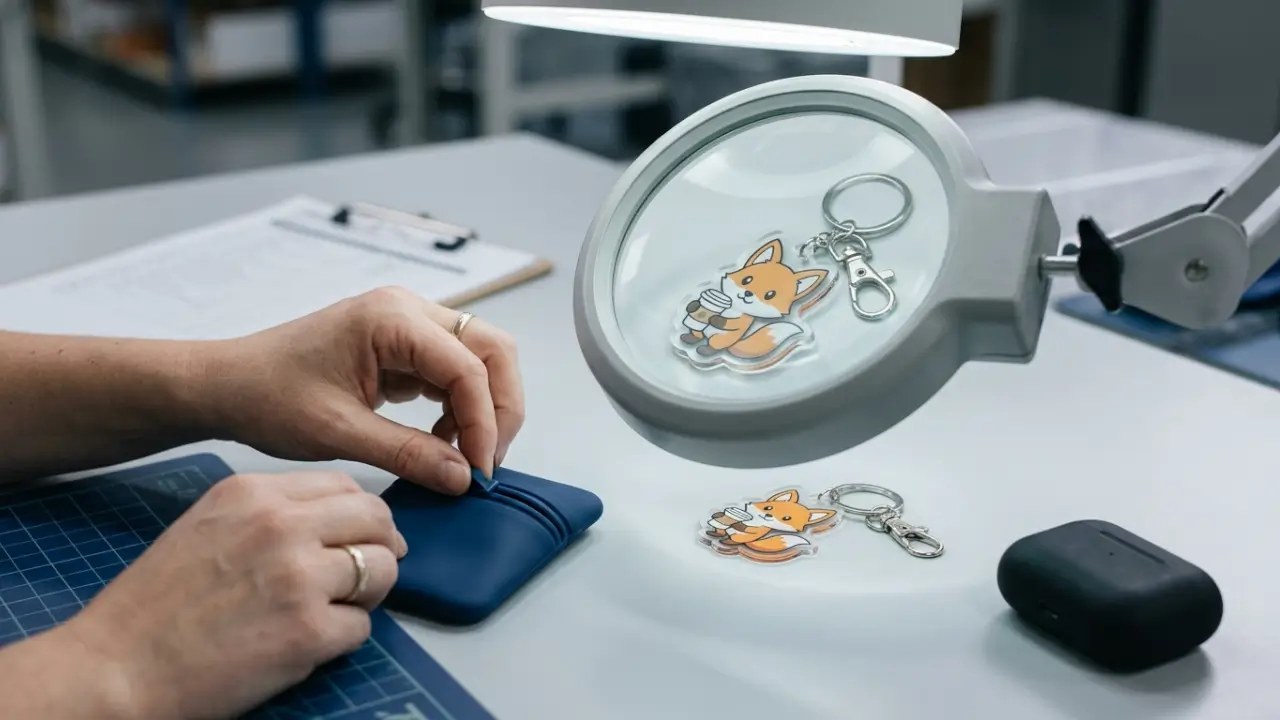
For silicone pouches: Measure usable internal space and the opening; test the closure with representative contents; inspect seams, decoration, and attachment points. Check for persistent odor and distortion. Do not advertise waterproofing or protective performance unless the specific claims are supported.
For acrylic keychains: Check edge finishing, surface clarity, print position, attachment security, and scratches under normal retail lighting. Confirm whether protective film is applied and how customers should remove it. Establish whether the artwork is printed on one side or both and whether its construction matches the approved sample.
For either format, ask for evidence of authorization to sell the depicted characters in your intended market. An anime-style appearance does not establish licensing. Buyers should also verify applicable product classification, age grading, small-parts requirements, labeling, and material restrictions with a qualified adviser for the destination market.
Pause the order if a supplier substitutes material specifications without approval, will not document the assortment, or presents unrelated test paperwork as proof for your exact item. A sample is a reference, not a guarantee that the shipment will match; agree on pre-dispatch checks.
Request two accessory quotes that answer the same questions
Send one comparison brief covering both formats. Ask the supplier to mark unavailable information rather than substituting an unconfirmed specification.
Please quote silicone earphone pouches and acrylic keychains for our intended retail market. Our customer type is [audience], proposed designs are [references], and planned order quantities are [quantities]. Please separate product, packaging, setup, and delivery charges.
- Material specification, dimensions, artwork placement, closure or hardware details.
- Character authorization information and relevant market-specific documentation.
- Minimum order by variant, case quantities, and permitted assortment changes.
- Sample arrangements, approved-sample reference, and inspection criteria.
- Retail-pack format, carton dimensions, and gross weight.
- Delivery term, destination, estimated readiness, and transit assumptions.
- Payment terms, defect-resolution process, and variant-level reorder conditions.
Request matched quotes and samples before placing your first bulk order. Include your fixture measurements, destination, target selling window, and preferred characters. Approve the format only after its sample, case mix, and delivered-cost calculation support your retail plan.
PREGUNTAS FRECUENTES
Do acrylic keychains sell better than silicone earphone pouches?
Not universally. Keychains suit character-led impulse buying, while pouches add a storage use case. Test comparable designs and compare sell-through, contribution per facing, and returns before choosing a winner.
Which accessory is cheaper to import?
Neither is always cheaper. Compare equivalent quantities, retail packaging, carton dimensions, shipping terms, and applicable destination charges. A lower product price does not necessarily mean a lower landed cost.
What should buyers confirm about pouch compatibility?
Confirm internal dimensions, opening size, closure clearance, and fit with representative earphone cases. Avoid universal compatibility claims based only on external measurements or product photos.
Can retailers reorder only the best-selling characters?
That depends on the supplier’s assortment rules and variant-level minimums. Confirm selective reordering before the first purchase; fixed mixed cartons can force retailers to replenish slower designs too.
Choose the format your store can prove
Use acrylic keychains as a character-first sales hypothesis and silicone pouches as a utility-led alternative. Then let matched samples, a controlled retail test, and comparable delivered quotes determine the order—not an unsupported claim that one material always sells better.

