





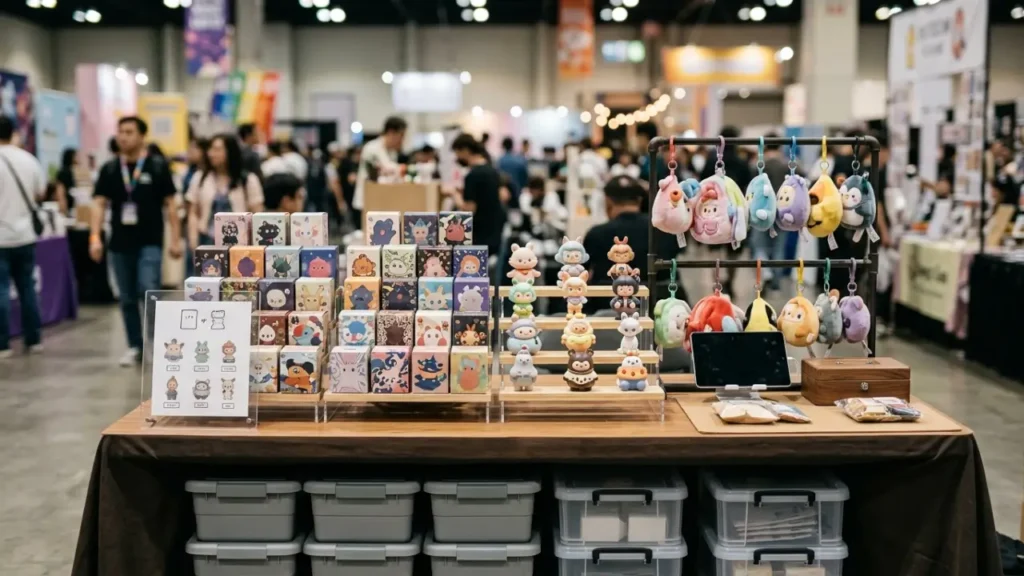
A crowded convention table forces every item to compete with checkout space, display samples, and backup stock. When selecting blind box products, the useful question is not simply which character looks appealing: it is which format fits your audience, your transport capacity, and your selling window.
For independent exhibitors, specialty retailers, and traveling merchandise sellers, compact accessories and small boxed figures are sensible formats to evaluate first. Plush pendants may add tactile appeal, but their packaging and display requirements need separate checks. The best choice is conditional—not a universal bestselling series.
Which blind box products deserve a place on a small table?
Start with the convention audience. An anime-focused exhibitor may prioritize recognizable character accessories, while a general pop-culture seller may test original-character figures with immediate visual appeal. A gift-oriented booth should also consider how easily shoppers can carry the purchase around the venue.
Use this comparison to shortlist formats. These are selection criteria, not verified specifications for any particular supplier’s range.
| Format or presentation | Potential booth role | Space-related risk | Confirm before ordering |
|---|---|---|---|
| Acrylic charm or keychain blind packs | Compact accessory add-on | Loose packs can become disorganized | Pack dimensions, hook compatibility, and sealed-random format |
| Small boxed figures | Collector-focused core assortment | Retail boxes can occupy more room than figures | Box footprint, assembled height, and internal protection |
| Plush pendant blind boxes | Bag-accessory or gift purchase | Plush volume and hanging samples consume space | Packaged size, attachment hardware, and display clearance |
| Blind-pack badges or pins | Shallow tray assortment | Small products need visible samples to explain appeal | Backing construction, protective packing, and age guidance |
| Miniature desk collectibles | Small themed display | Delicate parts may require bulky protective packaging | Assembly, stability, and damage-sensitive components |
| Counter-display cases of small blind boxes | Contained, easy-to-replenish presentation | The opened display may be larger than the closed case | Open dimensions, units per display, and replenishment method |
If your booth already sells bag accessories, compare the handling and presentation trade-offs in this guide to plush pendants versus acrylic keychains. Do not assume either format is smaller until you compare its retail packaging.
Measure the selling footprint, not just the collectible
Ask for three sets of measurements: the individual retail pack, the opened counter display, and the shipping carton. Each answers a different question—what fits on the table, what fits under it, and what fits in your vehicle or freight allocation.
Mark the usable table area after reserving checkout and packing space. Then mock up each shortlisted display with empty cartons or paper outlines. Include room for customers to point at a sample without knocking over neighboring stock.

As a planning example, a booth might show one opened sample per series while keeping sealed units in labeled bins below. This only works if staff can retrieve stock quickly and the venue permits that storage arrangement.
- Check display depth as well as frontage; deep cases can crowd payment equipment.
- Confirm permitted riser heights and keep displays stable.
- Keep sellable sealed stock separate from demonstration units.
- Test whether one staff member can replenish without blocking checkout.
The related guide to small anime accessories for limited shelf space can help extend this footprint-first approach across your assortment.
Build a narrow assortment before committing to full cases
Too many series can create a display problem before they create a sales opportunity. Give each shortlisted line a job: a main collector attraction, a compact accessory option, or a contrasting gift format. Remove lines that compete for the same customer without adding a clear reason to buy.
For example, a first test assortment might contain three series rather than eight, with a display sample allowance and a storage location assigned to each. These are planning numbers, not recommended supplier minimums.
Ask whether minimum order quantity applies per series, per SKU, or across the total order. Confirm the difference between a retail display case and a master shipping carton. Also document whether mixed-series orders are allowed and whether any case-composition statement applies to that exact release.
Never assume a sealed case guarantees a complete set, prevents duplicates, or contains a rare figure. Get the applicable assortment rules in writing before making customer-facing claims.
For a named figure candidate, review the Little Monster CUPA I Am Undefined product page, then request its actual pack dimensions and case details. A product listing alone does not establish suitability for your booth.
Shortlist first, then ask: send a supplier your usable display dimensions and preferred formats, and request comparable specifications before discussing order volume.
Price the convention order against transport and the event deadline
A lower unit quote may be less attractive if the carton is bulky, requires extra handling, or arrives too close to setup. Compare supplier quotations using the same quantity, packaging configuration, delivery destination, and shipping scope.
Landed inventory cost per sellable unit should account for merchandise, inbound freight, applicable duties or taxes, clearance and handling charges, and units allocated to samples or identified as unsellable. Confirm tax treatment with your adviser rather than assuming every charge is recoverable.
Track booth fees, staff travel, payment processing, and venue delivery charges separately when judging event profitability. Do not confuse a positive product markup with a profitable convention appearance.
- Set an inventory-ready date before the event, allowing time for receiving checks and repacking.
- Ask for dispatch readiness separately from estimated transit time.
- Confirm whether delivery is to your premises, a venue receiving service, or another handoff point.
- Review tracking, clearance responsibilities, and the response if arrival slips beyond your cutoff.
A future release may fit a later show better than your next convention. Use the blind box pre-order evaluation guide when comparing unreceived releases with inventory a supplier can substantiate as ready for dispatch.
During the event, record sales by series and time period. Base the next order on observed demand and remaining sealed stock; do not rely on emergency replenishment during a short convention.
Protect sealed boxes through loading, setup, and shopper handling
For collectible merchandise, crushed corners and broken seals can reduce buyer confidence even when the item inside is intact. Ask how retail boxes are protected inside master cartons, and review packaging photos before shipment where available.
At receiving, inspect outer cartons, retail-pack condition, series identifiers, and quantities. Photograph damage before discarding packing materials and check the supplier’s reporting procedure. Budget for representative opened samples without accidentally returning them to sealed inventory.

For figures, review paint finish, loose components, and stability on sampled units. For plush pendants, inspect stitching and attachment hardware; for acrylic accessories, check surfaces, edges, and fittings. A visual inspection is not a substitute for applicable safety testing.
Buyers should verify destination-market requirements for age grading, warnings, labeling, importer information, and product safety. Ask for documentation relevant to the exact SKU and market. For licensed characters, also review sourcing legitimacy and any convention rules on merchandise eligibility.
Reject quotes that leave booth-critical details unanswered
Missing measurements are not a minor inconvenience when the entire order must fit beneath one table. Pause a purchase if the supplier cannot clarify the following points:
- Product identity: photos, series names, and quoted SKUs do not match.
- Case structure: “one case” is quoted without a unit count or packing hierarchy.
- Assortment promises: complete-set or rare-item claims lack release-specific support.
- Delivery scope: “shipping included” does not state the destination or excluded charges.
- Damage handling: no reporting deadline, evidence requirements, or remedy process is explained.
A common buyer mistake is selecting a visually impressive display without allocating space for its backup cartons. Another is buying several overlapping lines because each has a low entry quantity. Judge the combined order against your storage limit, not each series in isolation.
Send a booth-specific brief for a comparable quote
Prepare your event date, inventory-ready deadline, delivery location, usable display dimensions, storage allowance, preferred formats, and intended customer group. Separate essential requirements from preferences so suppliers can identify practical alternatives.
We are sourcing sealed blind-box merchandise for a space-limited convention booth. Please quote the selected series and confirm retail-pack dimensions, opened display dimensions, units per display and master carton, carton measurements and weight, and minimum order quantities. Please state mixed-order options, assortment rules, sample availability and cost, dispatch readiness, estimated transit, delivery terms, packaging protection, damage-reporting procedures, and available market-relevant documentation. Our required inventory-ready date and delivery destination are provided below.
Attach your proposed quantities and ask suppliers to identify any required case rounding. Request notice of substitutions before shipment rather than accepting unspecified alternative series.
Before paying, request a written quote for your final shortlist with specifications, delivery assumptions, and packing details confirmed. Approve only the assortment that fits both your physical booth plan and your event deadline.
PREGUNTAS FRECUENTES
Which blind-box format should a small convention booth evaluate first?
Start with compact accessories and small boxed figures that match the audience. Compare packaged dimensions and sample-display needs before choosing; a small collectible can still have bulky packaging.
How many series should a first convention order include?
Use a narrow test assortment that you can display clearly and replenish easily. Choose the number of series after checking case quantities, storage capacity, and overlap between customer use cases.
Does a sealed display case guarantee a complete set?
Do not assume so. Ask for the exact release’s written assortment rules, including duplicate possibilities and any limitations on complete-set or rare-item claims.
Should exhibitors order pre-release blind boxes for a fixed event?
Only if the timing risk is acceptable and a backup plan exists. Confirm release expectations, dispatch readiness, transit assumptions, and what happens if the inventory misses your receiving cutoff.
What should a supplier quote include besides the unit price?
Request pack and carton dimensions, case quantities, minimums, shipping scope, delivery assumptions, packaging details, damage-reporting terms, and relevant product documentation.
Before you reserve table space
Give every series a defined audience, display position, and storage allocation. Verify case structure and event-ready delivery before committing funds. A compact, understandable assortment is a more manageable starting point than a crowded table of products you cannot replenish or explain efficiently.

