




You just sold an ultra-rare, “Secret” Pop Mart Skullpanda for $180 to a thrilled collector in your boutique. Your Shopify dashboard shows $180 in revenue. You feel like a retail genius. But when your CPA (Certified Public Accountant) reviews your books at the end of the quarter, they ask a terrifying question: “What was the exact cost of that single figure?”
If your answer is “I don’t know, I just bought a massive master carton from China for $1,500,” your financial records are compromised. You are flying blind. You might be paying thousands of dollars in excess income tax, or worse, you might be operating at a net loss without realizing it.
In the Art Toy industry, tracking COGS (Cost of Goods Sold) is the ultimate logistical nightmare. You do not buy single toys; you buy massive assortments. You break wholesale pallets down into End Boxes, break End Boxes down into Singles, and occasionally open Singles to sell as “Confirmed Figures” with wildly varying retail values. For B2B retail partners relying on KidultsBox for high-margin inventory, mastering the “Russian Nesting Doll” mathematics of blind box COGS is the only way to build a financially bulletproof, audit-ready retail empire.
1. The Foundation: Calculating “Landed Cost” (Not Just Invoice Price)
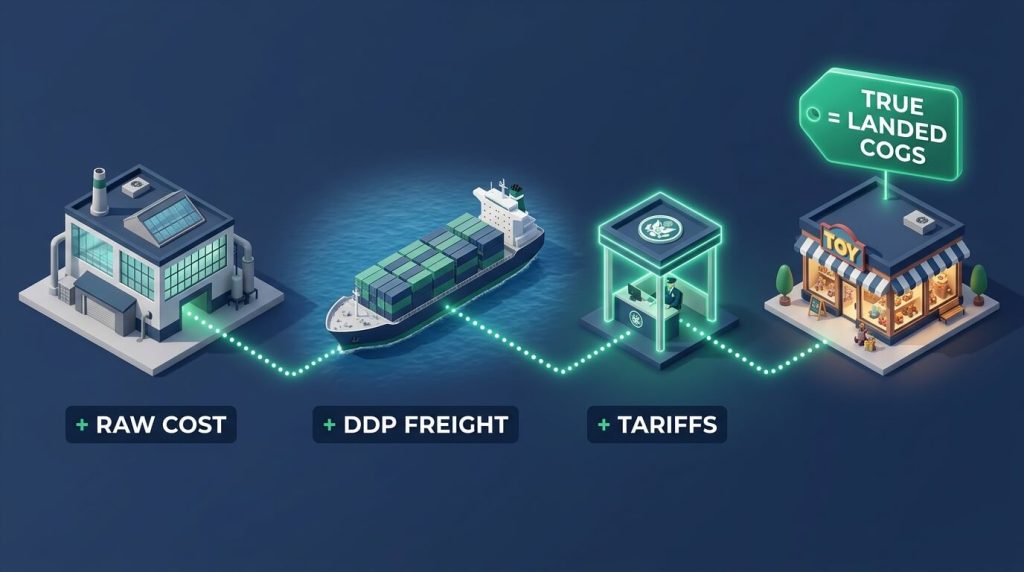
The single biggest mistake amateur retailers make is confusing the “Product Cost” with the “Landed Cost.” Your COGS must include every single penny required to get that specific blind box from a factory floor in Asia onto your retail shelf in New York or London.
The Landed Cost Formula
The following 144-unit case study uses hypothetical costs to demonstrate the calculation. It is not a KidultsBox quote, current price, or product-specific offer:
- Raw Product Cost: e.g., $1,000.00
- Inbound Freight (Air/Sea): e.g., $250.00
- Customs Duties & Tariffs: e.g., $85.00
- Fulfillment/Prep Fees (if 3PL is used): e.g., $30.00
- Total Landed Cost: $1,365.00
The True Unit COGS: $1,365.00 ÷ 144 = $9.47 per box. (Not the $6.94 raw cost you saw on the initial invoice).
DDP and landed cost: A DDP quote may consolidate product, freight, duty, and other stated charges, but do not assume every possible cost is guaranteed or that the accounting is error-free. Confirm the named place, importer arrangement, taxes, inclusions, exclusions, and supporting invoice data for the actual shipment.
2. The “Fractional SKU” Strategy for Shopify & POS
Once you know your Landed Cost is $9.47 per unit, how do you track it in your Point of Sale (POS) software when the product exists in multiple physical states?
You must build a Fractional SKU Architecture. Every level of the blind box hierarchy must have its own SKU, but the COGS must be mathematically linked.
| Inventory State | Retail Action & Price | Assigned COGS (Based on $9.47/unit) | POS Data Entry Rules |
|---|---|---|---|
| 1. Master Carton (144 units) | Rarely sold to end consumers. Used purely for receiving inventory. | $1,363.68 | Do not make this active on Shopify. Use for backend receiving only. |
| 2. End Box / Full Case (12 units) | Sold sealed to “Whale” collectors. Retail: $180.00. | $113.64 ($9.47 x 12) | Must use a “Bundling” app in Shopify to deduct 12 singles from inventory when 1 Case is sold. |
| 3. Single Blind Box (1 unit) | Standard impulse buy. Retail: $16.00. | $9.47 | The baseline SKU. All COGS tracking branches out from this unit value. |
3. The “Confirmed Figure” Dilemma: Tax Accounting vs. Managerial Accounting
This is the black belt level of retail finance. You take an End Box of 12 Kimmon Flower plushies (Total COGS: $113.64). You open all 12 boxes to sell as “Confirmed” (Opened) figures.
Inside, you find 11 “Common/Dud” figures (which you can only sell for $10 each) and 1 ultra-rare “Secret” figure (which you price at $150).
What is the COGS of the Secret figure? There are two ways to track this, depending on who is asking (The IRS or your Investors).
Method A: Standard Flat Costing (For the IRS/Taxes)
For strict tax compliance, the IRS (and HMRC) generally requires Actual/Average Costing. Because you paid $9.47 blindly for every box in that case, every figure inherits a $9.47 COGS, regardless of its resale value.
The Tax Math:
– Secret Figure Sale: $150.00 (COGS: $9.47) = $140.53 Taxable Gross Profit.
– Common Figure Sale: $10.00 (COGS: $9.47) = $0.53 Taxable Gross Profit.
This is the easiest and most legally sound method for your end-of-year tax returns.
Method B: Weighted Margin Allocation (For Management & KPIs)

If you use Flat Costing to judge your staff’s sales performance, the data looks wildly skewed (one figure has a 93% margin, the others have a 5% margin). For internal business analytics (Gross Margin Return on Investment – GMROI), retailers use Weighted Allocation based on Estimated Retail Value (ERV).
Total ERV of Case = $150 (Secret) + $110 (11 Commons @ $10) = $260.
The Secret’s Weight: $150 / $260 = 57.6% of the value.
The Secret’s Weighted COGS: 57.6% of $113.64 (Total Case Cost) = $65.45.
Why this matters: If you pay your store manager a 10% commission on gross profit, using Weighted COGS ($150 – $65.45 = $84.55 Profit) prevents you from massively overpaying commissions on “lucky” pulls, stabilizing your payroll expenses.
4. Writing Off the “Display Sample” (Shrinkage vs. Marketing)
To sell blind boxes effectively, you must sacrifice one unit to be the “Open Display Sample” on your acrylic risers so customers can see the physical quality of the La caja de Penny BJD.
If you simply take a box off the shelf and open it, your Shopify inventory will say you have 10 boxes, but you only have 9 sellable boxes. You will experience phantom overselling. Furthermore, you lose the tax deduction.
The Operational SOP for Display Samples:
- Take the blind box off the retail floor.
- In your POS system (e.g., Shopify), execute a Manual Inventory Adjustment. Minus 1 unit.
- Under the “Reason for Adjustment” dropdown, do NOT select “Shrinkage” or “Theft.” Select “Promotional / Marketing Expense.”
- This action legally removes the $9.47 COGS from your Inventory Asset balance sheet and moves it directly onto your Income Statement as an Advertising Expense, immediately lowering your taxable income for the year.
5. The “Dead Stock” Liquidation Write-Down
Inventory is not a fine wine; it rarely gets better with age. If you ordered a wholesale pallet of a highly obscure IP that hasn’t sold a single unit in 6 months, it is “Dead Stock.”
Tal y como se explica en nuestro Liquidation Strategy Guide, you might bundle this dead stock into “Lucky Bags” (Fukubukuro) to clear shelf space. How does this affect COGS?
The Lucky Bag Math:
You put one hot item (COGS $9.47) and two dead stock items (COGS $9.47 each) into a paper bag. The Total COGS of the bag is $28.41.
If you sell the “Lucky Bag” for $25.00 to get rid of it quickly, you have sold it below your Cost of Goods Sold.
Is this bad? No. Realizing a $3.41 loss on your financial statements is actually a tax advantage. The IRS allows you to deduct losses realized from liquidating obsolete inventory below cost. You recover $25 in liquid cash today to buy new, high-velocity KidultsBox inventory, and you get to write off the $3.41 loss against your overall store profits at tax time.
6. Integrating with Accounting Software (Xero / QuickBooks)
Shopify is an e-commerce engine, not a CPA. To manage COGS professionally, you must bridge your POS to a dedicated accounting ledger like QuickBooks Online (QBO) or Xero.
- Enter COGS at Receiving: Do not wait until the item sells. The moment your KidultsBox pallet arrives, input the exact Landed Unit Cost ($9.47) into the “Cost per item” field in the Shopify Product Admin.
- The COGS Sync: Use an integration app (like A2X or QuickBooks Commerce Sync). Every time a blind box is scanned at your register, the app automatically tells QuickBooks: “Credit Sales Revenue $16.00, Debit Cost of Goods Sold $9.47, Reduce Inventory Asset Account by $9.47.”
- End of Month Reconciliation: Because the COGS field is accurately populated, you can pull a “Gross Margin by Product” report on the 1st of every month. If a specific plush series shows a blended margin dropping below 40%, you instantly know it’s time to stop reordering it from your wholesale supplier.
Preguntas más frecuentes (FAQ)
Q: If a customer steals a blind box, how do I track the COGS?
A: You must log it as “Shrinkage” in your inventory system. This removes the item from your sellable inventory count and moves the Landed COGS (e.g., $9.47) to an “Inventory Loss” expense account. This ensures you do not pay income tax on the value of stolen goods.
Q: Can I change the COGS in Shopify if my next wholesale order from KidultsBox is cheaper?
A: Yes. If you reorder the same item but your freight cost goes down, lowering your Landed Cost to $8.00, you update the “Cost per item” field in Shopify. Shopify generally uses a Moving Average Cost or FIFO (First-In, First-Out) method, depending on your accounting integration, to smooth out the COGS over time.
Q: Does the cardboard box itself have a COGS value?
A: No. In standard retail accounting, the packaging (the blind box cardboard and foil) is considered an inseparable part of the primary product. You do not assign a separate value to the packaging vs. the toy inside.
Q: Does KidultsBox provide documentation to help me calculate my Landed COGS?
A: KidultsBox provides commercial invoices for B2B transactions and the cost information available for the shipment. Your bookkeeper should reconcile the invoice with the quote, payment, freight, tax, duty, broker, and destination records to determine landed COGS under your accounting policy.