



Open any inventory spreadsheet of an independent toy boutique, and you will quickly spot a terrifying financial leak: the owner has treated all products equally. They ordered 5 cases of Series A, 5 cases of Series B, and 5 cases of Series C. One month later, Series A is completely sold out, while Series B and C are gathering dust, trapping valuable cash flow on the retail shelf.
This is a fundamental violation of the most powerful law in business: The Pareto Principle (The 80/20 Rule). In the hyper-trend-driven world of Designer Art Toys and Blind Boxes, roughly 80% of your gross profit will be generated by just 20% of your inventory.
For independent retailers and B2B partners sourcing from KidultsBox, identifying which IPs belong in that magical 20% bracket—and ruthlessly reallocating your purchasing budget toward them—is the difference between a struggling hobby shop and a highly profitable retail empire. This comprehensive whitepaper will teach you how to execute an ABC Inventory Analysis, how to spot “Hero Products,” and why you still need to stock the bottom 80% (but strictly on a budget).
1. Understanding the Pareto Principle in Art Toys
The 80/20 rule dictates that a vital few inputs drive the majority of the outputs. In blind box retail, this manifests in what we call “The Velocity Discrepancy.”
When a highly hyped, culturally relevant product like the Pop Mart Labubu Macaron series drops, its Sell-Through Rate (STR) is exponential. Customers will drive across town to buy 3 or 4 boxes at a time, often clearing out your entire wholesale allocation in 48 hours. Conversely, an obscure indie designer toy might take 3 months to sell a single master carton. If you allocated equal capital to both, 50% of your money is currently paralyzed.
The Math of Unequal Returns
Imagine you have $2,000 to spend on wholesale inventory.
- The Amateur Strategy: You buy 10 different IP series, spending $200 on each. Two series sell out immediately ($400 investment turns into $800 revenue). Eight series sit on the shelf ($1,600 investment generates $0 this month). You are cash-poor.
- The 80/20 Strategy: You identify the two “Hero” IPs using trend data. You spend $1,600 on the top two IPs, and only $400 on the remaining eight “Filler” IPs. The Hero IPs sell out rapidly, turning your $1,600 investment into $3,200 cash in one week, which you immediately reinvest.
2. Executing an ABC Inventory Analysis
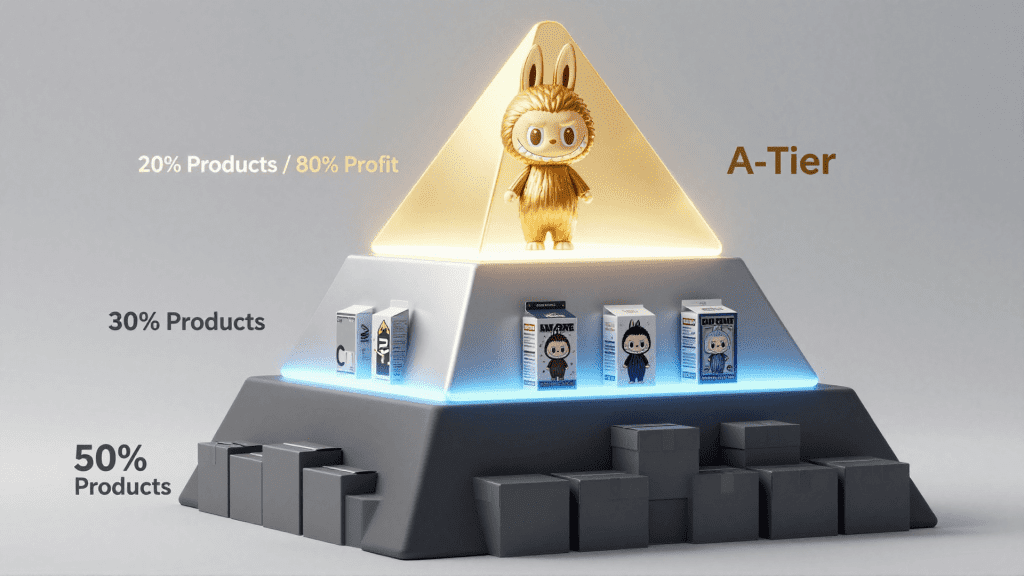
To mathematically apply the 80/20 rule to your store, you must categorize your KidultsBox wholesale orders using the ABC Classification Method. This requires looking at your POS (Point of Sale) data from the last 90 days.
| Classification | The “A-Tier” (The 20%) | The “B-Tier” (The 30%) | The “C-Tier” (The 50%) |
|---|---|---|---|
| Revenue Contribution | Generates ~80% of total store revenue. | Generates ~15% of total store revenue. | Generates ~5% of total store revenue. |
| IP Characteristics | Viral on TikTok/Xiaohongshu. High brand recognition. High resale value for “Secrets.” | Solid, consistent brands. Niche but loyal followings. Aesthetic appeal. | Unknown indie artists, hyper-niche themes, outdated series. |
| Examples | Малыш 3 плюшевый, Pop Mart MEGA, Skullpanda. | Kimmon Flower, ShinWoo, Nanci. | Generic food themes, past-season holiday stock. |
| Purchasing Strategy | Never go out of stock. Buy in massive bulk (Master Cartons). Over-order to ensure depth. | Buy in moderation. Restock monthly. Order “End Boxes” (Full cases). | Buy absolute minimums (1-2 cases). Do not restock once sold out. |
3. How to Identify Your “A-Tier” Hero Products Early
The goal is to identify an A-Tier product до you place your wholesale order. If you wait until it is selling out everywhere, you are already late. Look for these three leading indicators:
Indicator 1: The “Secondary Market Premium”
Check resale platforms like eBay, StockX, or local collector Facebook groups. If the “Secret” (Chase) figure of a newly announced series is already being pre-sold by scalpers for 500% over MSRP, you have an A-Tier product on your hands. The secondary market premium proves that demand vastly outstrips supply.
Indicator 2: The “Bag Decor” Versatility
In 2026, the highest velocity blind boxes are not desk toys; they are fashion accessories. If a product is a plush keychain with a sturdy loop (e.g., Baby Three V3), its Total Addressable Market (TAM) is doubled because it appeals to fashion-conscious Gen Z consumers building “Pain Baos” (Ita-bags), not just toy collectors.
Indicator 3: Cross-Cultural IP Collaborations
When a major art toy brand collaborates with a legacy IP (e.g., Pop Mart x SpongeBob, or 52Toys x Disney), the product automatically becomes A-Tier. You are no longer just selling to blind box fans; you are selling to the global fanbase of that legacy IP. The audience size is mathematically guaranteed to drive high velocity.
4. The Illusion of Choice: Why You Still Need the “C-Tier”
A logical question arises: “If 80% of my profits come from the Top 20% of products, why shouldn’t I just throw away the bottom 80% and ONLY sell Pop Mart and Baby Three?”
The Danger of the Monoculture Store
If you only sell two IPs, you are no longer a boutique; you are a commodity distributor. You need the bottom 80% (The C-Tier and B-Tier products) to create The Illusion of Abundance.
When a customer walks into an Art Toy store, they want the sensory experience of discovery. They want to see a massive wall of 50 different colorful series. Even if they ultimately buy the A-Tier product they saw on TikTok, the presence of the obscure C-Tier products convinces them that your store is a curated, high-end “Collector’s Paradise,” justifying the premium prices you charge.
Стратегия: Use C-Tier products as “Wallpaper.” Buy them in extremely low quantities (1 End Box per series) just to fill out your display wall and add color. Do not tie up heavy capital in them, but keep them visible to maintain your store’s aesthetic credibility.
5. Visual Merchandising the 80/20 Rule
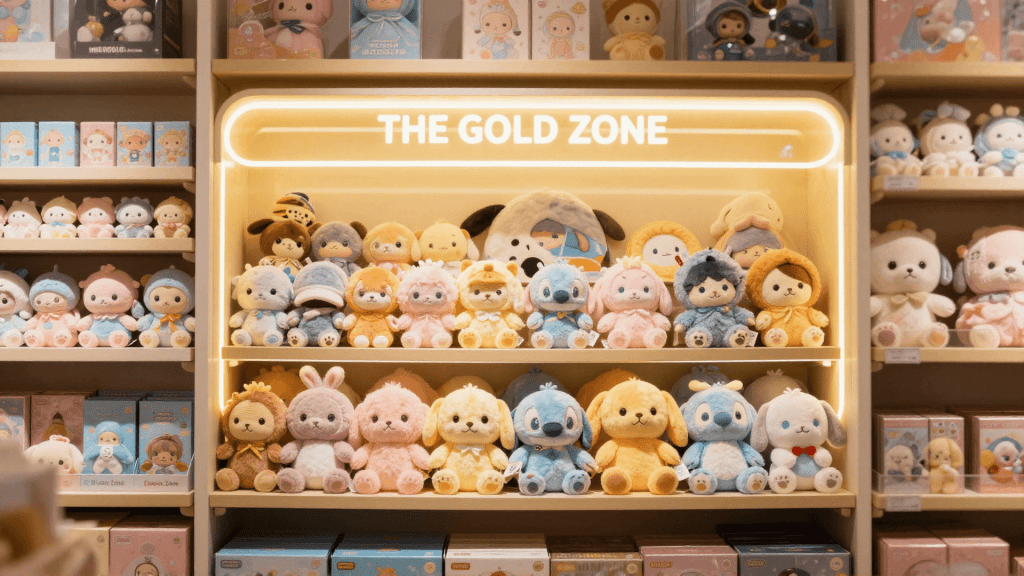
Your store’s physical layout must brutally reflect your ABC Inventory Analysis. You must manipulate customer traffic to prioritize the 20%.
- The “Gold Zone” for A-Tier: Your top 20% products must be placed in the “Gold Zone”—between 4 feet and 5.5 feet off the ground (direct eye level and touch level). They should also be double-faced (occupying two columns on the shelf instead of one) to simulate massive demand.
- The “Register Trap” for B-Tier: Smaller, reliable B-tier items (like plush pendants) should hang on clip-strips directly next to the cash register to catch impulse AOV (Average Order Value) bumps.
- The “Bottom Shelf” for C-Tier: Relegate your slow-moving, obscure 80% to the bottom shelves (knee height) or the very top shelves. They provide color and background ambiance, but they do not steal prime real estate from the money-makers.
6. Liquidating the Bottom 10% (Dead Stock)
Even with perfect forecasting, you will occasionally buy a “Dud.” If a C-Tier product has not sold a single unit in 45 days, it has become Dead Stock. It is now actively costing you money by occupying shelf space.
Do not let ego prevent liquidation. You must convert that dead plastic back into liquid cash immediately to reinvest in A-Tier stock from KidultsBox.
- The GWP (Gift With Purchase) Play: Run a promo: “Spend $100 on Pop Mart, get this [Dead Stock IP] blind box for FREE.” You maintain the MSRP of your good stock while instantly clearing the shelf of the bad stock.
- The “Fukubukuro” (Lucky Bag): Bundle one A-Tier item with two C-Tier items in an opaque paper bag. Sell the bundle for a 15% discount off the total retail value. Customers love the mystery, and you successfully offload two dead items at a profit.
Часто задаваемые вопросы (FAQ)
Q: How often should I re-evaluate my ABC Inventory list?
A: In the fast-moving Art Toy market, you should run an ABC analysis every 30 to 45 days. An A-Tier product in July can easily become a C-Tier product by September as trends shift. You must remain aggressively agile.
Q: Should I limit how many A-Tier products a single customer can buy?
A: Yes, if you are experiencing “Scalper Attacks.” If one person buys your entire stock of A-Tier items, you alienate your regular customers. Limit highly hyped releases to “2 Single Boxes or 1 Full Case per customer per day” to ensure the inventory draws in multiple unique foot traffic visits.
Q: Are “Secret” figures considered A-Tier?
A: Secret figures are anomalies. They are ultra-A-Tier in value, but you cannot “order” them wholesale (they are blind). When you pull a Secret as a retailer (e.g., from an open display box), place it in a locked acrylic case. Do not sell it immediately; use it as an “Anchor Display” to drive traffic and sell the remaining standard boxes of that series.
Q: Does KidultsBox offer guidance on what the current Top 20% products are?
A: Absolutely. As a global wholesale distributor, we see the macro-data of what is moving across North America, Europe, and SEA. When you request a wholesale catalog, our account managers will highlight the current A-Tier “Hero Products” to ensure your first order generates rapid ROI.