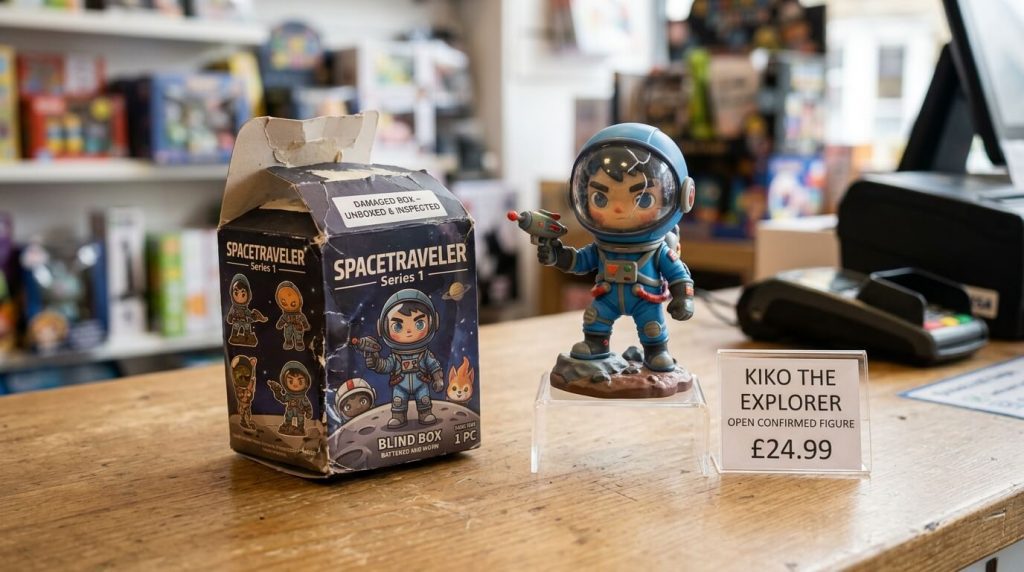




Managing inventory in an art toy store presents a unique logistical paradox: you are tracking thousands of units, but from the outside, they look entirely identical. In a standard blind box series, all 12 variants share the exact same outer packaging and Universal Product Code (UPC). If your retail staff relies purely on manual counts, your inventory accuracy will inevitably degrade, leading to phantom stockouts and mismanaged reorders.
To scale operations, independent toy retailers must move beyond manual clipboards and integrate proper scanning technology. In this guide, we will evaluate the operational differences between standard barcode scanners and Radio Frequency Identification (RFID) systems, discuss how to handle the “identical packaging” problem, and determine which tech stack makes the most financial sense for your retail floor.
The Blind Box Inventory Challenge
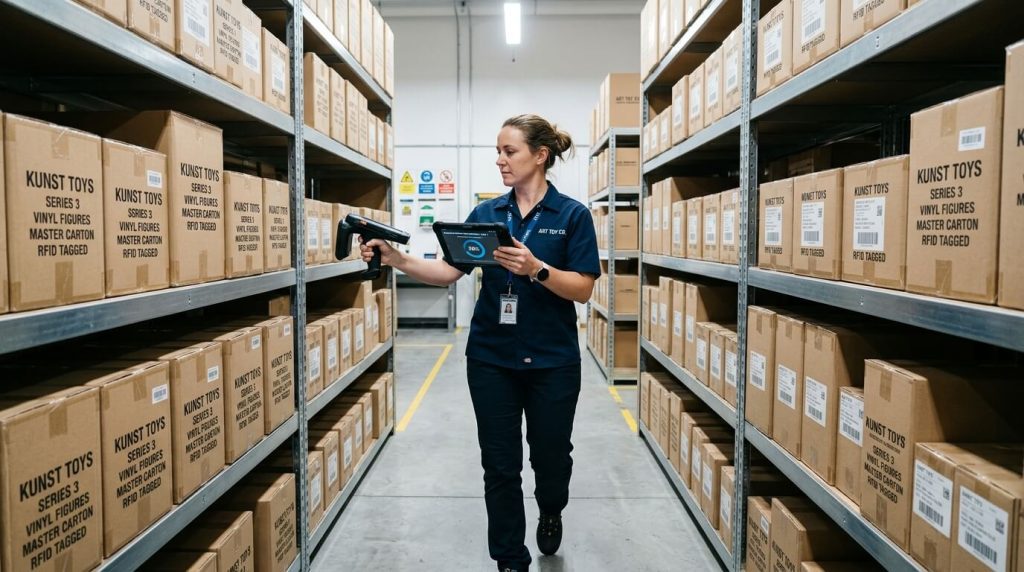
Before investing in hardware, you must understand the limitation of manufacturer data. When you receive a master carton of 144 blind boxes, the factory-printed barcode only identifies the series (e.g., “Киммон Let’s Cafe Series”), not the specific character inside.
If a customer opens a box in-store and decides to trade it, or if a staff member processes a return, that specific open item essentially becomes a new SKU. Standard UPC barcodes on blind boxes cannot track this variant-level data without internal relabeling.
Barcode Scanners: The Reliable Baseline
1D and 2D barcode scanners are the global standard for retail POS systems. They require a direct line of sight to read a printed label.
Operational Pros:
- Low Cost and Universal Integration: A high-quality 2D scanner costs under $100 and plugs directly into virtually any art toy POS system (Shopify, Square, Lightspeed) with zero configuration.
- Accuracy at the Register: For standard transaction processing at the checkout counter, a barcode scanner prevents cashier keying errors and speeds up the checkout line during busy weekend rushes.
Operational Cons:
The primary drawback is labor cost during cycle counting. To inventory a shelf of 300 blind boxes, a staff member must physically pick up and scan every single box individually. This makes weekly audits incredibly time-consuming, meaning most stores only do full inventory counts quarterly, allowing shrinkage (theft or loss) to go unnoticed for months.
RFID Technology: The Enterprise Upgrade
Radio Frequency Identification (RFID) uses electromagnetic fields to automatically identify and track tags attached to objects. Unlike barcodes, RFID does not require a direct line of sight.
Operational Pros:
- Rapid Cycle Counting: This is the ultimate advantage. A staff member walking down an aisle with a handheld RFID sled can scan 500 blind boxes in 10 seconds simply by waving the device. This allows for daily inventory reconciliation, immediately flagging missing stock.
- Serialization capability: Retailers can encode unique data onto blank RFID stickers. Even if 12 blind boxes share the same factory UPC, your custom RFID tag can assign each physical box a unique serial number, creating a robust loss prevention safeguard against both shoplifters and employee theft.
The Hidden Hurdle: Foil Bag Interference

Retailer Warning: Most blind boxes contain an internal metallic foil bag to prevent customers from using flashlights to see the figure. Metal disrupts RFID radio waves. If you place an RFID sticker directly over or too close to heavy foil, the read rate will drop significantly. When implementing RFID, store owners must test tag placement on the outer cardboard box to ensure the signal bounces correctly without foil interference.
Cost-to-Benefit Analysis for Toy Stores
RFID is powerful, but the implementation cost can erode the margins of smaller operations. Use the matrix below to evaluate which tech stack fits your business model.
| Technology | Initial Hardware Cost | Ongoing Consumable Cost | Best Retail Use Case |
|---|---|---|---|
| 2D Barcode Scanners | Low ($50 – $150 per register) | Negligible (Standard thermal labels) | Single-location boutiques; Mall Kiosks; Startups. |
| RFID Handheld Sleds + Antennas | High ($1,000 – $3,000+) | High ($0.10 – $0.15 per RFID tag) | Multi-unit franchises; Warehouses; High-shrinkage locations. |
| Hybrid (Barcode POS + RFID Audits) | Medium / High | Medium (Tagging only high-ticket items) | Stores looking to protect expensive 400%/1000% anchor items while scanning standard blind boxes traditionally. |
Часто задаваемые вопросы (FAQ)
Do wholesale suppliers put RFID tags inside the blind boxes at the factory?
Currently, no. Major manufacturers like POP MART or independent studios do not embed RFID chips into standard series blind boxes due to the added production cost. If you wish to use an RFID system, your staff will need to manually apply encoded RFID sticker tags to the outer packaging during the inbound receiving process.
Does it make financial sense to put a 15-cent RFID tag on a $12 blind box?
For independent retailers operating on a 50% gross margin, spending 15 cents per unit purely on an inventory tag is a notable operational expense. Many retailers compromise by utilizing standard barcodes for cheap, high-turnover plush keychains, and reserving RFID tags exclusively for high-ticket items like premium BJD dolls or $150 vinyl figures where the cost of shrinkage is devastating.
Can a barcode scanner read a QR code?
A standard 1D laser scanner cannot read a QR code. You must purchase a 2D imaging scanner. Upgrading to a 2D scanner is highly recommended, as it allows your POS system to scan digital loyalty cards or QR-based digital receipts from customers’ smartphone screens.
How can I streamline receiving inventory from my B2B supplier?
Efficient inventory starts at the supply chain level. Sourcing from a reliable B2B supplier ensures you receive clean, untampered master cartons with clear packing lists. When purchasing from platforms like Kidults Box, buyers can rely on organized bulk shipments, making it significantly easier to bulk-generate internal barcode or RFID labels upon receiving.
Upgrading your retail technology is the most effective way to eliminate phantom stockouts and protect your capital. Whether you are outfitting a new checkout counter with 2D scanners or planning a full RFID implementation, ensuring you have reliable inventory to scan is the critical first step.