





For a retailer, the blind box wholesale MOQ is not just a number to meet. It is the starting point for deciding how many series to test, how much shelf space to commit, and how quickly you can reorder if one character line sells faster than expected. At Blind Box Wholesale, the minimum wholesale order is USD $800, and buyers can use that minimum across a mixed order rather than putting the full value into only one series.
That flexibility matters for gift shops, anime stores, mall kiosks, toy stores, museum stores, and online sellers because blind box demand is often uneven. One plush series may sell because it is cute and giftable, while another figure series may work better with collectors. The goal of your first order is not to predict every winner perfectly. The goal is to build a controlled test order that reaches the MOQ, gives each selected series a fair chance, and leaves you with clear reorder data.
Confirm the USD $800 blind box wholesale MOQ before you build your cart
The first buyer action is to treat the USD $800 minimum as your order planning baseline. Before choosing designs, decide whether the order is for one location, several stores, a kiosk run, an event, or an online launch. The same MOQ can feel very different depending on how many selling points you are stocking.
A single gift shop may need a narrower mix because every box must earn shelf space. A chain buyer may spread the same order logic across multiple branches, giving each store a smaller trial allocation. An anime store may accept a deeper order in fewer series if its customers already understand blind box collecting. A general souvenir shop may need more variety to learn which character style works.
Use the USD $800 threshold to answer three practical questions before you request a quote:
- How many selling locations will receive stock from this order?
- How many blind box series can you display properly instead of hiding in storage?
- How quickly do you need sell-through data before placing a second order?
If you are new to the category, review the broader Руководство по оптовой покупке «блайнд-боксов» before finalizing your first assortment. It will help you connect MOQ, product format, display, and shipping decisions instead of treating them separately.
Spread the MOQ across mixed series instead of overbuying one design
A common first-order mistake is putting too much of the MOQ into one attractive series. The artwork looks strong, the packaging looks retail-ready, and the buyer assumes one theme will carry the whole order. That can work for stores with a known fan base, but it is risky for mixed-audience retailers.
Because the USD $800 wholesale minimum can be spread across mixed blind box series, you can build an assortment that tests several demand angles. For example, a gift shop might compare plush blind boxes, animal themes, and small collectible figures. An anime store might compare cute mascots, character-style figures, and display-friendly sets. A kiosk might choose compact products with strong visual packaging because the customer has only a few seconds to decide.
When building the mix, do not add series only for variety. Give each series a job:
- One series for impulse gifts near checkout.
- One series for collectors who may buy multiple boxes.
- One series for younger shoppers or family gifting.
- One series with higher visual impact for window or counter display.
For family-oriented assortments or products likely to reach younger shoppers, confirm age-grading, small-parts or choking warnings, and destination-market labeling requirements with the supplier before you approve the final mix.
If plush is part of your test, compare sizes, presentation, and character style in the plush blind box wholesale category. Plush blind boxes often work well for gift shops and lifestyle stores because the product feels soft, expressive, and easy to understand even for customers who are not collectors.
Choose first-order test quantities by store format: gift shop, anime store, or kiosk
Your first MOQ order should be shaped by how customers shop in your format. Do not copy another retailer’s mix unless their traffic, customer age, and display space are similar.
| Store format | Suggested first-order approach | Why |
|---|---|---|
| Gift shop | Small mixed test assortment | Tests impulse appeal across varied shoppers |
| Anime/pop-culture store | Deeper focus on trending series | Fans prefer recognizable characters and themed drops |
| Mall kiosk | Fast-moving visual variety | High foot traffic rewards eye-catching choices |
| Online seller | Small batch with content-friendly designs | Supports listing tests and social promotion |
Gift shops should usually test breadth first. Customers may be buying for birthdays, travel souvenirs, or small rewards, so the store needs several styles that are easy to understand. A gift shop buyer should avoid burying the whole MOQ in niche character lines unless the shop already has evidence those designs sell.
Anime stores can test more depth in fewer series because shoppers are more familiar with mystery packaging, set completion, and repeat buying. If your store already sells figures, keychains, cards, or character goods, choose blind boxes that sit naturally beside those categories. Your test should show whether customers buy one box as an add-on or come back to chase specific designs.
Mall kiosks and pop-up sellers should focus on fast recognition and compact stocking. The packaging must explain itself quickly. Choose series that display neatly, are easy for staff to restock during traffic spikes, and do not require long customer education. A kiosk buyer should also think about how many boxes can sit on the counter without blocking other products.
Online sellers should test photography and listing performance as well as product demand. If you sell through your own site or marketplace, choose series that photograph clearly, have strong packaging images, and can be organized into clean product pages. Your MOQ plan should support both initial launch content and reorder decisions.
Decide when to buy sealed whole sets versus random boxes
Before you finalize the MOQ mix, decide how much of the order should support collectors versus casual buyers. Random blind boxes are strong for impulse purchasing because the surprise is part of the appeal. Sealed whole sets are useful when customers want confidence that they can receive a complete series without duplicates, depending on the product format.
This decision affects MOQ planning because the same series can serve different customers depending on how it is packed and sold. A collector-focused anime store may want to understand sealed set options before choosing depth. A general gift shop may prefer random individual boxes because they are easier to sell as small gifts. A kiosk may use random boxes for quick add-on sales while keeping any set-based products limited to customers who ask.
If you are unsure which format fits your store, read the section on sealed whole set vs random blind box buying decisions. Then apply that decision to the MOQ: do not simply order more units; order the format that matches how your customers actually buy.
For a first order, many retailers use the MOQ to test both behavior types. One part of the order can target casual gifting and checkout purchases. Another part can test collector interest. As a planning example, not a rule, a buyer working around an approximately USD $800 minimum might put the larger portion, such as about $550, toward casual-gift random boxes and the smaller portion, such as about $250, toward a collector-focused sealed-set or deeper-series test. The reorder decision then becomes clearer: if random boxes sell one at a time, keep them broad; if customers ask about completing sets, plan more deliberately around set-based supply.
Match MOQ planning to cartons, stockroom space, and shipping mode
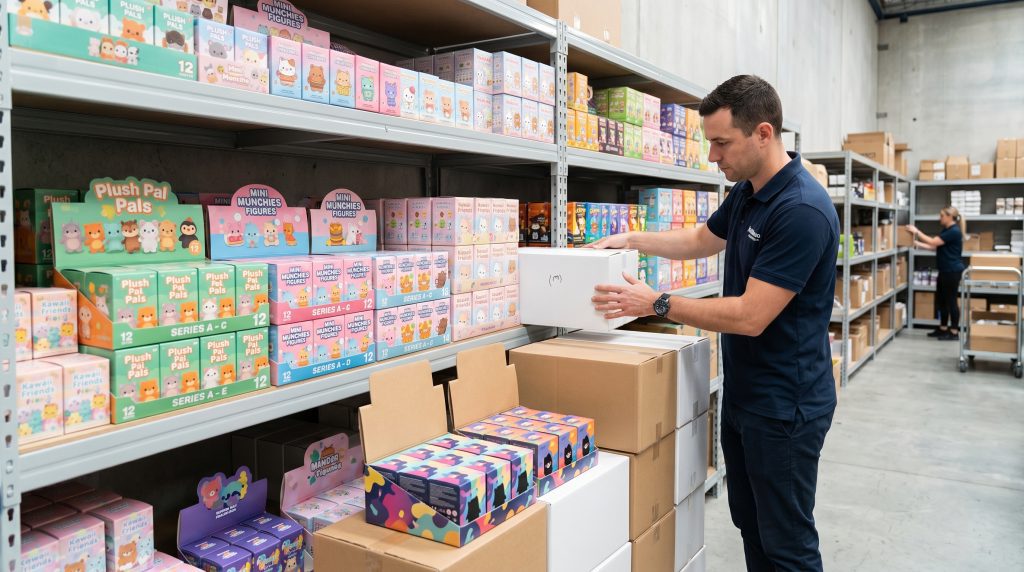
MOQ planning should include the back room, not just the sales floor. A blind box order may look manageable in value, but different products use space differently. Plush blind boxes, figure boxes, and display cartons may not occupy the same volume. Before approving an order, check whether your store can receive, sort, display, and store the mix without slowing daily operations.
Illustrative carton-volume contrast: at the same approximately USD $800 order value, plush blind boxes may take notably more carton and reserve-shelf space than compact small figure blind boxes because soft goods and larger presentations can be bulkier; treat this as a space-planning example, not a fixed specification, and confirm actual packing details for the series you quote.
Ask yourself where the order will go on arrival. Will staff break cartons into store allocations? Will some stock stay in reserve? Will displays be built immediately, or will the order arrive before a seasonal reset? These questions affect how much variety you can manage at the MOQ stage.
Shipping mode also influences how you build the first order. If speed is more important than freight efficiency, you may prioritize urgent launch items and keep the mix tighter. If you are planning farther ahead, you may be able to consider a broader or heavier assortment. For an overview of the trade-offs, compare air vs sea shipping for wholesale blind box orders before deciding how to time the order.
The key action is to align MOQ, volume, and selling calendar. Do not approve an assortment just because it reaches USD $800. Approve it because it can arrive when needed, fit your storage plan, and reach the sales floor quickly enough to generate useful data.
Use reorder signals to turn the first MOQ order into a safer second order
The first MOQ order is a test; the second order should be a response to evidence. Set up tracking before the first shipment arrives using this one-line template: per series — units received, weekly units sold, sale location, and single- vs multi-box purchase.
Track sell-through by series, not only total blind box revenue. A mixed order can look successful overall while one series is carrying the results and another is tying up cash. Also track where the sale happened. A plush blind box that sells near checkout may not perform the same on a lower shelf. A figure series that sells online may need better in-store signage to work offline.
Useful reorder signals include:
- Which series sold first without discounting.
- Which series customers asked about after stock ran low.
- Whether buyers purchased one box or multiple boxes at a time.
- Which display location produced the best conversion.
- Which products staff found easiest to explain and restock.
Use the first-order split as context when you read those signals. As a planning example, not a rule, if about $550 of an approximately USD $800 test went into casual-gift random boxes and about $250 went into a collector test, compare results against the job each portion was meant to do. A smaller collector portion may still deserve more reorder budget if it produces multi-box purchases, set-completion questions, or repeat visits.
For multi-location buyers, compare stores before reordering. A tourist gift shop, anime specialty store, and mall kiosk may need different replenishment even if they started with the same MOQ test. Your second order can then shift from broad testing to stronger depth in proven series.
Include your first USD $800 quote request details and constraints
When you are ready to source, prepare your quote request with practical details instead of only asking what is available. Include your store type, target customer, preferred product styles, whether you want plush or figures, how many locations you are stocking, and whether the order is a first test or a replenishment. Mention that you are planning around the USD $800 wholesale minimum so the assortment can be built efficiently.
A clear request helps the supplier recommend a mix that fits your MOQ without pushing you into unnecessary depth. It also helps identify whether your order should be broad for testing, focused for a known audience, or structured around a seasonal launch.
Use this checklist before submitting:
- List your buyer type: gift shop, anime store, kiosk, toy store, online seller, or chain buyer.
- State whether you want mixed series or a narrower assortment.
- Share any display limits, stockroom limits, or launch dates.
- Identify whether you prefer random boxes, sealed whole sets, or a mix.
- Ask for recommendations that fit the USD $800 minimum order value.
- Ask the supplier to confirm age-grading, small-parts or choking warnings, and destination-market labeling for the products included in the quote.
To build a first order that reaches the blind box wholesale MOQ without overcommitting to one design, send your assortment goals through the wholesale blind box quote request form and ask for a mixed-series recommendation based on your store format, stock plan, and shipping needs.
Следующие шаги: см. наш просмотреть категорию чтобы оформить заказ.

