



The pitch is intoxicating: “Rent an inline store for $10,000 a month, or rent a center-aisle kiosk for $2,500 a month and capture the exact same foot traffic.” For independent entrepreneurs entering the booming Art Toy and Blind Box industry, the mall kiosk (or cart) seems like the ultimate, low-risk retail hack.
You imagine stacking colorful Pop Mart boxes and Плюшевые игрушки Baby Three on the shelves, watching thousands of weekend shoppers stop for an impulse buy. However, commercial real estate is notoriously predatory. Operating a 150-square-foot island in the middle of a shopping mall comes with a brutal array of invisible expenses that can bankrupt a poorly capitalized business in three months.
For retail partners sourcing high-margin wholesale inventory from KidultsBox, maximizing profit requires navigating these landmines. This comprehensive B2B financial whitepaper will mercilessly expose the hidden costs of mall kiosk operations—from percentage rent traps to logistical nightmares—and provide the exact operational strategies required to survive and thrive.
1. The Lease Trap: Base Rent vs. Percentage Rent
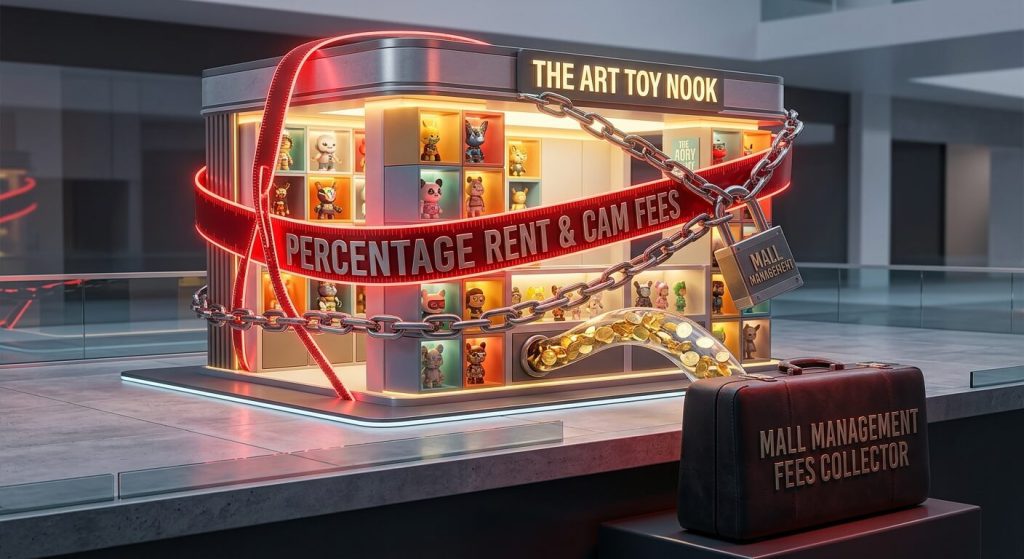
When a mall leasing agent quotes you “$3,000 a month,” they are only quoting the Base Minimum Rent. Malls operate as silent partners in your business. If you are successful, they want a cut of your gross revenue.
The “Breakpoint” Mathematics
Most premium mall kiosk leases include a Percentage Rent clause. This means you pay the Base Rent, PLUS a percentage of your sales (typically 10% to 15%) once your revenue crosses a certain threshold (the Breakpoint).
- Base Rent: $3,000 / month
- Percentage Rent: 12% over the Natural Breakpoint
- The Breakpoint Formula: Base Rent / Percentage = ($3,000 / 0.12) = $25,000
The Reality: If your kiosk has an incredible month and you sell $40,000 worth of Плюшевые игрушки Киммон and blind boxes, you don’t just pay $3,000 in rent. You pay $3,000 Base + 12% of the $15,000 you made over the breakpoint ($1,800). Your rent is now $4,800. You are penalized for high performance. This drastically eats into the gross margins of your wholesale inventory.
The CAM & Marketing Fees
On top of rent, mall management will hit you with CAM (Common Area Maintenance) fees. This covers mall security, floor waxing, and electricity. They will also force you into the mall’s “Marketing Fund.” Expect these mandatory additions to increase your monthly fixed lease cost by 15% to 25%.
2. The “360-Degree Shrinkage” Crisis (Theft)
An inline retail store has one entrance and three solid walls. You can place a security sensor at the front door. A kiosk is an open island. It has 360 degrees of vulnerability.
Blind boxes are small, lightweight, and highly desirable. They are the ultimate target for organized retail crime (ORC) and opportunistic teenagers. If you leave live, sealed boxes of Куклы BJD из серии «Penny’s Box» on the outward-facing shelves of a kiosk, a thief can grab them and disappear into the mall crowd in under two seconds while your cashier is ringing up another customer.
The Hidden Cost of Security: Labor Intensity
To prevent theft, you must implement the “Dummy Box” method (displaying only empty cardboard boxes on the shelves while keeping the live foil bags locked in drawers).
While this stops shoplifting, it introduces a massive hidden labor cost. Every time you receive a master carton from KidultsBox, your staff must spend hours carefully opening the bottoms of 144 boxes, extracting the foil bags, logging the inventory, and assembling the empty display boxes. This turns a simple “stock the shelf” task into a highly paid, time-consuming logistical operation.
3. The “No Backroom” Penalty: Storage Logistics

A kiosk has almost zero storage space. The cabinets beneath your cash register can hold maybe 2 to 3 days’ worth of inventory. When you order 10 wholesale Master Cartons from KidultsBox to prepare for a Black Friday rush, where do you put them?
| Storage Solution | The Hidden Cost | Operational Friction |
|---|---|---|
| Mall Remote Storage Closet | $300 – $600 / month | You must pay the mall to rent a concrete room in the service corridors. |
| The “Restock Run” Labor | 1 Hour of Payroll daily | Staff cannot carry 5 master cartons through a crowded mall. They must use a service cart, often only allowed during specific non-business hours (e.g., 8:00 AM before the mall opens). You are paying staff to push carts, not sell toys. |
| Off-Site Storage Unit | $150 / month + Transportation | If you run out of stock of a viral item at 2:00 PM on a Saturday, you cannot leave the kiosk to drive to a storage unit. You lose those sales entirely until the next day. |
4. The “Bathroom Break” Dilemma: Extreme Staffing Costs
If you own an inline store with a locking glass door, and your sole employee needs to use the restroom, they put a sign on the door: “Back in 15 Minutes” and lock it. You cannot lock a kiosk.
A kiosk is an open target. If an employee walks away for 5 minutes to use the mall restroom or grab a coffee, your inventory will be decimated by theft. Therefore, a kiosk fundamentally requires Double Coverage (two employees on shift at all times) or a dedicated “Floater” manager who relieves staff for breaks.
This means your payroll for a 150-square-foot kiosk will often be 1.5x to 2x higher than the payroll for a 500-square-foot closed boutique. You are paying a premium for the inability to secure the space.
5. Visual Merchandising CapEx: The Mall “Aesthetic Police”
Mall management is obsessed with sightlines and premium aesthetics. You cannot walk into a high-end mall and set up cheap wire racks and cardboard pop-up displays for your toys.
- Custom Acrylics: Malls will mandate that your displays match the aesthetic of the corridor. You will be forced to buy custom-cut, heavy-duty acrylic risers and locked glass towers to display your open sample figures. This Capital Expenditure (CapEx) can easily exceed $3,000.
- Signage Restrictions: You cannot use handwritten signs or cheap banners. Malls require professionally printed, backlit acrylic or digital LCD signage. If your marketing materials look “flea-market tier,” the mall will fine you or force you to remove them.
- The “Height Limit”: Malls strictly enforce vertical height limits on kiosks so they do not block the view of the expensive inline anchor stores (like Apple or Sephora). If you try to stack your Pop Mart inventory too high to maximize space, mall security will force you to tear it down.
6. The Survival Strategy: High Margin, High Velocity
If the hidden costs of rent, labor, and storage are so high, how do kiosk owners drive Ferraris? They understand Velocity and Average Order Value (AOV).
You cannot survive selling $5 knick-knacks. You must sell high-ticket impulse buys.
The “KidultsBox” Kiosk Matrix
- The Anchor (10% of Space): Display massive 400% or 1000% designer figures in the corners. You don’t expect to sell them daily; they act as a museum display to stop foot traffic and validate your premium branding.
- The Core Assortment (illustrative 60% of space): Model each SKU using your actual landed cost and selling price. A hypothetical $7-$9 cost and $15-$20 retail range may be useful for a scenario, but it is not a KidultsBox quote and does not guarantee a 50%+ gross margin after fees, shrinkage, discounts, and returns.
- The Impulse Add-On (30% of Space): Plush keychains (like Baby Three Macaron) and acrylic display cases. When a customer buys a blind box, your staff must aggressively cross-sell an accessory to bump the transaction from $15 to $30. This covers your labor cost.
Часто задаваемые вопросы (FAQ)
Q: Should I sign a 1-year or a month-to-month RMU (Retail Merchandising Unit) lease?
A: Never sign a long-term lease for your first kiosk. Ask mall management for a “Specialty Leasing” or “Pop-Up” contract, which is usually month-to-month or a 3-month commitment. The rent will be slightly higher, but if the foot traffic doesn’t convert into toy sales, you are not trapped in a $50,000 legal liability.
Q: How do I handle internet connectivity for my POS system?
A: This is a major hidden headache. Mall Wi-Fi is notoriously terrible and insecure. You must purchase a dedicated 5G/LTE Cellular Hotspot (like a MiFi device) and pay a monthly data plan ($40-$80/month) to ensure your Shopify or Square POS never drops a credit card transaction during a busy Saturday rush.
Q: Can I use the mall’s generic kiosk cart, or do I have to build my own?
A: Most malls provide a standard “RMU” (Retail Merchandising Unit) cart that you rent from them. However, they are blank slates. You are financially responsible for the “wrap” (the branded vinyl graphics covering the cart), the lighting upgrades, and all display shelving placed on top of it.
Q: Does KidultsBox offer dropshipping for kiosk owners to save storage space?
A: If a customer at your kiosk wants to buy a “Full Case” of a highly anticipated drop that you don’t have physical space to store, your staff can absolutely process the payment on an iPad and route the order through our B2B dropshipping portal. We will ship the master carton directly to the customer’s home, saving you premium kiosk storage space while capturing the revenue.