




In the physical retail industry, “Shrinkage” is the silent killer of businesses. Shrinkage refers to inventory that is lost due to shoplifting, employee theft, or product damage. When it comes to the Art Toy and Blind Box sector, the risk of shrinkage is exceptionally high.
Consider the math: If you operate at a 50% gross margin and someone steals a $20 Pop Mart blind box, you do not just lose $20. You have to sell two additional boxes just to recover the cost of the stolen item. For retail partners sourcing wholesale from KidultsBox, protecting your inventory is just as important as marketing it.
Blind boxes are the perfect storm for shoplifters: they are small enough to palm, lightweight, highly desirable, and incredibly easy to resell on the secondary market for cash. This comprehensive loss prevention whitepaper will teach you how to harden your store’s defenses, implement anti-theft merchandising, and stop “Box Weighing” scalpers from destroying your stock.
1. The Anatomy of Toy Theft: Understanding the Threat
To secure your store, you must understand how and why inventory disappears. In the art toy world, you are defending against three distinct types of loss:
- The Opportunistic Shoplifter: Usually teenagers or casual customers who see a blind box tucked away in a blind spot and slip it into their pocket on an impulse.
- The Organized Retail Crime (ORC) Reseller: Professional thieves who target highly hyped IPs (like the Baby Three Macaron series or Labubu). They steal in bulk with the explicit goal of flipping the sealed boxes on eBay or local marketplaces.
- The “Damage” Shrinkage (The Squeezer): This is unique to blind boxes. Overzealous collectors will squeeze, crush, and aggressively shake the cardboard boxes trying to guess the figure inside. Even if the product isn’t stolen, a crushed box is considered “damaged goods” and cannot be sold at full retail price, resulting in a direct financial loss.
2. Strategy 1: The “Dummy Box” Display Method (The Platinum Standard)
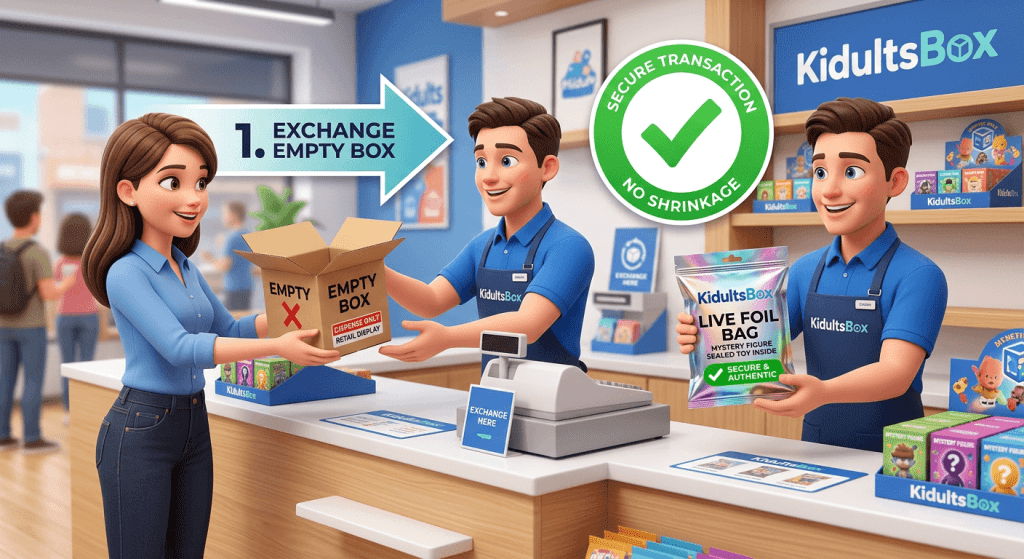
If your store suffers from high foot traffic but low staff counts, leaving live, sealed blind boxes on open shelves is a major risk. The absolute most effective loss prevention tactic in the industry is the “Dummy Box” (Display Only) Method.
Security Insight: How the Dummy Box Works
When you receive a wholesale carton from KidultsBox, do not put the live boxes on the floor. Instead, carefully slit the bottom tape of the blind boxes. Remove the sealed foil bag containing the toy and the ID card. Store the live foil bags in organized, numbered bins behind your cash register. Place the empty cardboard boxes back on the retail shelves.When a customer wants to buy a toy, they bring the empty box to the counter. The cashier takes the empty box and hands them the live, sealed foil bag in exchange after payment.
This method completely eliminates shoplifting. If a thief steals an empty box, you lose zero dollars in actual inventory.
| Merchandising Method | Theft Risk | Customer Experience (Friction) | Labor Required |
|---|---|---|---|
| Live Open Shelving | Extreme (Easy to pocket) | Excellent (Customers love shaking/feeling the weight) | Low (Just unpack and stack) |
| Locked Glass Cabinets | Zero | Poor (Customers must ask staff to unlock, killing impulse buys) | Medium (Staff must constantly assist shoppers) |
| The Dummy Box Method | Zero (Boxes are empty) | Good (Customers can hold the box, but lose the “weight” guessing game) | High (Staff must empty boxes and organize foil bags behind counter) |
3. Strategy 2: Spatial Security & The “Zone Defense”
If you choose to keep live inventory on the floor, your store layout is your first line of defense. Shoplifters seek out “Blind Spots”—areas where employees or cameras cannot see them.
The “Power Wall” Placement
Your primary Blind Box display should never be in the back corner of your store. Move your high-value Куклы BJD and Pop Mart series to a “Power Wall” located within 10 to 15 feet of the Point of Sale (POS) counter. The cashier must have an unobstructed, direct line of sight to the blind boxes at all times.
Eliminate the “Tunnel Effect”
Do not create high, narrow aisles. Keep middle-floor display racks at a maximum height of 4 feet (chest height). If your fixtures are 6 feet tall, they create tunnels where shoplifters can hide. By keeping center fixtures low, a single employee standing at the register can scan the entire store.
Strategic Mirrors
Convex mirrors placed in the top corners of your store are cheap and highly effective. Not only do they let staff see around corners, but they also act as a psychological deterrent. Shoplifters look for cameras and mirrors; if they see them, they usually move on to an easier target.
4. Strategy 3: Stopping the “Box Weighers” and Squeezers
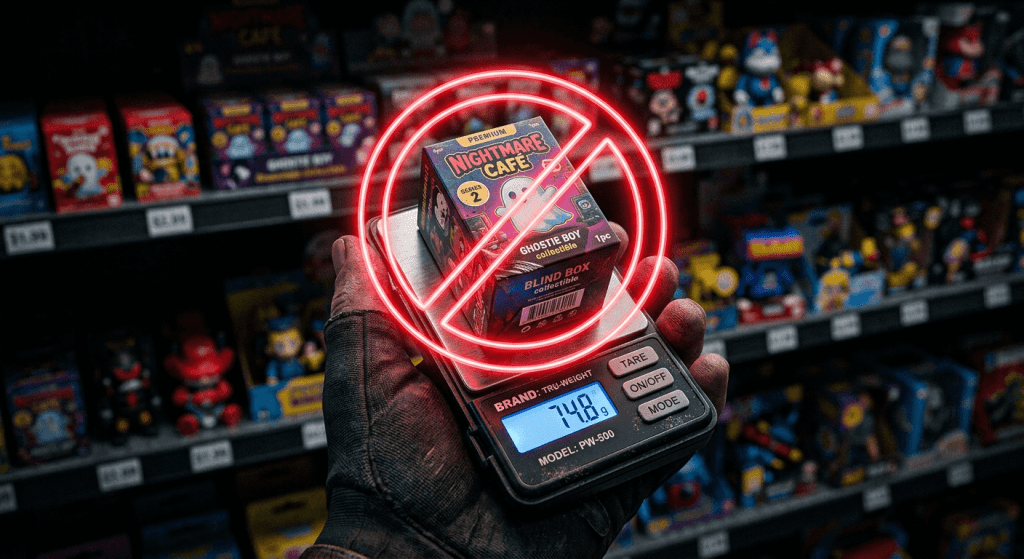
In the blind box community, there is a subculture of “Box Weighers”—collectors (and scalpers) who bring digital pocket scales into retail stores to weigh boxes down to the gram to find the “Secret” chase figure. There are also “Squeezers” who crush the box to feel the shape of the plastic inside.
Why this hurts your business: If a scalper weighs your entire stock and buys only the Secret figures, your remaining inventory becomes “dead.” Regular customers will realize your store has been “weighed out” and will stop buying from you, knowing they have a 0% chance of pulling a rare figure.
How to stop it:
- The “No Scales” Policy: Post clear, polite signage on your blind box wall: “To keep the mystery alive and fair for all collectors, the use of digital scales is strictly prohibited in this store.” Train your staff to enforce this politely but firmly.
- The “Break It, Buy It” Enforcement: For squeezers, staff must intervene immediately using Aggressive Hospitality (see below). If a customer crushes a box, the store manager must require them to purchase the damaged item.
- Shuffle the Stock: Frequently mix up the blind boxes on the shelf. Do not leave them in their original 12-box manufacturer layout. If you shuffle them, it disrupts the “box mapping” formulas that scalpers use to locate specific figures.
5. Strategy 4: Technological Deterrents (RFID & EAS)
If you operate a larger retail space where staff cannot watch everyone, Electronic Article Surveillance (EAS) is mandatory.
The Challenge with Art Toys
You cannot use standard “Spider Wraps” or hard plastic security tags on a blind box—they will crush the cardboard and ruin the collectible aesthetic.
The Solution: Micro-RFID / AM Labels
Purchase flat, adhesive AM (Acousto-Magnetic) or RF (Radio Frequency) security stickers. Do not stick them directly onto the front box art. This infuriates collectors who like to keep pristine boxes.
Instead, slice the bottom tape of the box, slip the security sticker внутри the box (attaching it to the inner foil bag), and carefully re-tape the bottom. Alternatively, stick the label on the absolute bottom of the box, covering the barcode. If a thief tries to walk out the front door, the security gates will alarm.
6. Strategy 5: “Aggressive Hospitality”
The number one deterrent to retail theft is not a camera; it is a highly attentive employee. Shoplifters want to remain anonymous. If you take away their anonymity, they will leave.
Train your staff in Aggressive Hospitality. When a customer lingers at the blind box wall for more than 2 minutes, or starts excessively shaking boxes, the staff member should immediately approach them.
The Script:
“Hi there! I see you’re shaking the Kimmon Flower series! Are you looking for the rare Rose figure? I felt one earlier that rattled a lot. Let me hold those boxes for you at the counter while you keep browsing!”
Why this works:
1. It tells the thief: “I see you, I know exactly what you are holding, and I am watching you.”
2. It provides excellent customer service to legitimate shoppers.
3. By offering to hold the items at the register, you physically remove the high-value item from the customer’s hands, eliminating the opportunity for them to pocket it.
Часто задаваемые вопросы (FAQ)
Q: How do I handle a customer who crushes a box but refuses to buy it?
A: Avoid physical confrontation. Remain calm. Inform them that due to the collectible nature of the item, damaged packaging makes it unsellable. If they refuse to pay, ask them to leave the store and do not welcome them back. Note their description for your staff. The cost of one crushed box is less than the legal liability of a physical altercation.
Q: Should I put security cameras directly above the toy section?
A: Yes. Place a visible, high-definition dome camera directly over the blind box aisle, paired with a public “Recording in Progress” monitor. Thieves often look up before stealing; seeing themselves on a TV screen is a massive deterrent.
Q: Do Dummy Boxes ruin the unboxing experience?
A: Not if handled correctly! When the customer buys the toy, hand them the sealed foil bag inside a fresh, pristine cardboard box from behind the counter. They still get to rip open the foil and experience the surprise.
Q: If I suspect someone has a box in their pocket, what can I do?
A: Retail laws vary by region, but generally, you cannot physically detain someone or accuse them of theft without 100% certainty (continuous line of sight). The best approach is the “Recovery Statement”: Approach them and say, “Hi, I noticed you had the Pop Mart figure earlier. Did you want me to ring that up for you at the front?” This gives them a face-saving way to hand it over without admitting theft.
Secure your profits and source with confidence. Ready to stock your highly-secured store with the best-selling toys on the market? Contact KidultsBox today for a wholesale quote.