

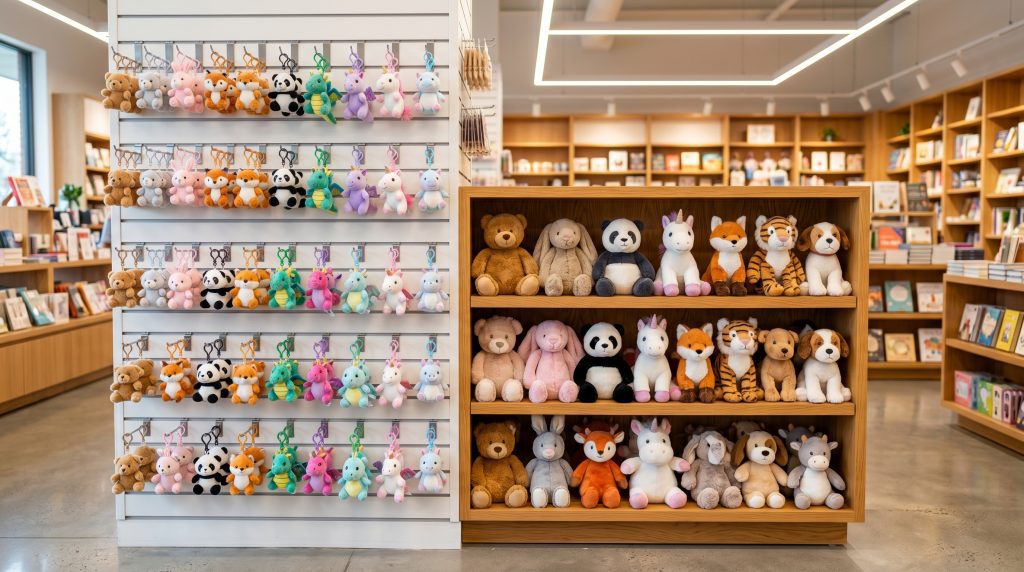
Before a buyer chooses any plush format, the working decision is practical: how much shelf space can the store commit, how fast must the item turn, and should the plush act as an impulse add-on or a main gift purchase? A checkout counter, mall kiosk, feature table, and destination gift wall all need different inventory behavior. The best wholesale choice is usually not one format only, but a planned mix where each format has a clear selling job.
This guide focuses on B2B sourcing decisions: when to buy plush keychains, when to buy plush dolls, how to think about MOQ and carton logic without overcommitting, and how to brief your wholesale supplier before placing a purchase order. For broader category planning, retailers can also review the Руководство по оптовой покупке «блайнд-боксов» and compare plush formats in the Категория «Оптовая продажа плюшевых игрушек в коробках-сюрпризах».
Compare shelf-space roles for plush keychains and plush dolls before buying
| Buyer decision | Plush keychains | Plush dolls |
|---|---|---|
| Best retail role | Better for impulse add-ons, checkout baskets, bundles, and small display footprints | Better for giftable purchases, feature displays, and customers seeking a larger collectible item |
| Space efficiency | Higher unit density in bins, hooks, counter trays, and kiosk walls | Requires more shelf depth, table space, or display bins per unit |
| Basket-building use | Strong as a low-friction add-on with stationery, blind boxes, snacks, or anime accessories | Strong as the central item in a gift set or themed display |
| Assortment risk | Easier to test more characters in smaller display zones | Needs tighter character selection because each style occupies more space |
| Shipping and storage | Usually more compact per unit, better for small backrooms and kiosk replenishment | Bulkier carton planning and more attention to warehouse storage are needed |
| Visual impact | Works best when grouped by series, color, or hook display | Higher impact as a window, endcap, or seasonal gift display item |
Start by mapping each format to a selling job. If the product must live near the register, fit on peg hooks, or support small-ticket upsells, plush keychains are usually easier to test. If the product needs to anchor a display table, create a stronger gift impression, or attract customers from a store entrance, plush dolls usually perform the merchandising job better.
The comparison should also include handling. Keychains are touched, clipped, and compared quickly, so hardware quality, stitching, and hangtag durability matter. Plush dolls are picked up, squeezed, and judged on face embroidery, softness, stuffing consistency, and presentation. A buyer should request samples or clear product photos before scaling either format.
How to assign plush keychains to checkout baskets, kiosks, and add-on bundles
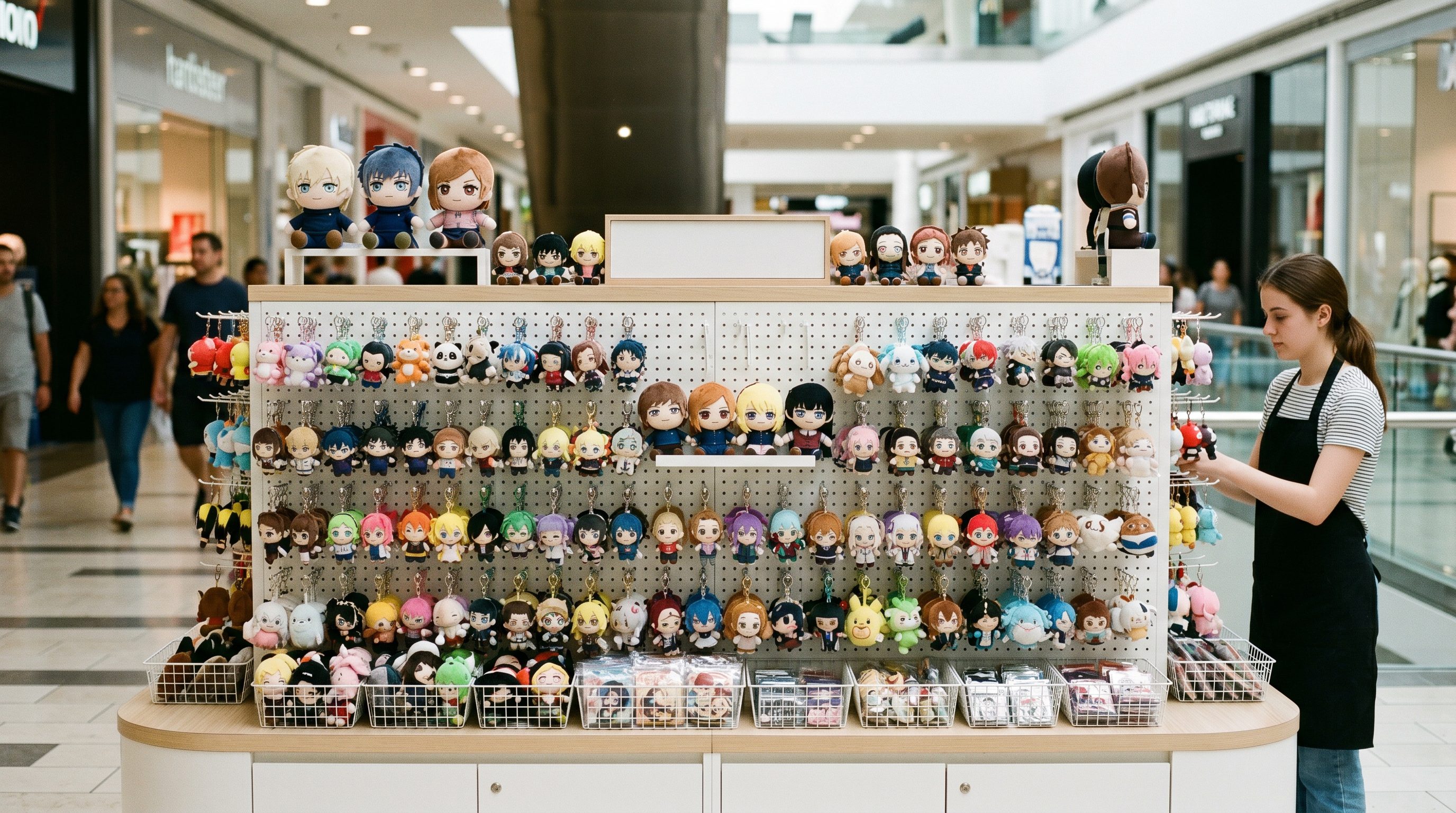
Buy plush keychains when your main goal is to increase attachment rate without asking the customer to make a large shelf-space decision. Anime stores can place character keychains near manga, trading cards, and blind box checkout areas. Gift shops can pair them with greeting cards, tote bags, water bottles, and small novelty items. Mall kiosks can use them as fast-moving items because they are easy to browse, easy to restock, and easy for staff to demo by clipping onto bags or lanyards.
For sourcing, ask your supplier how the keychains are packed: individually bagged, boxed, tagged, or bulk packed. This affects labor at receiving. A kiosk may prefer ready-to-display packaging because staff has limited setup time. A gift shop with more backroom capacity may accept simpler packing if it reduces waste and keeps replenishment easy. Do not assume all plush keychains come with the same clasp, chain, or ring style. Confirm whether the attachment is suitable for daily handling because weak hardware can turn a cute item into a return issue.
Keychains are also useful for blind box assortments because customers often accept smaller duplicates more easily than large duplicate plush dolls. If you are building a surprise assortment, decide how many characters, colors, or expressions should be in the mix before you commit to a replenishment cycle.
When comparing plush keychains vs plush dolls for a small store, the keychain advantage is flexibility. You can test several character families in a narrow area, then reorder the lines that move. The main risk is visual clutter. Avoid dumping unrelated styles into one bin unless your store sells treasure-hunt merchandise. For branded-looking retail, group by theme, license style, animal type, color palette, or character mood.
Choose plush dolls for giftable display volume and feature tables
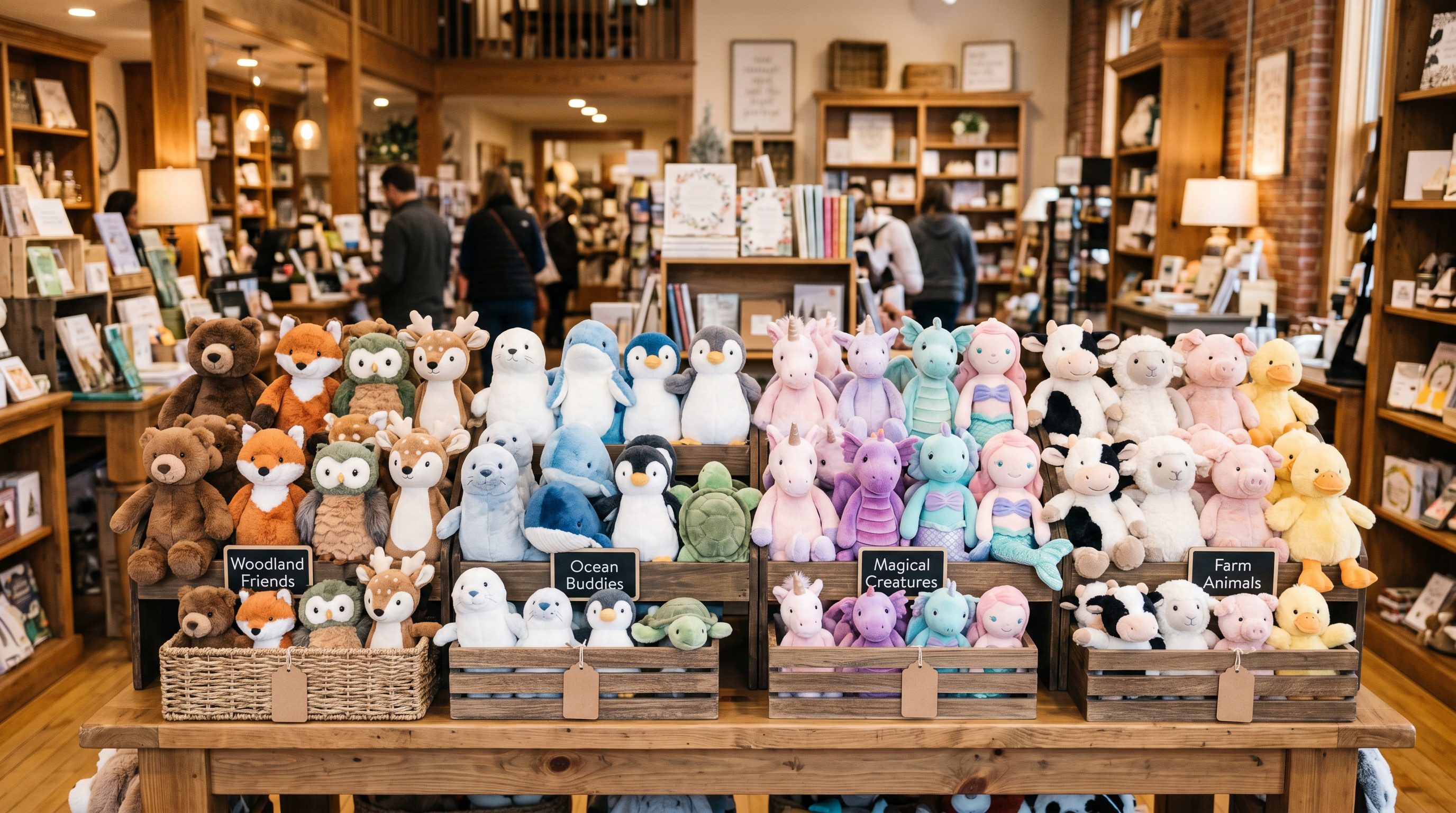
Buy plush dolls when the product must read as a gift, not only an accessory. Tourist gift shops, toy stores, bookstores with children’s sections, and lifestyle stores can use plush dolls to create emotional display value. A larger plush item is easier to feature in a window, on a table, or at the top of a shelving unit. It gives staff a stronger visual anchor when building seasonal stories around birthdays, holidays, school breaks, or fandom events.
The sourcing decision is more selective because plush dolls consume more cubic space. Before placing a wholesale order, decide which characters or animal types deserve larger inventory positions. A store should not simply order every available design in the same depth. Use stronger depth for proven characters and lighter test quantities for new expressions, variants, or seasonal colors. If the supplier offers assorted cartons, ask how the assortment is balanced and whether slower characters can be minimized in future orders.
Plush dolls also need a cleaner display plan. If your store has deep shelves, larger plush can sit upright and create a soft wall of product. If your store relies on narrow fixtures, plush dolls may slump or hide face details unless supported by bins or risers. Buyers should check product dimensions and carton packing style before committing, especially if the item will ship to multiple stores with different fixtures.
For stores that experience seasonal demand swings, plan plush dolls earlier than keychains because bulky inventory is harder to absorb at the last minute. Separate always-on characters from event-driven designs so a holiday table, tourist season display, or convention weekend does not depend on the same replenishment assumptions as the checkout add-on wall.
Set format-level MOQs, carton checks, and reorder triggers before replenishment
A common wholesale mistake is to plan plush inventory character by character while ignoring format. For B2B purchasing, first split the buy into keychain inventory and doll inventory. Each format has different storage pressure, display density, and reorder timing. Ask for MOQ, inner pack, master carton, carton dimensions, and assortment rules for each format separately. Do not assume the MOQ for plush keychains will match plush dolls, and do not assume carton efficiency is similar.
For keychains, reorder points can often be tighter because the format is compact and easier to replenish into small display areas. This makes them useful for stores with limited backroom space. However, if the keychains are part of a blind assortment, running out of popular designs can weaken the series quickly. Track sell-through by series or theme, not only total units, so replenishment reflects actual customer demand.
For plush dolls, reorder points should consider display gaps. A half-empty plush display looks weaker than a half-empty peg wall of keychains. If the doll line is a main visual attraction, buyers may need to reorder before the last units sell. At the same time, over-ordering large plush can tie up storage. The practical action is to set a minimum display quantity for each selling area, then order enough to maintain that presentation without overfilling the backroom.
Hypothetical reorder rule for plush dolls, example only: if a feature table is planned to hold about 12 plush dolls, a buyer might review replenishment before the table drops below about 8 units, then adjust the actual reorder to the supplier’s confirmed MOQ, carton pack, and the store’s real sell-through. This is not a universal MOQ or lead-time rule; it is a display-protection rule that keeps the table from looking picked over.
If you operate multiple stores, do not allocate the same ratio to every location. A mall kiosk may sell more plush keychains because customers are moving quickly and carrying purchases around. A destination gift shop may sell more plush dolls because visitors are intentionally buying gifts. A college-town anime shop may need keychains near the register and a smaller number of plush dolls for collectors who want display pieces.
To avoid guessing at carton burden, buyers can request format-specific MOQ, carton, and assortment details before placing a purchase order. Share whether you are buying plush keychains, plush dolls, or both, and include your store type, fixture limits, and preferred assortment style.
Build channel-specific mixes for anime stores, gift shops, and mall kiosks
Different retail channels should make different plush keychains vs plush dolls decisions. Anime stores should start by matching the format to fandom behavior. Keychains work well for customers who want to attach characters to bags, Ita bags, keys, phone straps, or backpacks. Plush dolls work better for collectors who display characters at home or buy gifts for friends in the same fandom. For anime stores, the action is to build a layered assortment: keychains for frequent add-ons and plush dolls for feature shelves.
Gift shops should focus on broad appeal and gifting clarity. Animal plush, food-themed plush, seasonal mascots, and soft pastel designs are often easier to sell to customers who do not know a specific character universe. Keychains can be placed next to mugs, stationery, and souvenirs. Plush dolls can sit in a baby, birthday, travel, or holiday zone. The buyer should select fewer themes and give each theme enough presence to look intentional. Gift-shop theme-depth heuristic, example only: before adding another theme, give the current theme at least a couple of visible facings so shoppers can understand the story rather than seeing one isolated plush.
Mall kiosks and pop-up stands should treat space as the main constraint. Keychains usually earn their place because they create variety in a small footprint. Plush dolls should be chosen only when they are visually strong enough to pull traffic from the aisle. If a doll does not improve the kiosk’s visibility, it may be better to stock more compact formats. For kiosks, ask the supplier whether cartons can be opened and replenished easily, because staff often needs to restock during selling hours.
Bookstores, museum shops, and lifestyle boutiques may use plush dolls more selectively. In these settings, the plush item must match the store’s curation. A small, elegant keychain may fit a lifestyle counter better than a large plush wall. A museum shop may prefer animal or educational themes. A children’s boutique may prefer plush dolls with gentle colors and soft presentation. The buying action is to match the format to store identity, not just to supplier availability.
Verify plush keychain hardware, hangtags, carton volume, and assorted-plush substitutions before the PO
Before issuing a purchase order, create a supplier checklist for both formats. Confirm the details that affect receiving labor, fixture planning, and customer handling:
- Product size for each plush keychain and plush doll format
- Outer material description and filling type
- Keychain hardware type, such as clasp, chain, ring, or strap style
- Hangtag, barcode label, polybag, box, or other retail packaging format
- Inner pack, master carton configuration, and carton dimensions
- Assortment breakdown by character, animal type, color, expression, or series
- Whether the goods are available as open stock, mixed assortment, or both
- Real packing photos showing how the goods are packed before shipment, not only studio product images
Shipping logic matters because plush is light but can be bulky. Plush keychains generally help buyers maintain variety with less storage pressure. Plush dolls require more attention to carton volume, fixture capacity, and warehouse handling. If you are shipping to several retail locations, ask whether orders can be packed by store allocation or whether your warehouse must break cartons after arrival. The right choice depends on your labor capacity, not only product preference.
Also confirm how substitutions are handled in assorted plush programs. Define an acceptable swap in concrete terms before the order is packed. For a broad gift-shop animal assortment, an acceptable substitution might mean the same animal type within the same size band, such as one small bear design replacing another small bear design. For a named character, limited series, or fandom-specific display, use a no-swap rule unless the exact character is approved by the buyer. Clear substitution rules protect both the supplier and the retailer.
Finally, align your purchase order with your merchandising calendar. If the items are for a new store opening, convention weekend, tourist season, or holiday table, separate must-have styles from flexible add-ons. Plush keychains can often support quick variety, while plush dolls should be prioritized for the displays that need the strongest visual impact. Buyers comparing character-heavy plush formats can also review related BJD and MJD plush blind box options when the assortment needs a stronger collector angle.
Need help deciding the right plush keychain and plush doll mix for your store type, display space, and replenishment plan? Send your target buyer profile, store format, and preferred assortment style so the sourcing team can help you plan a practical retail-ready plush assortment.
Следующие шаги: см. наш просмотреть категорию чтобы оформить заказ.