



In a physical retail store, the checkout counter (or “Cash Wrap”) is historically misunderstood by amateur shop owners. They view it merely as an administrative checkpoint—the place where the transaction ends. In reality, the checkout counter is the most lucrative 3 square feet in your entire store. It is where the transaction multiplies.
When a customer places a Слепая коробка Pop Mart on your counter and pulls out their credit card, a profound psychological shift occurs in their brain. Their buying resistance drops to zero. They have already committed to spending money; the metaphorical wallet is open. In this highly vulnerable, euphoric state of anticipation, adding a $10 accessory to a $20 order requires almost zero cognitive effort.
For independent toy boutiques and B2B partners sourcing high-margin inventory from KidultsBox, optimizing the Point of Sale (POS) area is the fastest way to increase your Average Order Value (AOV) by 30% to 50%. This deep-dive neuromarketing whitepaper will deconstruct the science of “Ego Depletion,” the spatial architecture of the queue, and the exact upselling scripts your staff must use to monetize the final seconds of the shopping journey.
1. The Neuroscience of the Impulse: Why We Buy at the Register
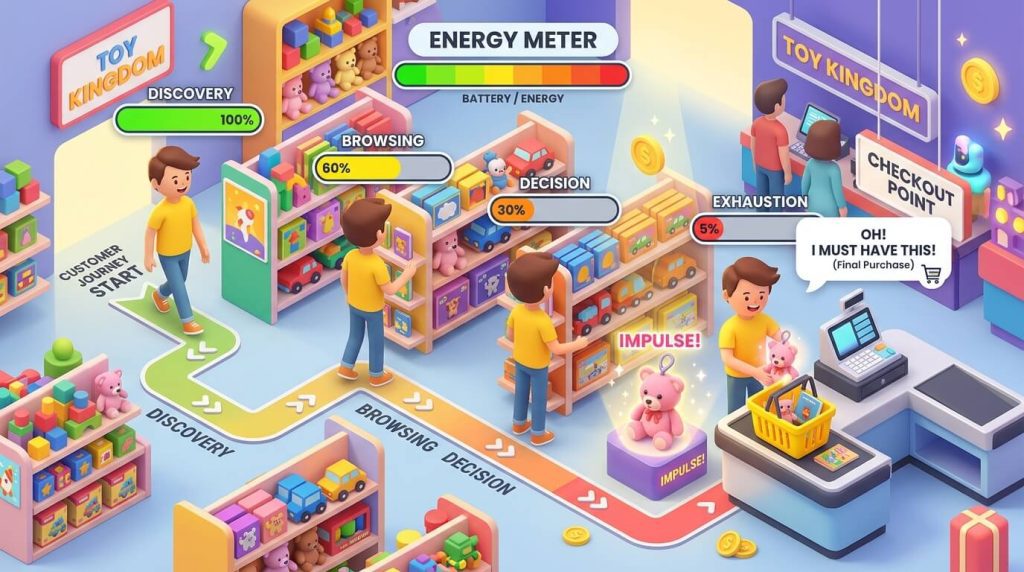
To design a highly profitable checkout counter, you must first understand the biological hardware of your customer. Why do people who agonize over a $15 purchase in the aisle suddenly throw a $10 plush keychain onto the counter without thinking?
The “Ego Depletion” Theory
In psychology, willpower and decision-making are treated like a muscle. When a customer walks through your store, they are making hundreds of micro-decisions: “Should I buy the Baby Three Macaron or the Kimmon Flower series? Should I buy one box or a full case? Can I afford this?”
By the time they reach the cash register, their decision-making muscle is exhausted. This is called Ego Depletion. They no longer have the mental energy to weigh the pros and cons of a purchase. If you place a cute, low-ticket, high-value item directly in front of them while they wait for the credit card terminal to beep, their brain takes the path of least resistance: “Sure, why not. Add it to the total.”
The “Open Wallet” Dopamine State
The second factor is dopamine. Buying a blind box is an act of anticipation. The customer is already experiencing a neurochemical high, imagining pulling the ultra-rare “Secret” figure. They are in a state of self-reward. An impulse buy at the register feels like an extension of that reward, rather than an additional cost.
2. Spatial Architecture: Designing the “Serpentine” Queue
If your checkout line is a straight shot to the register, you are failing. You must design the queue to maximize “Dwell Time” (the amount of time a customer is forced to stand near unpurchased merchandise).
Large retailers like Sephora and TJ Maxx use the Serpentine Queue (a winding, maze-like line bounded by low shelves). While you may not have the square footage of a department store, you can replicate the psychology.
- The Choke Point: Use a double-sided acrylic fixture to guide customers into a single-file line leading to the register. Force them to walk through the merchandise to pay.
- The “Right-Hand” Bias: Studies show 90% of consumers are right-handed and will naturally look and reach to their right. Place your highest-margin impulse items on the right side of the checkout queue.
- The 60-Second Trap: The ideal wait time in line is 60 to 90 seconds. If it is faster, they won’t look at the impulse items. If it is slower, they get angry. Use clear, bright signage to hold their attention during this exact window.
3. The Impulse Merchandising Matrix: What to Stock at the POS

You cannot put a massive $200 1000% MEGA figure at the cash register and expect an impulse buy. Impulse items must meet three criteria: Low Price Point, High Margin, and Immediate Utility.
Here is the KidultsBox optimized inventory matrix for your cash wrap.
| Категория продукта | The Psychological Hook | Estimated Retail Price | Why It Converts at the Register |
|---|---|---|---|
| Acrylic Display Cases (Single/Stackable) | Protection / Utility. “I just spent $20 on a toy, I need to protect it from dust.” | $8.00 – $15.00 | It solves an immediate problem created by the main purchase. The cross-sell is totally logical and feels responsible to the buyer. |
| Plush Keychains / Bag Charms | Instant Gratification. The “Pain Bao” (Ita-bag) trend. | $12.00 - $18.00 | Highly tactile. Customers waiting in line will pick them up to feel the fur (e.g., Kimmon plushies). Once they touch it, the Endowment Effect makes them want to keep it. |
| “Bean” or Micro Blind Boxes | The “One More Try” Gamble. | $5.00 – $8.00 | Priced under $10, these bypass the brain’s financial defense mechanism. “It’s only five bucks, throw it in.” |
| Sticky Nano-Tape / Display Putty | Utility / Deskterior. “How will this stand on my car dashboard?” | $3.00 - $5.00 | Incredibly high margin (often costs cents wholesale). Perfect upsell for Куклы BJD or top-heavy vinyl figures. |
4. Pricing Hacks: Anchoring and The “Bundle Completion”
How you price the items at the register determines how fast they move. You must use Relative Pricing.
The Price Anchor Effect
If a customer is buying a sealed “End Box” (Full Case) for $150, a $15 acrylic display case feels mathematically insignificant. It is only 10% of their total order. However, if they are only buying a $10 keychain, a $15 display case feels outrageously expensive.
The Tactic: Place high-tier accessories near the register, but always have a “Decoy” low-tier item (like a $3 blind box pin or sticker pack). The $3 item makes the $15 item look like a “medium” purchase rather than a “maximum” purchase.
The “Free Shipping” / Discount Threshold
If you run a hybrid O2O (Online to Offline) store or a Shopify POS, use threshold psychology. If you offer a promotion stating “Spend $50 and get a free tote bag,” and the customer is at $42, the cashier should point to the $8 micro-blind boxes on the counter.
The customer views the $8 impulse buy not as an expense, but as the “key” to unlocking the free $15 tote bag. It is a psychological win for them, and a margin win for you.
5. The Cashier’s Playbook: The Final Close Scripts
Your employees are the final catalyst. A silent cashier is a massive financial liability. You must train your staff to execute the “Assumptive Cross-Sell” without sounding like a pushy used-car salesman.
Here are three mandatory scripts for your checkout staff:
Scenario 1: The Protection Upsell (High Conversion)
Customer places a Pop Mart Skullpanda on the counter.
Cashier: “Awesome choice! Are you going to display this on your desk or a shelf at home?”
Customer: “On my desk!”
Cashier: “Perfect. Just a heads up, the matte finish on these attracts dust pretty quickly. Did you need to grab one of these UV-protected acrylic cubes to keep it mint? They’re only $12 and they stack magnetically.”
Scenario 2: The “Trading Board” Engagement
Customer buys two blind boxes.
Cashier: “Good luck on your pulls! Are you hoping for the Secret figure?”
Customer: “Haha, yes, but I’ll probably just get duplicates.”
Cashier: “Well, if you open them here at our Unboxing Station and get a duplicate, we have an active Trading Board right behind me. You can swap it for any open figure on that wall today!”
Scenario 3: The “Full Case” Upgrade (Whale Hunting)
Customer places 4 or 5 boxes of the same series on the counter.
Cashier: “You’re going deep on the Baby Three series! You know, since you’re already getting five, if you grab the full sealed case of 8, I can guarantee you won’t get any duplicates, and you get a fresh chance at the hidden Chase figure. Want me to just grab you a sealed box from the back?”
6. Visual Merchandising: Avoiding the “Junk Drawer” Aesthetic
A major risk of stocking the checkout counter is that it quickly begins to look like a messy gas station counter, full of cheap lighters and gum. This destroys the premium boutique vibe of an Art Toy store.
The “Clean Wrap” Protocol:
1. No Cardboard Dump Bins: Do not use cheap, torn cardboard display trays sent by generic factories. Invest in thick, custom-cut clear acrylic tiered displays for your impulse items.
2. Negative Space: Leave at least 30% of your counter space completely empty (clean wood or marble). The customer needs a clean, respectful space to put their wallet down and sign the receipt. If the counter is overwhelmingly cluttered, it induces anxiety, which kills the impulse to buy.
3. The “Open Sample” Rule: Just like your main wall, impulse items must have an unboxed, touchable sample. If you are selling a $15 plush keychain, sacrifice one to leave on the counter so customers can pet the fur while they wait.
7. The “Unboxing Station” as an Impulse Driver
As detailed in our Unboxing Station Strategy Guide, placing the unboxing area adjacent to the cash register creates a feedback loop of impulse buying.
When a customer pays, moves two feet to the left, rips open the box, and groans because they didn’t get the figure they wanted, they are still within arm’s reach of the register. The friction to buy “just one more” is essentially zero. They will often turn right back to the cashier and say, “Ring me up for another one.”
If the unboxing station was near the exit or outside the store, they would simply leave. Proximity equals revenue.
Часто задаваемые вопросы (FAQ)
Q: Should I put high-value “Secret” figures at the register?
A: Yes, but strictly as a visual “Trophy” inside a locked, illuminated glass case. A $150 Secret figure is rarely an impulse buy, but seeing it at the register validates the customer’s decision to buy the $15 standard boxes. It proves that “winning is possible” at your store.
Q: How do I handle a busy queue when trying to upsell?
A: Efficiency is key. If there is a line of 10 people out the door, drop the long upsell scripts. Switch to the “Point and Nod” method. Simply tap the acrylic display box on the counter and say, “Need a case for that?” while scanning the item. Never sacrifice the speed of the line for a $10 upsell, or you will lose the main customers waiting.
Q: Does KidultsBox supply low-ticket impulse accessories?
A: Absolutely. Alongside our core premium blind boxes, KidultsBox supplies high-margin, low-ticket items like acrylic museum cubes, miniature diorama props, and plush blind box pendants designed specifically to maximize your checkout counter ROI.
Q: Are “Gift Cards” good impulse items for toy stores?
A: Excellent! High-quality, thick plastic gift cards placed right at the register sell incredibly well during Q4/Holidays. Art toys are difficult to buy for other people because you don’t know what they already have. A gift card solves the gift-giver’s anxiety perfectly.