





In the art toy retail sector, selling a standalone blind box captures the initial transaction, but outfitting that toy captures the long-term lifetime value (LTV) of the collector. The explosive rise of highly articulated 1/12 scale BJD (Ball-Jointed Dolls) and dressable plush blind boxes has created a massive, high-margin secondary market: Miniature Accessories.
Based on point-of-sale (POS) data, customers who purchase customizable art toys exhibit a 40% to 60% higher propensity to add complementary accessories to their cart if they are merchandised effectively. In this B2B sourcing guide, we will break down the financial leverage of miniature props, how to navigate scale compatibility (1/12 vs. 20cm plush), and the visual merchandising strategies required to turn low-cost accessories into your store’s primary profit engine.
The Financial Leverage of Miniature Accessories
Why should a retailer dedicate valuable shelf space to tiny pairs of plastic glasses, miniature backpacks, or 1/12 scale weaponry? The answer lies in the Gross Margin Return on Investment (GMROI).
Standard blind boxes generally yield a 45% to 55% gross margin. Miniature accessories, however, operate on a highly accelerated markup structure. A tiny pair of acrylic doll glasses might cost $1.50 wholesale but can easily retail for $6.99 to $8.99—a 75%+ gross margin. Because these items have a microscopic physical footprint, you can stock hundreds of units on a single countertop spinner rack. Accessories are the ultimate “basket builders,” effortlessly driving up your Average Order Value (AOV) without requiring the customer to deliberate over another $20 primary purchase.
Sourcing by Scale: Compatibility is King
The most common operational failure when sourcing accessories is scale mismatch. If a customer buys an accessory that does not fit their figure, they will return it, destroying your margin through labor costs. Wholesale buyers must strictly categorize accessory purchases by scale and form factor.
1. The 1/12 Scale Ecosystem (BJD & MJD)
This category targets the premium collector. 1/12 scale figures (roughly 4 to 5.5 inches tall) require highly detailed, rigid accessories. When sourcing for this demographic, focus on:
- Magnetic & Pegged Props: Angel wings, demon tails, or weaponry that utilize internal magnets or standard 3mm ABS pegs to attach to the doll’s back.
- Micro-Clothing: Tiny cloth jackets, maid dresses, and hats. Ensure you source items specifically labeled for 1/12 scale “fat body” (OB11 style) figures, which is the standard proportion for most Asian art toy BJDs.
2. The “Dress-Up Plush” Ecosystem (10cm – 20cm)
As noted in our trend report on plush blind box keychains and figures, customizable plush is dominating the market. Collectors frequently buy “naked” plush figures and purchase separate “clothing blind boxes” to outfit them.
- Plush Apparel: Sourcing wholesale lots of 10cm, 15cm, and 20cm plush clothing (hoodies, overalls, goggles) is currently one of the highest-velocity retail strategies. These are highly tactile and heavily gifted items among Gen Z consumers.
Visual Merchandising: The “Dressed Model” Upsell

Accessories absolutely will not sell if they are piled into a bin or left in opaque packaging. Customers lack the spatial imagination to know if a tiny hat will look good on their figure. You must show them.
The Retail SOP: Never display a “naked” BJD or plush display model. Taking a page from miniature diorama cross-merchandising, you must dress your anchor display models in the accessories you wish to sell.
If you have a popular plush blind box on display, put a $7 miniature pair of aviator goggles and a tiny leather jacket on it. Place the sealed accessory boxes directly next to the display model. When a customer says, “I want the plush toy,” the cashier is trained to respond: “Great choice! Do you want to add the aviator goggles and jacket to complete the look? We only have a few sets left.” This “Dressed Model” strategy transforms an abstract accessory into an immediate, must-have upgrade.
Managing Accessory Shrinkage and Vertical Displays
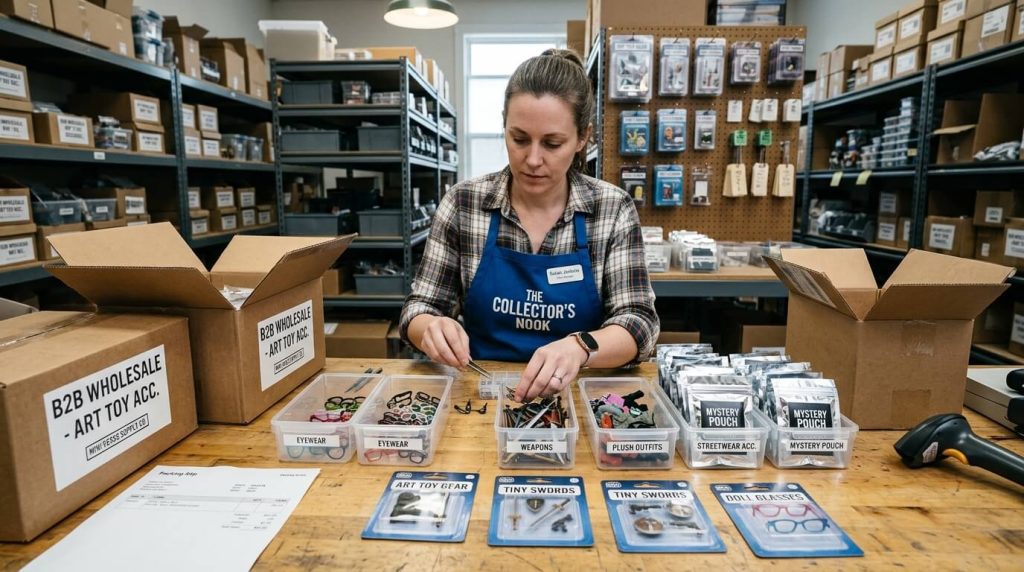
The primary hazard of stocking miniature accessories is shrinkage (theft). A 1-inch pair of doll sneakers is incredibly easy to slip into a pocket.
To combat this, utilize vertical hanging displays and pegboards located specifically in the high-visibility POS zone. Sourcing accessories that come in blister packs with Euro-hole hang tabs allows you to rack them securely behind the checkout counter. For loose accessories, utilize locked clear acrylic cases for display, and keep the salable stock in small, categorized organizer bins beneath the register.
Wholesale Sourcing and Margin Matrix for Accessories
Use this operational matrix to plan your accessory open-to-buy (OTB) budget and project your baseline profitability.
| Accessory Category | Target Scale / Toy Type | Расчетная оптовая стоимость | Предлагаемая розничная цена (MSRP) | Retail Margin Impact |
|---|---|---|---|---|
| Micro-Eyewear / Masks | 1/12 BJD & 15cm Plush | $1.50 – $2.50 | $6.99 – $9.99 | High (70%+) – Perfect POS impulse item. |
| Plush Clothing Sets (Outfits) | 15cm – 20cm Plush | $4.00 – $6.50 | $12.99 – $18.99 | Solid (60%) – High volume, fashion-driven. |
| Hard Props (Swords, Wings) | 1/12 BJD & PVC | $2.50 – $4.50 | $8.99 – $14.99 | High (65%) – Appeals to hardcore collectors. |
| Miniature Furniture | 1/12 Room Boxes | $5.00 – $8.00 | $14.99 – $24.99 | Solid (60%) – Acts as secondary anchor items. |
Часто задаваемые вопросы (FAQ)
Are “Accessory Blind Boxes” a good retail strategy?
Yes. Many major B2B suppliers now produce blind boxes that contain nothing but clothing or props (e.g., a “Shoe Series” or “Hat Series”). These perform exceptionally well because they retain the gamified unboxing thrill while serving as functional upgrades for toys the customer already owns.
How do I know if an accessory will fit a specific art toy IP?
Always check the sizing specifications on the B2B catalog. The industry standard for art toy BJDs is the “OB11” (Obitsu 11) body type. If clothing or props are marked as OB11 compatible, they will fit roughly 80% of the 1/12 scale BJDs on the market. For plush, manufacturers clearly designate items as 10cm, 15cm, or 20cm compatible.
Should I stock seasonal doll clothing?
Seasonal outfitting is highly lucrative. Stocking miniature Santa hats in November or tiny pumpkin baskets in October prompts collectors to “dress up” their existing displays for the holidays. Because these are highly time-sensitive, retailers must source them early, ideally relying on domestic warehouse fulfillment to avoid missing the holiday window due to ocean freight delays.
Can I source these miniature accessories in bulk?
Yes. Specialized B2B aggregators carry vast catalogs of OEM accessories specifically designed to complement trending blind box IPs. Sourcing from a unified platform like Kidults Box ensures you can consolidate your main figure purchases with high-margin accessory add-ons in a single shipment.
Transforming your store from a simple blind box retailer into a comprehensive “collector’s outfitter” is the ultimate strategy for maximizing customer lifetime value. If you are ready to expand your inventory into high-margin clothing and miniature props, exploring our dedicated B2B accessory catalog is your next step.
