

In the Art Toy and Blind Box industry, the plastic costs pennies; the Intellectual Property (IP) is worth billions. When a customer pays $20 for a Pop Mart Лабубу or a $150 premium for a Secret figure, they are paying for the brand, the artist’s vision, and the cultural cachet of the character.
However, this massive profitability attracts an incredibly aggressive black market. Many novice independent retailers and e-commerce dropshippers fall into the trap of sourcing “cheap” inventory from unverified factories on Alibaba, only to find their businesses destroyed overnight. In 2026, customs agencies globally use AI to scan for copyright infringement, and payment processors like Shopify Payments and PayPal may restrict listings, investigate the account, reserve funds, or terminate service under their current policies after an IP complaint. Outcomes depend on the platform, evidence, and account history.
For B2B partners sourcing from a verified global distributor like KidultsBox, understanding the mechanics of IP licensing, avoiding the “Bootleg Trap,” and navigating the complexities of the “Grey Market” is your ultimate shield. This comprehensive whitepaper provides the exact legal and operational frameworks every toy retailer must know.
1. The Foundation: How Toy IP Licensing Actually Works
Before you place a product on your shelf, you must understand the chain of custody. Who owns the character, and who has the right to manufacture it?
The Three Key Players in Licensing
- The Licensor (The Creator/Owner): This is the artist (e.g., Kasing Lung, creator of Labubu) or the massive corporate entity (e.g., Disney, Sanrio, Warner Bros) that owns the copyright and trademark to the character’s design and name.
- The Licensee (The Manufacturer): A company like Pop Mart, 52Toys, or TNTSPACE pays the Licensor a massive upfront fee and ongoing royalties for the legal right to manufacture and sell toys based on that IP for a specific duration of time.
- The Distributor / Retailer: A business purchases finished goods for resale. Authorization status, territory, channel restrictions, and the right to use brand assets must be verified from the actual agreements or documents; purchasing a product does not make a retailer an official brand representative.
If you bypass the Licensee and try to buy directly from a factory that is secretly producing extra units off-the-books, you are trafficking in stolen intellectual property.
2. The Retailer’s Nightmare: Counterfeits and Bootlegs
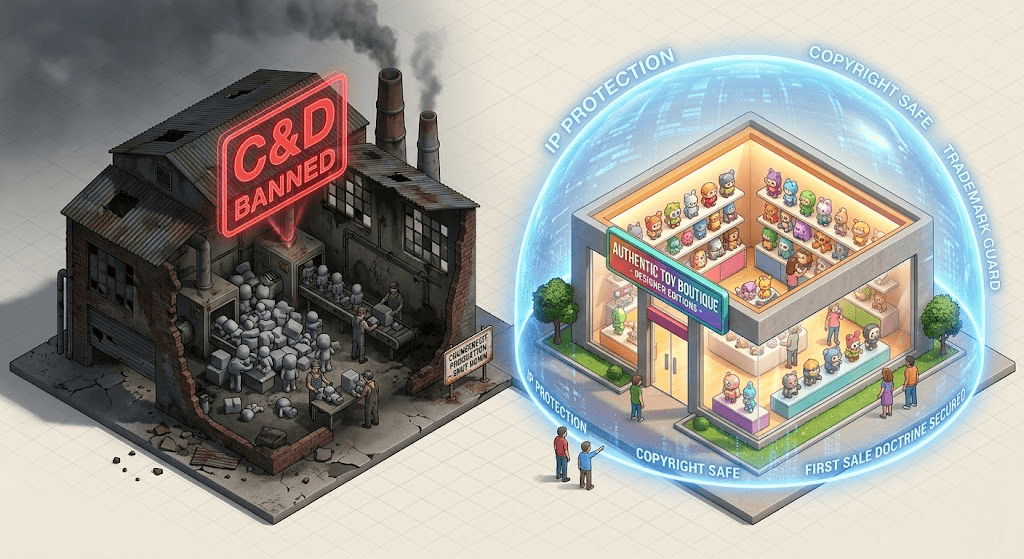
Selling counterfeit goods (bootlegs) is a federal crime in most Western countries. It is not just a “slap on the wrist.” It is a business-ending event.
The “Cease and Desist” (C&D) Cascade:
If a brand protection agency (hired by companies like Sanrio or Pop Mart) discovers fake products on your Shopify store, they do not just send an email. They execute a coordinated takedown:
1. They issue a DMCA takedown to your web host (Shopify), which takes your website offline.
2. They notify your payment gateways (Stripe, PayPal), which instantly freeze all your rolling cash reserves for 180 days.
3. They file a trademark infringement lawsuit against your LLC, holding you personally liable for damages.
The Rule: If a wholesale price seems “too good to be true” (e.g., $3 for a brand new Labubu Blind Box), it is a counterfeit. Never compromise your entire business for a cheap margin.
3. The Matrix of Authenticity: Official vs. Grey Market vs. Fake
In global trade, not everything is black and white. You must understand the four tiers of toy authenticity to accurately price and market your inventory.
| Категория продукта | What to Verify | Retail Risk |
|---|---|---|
| Authentic goods with documented channel status | Invoices, product identifiers, territory, warranty, authorization claims, and permission to use brand assets. | Lower risk, but not zero; product compliance, advertising, territory, and platform rules still apply. |
| Parallel imports | Authenticity, where first placed on the market, trademark and exhaustion rules, material differences, labeling, warranty, and destination-country import rules. | Jurisdiction-specific. Obtain advice before bulk cross-border sales. |
| Suspected counterfeits | Stop the purchase and verify with the rights holder or qualified investigator. | High legal, customs, platform, safety, and refund risk. |
| Fan art or unlicensed kits | Written licenses for the character, artwork, trademarks, and commercial use. | Potential copyright and trademark risk; do not assume handmade status creates permission. |
4. Geographic Restrictions: The “Region Lock” Trap
This is the most complex aspect of IP licensing for international dropshippers and retailers. IP licenses are almost always Geographically Restricted.
The Co-Branding Dilemma
Let’s say 52Toys signs a deal with Disney to make a “Mickey Mouse” blind box series. Disney might only grant 52Toys the license to sell that product in Mainland China and Southeast Asia. Disney already has a different toy partner in the USA, and they do not want the Chinese product competing with the American product.
If you, as a US-based retailer, try to import a massive pallet of these 52Toys Disney blind boxes into the Port of Los Angeles, US Customs (acting on behalf of Disney’s US trademark protections) may seize the container, even though the toys are 100% authentic and legally made by 52Toys in China.
The Retail Strategy: Before any cross-border bulk import, verify who owns or licenses the relevant copyright and trademarks, where the goods were first placed on the market, territory or channel restrictions, material differences, destination labeling, and importer obligations. Do not assume an original designer IP is cleared for every country merely because it is not tied to a large entertainment company.
5. How to Authenticate Art Toys (The Retailer’s Checklist)

As a store owner, you are the gatekeeper. You must train your receiving staff to verify the authenticity of every wholesale master carton that arrives at your dock.
- The Holographic Security Sticker: Top brands (like Pop Mart and Finder’s Unicorn) place a laser-etched holographic sticker on every single blind box. If you tilt the box under a light, the logo should shift colors and display a 3D depth effect. Counterfeits use cheap, flat, shiny foil stickers that do not have true holographic depth.
- The QR Traceability Code: Many modern security stickers feature a scratch-off panel revealing a QR code or a serial number. When scanned by a smartphone, it should direct the user to the brand’s official verification website (e.g., Pop Mart’s WeChat mini-program) and confirm the item is authentic. Crucial Note: The system will also tell you if that specific QR code has been scanned 10,000 times before—a dead giveaway that counterfeiters copy-pasted a single real code onto a million fake boxes.
- The “Weight Coin” Presence: As discussed in our loss prevention guides, premium brands insert heavy metal coins into lighter boxes to prevent “box weighing” by scalpers. Counterfeit factories rarely spend the extra money to insert weight-balancing coins.
- Paint Odor and Texture: Authentic toys use high-grade, non-toxic PVC and matte paints. Counterfeits use cheap, recycled plastics. If you open a box and are hit with an overwhelming, toxic chemical smell of cheap paint, or if the matte finish looks glossy and sticky, you are likely holding a bootleg.
6. The “First Sale Doctrine”: Your Legal Right to Resell
Many new retailers panic when a brand contacts them saying, “You are not an authorized retailer, take our products down.” You need to understand your rights under the First Sale Doctrine (in the US) or the Principle of Exhaustion (in the EU).
First-sale or exhaustion rules can limit certain rights after an authorized sale, but the result depends on the jurisdiction, where the first sale occurred, the right asserted, material differences, product alterations, and how trademarks and brand assets are used. See the current US Copyright Act and obtain local advice for cross-border or disputed goods.
Buying authentic goods may support a resale defense, but it does not create an absolute, worldwide immunity from claims. Keep invoices and product records, avoid suggesting official affiliation, confirm destination-country import and exhaustion rules, and get legal advice if a rights holder objects.
However, while you can sell the product, you cannot use the brand’s trademarked logos to pretend you are an “Official Pop Mart Store” if you are not. You must operate under your own independent retail brand name.
Часто задаваемые вопросы (FAQ)
Q: Can I use the character’s name (e.g., “Labubu”) in my Google Ads or Facebook Ads?
A: This is risky. While you can use the name in your website’s product title to describe what you are selling (Fair Use / Nominative Use), bidding on trademarked keywords in Google Ads often triggers automated disapprovals by the trademark holder. It is safer to bid on broader terms like “Designer Blind Boxes” or “Kawaii Art Toys.”
Q: A customer wants to return an item because it didn’t have a holographic sticker, but it’s an indie brand. What do I say?
A: Not all brands use holograms! Smaller, independent designer studios (Indie Art Toys) simply cannot afford the complex anti-counterfeit packaging of massive corporations. Educate the customer that authentication methods vary by brand size, and assure them of your verified wholesale supply chain through KidultsBox.
Q: Can I sell “Opened” or “Confirmed” figures legally?
A: Yes. Opening the foil bag to reveal the figure (to sell it as a “Confirmed Set”) does not violate IP laws. The physical product is still authentic. In fact, selling opened figures at a premium is a standard and highly profitable practice in the global art toy retail community.
Q: How does KidultsBox guarantee the authenticity of its wholesale products?
A: KidultsBox provides commercial invoices and available product-identification or traceability information for orders. Authentication methods and distribution documentation vary by brand and product; request the documents relevant to the exact SKU before relying on an authorization or authenticity claim.