






For independent art toy vendors, signing a commercial lease for a dedicated storefront is a massive financial liability. The “Rent-a-Shelf” (or micro-retail/consignment) model offers a lower-risk entry point: you rent a physical acrylic cube or shelf space inside an established, high-traffic retail store. While this model eliminates your payroll and utility overhead, it introduces severe margin compression and acute inventory management challenges.
Based on micro-retail operational data, selling blind boxes in a shared retail environment requires a completely different strategy than managing a standalone store. In this guide, we will break down the financial math of flat rent versus commission structures, detail how to merchandise a high-density shelf, and establish strict loss prevention protocols to protect your inventory when you aren’t physically present to watch it.
Financial Modeling: Flat Rent vs. Commission

Before stocking a single blind box, vendors must negotiate the lease structure with the host store. Because the standard gross margin on a wholesale blind box hovers around 45% to 55%, choosing the wrong lease structure will destroy your profitability.
1. The Commission Model (The Margin Killer)
In this model, the host store takes a percentage of every sale (typically 20% to 35%).
The Math: If you buy a blind box wholesale for $8.00 and sell it for $15.99, your gross profit is $7.99. If the host store takes a 30% commission on the retail price ($4.80), your net profit drops to a mere $3.19 per box.
Verdict: The commission model is mathematically hostile to standard blind box vendors. It is only viable if you are selling highly marked-up, custom-painted figures or rare 1/144 chase figures.
2. The Flat Rent Model (The Volume Strategy)
In this model, you pay a fixed monthly fee (e.g., $100 to $250 per month depending on shelf placement) and keep 100% of your sales revenue.
The Math: Your break-even point is fixed. If rent is $150 and your gross profit per box is $8.00, you only need to sell 19 boxes a month to cover rent. Every box sold after the 19th is pure profit.
Verdict: Flat rent is the mandatory strategy for volume-based art toy vendors. It allows you to scale your revenue without being penalized by aggressive commission splits.
High-Density Merchandising for Micro-Spaces
A standard rented shelf is typically a 15x15x15 inch acrylic cube. You cannot waste this microscopic real estate on bulky packaging. You must execute high-density visual merchandising.
- Focus on Fast-Movers: Do not stock large 400% figures; they consume the entire shelf and have slow turnover. Instead, focus entirely on standard 3-inch PVC blind boxes and plush blind box keychains. Foil-bagged plush toys are malleable and can be densely packed or hung from small adhesive J-hooks attached to the roof of your cube.
- The “Magnet” Display: A stack of sealed boxes is invisible to casual mall traffic. You must unbox one highly detailed, vibrant figure and place it at the front of your shelf as a “magnet.” Displaying it on a cheap, battery-powered rotating acrylic base instantly catches the eye of passersby.
Loss Prevention: The “Dummy Box” Strategy
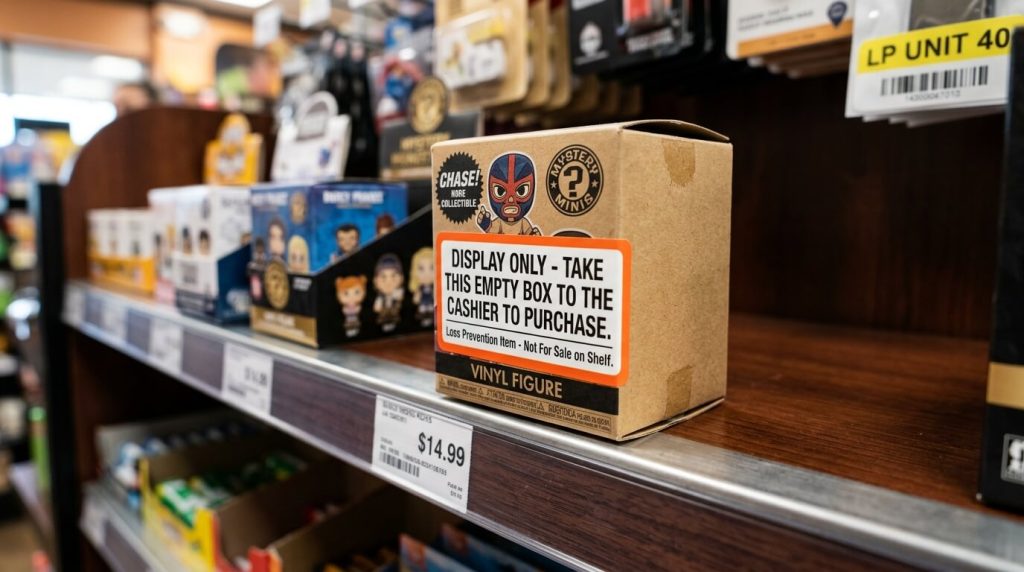
The harshest reality of the Rent-a-Shelf model is Shrinkage (Theft). The host store’s staff is primarily focused on their own merchandise, not yours. Small, lightweight blind boxes placed near eye level or in lower cubes are prime targets for shoplifters.
To combat this, savvy vendors utilize the Dummy Box Strategy for high-value items:
- If you are selling a “Confirmed” (opened) chase figure for $80, do not put the actual figure on the open shelf.
- Place the empty cardboard box on the shelf, clearly labeled with a sticker that reads: “Display Only: Bring this box to the cashier to receive the actual figure.”
- Keep the actual high-value inventory safely stored behind the host store’s checkout counter.
For a deeper dive into protecting your inventory, review our comprehensive B2B guide on loss prevention and theft safeguards for toy retailers.
Data Tracking and Replenishment SOPs
Operating a remote shelf means you cannot rely on visual stock checks. If your shelf sits empty for three days because you didn’t know you sold out, you are burning your rental investment.
You must ensure your host store integrates your inventory correctly into their retail POS system. Every item you stock must have a unique, scannable barcode tag applied to it. Do not rely on the factory UPC, as the host store may have another vendor selling the exact same blind box series. Generate custom SKU stickers (e.g., “VendorA-Nanci-01”) so the host’s POS generates an accurate weekly sales report, allowing you to restock proactively.
Product Matrix for Shelf Rentals
Use this matrix to curate the most profitable inventory mix for a restricted physical space.
| Product Type | Space Required | Turnover Rate | Recommendation for Rent-a-Shelf |
|---|---|---|---|
| Plush Keychains (Foil Bags) | Very Low (Can be hung/stacked) | Very High | Core Inventory. Maximizes revenue per square inch. |
| Standard PVC Blind Boxes | Medium (Rigid boxes) | High | Primary Revenue. Keep 3-4 series maximum to avoid visual clutter. |
| Confirmed “Chase” Figures | Low (Out of box) | Medium / Slow | Magnet Item. Use dummy boxes; keeps margins high to offset rent. |
| Large Vinyl (400%+) | High (Consumes entire cube) | Very Slow | Do Not Stock. Waste of spatial rent. |
Frequently Asked Questions (FAQ)
How often should I restock my rented shelf?
Ideally, you should visit your shelf once a week. This allows you to restock sold inventory, clean the acrylic (dusty shelves deter buyers), and rotate display models. If a specific series hasn’t moved in 14 days, pull it and replace it. In micro-retail, stagnant inventory is actively losing you money.
What happens if a customer steals a blind box from my rented shelf?
In 99% of Rent-a-Shelf contracts, the vendor absorbs the cost of stolen items, not the host store. This is why investing in custom barcode labels, acrylic display protection for sample figures, and the dummy box strategy is a non-negotiable operational cost.
Can I charge more than MSRP since my rent is high?
It is not recommended. Today’s collectors are highly educated on standard blind box MSRPs. If your Nanci box is priced at $22 when it sells online for $15, they will immediately pass. You must compete on convenience and curation, not aggressive markups. Your profit must come from buying efficiently at wholesale prices.
How can I source inventory efficiently for a small shelf?
Rent-a-Shelf vendors usually cannot afford the massive MOQs (Minimum Order Quantities) required by direct factories. The most profitable strategy is sourcing mixed cartons from a reliable B2B supplier. Platforms like Kidults Box allow vendors to curate a diverse mix of plush keychains and PVC boxes without locking up thousands of dollars in a single series.
Mastering the Rent-a-Shelf model requires ruthless spatial efficiency and disciplined inventory tracking. If you have secured a lease for a retail cube and need to stock it with fast-turning, high-margin blind boxes, exploring a curated wholesale catalog is your next operational step.

