





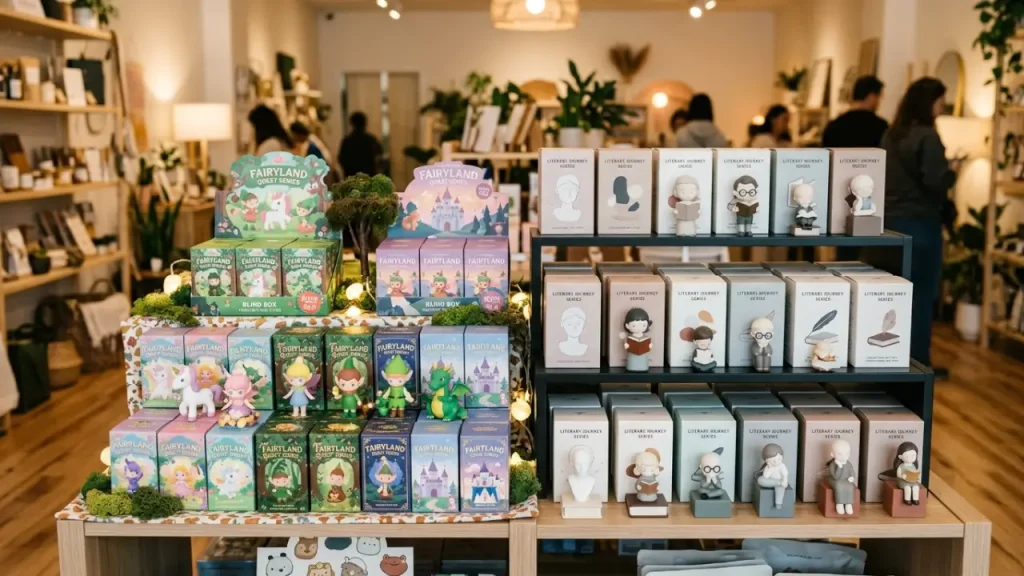
Shelf space is limited, and two visually appealing collectible lines can serve very different shopping missions. Before committing a display slot, gift-store buyers need to decide whether Disney Princess or Hirono x Le Petit Prince fits their audience, price architecture, display space, and inventory plan.
The decision should not rest on personal taste or product photography alone. Compare customer recognition, gifting context, case configuration, packaging condition, landed cost, and the likelihood of reorders. Because specifications and availability can vary by source and market, confirm all current details in writing before placing an order.
Match Each Series to the Gift Shopper You Actually Serve
Start with the recipient rather than the character design. Disney Princess may be easier to explain to shoppers already familiar with the broader franchise. Hirono x Le Petit Prince may appeal to customers drawn to art toys, literary gifting, crossover collectibles, or more contemplative display pieces. These are positioning hypotheses, not guaranteed sales outcomes, so compare them with your own transaction history.
Disney Princess may warrant closer consideration when a store serves family gift buyers, tourists, franchise-oriented collectors, or shoppers looking for a recognizable celebration gift. Review the dedicated Disney Princess blind box retail sourcing guide for additional questions to use when evaluating that line.
Hirono x Le Petit Prince may be relevant to design-led gift stores, museum-style shops, bookstores, art-toy retailers, and stores with customers who already understand collectible collaborations. Before choosing it, ask whether staff can communicate the crossover clearly without requiring a long explanation at checkout.
- Acción del comprador: Review the last three to six months of sales by recipient type, not only by brand.
- Buyer question: Are most purchases self-directed collecting, birthday gifting, tourist gifting, or impulse checkout purchases?
- Decision rule: Favor the series whose likely audience already appears in your store rather than assuming a new license will create that audience.
A Retail Scorecard for Weighing the Two Lines
Use the following table as an evaluation worksheet. It does not declare a universal winner; it identifies what a buyer should verify for each store concept.
| Retail factor | Disney Princess angle to assess | Hirono x Le Petit Prince angle to assess | Buyer action |
|---|---|---|---|
| Customer recognition | Test recognition among franchise and family-gift shoppers | Test recognition among art-toy and literary audiences | Ask staff to record customer inquiries for one week |
| Gift occasion | Consider birthdays, celebrations, and character-led gifts | Consider design, literature, and collector gifting | Map each series to existing gift occasions |
| Self-purchase appeal | Review whether local collectors buy princess-themed figures | Review demand for Hirono, crossover, or narrative collectibles | Compare with sales of adjacent figure lines |
| Staff explanation | May rely on broader franchise familiarity | May benefit from concise crossover context | Draft a one-sentence sales explanation |
| Display compatibility | Check color balance and visibility within the current character section | Check fit with art toys, books, or design gifts | Assign a physical shelf before ordering |
| Estructura del surtido | Confirm figures per series, case quantity, and hidden-edition rules | Confirm the same details independently | Do not assume both series share specifications |
| Estado del embalaje | Inspect corners, seals, print consistency, and gift readiness | Apply the same inspection standard | Request current packaging photos |
| Reorder risk | Estimate whether recognition supports replenishment | Estimate whether collector demand is broad or concentrated | Set a sell-through trigger before launch |
A useful test is to have store staff rank both series against these factors without seeing the purchase cost. Cost can then be added after the merchandising fit is clear, reducing the temptation to select a line solely because its initial quote looks lower.
How Case Packs Can Change the Better Choice
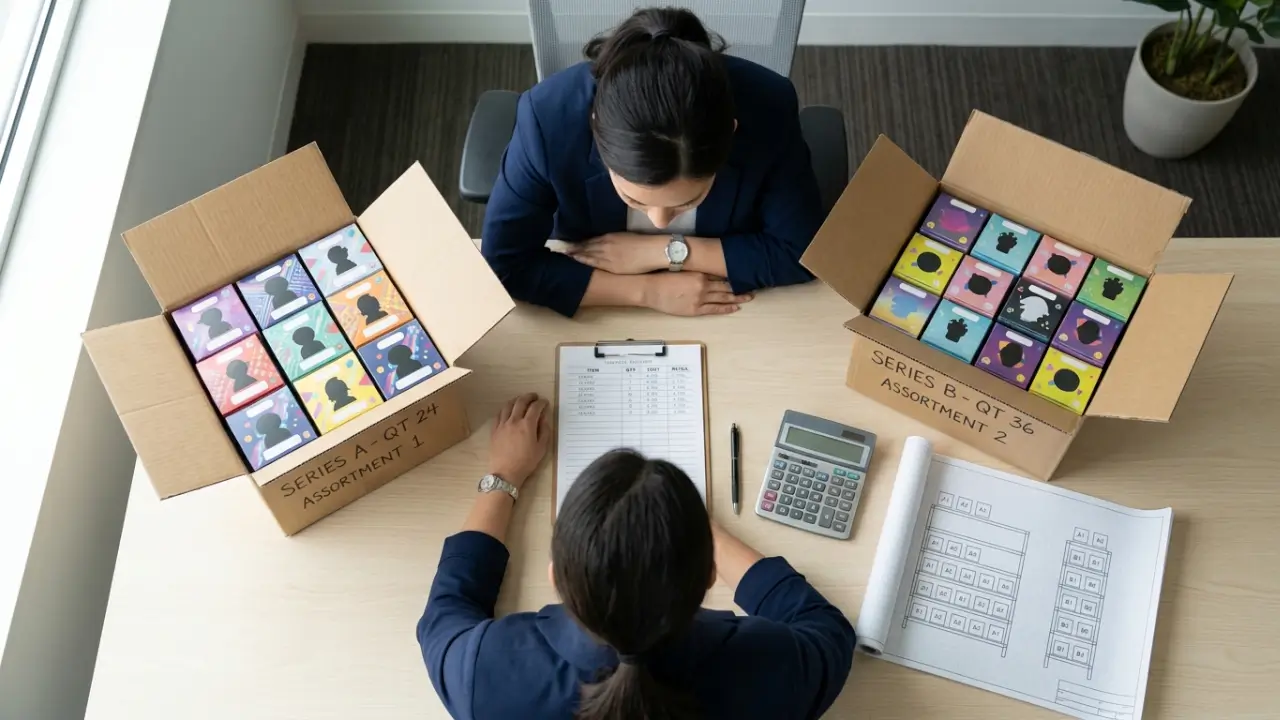
A suitable series can still become a poor order if the supplier’s case configuration creates too much inventory. Ask for the number of blind boxes per sealed case, whether a case is represented as a complete series assortment, how hidden or special editions affect that representation, and whether orders can be placed by case, individual box, or mixed carton.
Do not treat MOQ and case quantity as interchangeable. MOQ is the minimum order accepted, while case quantity describes how units are packed. A quotation might require several cases, one shipping carton, or a monetary minimum; buyers should ask the supplier to state the requirement unambiguously.
As a planning example, a store considering 48 total units might compare four hypothetical allocations: 24 units per series, 36 units of the more familiar line plus 12 of the niche line, a single-series test, or a mixed assortment if legitimately available. The correct allocation depends on actual case packs and supplier terms, not these example numbers.
For a deeper look at the inventory implications, use this guide to Conjuntos de series cerradas frente a surtidos mixtos en cajas sorpresa. Always confirm whether merchandise described as mixed is individually sealed, traceable to the stated series, and suitable for retail resale.
- Request the unit count per inner case and outer carton.
- Confirm whether the quote covers sealed cases or loose boxes.
- Ask whether carton labels identify the series and quantity.
- Check whether ordering both lines changes the minimum requirement.
- Document the received quantity by series before stock is distributed.
Compare the Two Lines on Landed Unit Cost, Not Headline Price
The quoted unit price is only one component of the buying decision. Calculate a provisional landed unit cost using merchandise value, freight, payment charges, customs-related costs, taxes or duties where applicable, brokerage, inspection expense, and an allowance for damaged or commercially unsellable packaging.
Use the same cost boundary for both quotes. A Disney Princess quote priced to one delivery point cannot be compared directly with a Hirono x Le Petit Prince quote that excludes international freight or ends at a different shipping stage. Ask each supplier to identify the currency, trade or delivery basis, carton dimensions, gross weight, and quote validity period.
Gift stores should also model cash exposure. A slower-selling series may occupy shelf space and delay the next order even when its unit cost is attractive. A higher-cost line can also be risky if the retail price sits above the store’s normal impulse-gift range. Compare projected stock turn rather than inserting an unsupported sales rate.
Mid-order checkpoint: Before requesting final pricing, send the supplier the same desired quantity, destination, packaging expectation, and delivery basis for both series. Standardized inputs produce a more useful comparison.
Gift-Ready Boxes Need More Than an Authentic-Looking Front
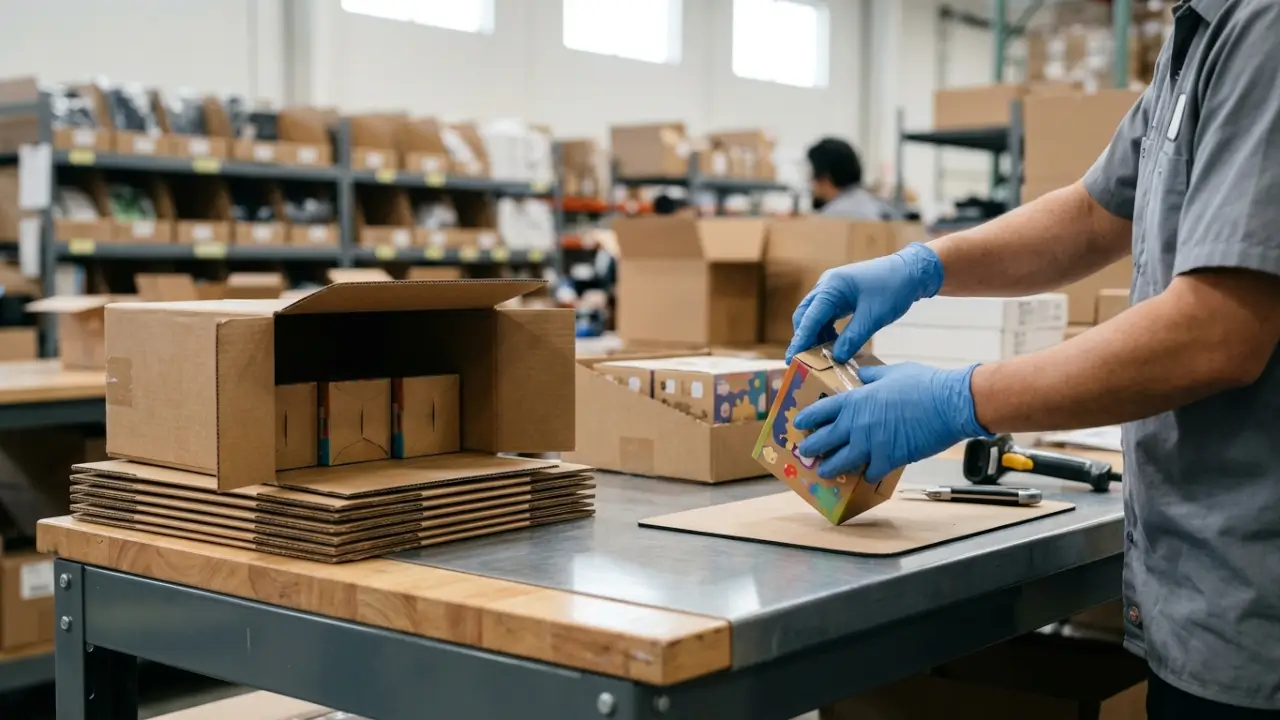
Blind boxes are often displayed and gifted in their retail packaging, so crushed corners, opened seals, fading, residue, or inconsistent printing can reduce sellability even when the figure is undamaged. Request recent photos of all sides of the retail box, the inner-case arrangement, outer-carton markings, and protective packing method.
Build a receiving check that covers both packaging and product identity. For example, staff may inspect a defined sample from each carton, then expand the check if they find repeated damage or discrepancies. Record carton condition before opening, count units by series, photograph concerns, and keep the relevant labels until the order is reconciled.
Buyers should also verify destination-market requirements concerning intellectual property documentation, product labeling, age grading, consumer warnings, materials, importer information, and customs declarations. Requirements differ by jurisdiction and product classification. Do not assume that branded packaging alone demonstrates authorization, authenticity, or local compliance; request documentation and obtain qualified advice where necessary.
Let Sell-Through Evidence, Not Launch Excitement, Trigger the Reorder
Collector products can sell unevenly. Track units received, units sold, damaged units, returns, and remaining stock separately for each series. Avoid combining both lines into one sell-through figure, because strong performance from one can conceal weak performance from the other.
As an example planning rule, a retailer may review replenishment when half of the sellable stock has moved within its chosen review period and demand remains distributed across multiple days or customer groups. This is only a planning reference. The actual threshold should account for case size, cash budget, freight timing, and the supplier’s current lead-time estimate.
Ask whether quoted lead time begins after payment, order confirmation, or dispatch booking. Also ask whether it refers to preparation time only or includes transportation. For cross-border orders, build contingency around customs processing and verify import requirements for the destination market.
If neither series fits the store’s primary audience, compare a different collectible format instead of forcing the choice. The Guía para compradores de cajas sorpresa de Cupa provides another framework for evaluating a character-led series, while the comparison of blind box fridge magnets and bag charms can help buyers assess smaller gift formats.
Warning Signs That Two Quotes Aren’t Yet Comparable
A low headline price is a warning sign when the quote omits packaging format, case quantity, shipping scope, condition, or product identification. Pause if a supplier avoids current photos, changes terminology between messages, pressures payment before specifications are documented, or cannot explain whether units are sealed cases or loose blind boxes.
Other mistakes include assuming both POP MART series have identical case structures, ordering for personal preference rather than store demand, ignoring outer-carton dimensions, and treating every box as sellable inventory. Buyers should also avoid advertising hidden-edition odds or assortment guarantees unless those details have been confirmed for the specific product and supply source.
Inquiry template for both series
Please quote Disney Princess and Hirono x Le Petit Prince separately for delivery to [city and country]. For each series, provide the exact product or series name, unit quantity, units per sealed case, minimum order requirement, retail-box condition, outer-carton quantity, carton dimensions and gross weight, price currency, payment terms, quote validity, shipping basis, preparation estimate, and available product or authorization documentation. Please also clarify whether the quotation is for sealed cases, loose boxes, or mixed stock and send current packaging photos.
Before comparing totals, check that every response answers the same questions. Mark missing details as unresolved rather than filling them in with assumptions.
- Exact series and edition identification
- Quantity by unit, inner case, and outer carton
- MOQ and whether the two series can be combined
- Sealed-case, loose-box, or mixed-stock status
- Current retail and shipping packaging photos
- Price currency and included cost components
- Carton size, weight, shipping basis, and destination
- Preparation and transport estimates stated separately
- Damage, discrepancy, and claim procedure
- Documents relevant to authenticity and destination compliance
Ready to compare supply options? Prepare one standardized inquiry using the template above and request written quotes for both series. Choose only after audience fit, case exposure, packaging condition, documentation, and landed cost have been reviewed together.
PREGUNTAS FRECUENTES
Which series is easier for a general gift store to explain?
Disney Princess may require less introduction among shoppers already familiar with the franchise, while Hirono x Le Petit Prince may need more context but could fit an art-toy, literary, or design-led audience. Test recognition with your actual customers before ordering.
Should a retailer stock both series at launch?
Stocking both can provide useful demand data, but only if case quantities, MOQ, budget, and display space allow a controlled test. If buying both creates excess inventory, start with the line that best matches existing customer behavior.
Can quotes be compared using unit price alone?
No. Compare the same quantity, case format, shipping basis, destination, currency, packaging condition, and included costs. A lower unit quote may become more expensive after freight, customs-related charges, or damaged packaging are considered.
What should buyers confirm about sealed cases?
Confirm units per case, whether the case is represented as a complete assortment, how special editions affect that assortment, whether seals are intact, and how cases are protected inside the shipping carton.
How should a gift store plan a reorder?
Track sellable units and sales separately for each series, set a review threshold, and compare remaining stock with the supplier’s current preparation and transport estimates. Reorder from measured demand rather than launch-week attention alone.
Before Choosing the First Series
Disney Princess may align more naturally with familiar character gifting, while Hirono x Le Petit Prince may suit a design-conscious or literary collector audience. Neither is automatically the better gift-store purchase. The stronger choice is the series supported by customer evidence, manageable case exposure, verified packaging, comparable landed cost, and a realistic replenishment plan.

