




Opening a physical Art Toy boutique in 2026 is one of the most lucrative retail opportunities available, but it is not cheap. To build a premium “Deskterior” showroom that attracts high-net-worth “Kidult” collectors, you cannot rely on cheap wire shelving and a folding table. You need custom acrylic lighting, a sophisticated POS system, mall security deposits, and a massive initial wholesale order from a premium distributor like KidultsBox. For most entrepreneurs, this requires Outside Capital.
Whether you are seeking $50,000 for a high-traffic mall kiosk or $250,000 for a 2,000-square-foot flagship boutique, walking into a bank or an angel investor’s office simply saying, “I want to sell plastic toys,” will result in immediate rejection. Traditional investors view “toys” as a dying, low-margin industry dominated by Amazon and Walmart. You must re-educate them.
You are not opening a toy store. You are opening a High-Frequency, Gamified Pop-Culture Art Gallery. This comprehensive B2B financial whitepaper will provide you with the exact formulas to calculate your startup capital (CAPEX), the psychological arguments needed to pitch venture capitalists and loan officers, and the supply-chain defense strategies required to prove your business is a bulletproof investment.
1. The Investor Pitch: Reframing the “Toy” Industry
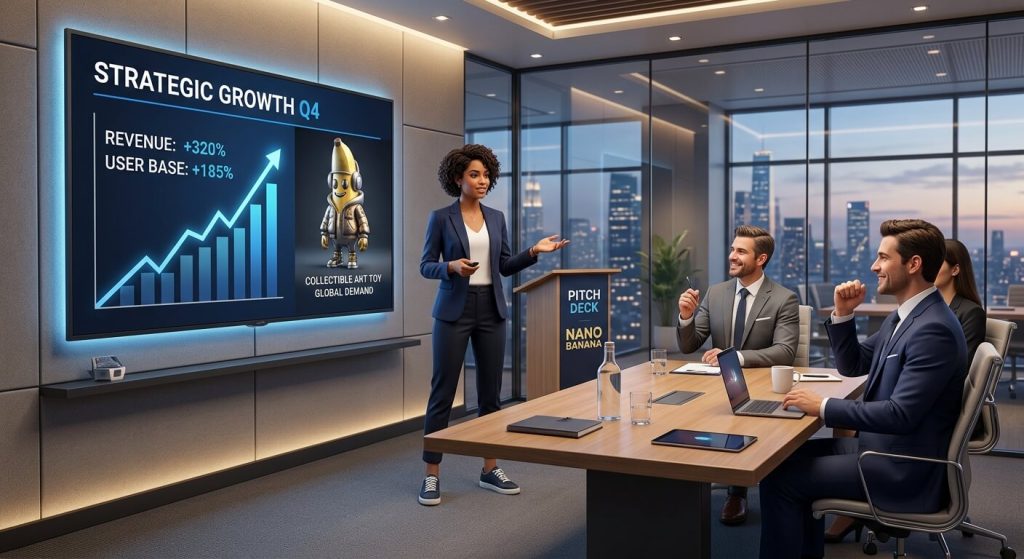
To secure funding, you must first destroy the investor’s preconceived notions. If an investor pictures a chaotic Toys “R” Us aisle filled with screaming toddlers, they will close their checkbook. You must paint a picture of a sleek, neon-lit boutique filled with 25-to-35-year-old professionals spending $150 a week on aesthetic collectibles.
The 4 Pillars of the Art Toy Pitch
- The “Gacha” Revenue Engine: Blind boxes are inherently addictive. Explain to the investor that unlike a clothing store where a customer buys a shirt and leaves, the blind box model guarantees immediate repeat purchases. If a customer wants the 1/144 “Secret” Pop Mart Labubu, they will buy 5 to 10 boxes in a single visit. This results in an incredibly high Average Order Value (AOV).
- The “Kidult” Demographic: Your target market is childless Millennials and Gen Z professionals with high disposable income. They are not buying toys to play with; they are buying “Dopamine Decor” to decorate their offices and luxury handbags. This demographic is practically recession-proof.
- The Insulated Margins: Unlike electronics or books, designer art toys carry a massive Gross Profit Margin (typically 45% to 65% when sourced wholesale). You do not need to compete in a “race to the bottom” on price, because the IPs (Intellectual Properties) are highly exclusive and strictly price-controlled.
- O2O (Online-to-Offline) Synergy: Assure the investor that the physical store is an “Activation Hub.” The brick-and-mortar location acts as a billboard that generates viral social media content (via in-store Unboxing Stations), driving massive digital sales through your synchronized Shopify store.
2. Calculating Your Capital Requirements (The Ask)
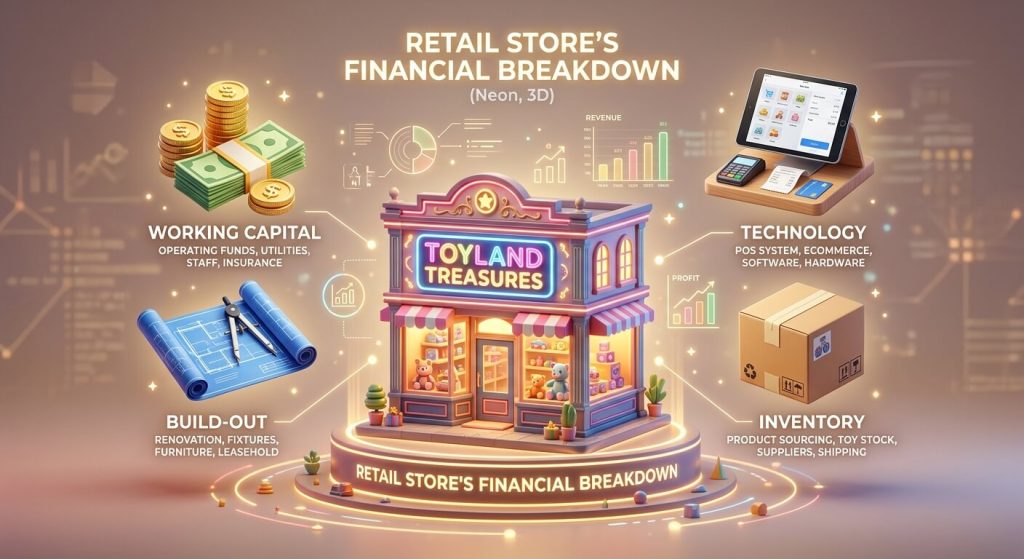
Before you ask for money, you must know exactly how much you need down to the dollar. Asking for “around a hundred grand” shows incompetence. You must present a detailed Sources and Uses of Funds statement.
Here is a baseline capital breakdown for a mid-sized (800 sq ft) premium Art Toy boutique in a Tier-2 city in 2026.
| Expense Category (Uses of Funds) | Estimated Cost (USD) | Why Investors Scrutinize This |
|---|---|---|
| Lease Execution & Security Deposit | $10,000 – $20,000 | Commercial landlords usually require First Month, Last Month, and a Security Deposit. Investors want to ensure you negotiated a reasonable lease with a “Tenant Improvement” (TI) allowance. |
| Store Build-Out (Tenant Improvements) | $25,000 – $45,000 | This covers premium vinyl flooring, custom paint, LED track lighting, and massive floor-to-ceiling acrylic display cases. Do not skimp here. The environment justifies the $25 price tag of a blind box. |
| Technology & POS Infrastructure | $3,000 – $5,000 | Includes Shopify POS Pro hardware, 2D barcode scanners (essential for custom blind box barcodes), receipt printers, and security cameras (EAS systems). |
| Initial Inventory Order (ISO) | $20,000 – $35,000 | This is your “Opening Day” stock. Investors love this because it is an asset. You will order pallets of Kimmon Plushies, Penny’s Box BJDs, and Pop Mart cases directly from KidultsBox. |
| Working Capital (6-Month Runway) | $25,000 – $40,000 | The most critical line item. This covers your rent, employee payroll, and marketing budget for the first 6 months while the store builds local foot traffic. If you don’t ask for working capital, investors know you will fail in month three. |
| TOTAL ASK: | $83,000 – $145,000 | This is the hard number you put on the final slide of your Pitch Deck. |
3. The “Risk Mitigation” Supply Chain Pitch
The single biggest fear a retail investor has is “Dead Stock” (inventory that does not sell and rots on the shelf). If you tell an investor you are buying $30,000 worth of toys from random factories on Alibaba, they will walk out of the room. You must prove your supply chain is resilient, agile, and protected from counterfeits.
How to Pitch KidultsBox as Your Competitive Moat
To win over the investor, you must proudly name-drop your wholesale partner. Use this exact narrative in your pitch deck:
“We completely mitigate inventory risk by partnering with a Tier-1 global B2B distributor, KidultsBox. Unlike traditional retail where we have to place 6-month advance orders for 5,000 units, KidultsBox allows us to order ‘End Boxes’ (small master cases) with incredibly low MOQs (Minimum Order Quantities).
If a new Baby Three series goes viral on TikTok on a Tuesday, we can place a low-risk wholesale order on Wednesday, and have the authentic, verified inventory shipped DDP (Delivered Duty Paid) to our store within 10 days. Furthermore, sourcing through official channels guarantees 100% IP authenticity, protecting the business from the devastating legal liabilities and customs seizures associated with counterfeit goods.”
This paragraph proves to the investor that you are an agile, data-driven operator, not a gambler.
4. Funding Source A: Small Business Administration (SBA) & Traditional Bank Loans
If you have good personal credit (700+) and are willing to put up personal collateral (like home equity), a traditional bank loan is the cheapest form of capital because you do not have to give up equity (ownership) in your company.
The SBA 7(a) Loan (US Specific)
The US government partially guarantees these loans, making banks much more willing to lend to retail startups. You can secure up to $5 million, though a toy store typically needs a microloan or a smaller 7(a) loan (under $150k).
- What the Bank Wants to See: A flawless, 30-page written Business Plan. They do not care about “Hype.” They care about your EBITDA (Earnings Before Interest, Taxes, Depreciation, and Amortization) projections. You must show a detailed spreadsheet proving you can generate enough monthly cash flow to cover the loan’s principal and interest (Debt Service Coverage Ratio > 1.25).
- The Catch: Banks require an “Equity Injection.” You cannot finance 100% of the store. The bank will require you to invest 10% to 20% of your own cash into the business to ensure you have “skin in the game.”
5. Funding Source B: Angel Investors & Venture Capital
If you do not have collateral or want to scale aggressively (e.g., opening 5 locations in 3 years), you need Angel Investors. These are wealthy individuals looking for a higher return on investment (ROI) than the stock market.
How to Pitch an Angel Investor
Angels do not care about interest rates; they care about Multiples y Exits. If they give you $100,000 for 20% of your company, they want to know how that 20% becomes worth $500,000 in five years.
You must pitch the “Franchise / Omnichannel Vision.” Do not pitch a single mom-and-pop store. Pitch a modern retail brand. Show them how the physical store will act as a customer acquisition tool to build a massive email list and Discord community. Explain how you will launch a highly profitable Blind Box Subscription Box service (Monthly Recurring Revenue) using KidultsBox’s wholesale supply chain, creating a business valuation based on recurring tech-like metrics rather than just retail foot traffic.
6. Funding Source C: The “Bootstrapper’s Pop-Up” Proof of Concept
What if the banks say no, and you don’t know any rich Angel Investors? You must bootstrap (self-fund) using the Proof of Concept (POC) Method.
Do not try to raise $100,000. Raise $5,000 from your own savings or credit cards.
- The Micro-Start: Take that $5,000 and open a wholesale account with KidultsBox. Buy highly liquid, fast-moving inventory like Plush Keychains and BJD de Penny’s Box.
- The Convention Circuit: Do not rent a store. Rent a 10×10 booth at local Anime Conventions, Night Markets, and Comic-Cons on the weekends. (Review our Comic-Con Sales Guide).
- The Reinvestment Loop: Sell out your inventory at the convention for $10,000. Take that $10,000, buy more inventory, and do it again.
- The Ultimate Pitch: After 6 months, you will have generated $50,000 in gross revenue and built a massive local Instagram following with zero retail lease overhead. Now, take those profit and loss (P&L) statements to the bank. When you can prove mathematically that you know how to sell the product profitably, securing funding for the permanent brick-and-mortar location becomes effortless.
7. The Financial Projections: What the Spreadsheet Must Show
Whether pitching a bank or an angel, your financial spreadsheet must reflect the unique mechanics of the blind box industry. Ensure your projections highlight these specific metrics:
- AOV (Average Order Value): Show this increasing over time as you implement upselling strategies (e.g., transitioning customers from buying 1 box to buying a full “End Box”).
- Shrinkage (Loss Prevention): Show a 2% to 3% buffer for shrinkage (theft/damaged boxes). Investors respect founders who acknowledge risk. Mention your “Dummy Box” retail display strategy to minimize this.
- Seasonality: Your revenue projections should NOT be flat. Show massive revenue spikes in Q4 (Christmas/Black Friday) and February (Valentine’s Day), as art toys are prime gifting items.
- COGS (Cost of Goods Sold): Explicitly show that by leveraging tiered volume discounts from your primary supplier (KidultsBox), your COGS will decrease by 3-5% in Year 2, widening your gross profit margin as you scale.
Preguntas más frecuentes (FAQ)
Q: Do investors care if I sell online as well as offline?
R: Yes. They demand it. In 2026, an investor will rarely fund a purely physical retail store. You must present a robust “Omnichannel” strategy. Explain how your physical POS (Point of Sale) integrates seamlessly with your Shopify store, allowing you to execute “Buy Online, Pick Up In-Store” (BOPIS) and nationwide dropshipping during slow local foot-traffic days.
Q: How much equity should I give an Angel Investor?
A: It depends on your valuation, but a general rule for a retail startup is giving away 15% to 30% for seed capital. If you give away more than 50%, you lose control of your own company and destroy your motivation to work 80-hour weeks to make it succeed. Always consult a startup lawyer.
Q: Can I use Kickstarter or Crowdfunding to open a store?
A: Crowdfunding is excellent for creating a new product (like a board game or a new toy IP), but it is historically terrible for opening a physical retail store. People on Kickstarter want a tangible reward mailed to them; they do not want to fund your commercial lease. Stick to traditional lending or angels for physical retail.
Q: Will KidultsBox provide documentation to help me get a loan?
A: While we cannot write your business plan, we absolutely provide the necessary B2B infrastructure. We can provide you with formal wholesale price lists, catalog data, and estimated DDP shipping quotes so your financial projections are based on real-world, verified supply chain data, which banks heavily scrutinize.