

For the past twenty years, the traditional “Anime Shop” or “Otaku Store” operated on a rigid, predictable business model. You sold manga volumes at razor-thin margins, $200 1/7 scale PVC figures that sat in glass cabinets for months, and $5 acrylic keychains to drive daily foot traffic. However, in 2026, competing against Amazon and giant Japanese e-commerce exporters with this old-school inventory strategy is a recipe for bankruptcy.
To survive, the modern pop-culture boutique must evolve. The savior of physical retail is the Designer Art Toy Blind Box.
Bridging the gap between the “Hardcore Otaku” (who only buys merchandise from specific Japanese anime IPs) and the “Trendy Kidult” (who buys Bebé Tres or Pop Mart purely for the cute aesthetic) is not just a merchandising challenge; it is a cultural integration. For independent retailers sourcing high-margin inventory from KidultsBox, this comprehensive B2B whitepaper outlines the exact psychological, spatial, and sales strategies required to fuse these two highly lucrative worlds seamlessly.
1. The Demographics: The “Otaku” vs. The “Kidult”
Before mixing the inventory on your shelves, you must understand the psychological divide between your two core customer bases. If you alienate your traditional anime fans, you lose your foundation. If you ignore the art toy collectors, you lose your growth.
| Customer Profile | The Hardcore Anime Fan (The Otaku) | The Art Toy Collector (The Kidult) |
|---|---|---|
| Purchase Motivation | Loyalty to Story/Character. They buy a Gojo figure because they love Naruto/Jujutsu Kaisen. The IP precedes the object. | Aesthetic & Dopamine. They buy a Peluche Kimmon because it is cute, feels premium, and the “Gacha” unboxing is thrilling. There is no prior story required. |
| Shopping Behavior | Targeted. They walk in knowing exactly which character from which specific anime season they want. | Impulsive. They walk in to browse, see a beautiful box design, and buy three to test their luck. |
| Price Tolerance | Bimodal. Will spend $3 on a gashapon or $300 on a scale resin statue, but hesitate in the middle. | Strong in the “Affordable Luxury” zone ($15 – $30). Will easily drop $150 on an “End Box” (Full Case). |
| Display Method | “Shrine” building. Creating massive, crowded shelves dedicated to one specific anime franchise. | “Deskterior.” Curating a few, highly aesthetic pieces to decorate a work desk, PC setup, or luxury handbag. |
Your goal is to cross-pollinate. You want the anime fan to experience the thrill of a premium blind box, and you want the art toy collector to appreciate the intricate sculpting of anime merchandise.
2. Merchandising Strategy: The “IP Halo” Effect

The biggest mistake a traditional anime store makes when introducing designer blind boxes is quarantine. If you create a separate, isolated “Pop Mart Corner” in the back of the store, the hardcore anime fans will walk right past it, dismissing it as “stuff for kids” or “normie toys.”
The Solution: Trojan Horse Merchandising
You must use recognized Anime IPs as a “Trojan Horse” to introduce the blind box format.
- Step 1: The Anime Collab Bridge. Stock blind boxes that feature licensed anime characters. Brands like 52Toys and Pop Mart frequently release series for Evangelion, Dragon Ball, Sailor Moon, and Shin-chan. Place these officially licensed anime blind boxes directly next to the $200 scale figures of the same franchise.
- Step 2: The Proximity Blend. Once the anime fan realizes that a $15 blind box offers incredible detail and a fun unboxing experience for their favorite show, their resistance to the format drops.
- Step 3: The Aesthetic Bleed. Now, place original designer toys next to the anime collabs. Place a dark, edgy ShinWoo Ghost Bear next to the Jujutsu Kaisen display. Place a highly-detailed, mecha-inspired Pop Mart Skullpanda next to the Gundam model kits. The anime fan will buy the designer toy because it matches their aesthetic vibe, even if it lacks an anime backstory.
3. Capitalizing on the “Ita-Bag” (Pain Bao) Culture
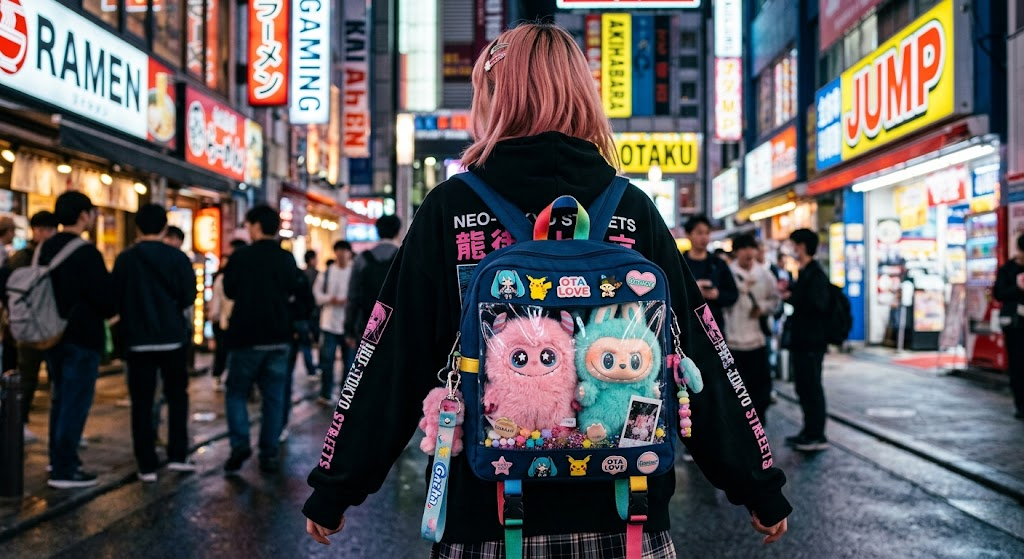
If there is one cultural phenomenon that perfectly bridges the gap between anime fans and art toy collectors, it is the Ita-Bag (痛包).
An Ita-bag is a backpack or tote bag featuring a clear vinyl window, which the owner fills with merchandise (badges, acrylic stands, and small plushies) to show off their devotion to a character or aesthetic. Originally a hardcore anime trend in Akihabara, this has exploded globally into the mainstream “Bag Decor” trend.
The Retail Playbook for Ita-Bags:
Traditional anime stores sell flat, $5 acrylic keychains for these bags. You must upgrade your customers to $15 Cajas ciegas de felpa.
- The Visual Demo: Buy a high-quality Ita-bag for your store display. Fill the clear window not just with flat anime buttons, but with massive, 3D plush blind box keychains like the Baby Three V3 Macaron or the fluffy Kimmon Mimon.
- The Pitch: When an anime fan buys a bag or a standard keychain, point to the display. “The flat acrylics are great, but if you want your bag to look full and 3D, these designer plush blind boxes take up so much space and look incredibly premium.”
- The Profit Shift: You just transitioned a customer from a $5 low-margin purchase to a $20 high-margin purchase, effectively quadrupling your AOV (Average Order Value) on a single accessory transaction.
4. Upgrading the “Gashapon” Ecosystem
Almost every anime store has a row of capsule toy machines (Gashapon) near the entrance. These dispense small, $4 to $6 plastic trinkets. While they are great for drawing foot traffic, the profit margins are eaten alive by the massive shipping volume of the empty plastic capsules.
The Strategy: The Inside Upsell.
Use the Gashapon machines outside as the “Lead Magnet.” When the customer comes inside to ask for tokens or change for the machines, you execute the upsell.
Cashier Script:
“Here are your tokens for the capsule machines outside! By the way, if you love the gacha thrill, have you checked out our premium Designer Blind Box wall over here? Instead of a small 2-inch capsule toy, these are 4-inch, hand-painted vinyl art pieces with real fabric accessories and glass eyes. The quality difference is insane, and the unboxing experience is much more intense. We even have an Unboxing Station with a ring light if you want to open it here!”
By comparing the blind box directly to the gashapon experience, you contextualize the $15 price tag. It is no longer “an expensive toy”; it is a “premium, upgraded gacha experience.”
5. The High-End Overlap: BJDs vs. Scale Figures
Hardcore anime collectors are used to spending $200 on 1/7 scale PVC statues (like Alter or Good Smile Company). However, these statues are static; once placed on a shelf, they never move. This is where you introduce BJD (Ball Jointed Doll) Blind Boxes como Penny’s Box Antediluvian.
When an anime collector is browsing the expensive glass cabinets, your staff must physically hand them an opened Penny’s Box BJD sample.
The Sales Angle: “Scale figures are beautiful, but they are stuck in one pose forever. These BJD blind boxes have 15 points of mechanical articulation, real tailored fabric clothing, and swappable glass eyes. You can pose them dynamically, change their outfits, and take incredible macro photography. And the best part? They are only $25 compared to a $200 static statue.”
Because anime fans already appreciate high-quality sculpting and intricate painting, the transition to articulated designer dolls is remarkably smooth once they physically interact with the product.
6. Objection Handling: “What Anime is this from?”
When integrating designer toys into an anime store, the most common question your staff will face from traditional Otakus is: “What show/anime is this character from?”
If your staff simply says, “Oh, it’s not from a show, it’s just a toy,” the anime fan will instantly lose interest, perceiving it as a generic, meaningless product. Your staff must be trained to sell the “Designer Lore.”
Staff Training Protocol: The “Independent Artist” Pitch
Never say “It’s just a toy.” Elevate the product to Art.
Correct Response: “Actually, she isn’t from an anime! She is an original IP created by a famous independent illustrator named [Artist Name]. Instead of making a comic book, the artist tells their story purely through the sculpting and the themes of these figures. For example, this series explores the concept of [insert theme, e.g., ‘Dreams and Nightmares’ or ‘Cyberpunk Survival’]. They are basically 3D, limited-edition art pieces.”
By framing the toy as an original piece of indie art, you appeal to the anime fan’s appreciation for illustration and character design, completely bypassing the need for a 24-episode animated series to justify the purchase.
Preguntas más frecuentes (FAQ)
Q: Will selling blind boxes make my store look less authentic to hardcore anime fans?
A: No, provided you curate correctly. If you suddenly fill half your store with cheap, generic western toys, yes. But Designer Toys (like those from Pop Mart, 52Toys, and TNTSPACE) have deep roots in Asian pop culture and share the exact same manufacturing DNA as high-end anime figures. They complement the space, elevating it from a “comic shop” to an “Asian Pop-Culture Boutique.”
Q: How do I handle customers who want a specific character but hate the blind box gamble?
A: This is common with anime fans who only want their “Waifu” or “Husbando.” You must implement an “Opened Box (Confirmed)” tier. Carefully open 1 or 2 cases of a series, and sell the figures individually in clear acrylic boxes at a slight premium (e.g., $5 extra). This guarantees the sale for the risk-averse anime fan while increasing your overall margin.
Q: What is the best initial order to test the crossover?
A: Start with Anime-Licensed Blind Boxes (e.g., Pop Mart x Naruto, 52Toys x Crayon Shin-chan) as your bridge. Then, order 3 cases of high-end Muñecas BJD (like Penny’s Box) for the scale-figure collectors, and 3 cases of Llaveros de felpa (like Baby Three) for the Ita-bag crowd. This tests all three crossover points with minimal capital risk.
Q: Do art toys have the same “Pre-Order” culture as anime scale figures?
A: Yes, but much faster! Anime figures often have a 12-month pre-order wait time. Art toy blind boxes usually arrive within 3 to 6 weeks of announcement. This allows you to collect pre-order cash and fulfill the product in the same financial quarter, drastically improving your store’s cash flow.