




You have spent hours optimizing your Shopify store. You have calculated your shipping costs down to the penny. You found a winning product—a highly hyped Pop Mart series—and you are projecting a healthy 45% net profit margin. But when you receive your bank statement 30 days later, your profit has mysteriously shrunk to 35%. What happened?
You fell victim to the silent assassin of international trade: The Currency Exchange Trap.
While the global art toy market operates visually in English, physically, it is anchored in China. The manufacturing, the domestic wholesale networks, and the raw materials are all priced in RMB (Renminbi) / CNY (Chinese Yuan). If you are an independent retailer in the USA, UK, or Europe paying your supplier in USD, EUR, or GBP, you are navigating two separate, highly volatile financial currents: Macro-economic exchange rate fluctuations and predatory payment gateway fees.
For B2B partners of KidultsBox, mastering the flow of capital across borders is just as critical as visual merchandising. This deep-dive financial whitepaper will deconstruct the hidden costs of cross-border toy sourcing, expose the “PayPal Spread,” and provide the exact FinTech tools required to protect your retail margins.
1. The Foundation: Understanding the USD/CNY Dynamic
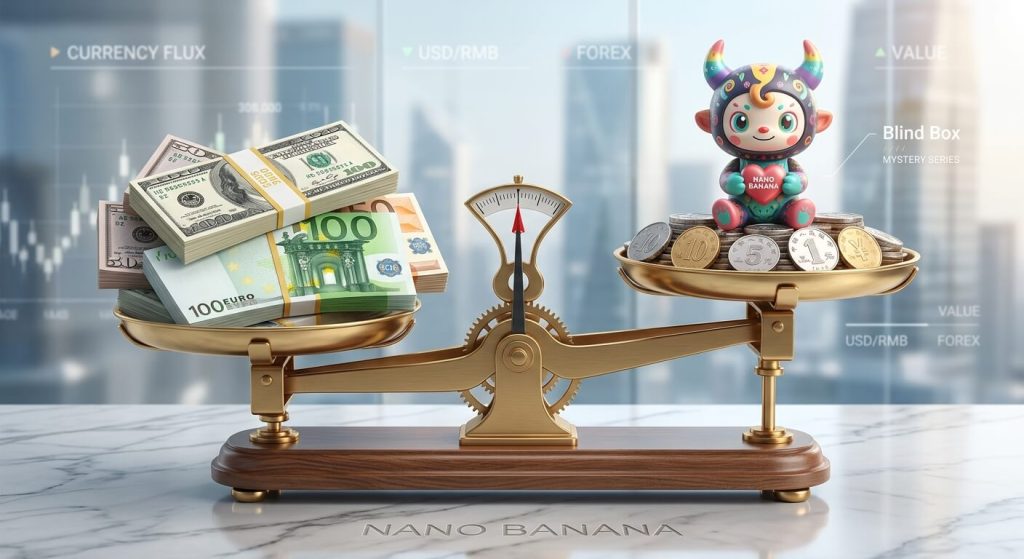
When you ask a Chinese supplier for a quote, they will typically give it to you in USD (US Dollars). However, their rent, payroll, and factory costs are paid in CNY. This means their USD quote is not static; it is a mathematical reflection of the current exchange rate.
How Macro-Economics Affects Your Toy Store
Imagine a Master Carton of Baby Three Plushies costs the supplier 1,400 CNY.
- Scenario A (Strong USD): Exchange rate is $1 USD = 7.2 CNY. The supplier quotes you $194.44 USD. You are happy.
- Scenario B (Weak USD): Six months later, the exchange rate drops to $1 USD = 6.8 CNY. To cover their 1,400 CNY cost, the supplier must now quote you $205.88 USD.
Nothing about the toy changed. The factory didn’t raise prices. The shipping weight is the same. Yet, your Cost of Goods Sold (COGS) just increased by nearly 6%, instantly wiping out a massive chunk of your retail profit margin if you do not adjust your store’s pricing accordingly.
2. The “Predatory Spread”: The Hidden Danger of PayPal and Credit Cards
The majority of beginner dropshippers and independent boutique owners use standard credit cards or PayPal to pay their overseas suppliers. They assume the 2.9% transaction fee is the only cost of doing business. This is a financially fatal assumption.
When you pay an international invoice in a foreign currency (or even if you pay in USD to a Chinese PayPal account that must convert it to withdraw), payment gateways apply a Currency Conversion Spread.
The PayPal “Double Dip” Trap
If you Google the current exchange rate (the Mid-Market Rate), you might see $1 = €0.92. However, if you use PayPal to pay a €5,000 European invoice or an equivalent Chinese invoice, PayPal does not use the Mid-Market Rate. They use their own “Retail Rate,” which is typically 3% to 4.5% worse than the Google rate.
This means on a $10,000 wholesale order, you are not just paying a $290 transaction fee; you are losing an additional $350 to $450 in invisible exchange rate markup.
3. The Retailer’s FinTech Stack: How to Pay Like a Pro
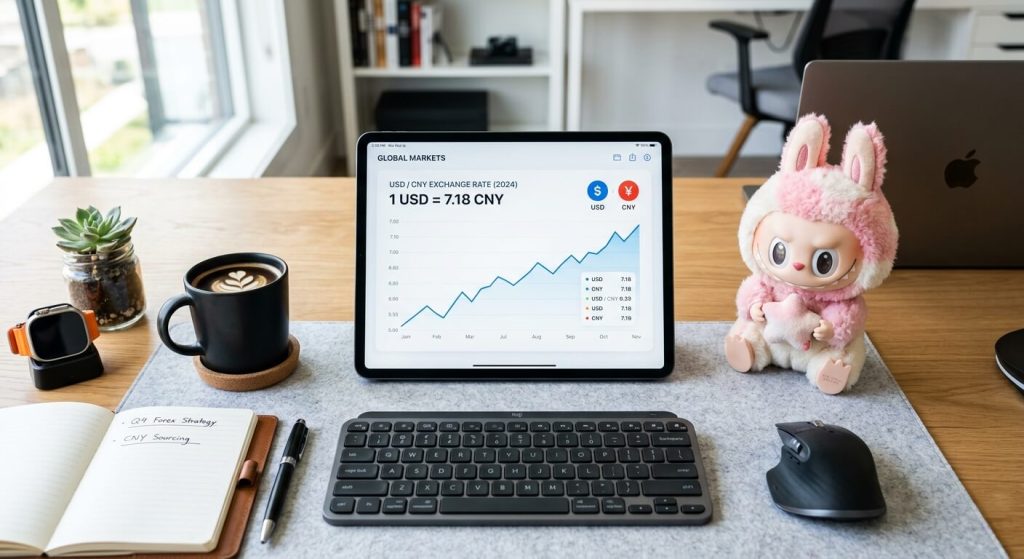
To survive in the high-volume, globalized art toy market, you must abandon consumer-grade payment methods and build a B2B FinTech (Financial Technology) Stack. The goal is to access the true “Mid-Market” exchange rate with minimal transaction fees.
| Payment Method | The True Cost | Speed & Reliability | KidultsBox Recommendation |
|---|---|---|---|
| PayPal / Standard Credit Card | ~3% Fee + ~4% FX Spread = ~7% Total Loss | Instant. High buyer protection. | Avoid for Bulk. Only use for tiny sample orders (under $500) where speed outweighs the massive percentage loss. |
| Bank Wire (Traditional TT) | $30-$50 Flat Fee + Variable Bank FX Spread (often 2-3%) | Slow (3-5 business days). Can get stuck in correspondent banks. | Outdated. Better than PayPal for massive orders (>$10k), but traditional banks still hide profits in bad exchange rates. |
| Wise (formerly TransferWise) | Tiny fixed fee + Mid-Market Exchange Rate (0% Spread) | Fast (1-2 days). Fully transparent tracking. | The Platinum Standard. If you are paying an international supplier in USD, EUR, or GBP, Wise gives you the exact Google exchange rate and charges a fraction of a percent in fees. |
| Payoneer / PingPong / Airwallex | ~1% to 1.5% Total Fee (Highly negotiable at volume) | Instant (Wallet to Wallet). | Excellent for E-commerce. These platforms allow you to hold virtual receiving accounts in USD, EUR, and GBP, avoiding conversion entirely if you pay a supplier who uses the same platform. |
4. Pricing Strategy: The “Currency Buffer” Formula
Because exchange rates fluctuate daily, you cannot afford to recalculate the MSRP of your blind boxes every morning. Changing the price of a Peluche Kimmon on your website from $18.99 to $19.45 and back again destroys consumer trust.
You must build a Currency Buffer into your Retail Pricing Model.
The Calculation:
When you calculate your landed COGS (Wholesale Toy Price + Freight + Duties), do not use today’s exact exchange rate. Add a 5% volatility buffer.
- Base Wholesale Cost: $10.00
- DDP Freight Cost: $2.00
- Current Landed Cost: $12.00
- Buffered Landed Cost (Add 5%): $12.60
You base your Retail Price markup on the $12.60 figure. If the currency remains stable, that extra 5% drops straight to your net profit line. If the US Dollar or Euro weakens significantly against the RMB over the next three months, your margins are protected, and you do not have to nervously raise prices on your customers.
5. Timing the Market: The “Golden Week” Factor
In currency exchange and international sourcing, when you buy is just as important as cómo you buy.
China operates on a massive export economy. Leading up to major holidays—specifically the Lunar New Year (January/February) y Golden Week (October 1st-7th)—factories and wholesale markets experience extreme chaos. Millions of businesses are scrambling to settle invoices, pay bonuses in RMB, and rush shipments to ports before the country shuts down.
- The Sourcing Rush: As foreign companies dump billions of USD/EUR into China to pay for holiday manufacturing, the demand for RMB spikes. This can occasionally cause short-term currency fluctuations.
- The Logistics Surcharge: More importantly, ocean and air freight rates skyrocket by 20% to 40% in the weeks leading up to these holidays due to zero container capacity.
The Retailer’s Move: Do not place your Q4 (Black Friday / Christmas) wholesale orders in September. You must finalize your bulk orders for BJD de Penny’s Box and Pop Mart cases in August. By paying your invoices early, you avoid both the peak-season freight surcharges and the holiday-induced exchange rate volatility.
6. The Wholesaler Advantage: Why KidultsBox Shields Your Risk
If you attempt to source directly from 10 different factories on Alibaba, you are acting as your own currency trader. You have to monitor the USD/CNY rate daily to ensure you aren’t being overcharged.
Partnering with a massive B2B global distributor like KidultsBox acts as a financial shock absorber. Because we operate on immense volume, we are able to absorb micro-fluctuations in the currency market. We provide stable, predictable, and transparent tiered pricing in USD.
When you request a wholesale quote from KidultsBox, the price is locked in. Furthermore, by utilizing our DDP (Delivered Duty Paid) logistics network, we fix your freight and customs costs upfront. You pay one clean invoice via secure, low-fee banking channels, allowing you to focus 100% of your energy on retail marketing rather than forex trading.
Preguntas más frecuentes (FAQ)
Q: I’m in the UK/EU. Should I ask my supplier to bill me in GBP/EUR or USD?
A: Historically, the global toy supply chain operates in USD. If a Chinese supplier offers to bill you directly in GBP or EUR, they are almost certainly applying their own hidden “padding” (3-5%) to protect themselves against the conversion back to USD/CNY. It is almost always mathematically cheaper to ask for the invoice in USD, and then use a tool like Wise to convert your GBP/EUR to USD at the exact mid-market rate.
Q: Does paying via “Alibaba Trade Assurance” have hidden currency fees?
A: Yes. While Trade Assurance protects you from fraud, Alibaba usually charges a ~3% processing fee if you pay by credit card. Additionally, your local bank will charge a Foreign Transaction Fee (1-3%) because Alibaba’s payment gateway is international. If you use Alibaba, pay via Bank Wire (T/T) through the platform to minimize percentage-based fees on large orders.
Q: What happens to my pre-order margins if the currency crashes before the toys ship?
A: This is the danger of long-term pre-orders. If you collect $10,000 from your customers today, but you don’t pay your wholesale invoice until the toys are manufactured in 3 months, a 5% currency shift wipes out $500 of your profit. Always pay your wholesale supplier the moment you collect the pre-order funds from your customers to lock in your margin.
Q: Can KidultsBox accept payments from Payoneer or Wise?
A: Absolutely. We understand the modern B2B financial ecosystem. We provide official commercial invoices and accept payments via established, low-fee FinTech platforms (including TT bank transfers) to ensure our retail partners maintain their maximum profit margins.