

A retailer’s first plush buying risk is committing fixture space, cash flow, and backroom capacity before the assortment role is clear. A profitable plush blind box assortment comes later, after the buyer has weighed shopper profile, sell-through confidence, and how often the store can reorder without disrupting the display. Gift shops, anime stores, mall kiosks, toy boutiques, and online sellers all need different mixes, even when they source from the same wholesale supplier.
This guide shows how to plan a plush blind box assortment as a buying decision: what to carry first, how to split risk across styles, when to use plush keychains versus larger plush dolls, and how to think about cartons, case packs, and replenishment before you place a wholesale order. For broader category planning, use this wholesale blind box buying guide alongside the assortment steps below.
Choose the plush blind box assortment mix by store type before ordering
| Retail buyer type | Assortment priority | Stock logic | What to avoid |
|---|---|---|---|
| Gift shops | Soft, easy-to-gift characters with broad age appeal | Keep the mix easy to understand for impulse buyers and gift-givers | Overly niche themes that require fandom knowledge |
| Anime stores | Character-forward plush with collectible energy and display depth | Support repeat visits with multiple designs from the same series | Too many unrelated one-off plush lines that dilute collector interest |
| Mall kiosks | Compact, high-visibility plush blind boxes that fit small fixtures | Prioritize fast restocking and clean counter presentation | Bulky cartons that block limited storage space |
| Toy boutiques | Balanced mix of cute, premium-feeling, and novelty plush formats | Use a curated range that encourages parent-child selection | Assortments that look repetitive across shelves |
| Online boutiques | Photogenic plush designs with clear product page storytelling | Group SKUs by theme so listings, bundles, and restocks stay manageable | Too many small test lines that make fulfillment confusing |
Before reviewing a catalog, define the store type you are buying for. A gift shop near museums or tourist areas usually needs plush blind boxes that work as low-explanation presents. The buyer should favor characters and animal themes that make sense within seconds. An anime store can carry more character-specific or collector-focused plush because the customer expects discovery and series depth.
A kiosk buyer should not plan the same assortment as a full toy store. Counter space and backstock are limited, so the assortment needs to be visually strong and easy to replenish. Online boutiques can handle more visual variety, but only if product photos, listing names, and fulfillment labels are organized. The key buyer action is to assign each plush blind box series a role before ordering: broad impulse item, collector line, seasonal feature, display filler, or online bundle component.
Allocate opening stock across core lines, trial lines, and refill inventory
Once you choose the retail role, divide your opening buy into three working groups: core lines, trial lines, and refill inventory. Core lines are the plush blind box assortment items you expect to keep visible for more than one selling cycle. These should have the strongest fit with your store audience and fixture. Trial lines are smaller commitments used to test a new theme, scale, or character style. Refill inventory is the backstock needed to keep the display from looking picked over while you wait for the next supply decision.
Do not treat every plush blind box line equally. If all styles receive the same shelf space and reorder attention, weak sellers can occupy the same visual priority as strong sellers. A better approach is to give core lines the most reliable display position, place trial lines in secondary areas, and track whether customers ask for more after the first exposure. As a starting example, some buyers weight roughly 60% core, 25% trial, and 15% refill, then adjust to the fixture, storage space, and reorder confidence rather than treating the split as a rule. If your supplier uses minimum order quantities or case-based ordering, use the MOQ as a planning constraint rather than a reason to overbuy every design. The goal is to meet wholesale requirements while still protecting cash flow and storage space.
Retailers should also separate display quantity from safety stock. A plush blind box display may need enough units to look full, but backroom stock should be based on reorder confidence. If the line is proven, holding additional refill inventory may be reasonable. If the line is new, keep the trial tighter and plan a faster review. Before finalizing how much of the fixture should be plush, review the plush blind box category and compare space needs with adjacent collectible categories such as BJD/MJD plush blind boxes o Cajas sorpresa de PVC.
Decide whether plush keychains or plush dolls should lead the fixture
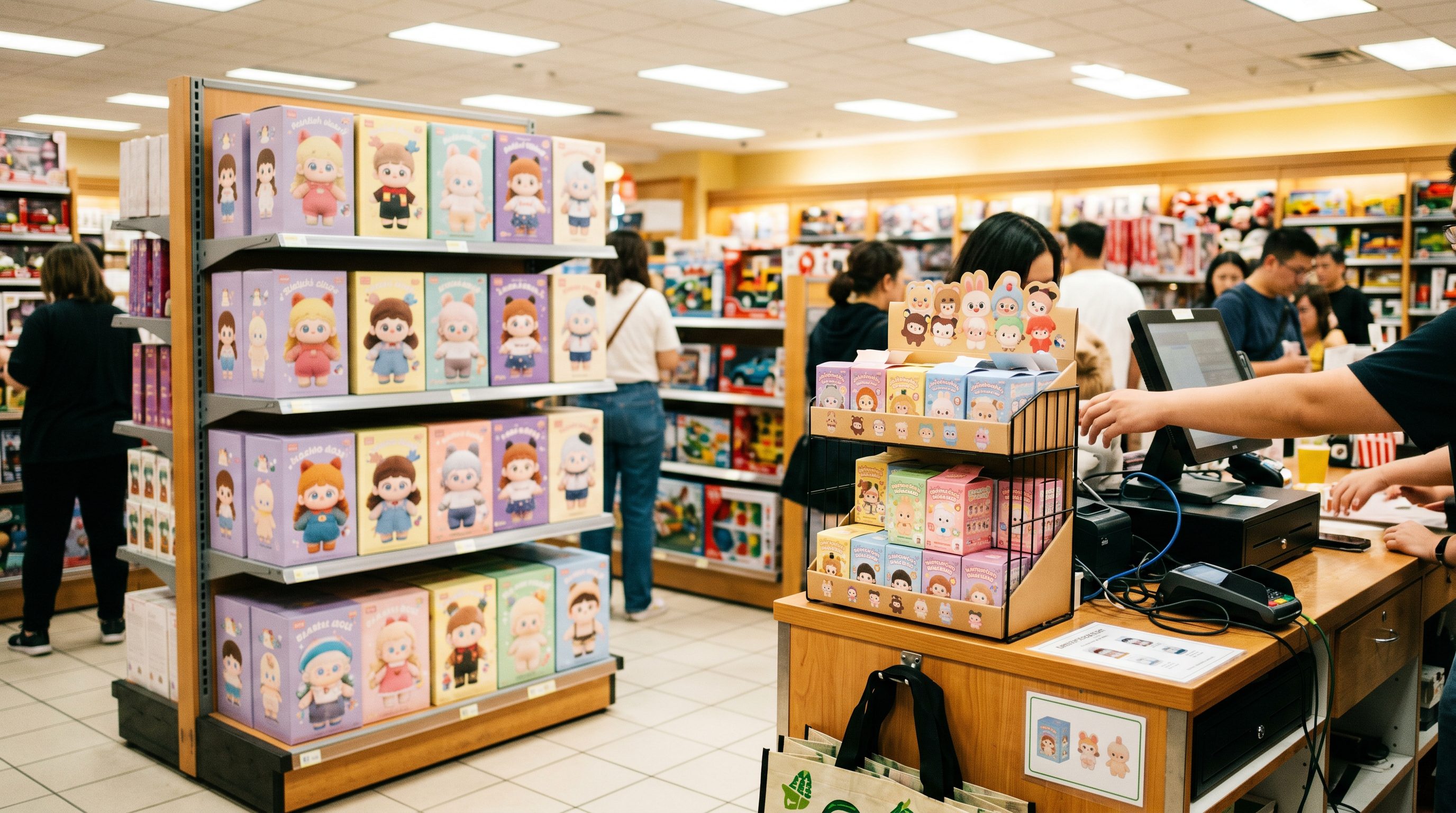
Not every plush blind box assortment should be built around the same plush format. Plush keychains and plush dolls behave differently in-store. Keychains usually work well near checkout counters, bag displays, stationery zones, and small impulse areas because they are compact and easy to add to another purchase. Plush dolls often need more shelf presence and can become the main visual feature of a toy, gift, or anime section.
If your fixture is shallow, narrow, or located near the cash wrap, plush keychains may lead the assortment because they allow more variety in less space. If your store uses larger cube shelving, table displays, or window-facing merchandising, plush dolls can create stronger visual impact. Review plush keychains versus plush dolls as an internal fixture decision before deciding which format should receive the larger share of the buy.
A practical retailer decision is to assign one format as the traffic driver and the other as the add-on. For example, an anime store may use plush dolls to attract collectors to the shelf, then place plush keychain blind boxes nearby as lower-space add-ons. A gift shop may reverse the logic: keychains at the counter for impulse gifting, with a smaller plush doll range on a side shelf for shoppers who want something more substantial. The best mix depends on fixture space, basket-building strategy, and how much backstock the store can hold without crowding operational areas.
When comparing formats, ask your supplier for carton dimensions, product dimensions, and case display options when available. Larger plush may increase shipping volume and storage pressure, even if the per-unit merchandising value feels stronger. Smaller plush may be easier to test across several themes, but the display can look scattered if the packaging does not block well on the shelf.
Build seasonal plush reserves only after separating evergreen demand from event demand
Seasonal buying should not mean replacing the entire plush blind box assortment with holiday designs. A safer approach is to separate evergreen demand from event demand. Evergreen plush includes animals, cute mascots, soft character styles, and themes that can sell outside a specific holiday. Event demand includes Valentine’s gifting, back-to-school rewards, Halloween novelty, holiday stocking stuffers, convention weekends, and local tourist peaks.
The buyer action is to decide how much seasonal reserve the store can support without weakening everyday replenishment. If a gift shop expects a holiday traffic lift, it can add seasonal plush blind boxes as a feature table or counter basket while keeping evergreen plush on the main shelf. An anime store may need event-timed stock before conventions or school breaks, but should avoid letting short-window themes crowd out lines that customers collect year-round.
Use the calendar backward. Identify when the display must be ready, then confirm how much receiving, labeling, pricing, and merchandising work is required before the selling window. Avoid placing seasonal plush stock so late that staff must rush setup or so early that storage fills before the promotion begins. Seasonal plush blind box stocking should be planned as a separate reserve instead of being mixed automatically into everyday replenishment.
Seasonal reserves should also be physically separated in your inventory plan. Mark which cartons are for immediate shelf replenishment and which are held for the seasonal reset. Without that distinction, staff may open seasonal cases too early to fill an everyday gap, leaving the promotion understocked when the event starts.
Compare plush carton volume against hard-goods before confirming shelf and backroom space
Plush blind boxes can create more shipping and storage considerations than small hard goods because plush volume varies by format. Before confirming the order, request packaging details that help you understand how the product will arrive, how it will sit on the shelf, and how much receiving space it will require. You do not need exact shipping cost assumptions at the assortment stage, but you do need to know whether the order is operationally realistic for your store.
Ask whether the item is shipped in retail display boxes, master cartons, or other case arrangements. A mall kiosk may prefer packaging that can move from carton to counter with minimal handling. A larger toy boutique may prefer packaging that supports a fuller shelf presentation. An online seller may care more about individual packaging condition, barcode organization, and how easily staff can pick and pack the blind boxes without damaging presentation.
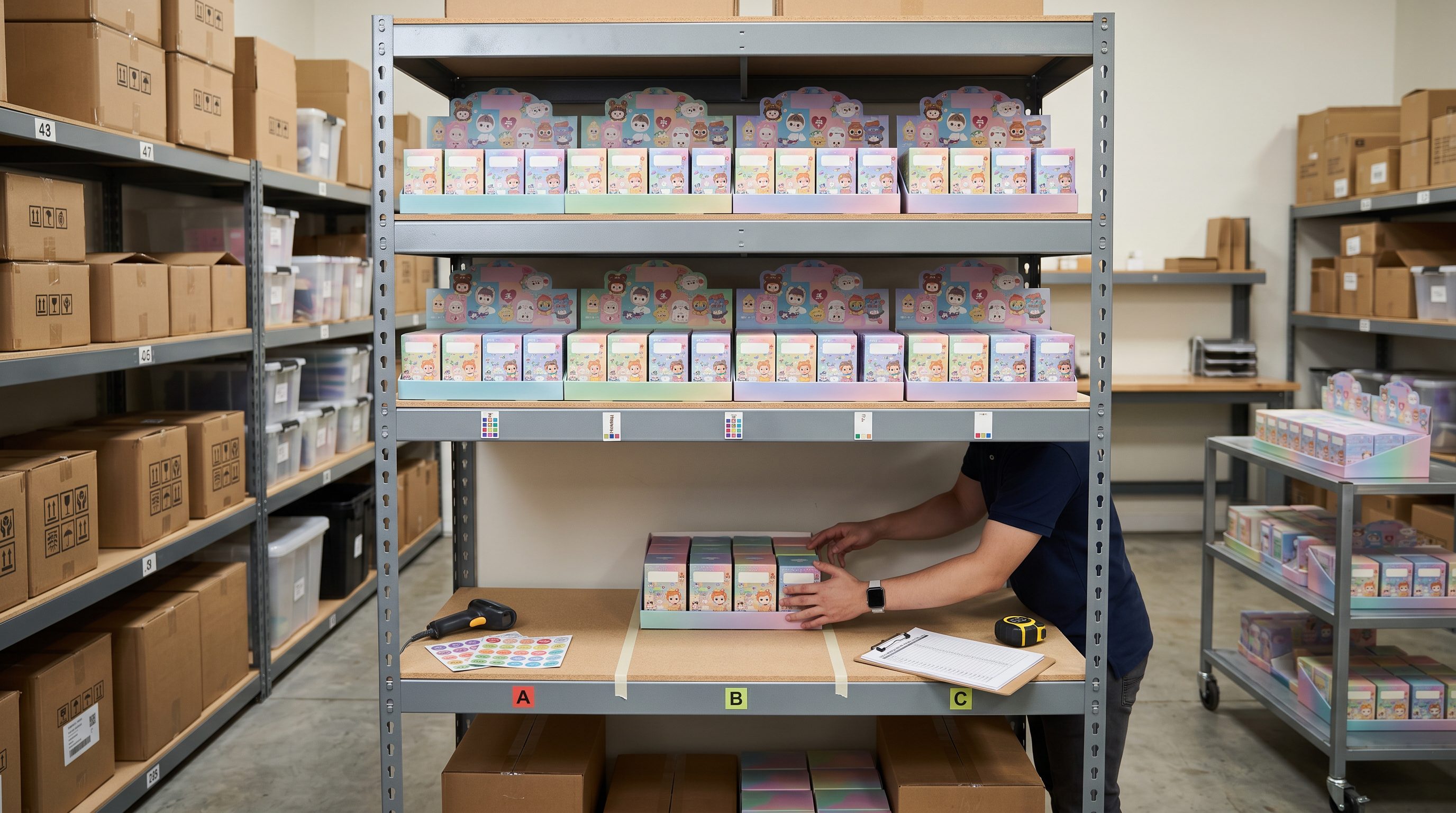
Fixture fit should be confirmed before the buy, not after delivery. Measure shelf depth, counter width, peg area if keychains are involved, and backroom space. Then decide which plush blind box assortment lines can be displayed fully and which should be limited to smaller tests. If the packaging is too deep for your shelf or too tall for your counter, the line may still be attractive but unsuitable for that location.
Shipping logic should also influence assortment breadth. A retailer that can reorder more frequently may test a wider spread of plush themes with lower internal risk. A retailer that consolidates shipments may need to focus on fewer, stronger plush lines to avoid tying up space in slow-moving variants. In either case, confirm packing structure, product images, and display needs before the purchase order is finalized.
Set reorder rules before the first plush blind box shipment arrives
Many retailers wait until stock is visibly low before thinking about reorder rules. That creates avoidable gaps, especially with blind box displays where a half-empty fixture reduces the feeling of discovery. Before the first shipment arrives, decide what signal will trigger a reorder review. The signal can be based on display fullness, backstock level, sales velocity, customer requests, or a scheduled weekly inventory check. The exact method depends on the store, but the rule should exist before the first unit sells.
For gift shops and kiosks, visual fullness is critical. A plush blind box counter display should not look abandoned. Staff can be instructed to consolidate boxes neatly and flag low stock when the display no longer looks abundant. For instance, trigger a review when the display looks under ~70% full, then confirm whether the cause is normal sell-through, poor facing, or a misplaced backstock carton before reordering. For anime stores, the signal may include customer questions about specific series, repeat purchases, or social media interest. For online boutiques, the trigger may be listing availability and whether the remaining quantity is enough to support ongoing ads or email promotions.
Reorder rules should also identify which lines are allowed to expand and which should be cleared. If a trial line sells steadily and fits the store identity, it can move into the core assortment. If a line sells only when discounted or only during one event, it should not automatically receive the same reorder priority. This is where assortment planning becomes a repeatable buying system rather than a one-time product selection.
Keep notes by plush format, theme, and display location. A slow seller near the back of the store may perform better at the counter, while a strong seller may justify a larger front-facing display. Without location notes, buyers may misread performance and drop a line that simply had weak placement.
Request samples, images, and a quote package before committing the assortment
Before committing to a plush blind box assortment, collect the information needed for both buying and merchandising. Ask for available product photos, size references, packaging details, case or carton structure, and current availability. If you are testing multiple plush formats, request guidance on which items are better suited to gift shops, anime stores, kiosks, toy boutiques, or online retail. This helps prevent a mismatch between attractive products and the realities of your fixture.
Samples can be useful when texture, stitching quality, packaging finish, or size perception will affect the sale. If samples are available, evaluate them the same way a customer will encounter them: on a shelf, in the hand, under store lighting, and next to your existing merchandise. Do not evaluate plush only on a desk in the back office. A product that looks strong in a supplier image still needs to work inside your store environment.
Finally, prepare your quote request with practical details: store type, target plush formats, desired assortment breadth, destination region, preferred shipment consolidation if relevant, and whether you are buying for a seasonal event or evergreen display. The clearer the request, the easier it is for a wholesale supplier to recommend a workable mix without pushing unnecessary variety.
Ready to plan your next plush blind box assortment? Send your store type, target display size, and preferred plush formats through the wholesale blind box quote request so Blind Box Wholesale can help match assortment options to your retail buying plan.
Next steps: see our browse the category to plan your order.