


The Art Toy industry is built on a paradox. On one hand, brands like Pop Mart and designers of plush icons like Bebé Tres market their products as “Healing Toys”—stress-relieving, joyful companions for modern adults. On the other hand, the packaging required to deliver that single hit of unboxing dopamine creates an environmental nightmare.
In 2026, the modern “Kidult” consumer (Gen Z and Millennials) is experiencing a deep psychological friction. They love collecting, but they harbor immense guilt over single-use plastics. When a collector opens a full case of 12 blind boxes, they are left with a mountain of shrink wrap, glossy cardboard, mylar foil bags, silica gel packets, and plastic internal clamshells.
For independent retailers, drop-shippers, and global distributors like KidultsBox, Sustainability is no longer just PR; it is a vital commercial pivot. Governments in the EU are enforcing strict EPR (Extended Producer Responsibility) packaging laws, and consumers are actively boycotting brands with egregious waste profiles. This comprehensive whitepaper delves into the material science, the economic cost of going green, and how toy retailers can leverage sustainable packaging as a massive competitive advantage.
1. The Anatomy of Blind Box Waste (The Plastic Problem)
To understand the solution, we must autopsy the problem. Why are blind boxes so heavily packaged in the first place? It is not out of malice; it is out of structural necessity and the demand for the “Mystery” experience.
The Layers of Defensive Packaging
- Outer Shrink Wrap (POF/PVC): Used to prevent “Box Searchers” from opening boxes in the store and tampering with the contents. Non-recyclable in standard municipal bins.
- Glossy Cardboard Box: Laminated with a thin layer of plastic film to make the artwork “pop” under retail lights. This lamination renders the cardboard unrecyclable because paper mills cannot separate the plastic from the pulp.
- The Foil Bag (Mylar/Aluminum Composite): The core of the mystery. It prevents the customer from holding the box up to a harsh light to see the silhouette of the toy. Mylar is virtually impossible to recycle.
- The Internal Clamshell (PET/PVC): Used to prevent the figure and its accessories from rattling or breaking during global transit. Often single-use and immediately discarded.
- The Silica Gel Packet: Necessary to prevent moisture and mold, especially during sea freight from Asia to Europe/USA.
The challenge for manufacturers is daunting: How do you remove the foil and plastic without destroying the “Blind” aspect of the Blind Box or sacrificing the product’s safety during trans-oceanic shipping?
2. Consumer Psychology: The “Green” Gen Z Collector
A fatal mistake older retailers make is assuming that because a customer buys a plastic toy, they do not care about the environment. The data tells a drastically different story.
According to 2025 consumer habit surveys, 73% of Gen Z consumers stated they would pay a 10% premium for products housed in verifiable eco-friendly packaging. However, this demographic is also highly educated on “Greenwashing” (fake environmental claims). They do not want a green leaf printed on a plastic box; they want fundamental material changes.
When a retailer offers an eco-friendly unboxing experience, the customer’s purchase guilt evaporates. This leads to a higher Average Order Value (AOV) because the psychological barrier to buying “just one more box” is removed when the packaging is perceived as harmless.
3. Innovations in Toy Packaging: What is Replacing Plastic?

The factories producing for the top-tier brands in the KidultsBox ecosystem are currently testing cutting-edge material replacements. Here is what is hitting the retail shelves in late 2026.
A. The End of the Foil Bag: Opaque Biodegradable Cellulose
The Mylar foil bag is the biggest villain of the blind box world. The industry is currently shifting toward Opaque Cellulose Films (derived from wood pulp) or thick, dyed Kraft paper pouches. These materials tear with a satisfying “rip” (preserving the ASMR unboxing experience) and completely block light, maintaining the mystery, but they can be composted in a backyard bin in under 90 days.
B. Molded Pulp Internal Trays (The Egg Carton Method)
To replace the clear plastic internal clamshells that hold the toys securely, manufacturers are adopting high-density molded pulp (similar to the packaging used for premium smartphones or egg cartons). It is custom-molded to fit the exact shape of a Peluche Kimmon or a vinyl figure, absorbing shock better than hard plastic while being 100% recyclable.
C. Soy-Based Inks and Unlaminated Cardboard
To make the outer boxes recyclable, brands are stripping away the plastic gloss lamination. They are moving to raw, textured Kraft or uncoated white cardboard printed with soy or water-based inks. The aesthetic is shifting from “High Gloss Neon” to a more “Matte, Premium Organic” look, which ironically feels more luxurious and artistic to modern adult collectors.
4. Cost vs. Margin: The Economics of Going Green
The most common pushback from retail owners is: “If the factory uses sustainable packaging, my wholesale cost will skyrocket, and I will lose my profit margin.”
Let us examine the actual B2B cost breakdowns per unit when sourcing from a major manufacturer.
| Packaging Component | Traditional (Plastic/Mylar) Cost | Sustainable (Pulp/Cellulose) Cost | Net Increase per Unit |
|---|---|---|---|
| Outer Box (Glossy vs. Uncoated Soy) | $0.15 | $0.18 | +$0.03 |
| Inner Mystery Bag (Mylar vs. Cellulose) | $0.05 | $0.12 | +$0.07 |
| Internal Support (PET Clamshell vs. Molded Pulp) | $0.08 | $0.15 | +$0.07 |
| Total Packaging Cost per Box | $0.28 | $0.45 | +$0.17 |
The Retailer’s Reality Check: Yes, sustainable packaging increases the manufacturing Cost of Goods Sold (COGS) by approximately $0.17 to $0.25 per box.
However, if an eco-friendly box allows you to raise your MSRP (retail price) from $15.00 to $15.99 without losing sales volume (due to the “Green Premium” willingness to pay), you have not only covered the $0.17 cost increase, but you have actively increased your net profit by $0.82 per box.
5. Retailer Strategies: Implementing “Circular Retail”
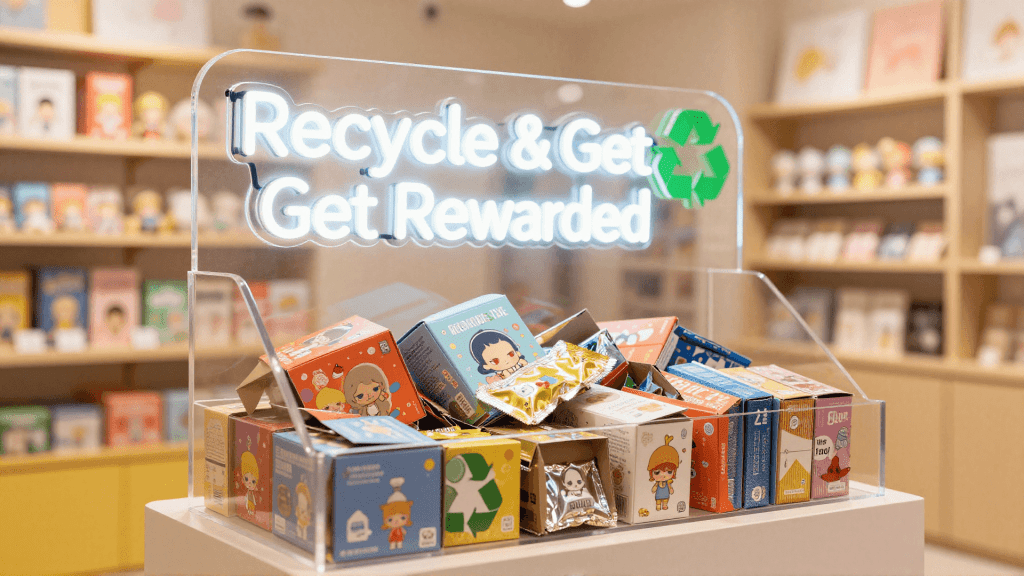
Even if the manufacturers are slow to adopt 100% green packaging, you, as the independent retailer, can implement sustainability initiatives at the store level to capture the eco-conscious demographic.
The “Empty Box” Recycling Bounty (A Massive Traffic Driver)
Do not wait for the packaging to become biodegradable; intercept it before it hits the landfill. Set up a beautiful, branded “Recycling Station” inside your toy store.
The Pitch: “Bring back 10 empty blind box cardboard boxes and foil wrappers to our store for proper recycling, and we will give you a 15% discount on your next full case, or a free acrylic display case!”
Why this is retail genius: You are solving the customer’s trash problem, making them feel good about the environment, and—most importantly—forcing them to walk back into your physical store, where they will inevitably buy more Muñecas BJD de Penny’s Box.
Upcycling Display Materials
If you unbox display models for your shelves, do not throw away the empty boxes. Use them. Many indie bookstores and cafes create massive “Blind Box Wallpaper” by flattening the vibrant cardboard boxes and using them to decorate the counter or walls. It showcases your inventory volume while keeping the cardboard out of the trash.
6. The Future of the Toy Itself: Bio-PVC and Recycled ABS
Fixing the box is step one. Step two is fixing the toy.
Traditional designer toys are made of PVC (Polyvinyl Chloride), which is notoriously toxic to produce and impossible to biodegrade. The Vanguard of the industry is experimenting with Bio-PVC (plastics derived from sugarcane or corn starch rather than petroleum) and Recycled ABS (using melted-down factory scraps to cast new toys).
Currently, the limitation is precision. Bio-plastics often shrink unpredictably when cooling in steel injection molds, which makes high-detail sculpting and sharp mechanical joints difficult. However, for “soft” shapes and simplistic designs, expect to see the first wave of 100% Bio-Plastic blind boxes hitting the KidultsBox wholesale catalog by late 2027.
7. Marketing Sustainability to Your Customers (Avoiding Greenwashing)
If you source an eco-friendly line of toys, you must market it correctly. Consumers are highly cynical. If you over-promise, you will be accused of “Greenwashing.”
- Don’t Say: “This toy will save the ocean!” (Hyperbolic, easily disproven).
- Do Say: “We are proud to stock the new Eco-Series. The outer box is printed with soy-based inks and the inner bag is 100% compostable cellulose. It’s a small step towards a cleaner hobby.” (Specific, factual, humble).
Highlight the sustainable features in your unboxing videos. When filming a TikTok Reel, physically show how the new compostable bag tears differently from the old foil bag. Make the “greenness” a feature of the unboxing ASMR.
Preguntas más frecuentes (FAQ)
Q: Are the plush toys (like Baby Three) more environmentally friendly than vinyl toys?
A: Not necessarily. Standard plush toys use polyester fabric and PP cotton stuffing, which are derived from petroleum (essentially woven plastic). They do not biodegrade. However, some newer boutique brands are experimenting with organic cotton and recycled PET bottle stuffing. Always check the materials tag.
Q: I sell in the EU. How do EPR (Extended Producer Responsibility) packaging laws affect my toy store?
A: If you import wholesale master cartons from Asia into countries like Germany (LUCID) or France (Triman), you are legally considered the “Producer” placing the packaging on the market. You must register with a national recycling scheme and pay a fee based on the kilos of cardboard and plastic you import. Sourcing toys with less plastic packaging directly lowers your legal EPR tax burden.
Q: Will eco-friendly bags ruin the “Blind” aspect if they are held up to the light?
A: Early paper bags had this problem, allowing “Box Searchers” to shine phone flashlights through the paper to see the toy silhouette. Modern eco-packaging uses high-opacity, thick Kraft paper with dark internal dying to ensure it is 100% light-blocking, completely preserving the mystery.
Q: Does KidultsBox offer eco-friendly blind box lines?
A: The industry is in a transitional phase. While standard PVC and foil remain the norm for the largest IPs, KidultsBox is actively partnering with progressive designer studios prioritizing sustainable packaging. Ask your account manager about our emerging “Eco-Conscious Category” for your next wholesale order.