




In the world of physical retail, foot traffic is oxygen. But if you want to open your Art Toy boutique in a “Class A” shopping mall (high-end centers owned by mega-conglomerates like Simon Property Group, Westfield, or Brookfield), you cannot simply walk in and hand them a deposit. Premium landlords gatekeep their real estate.
To a corporate Leasing Agent, an independent “Toy Store” sounds like a terrifying financial risk. They picture chaotic flea-market aesthetics, screaming toddlers, cheap plastic junk, and a business that will inevitably fail, leaving them with unpaid rent and an empty storefront. If you approach them with this positioning, your Letter of Intent (LOI) will be immediately rejected in favor of another generic perfume brand or athleisure store.
To secure a prime inline store or a high-visibility center-court kiosk, you must execute a psychological reframe. You must convince the landlord that you are not opening a toy store; you are opening an “Experiential Pop-Culture Art Gallery” targeting high-net-worth adults. For B2B partners sourcing premium wholesale inventory from KidultsBox, this comprehensive commercial real estate (CRE) playbook will teach you how to build an irresistible Pitch Deck, negotiate Tenant Improvement (TI) allowances, and secure the exact square footage your business needs to explode.
1. The Psychology of the Leasing Agent: Risk vs. Reward
Before you draft a single slide of your pitch deck, you must understand the two metrics that keep a Mall Leasing Director awake at night:
- Tenant Default Risk: Will this person actually pay the $8,000/month rent for the next 3 years?
- The “Halo Effect” (Co-Tenancy): Will this store make the mall look “cool”? Will it drive new, younger foot traffic that will subsequently spend money at the food court and the luxury fashion stores next door?
The Anti-Toy Store Reframe
You must brutally distance yourself from the legacy “Toys R Us” model. Your entire pitch must center around the “Kidult” Demographic.
Tell the landlord: “We do not sell to children. We sell high-end designer collectibles to Gen Z and Millennials aged 18 to 35. Our average customer is a young professional with high disposable income who spends $50 to $150 per visit on aesthetic desk decor and fashion accessories.”
When the landlord hears “young professional with high disposable income,” their eyes light up. That is exactly the demographic every mall on earth is desperately trying to attract.
2. The Ultimate Art Toy Pitch Deck (Slide-by-Slide)
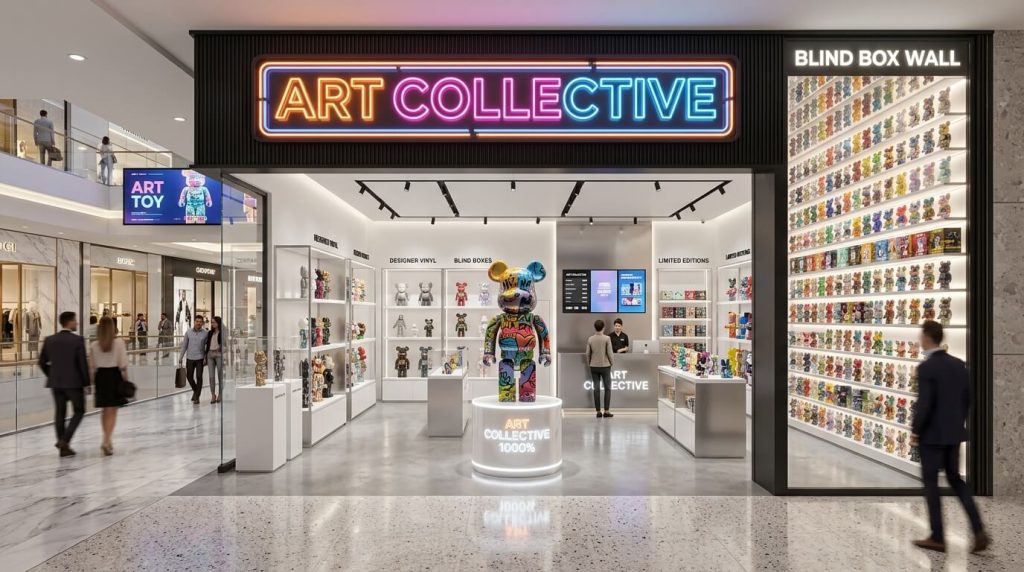
You cannot pitch a Class A mall over a phone call. You must submit a professional PDF Pitch Deck (also known as a Tenant Lookbook). This document must be hyper-visual. Here is the mandatory 5-slide architecture.
| Slide Title | The Visual Content | The Business Goal (What it proves to the Landlord) |
|---|---|---|
| 1. The Concept & Vibe | High-res photos of pristine, neon-lit blind box walls, aesthetic Pop Mart MEGA figures, and Gen Z shoppers. | Proves your store is “Boutique” and “Instagrammable,” not a messy discount bin. It elevates their mall’s aesthetic. |
| 2. The Demographic Data | Infographics showing the global $45 Billion Art Toy Market, highlighting the 18-35 age bracket and high AOV. | De-risks the business model. Proves that adults actually buy these products at high volumes. |
| 3. The “Experiential” Hook | Photos of an “Unboxing Station,” Trading Boards, and excited customers holding rare figures. | Proves Dwell Time. You aren’t just selling items; you are creating an event. Malls desperately need “Experiential Retail” to survive against Amazon. |
| 4. Supply Chain & Brand Partners | Logos of the IPs you carry: Baby Three, ShinWoo, Penny’s Box. Mention your partnership with KidultsBox. | Proves inventory stability. By stating you have a reliable global B2B distributor, you prove you won’t have empty shelves in month 3. |
| 5. The 3D Render (CRITICAL) | A professional architectural 3D rendering of exactly how your store/kiosk will look in their specific mall. | The Closer. Leasing agents lack imagination. If you show them a stunning 3D mockup of your neon signage in their corridor, they will instantly want it. |
3. Selling the “Weekly Foot Traffic” Superpower
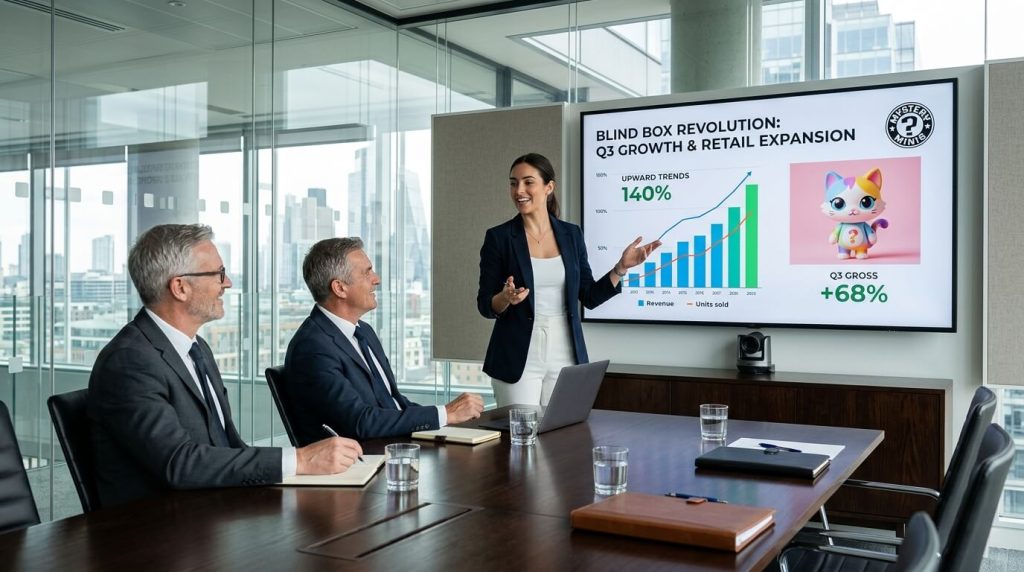
When you are negotiating against a high-end clothing store for the same retail space, you have one massive advantage that you must hammer home during the pitch: Visit Frequency.
A customer buys a winter coat once a year. A blind box collector buys a blind box every single week.
The “Drop Culture” Pitch Script:
“Unlike traditional apparel tenants, our business model is built on ‘Drop Culture.’ We receive new, highly anticipated, limited-edition inventory from our distributors every single Friday.
Because of this, our customers do not visit our store once a quarter. They visit us weekly to hunt for the newest ‘Secret’ figures and trade with the community. We will literally inject 300 to 500 guaranteed, highly engaged, high-spending young adults into your mall corridor every single weekend. We are not just a tenant; we are a foot-traffic anchor for this wing of the mall.”
4. De-Risking the Deal: Pop-Ups to Permanent Leases
If you are a first-time business owner with no previous brick-and-mortar track record, a Class A mall will likely reject your request for a 5-year lease on a 1,500 sq ft inline store. The risk is too high for them.
You must use the “Prove It” Strategy via Specialty Leasing.
- Step 1: The RMU (Retail Merchandising Unit) or Kiosk. Ask the Specialty Leasing department for a 3-month or 6-month short-term lease on a center-aisle kiosk during Q4 (October – December).
- Step 2: Dominate the Sales Data. Use the high-margin Kimmon plushies and Pop Mart blind boxes from KidultsBox to generate explosive revenue. Keep meticulous POS records.
- Step 3: The Upgrade Pitch. In January, take your 3-month sales data back to the Leasing Director. “We generated $80,000 in gross sales from a 10×10 cart in 90 days. We have completely outgrown this cart. We are ready to sign a 3-year lease on the vacant 800 sq ft inline store next to Sephora.” With hard data in hand, they will roll out the red carpet for you.
5. Commercial Real Estate Traps to Avoid
When the landlord finally says “Yes” and hands you a Letter of Intent (LOI) or a lease agreement, the battle is only half won. Commercial leases are notoriously predatory. You must negotiate these three clauses:
A. Percentage Rent & The Natural Breakpoint
Malls often charge a Base Rent plus a percentage of your sales (e.g., 10%) over a certain threshold (The Breakpoint).
The Trap: Because blind boxes are high-volume, you will hit your breakpoint very fast, effectively punishing you for being successful.
The Negotiation: Demand an “Artificial Breakpoint.” Insist that percentage rent does not kick in until you hit $40,000/month in sales, ensuring your profit margins on wholesale goods from KidultsBox remain intact.
B. Tenant Improvement (TI) Allowance
If you are moving into an inline store that used to be a shoe shop, you need to build a custom Blind Box Wall, install new LED lighting, and lay new flooring. This can cost $30,000+.
The Negotiation: Do not pay for this yourself. Ask the landlord for a TI Allowance (e.g., $30 per square foot). The landlord will literally give you cash to build out your store, because your beautiful renovations increase the permanent value of their real estate.
C. The Radius Clause
Malls will put a clause in your lease saying you cannot open another toy store within a 5-mile or 10-mile radius.
The Trap: If your store is a massive success, you might want to open a second location in a busy outdoor shopping center 3 miles away. The radius clause will block you.
The Negotiation: Strike this clause completely, or negotiate it down to a 1-mile radius.
6. Social Proof: The “O2O” Advantage
Leasing agents are terrified of the “Retail Apocalypse” (the death of malls due to e-commerce). You must position your store as the solution to this problem.
Show them your Instagram, TikTok, or Shopify data. Explain the O2O (Online-to-Offline) model:
“We already have a thriving e-commerce customer base in this city. We are not hoping the mall brings us customers; we are bringing our online customers to your mall. We use BOPIS (Buy Online, Pick Up In-Store) to force our 10,000 local social media followers to physically walk through your doors to pick up their limited-edition pre-orders.”
When a landlord hears that you have a self-sustaining marketing engine that drives guaranteed foot traffic, you transition from being a “risky tenant” to a “highly desirable anchor.”
Frequently Asked Questions (FAQ)
Q: Will a mall require a personal guarantee on the lease?
A: Almost certainly, especially for your first store. A “Personal Guarantee” means if your LLC goes bankrupt and breaks the lease, the landlord can come after your personal assets (your house, car, etc.) to collect the unpaid rent. Negotiation Hack: Try to negotiate a “Rolling Guarantee,” where your personal liability burns off after the first 12 or 24 months of on-time rent payments.
Q: Should I hire a commercial real estate broker?
A: Yes. A good retail broker costs you nothing (their commission is paid by the landlord). They know exactly what rent other tenants in the mall are paying, they know how to negotiate the LOI, and they have existing relationships with the Leasing Directors. They level the playing field.
Q: Malls hate “clutter.” How do I prove my blind box store will look high-end?
A: In your pitch deck, commit to Acrylic and LEDs. Promise the landlord that all inventory will be displayed on sleek, custom acrylic shelving with integrated 4000K neutral-white LED lighting, avoiding wire racks or cardboard dump bins. Compare your aesthetic to an Apple Store or a high-end sneaker boutique like Kith.
Q: Can I use KidultsBox as a reference for my supply chain stability?
A: Absolutely. Leasing agents want to know you won’t suffer from “empty shelf syndrome.” Explaining that you have a dedicated, global B2B distributor supplying you with constant, reliable Master Cartons of the world’s top IPs provides immense reassurance to commercial landlords.