



Committing shelf space and cash to a collectible doll line usually happens before you know which details your customers will actually care about. If you are weighing Girls’ After-School Club against Saturday Girls, a useful 1/6 BJD comparison has to go past styling and look at construction, included accessories, assortment rules, and delivered cost.
No verified specification sheets or commercial terms for either series are supplied here. This guide therefore does not assign unconfirmed features to either line. Instead, it shows exactly what to request, how to compare the answers, and when one series would make more sense for your store than the other.
Which 1/6 BJD Series Fits Your Customers?
Start with the purchase your customer expects to make. Do they want an outfit-led display doll, a poseable photography subject, or a collectible surprise? Do not infer the selling format or intended age group from either series name.
- Especialistas em bonecas: Prioritize joint construction, body measurements, dressing access, and any documented compatibility with accessories.
- Online collectible stores: Favor the series with clearer variant identification, complete contents lists, and accurate product photography.
- Gift shops: Compare packaging presentation, whether a stand is included, and how much explanation a first-time buyer needs at the counter.
- Convention sellers: Check packed dimensions, transport protection, and how easily a customer can grasp the purchase format at a busy booth.
For a broader assortment, review these product-selection considerations for online anime stores. The key decision is whether either doll series fills an identifiable gap rather than simply duplicating a style you already carry.
A practical rule: favor Girls’ After-School Club if its verified specifications better match your main customer use case; favor Saturday Girls if its documented offer does. Styling should break a close tie, not compensate for missing product information.
Put Both Doll Series Against the Same Specification Sheet
The scale label alone does not establish exact height, clothing fit, material, or joint mechanism. Ask each supplier to identify the exact release and SKU being quoted. Different editions or bundles can make apparently similar offers hard to compare.
Complete the following table using written specifications and sample observations. An unanswered cell is a purchasing uncertainty, not evidence that the feature is absent.
| Check | Girls’ After-School Club: request | Saturday Girls: request | Buying implication |
|---|---|---|---|
| Release identity | Official product name, edition, SKU | Official product name, edition, SKU | Prevents comparing different releases or bundles. |
| Body dimensions | Height and relevant fit measurements | Height and relevant fit measurements | Supports shelf planning and accessory-fit claims. |
| Materials and joints | Body materials and joint mechanism | Body materials and joint mechanism | Clarifies handling, posing, and customer expectations. |
| Included contents | Doll, outfit, shoes, stand, extras | Doll, outfit, shoes, stand, extras | Separates a lower price from a smaller bundle. |
| Personalização | Removable parts and documented compatibility | Removable parts and documented compatibility | Avoids unsupported wig, eye, or clothing-fit promises. |
| Selling format | Identified variant, random box, or set | Identified variant, random box, or set | Determines listing language and assortment exposure. |
| Pack structure | Retail units per case and shipping carton | Retail units per case and shipping carton | Reveals the actual inventory commitment. |
| Embalagem para varejo | Box dimensions, inserts, seals, labels | Box dimensions, inserts, seals, labels | Affects presentation, inspection, and fulfillment cost. |
Request close-up photographs of joints, garment closures, shoes, and accessory trays. Where handling matters, a short sample video can clarify dressing access and posing limitations better than promotional artwork.
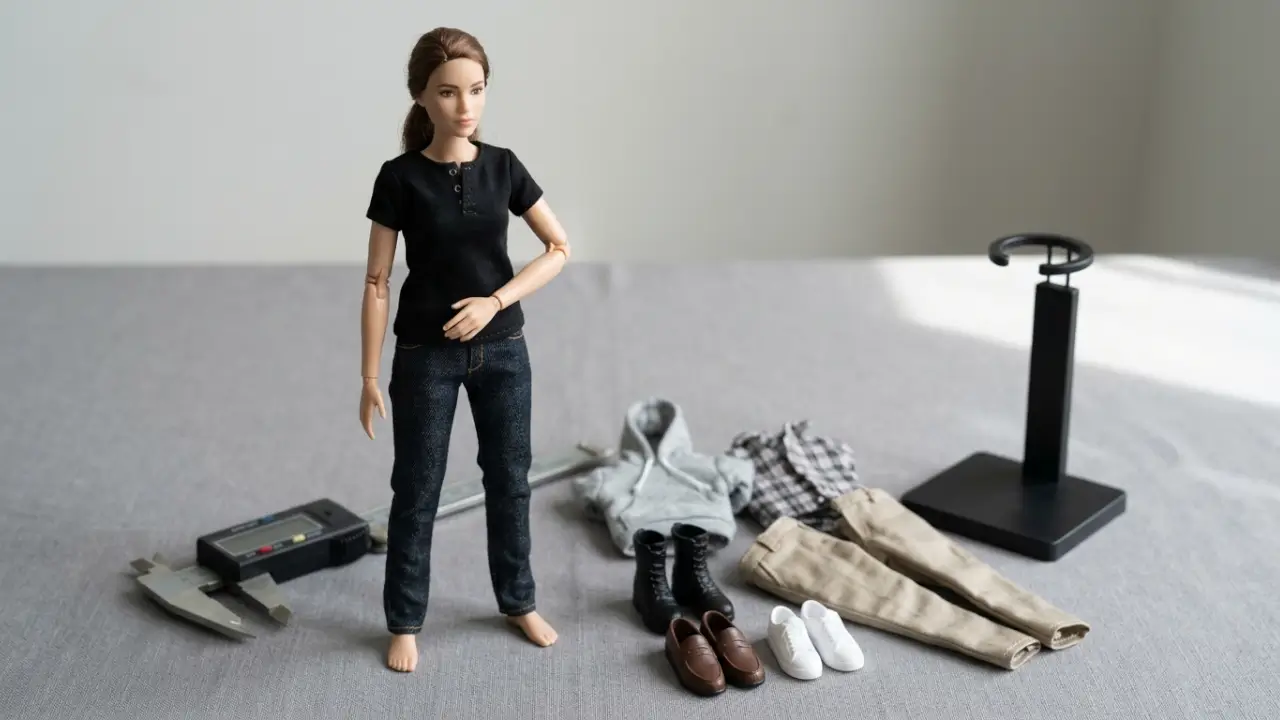
Do not advertise universal compatibility with other 1/6 accessories without checking measurements and fit. Proportions can differ even when the scale description matches.
When Case Packs Change the Better First Order
Ask whether the minimum order applies per series, per variant, per case, or across a mixed purchase. Also confirm whether a “set” means every standard design or simply a specified number of retail units.
If either release uses random packaging, request its documented assortment rules. Do not assume a sealed case is duplicate-free, includes every standard design, or contains a special variant. If designs are identified instead, ask which combinations are permitted and how substitutions are approved.
Exemplo de planejamento: A retailer might allocate 24 units to a trial, splitting them equally between the two series only if the actual order rules permit it. If one offer requires a substantially larger commitment, compare cash exposure rather than forcing an equal-unit test.
Define what the test measures: units sold, customer questions, packaging complaints, and demand for additional designs. Keep any demonstration sample outside the saleable-unit count if you intend to open one.
For tighter purchasing budgets, these assortment planning ideas for small collectible stores can help frame how much cash to reserve for follow-up purchases.
Why the Lower Doll Quote May Cost More to Stock
Normalize both quotations before comparing totals. Each should identify the same purchase unit, currency, delivery basis, destination, and included services. A per-doll price cannot be compared directly with a per-set figure.
For planning, calculate landed inventory cost as merchandise plus freight, insurance where applicable, destination duties and taxes as applicable, brokerage or clearance charges, and inbound handling. Divide by the units intended for sale, accounting separately for opened samples and any expected unsaleable units.
Keep local fulfillment, marketplace fees, and promotional spending visible in a separate contribution calculation. This prevents a modest purchase-price saving from hiding expensive outbound packaging or listing work.
- Request packed carton dimensions and gross weight; ask the carrier how chargeable weight is determined.
- Separate supplier preparation time from transit and destination clearance estimates.
- Confirm whether the shipment is consolidated, split, or dependent on the availability of every requested variant.
- Ask for dated availability information and quotation validity rather than treating a listing as a stock commitment.
Before choosing on price, ask the supplier to fill any gaps in the comparison table. A normalized quote for each series is a useful next step without committing to an order.
Plan reorders against your observed sales rate and a confirmed replenishment estimate. Do not assume the same release or assortment will remain available.
Check Joints, Clothing, and Boxes Before Listing Either Series
Approve an identified sample or agree on a documented pre-dispatch inspection process. Record the SKU, contents, condition, and inspection limits so the reference can be tied to the order.
For a display-led purchase, compare face-decoration consistency, visible marks, garment stitching, accessory completeness, and the presentation of the doll inside its tray. For posing-focused customers, check whether joints hold the intended display poses without forcing their range.

Confirm how loose accessories are restrained and whether the packaging protects protruding parts and decorated surfaces. If clothing touches the body during storage, ask about material-contact precautions and inspect for visible color transfer.
- Agree which cosmetic defects, missing parts, and functional problems must be reported.
- Confirm how damaged retail boxes are classified separately from damaged dolls.
- Document claim evidence, reporting deadlines, and available remedies in writing.
- Agree whether inspection can open retail seals, especially if sealed packaging is part of the sales proposition.
Buyers should verify destination-market requirements for product classification, age grading, small-parts warnings, labeling, traceability, and any applicable testing documentation. A “collectible” description alone does not settle regulatory obligations.
If buying for events, also assess handling between venues. These selection considerations for convention inventory provide context for balancing display appeal against transport burden.
When Neither Series Is Ready for a Purchase Order
Pause if a supplier cannot distinguish the two releases with product identifiers, current photographs, and contents lists. Similar styling is not enough to establish that the quoted goods match your intended listing.
Other warning signs include unexplained changes in case terminology, a freight estimate without carton data, unclear provenance, and a refusal to document substitution rules. A missing answer may be resolvable; a contradictory answer needs clarification before payment.
Compare both lines as confirmed, pending verification, or unacceptable against your essential requirements. Reject unresolved failures on product identity, saleable condition, or applicable documentation rather than averaging them away with attractive styling.
If both qualify, prioritize the offer with lower inventory exposure and better evidence for customer-facing claims. If neither qualifies, request samples or revised documentation instead of selecting a winner prematurely.
Request Comparable Offers for Girls’ After-School Club and Saturday Girls
Send the same brief for both series so suppliers quote against a shared purchasing scenario:
Please quote Girls’ After-School Club and Saturday Girls separately for delivery to [destination/postcode]. Our sales channel is [channel], and our intended trial quantity is [quantity]. Please confirm the exact release/SKU, materials, dimensions, joint construction, included contents, selling format, and assortment rules.
Please state MOQ, units per case and shipping carton, mixed-order options, carton dimensions and weight, sample terms, preparation estimate, freight basis, quotation validity, and substitution policy. Include packaging photos, available destination-relevant documentation, inspection options, and the process for reporting defects or missing accessories.
Request a written side-by-side quote before placing your first order. Attach the specification table and mark your non-negotiable requirements. Ask the supplier to flag anything unconfirmed rather than substitute an assumed specification.
PERGUNTAS FREQUENTES
Which series is better for a first wholesale order?
Choose the series with verified specifications, suitable case quantities, and a clear fit for your customers. There is not enough confirmed product information here to name an unconditional winner.
Does 1/6 BJD mean both series use the same clothes?
No. Scale alone does not establish clothing or shoe compatibility. Confirm body measurements, closure access, and actual fit before making compatibility claims.
Are both series sold as blind boxes?
The selling formats are not verified here. Ask whether each quoted SKU is an identified design, random sealed unit, complete set, or another bundle.
What should a sample inspection cover?
Check product identity, contents, joint function, decoration, clothing, accessory retention, and retail-box condition. Document observations and agree on acceptable condition before ordering.
How should buyers compare the two prices?
Compare equivalent bundles and purchase units, then add applicable inbound costs. Account for samples separately and check whether case requirements create excess inventory.
Before You Commit Shelf Space
Let confirmed specifications, sample results, and order economics decide between these two series. Resolve missing information first, test an order size your business can absorb, and use actual customer response to guide the next purchase.