


As a modern art toy retailer, your greatest operational advantage is hiring staff who are deeply embedded in the “Kidult” culture. You want employees who are obsessed with Pop Mart, who collect Três peluches do Bebê, and who understand the thrill of a 1-in-144 Chase figure. However, this advantage is a double-edged sword. If your employees are your biggest fans, they are also your biggest potential financial liability.
A poorly structured employee discount program in the blind box industry will lead to three catastrophic outcomes: erased profit margins, inventory hoarding (where staff buy all the good stock before the customers see it), and secondary-market scalping by your own team.
For independent boutiques and B2B partners relying on high-margin wholesale inventory from KidultsBox, you must implement a discount policy that acts as a powerful retention perk without cannibalizing your retail revenue. This comprehensive HR whitepaper will mathematically deconstruct the “At-Cost” pricing model, the 72-Hour Freeze rule, and the anti-scalping protocols required to protect your business.
1. The Financial Mathematics of the Discount
In traditional retail (like apparel), a 30% to 50% employee discount is standard. If you apply a flat 30% discount to a blind box, you are likely operating at a net loss once overhead is factored in.
Why Flat Percentage Discounts Fail
For the hypothetical policy examples below, assume an $18.00 retail price and $8.50 landed COGS. These illustrative figures are not a KidultsBox quote or current price; substitute your actual product-level cost and retail price.
- Standard Retail Sale: $18.00 – $8.50 COGS = $9.50 Gross Profit (52% Margin).
- The Flawed 30% Employee Discount: The employee pays $12.60. After your $8.50 COGS, you make $4.10. However, when you factor in credit card processing fees, rent allocation, and the employee’s own hourly wage during the transaction, that $4.10 vanishes. You just sold a highly desirable piece of inventory for zero actual profit.
The Solution: The “COGS + 10%” Model.
Instead of discounting the retail price, mark up the wholesale price. Charge the employee your exact wholesale landed cost ($8.50) plus a flat 10% administrative fee ($0.85). The employee pays $9.35 (which is nearly 50% off retail, feeling like a massive VIP perk), but you securely cover all processing fees and break completely even on the inventory. You lose no money, and the employee gets an unbeatable deal.
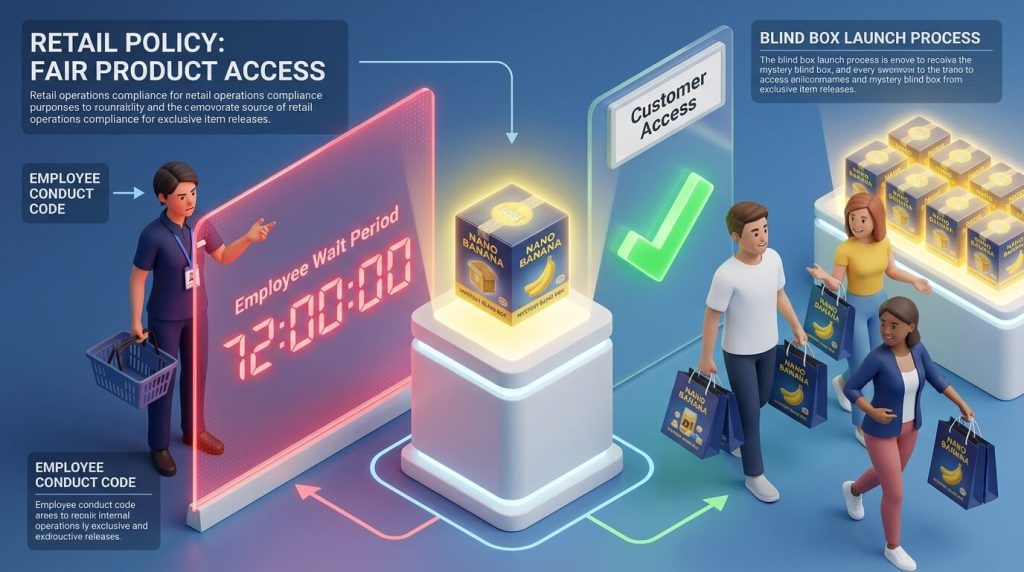
2. The “72-Hour Freeze”: Protecting the Hype
The most dangerous moment for any toy store is the Launch Day of a highly anticipated IP. If KidultsBox delivers 5 master cartons of the new Série Kimmon Flower, and your 4 employees immediately use their discounts to buy 2 full cases for themselves before the store opens, you have betrayed your actual customers.
When real collectors line up outside your store on launch day and see half the inventory already gone, they will accuse your store of “backdooring” stock. Your reputation will die instantly on local Discord servers and Reddit.
The Mandatory Operational Protocol:
- The 72-Hour Cool-Down: Employees are strictly prohibited from purchasing any newly released series, limited-edition items, or restocked high-hype items until the product has been available to the general public on the retail floor for a minimum of 72 hours.
- Customer Priority: The paying customer (who pays full MSRP) always eats first. If a product sells out within the first 72 hours, the employees missed out. This is the cost of doing business.
- No “Stashing”: Employees cannot take a box off the shelf and hide it in the back room or under the register to buy it after their shift. If it is in the building, it must be available for a customer to purchase.
3. Purchasing Limits and Allowance Caps
If you implement the “COGS + 10%” model, blind boxes become incredibly cheap for your staff. If left unchecked, an employee might buy 50 boxes a month, essentially using your business as their personal wholesale supplier. You must cap the volume.
| Discount Category | Monthly Limit per Employee | The Retail Logic |
|---|---|---|
| Single Blind Boxes | Maximum 8 boxes per month. | Allows them to participate in the hobby (approx. 2 boxes a week) without draining your retail floor depth. |
| “End Boxes” (Full Cases) | Maximum 1 Case every 3 months. | Full cases are high-revenue drivers. Allowing staff to buy them at-cost constantly hurts your top-line revenue metrics. |
| Display Accessories (e.g., Acrylic Cases, Nano-Tape) | Unlimited (Within reason). | Accessories have astronomical wholesale margins (often 80%+). Letting staff buy display cases cheaply encourages them to build their own “Deskterior,” which makes them better advocates for the products. |
| 1000% / 400% MEGA Figures | ZERO DISCOUNT. | These are investment-grade assets. Employees must pay full retail MSRP for high-end sculptures or lottery-based items. They are too scarce to discount. |
4. The “Anti-Scalping” Clause (Zero Tolerance)
The greatest risk of an employee discount in the Art Toy world is Secondary Market Arbitrage.
An employee buys a Penny’s Box BJD for their $10 discounted price. They open it in the breakroom, pull the ultra-rare 1/144 “Secret” figure, and immediately list it on eBay or Xiaohongshu for $150. They just used your inventory and your discount to run a side-hustle.
The Ironclad Employee Contract Clause:
Your employee handbook must contain a brutally clear Anti-Scalping agreement that employees sign upon hiring:
“Merchandise purchased using the Employee Discount program is strictly for personal collection or bona fide gifting. Employees are expressly prohibited from reselling, flipping, or trading discounted merchandise for profit on any secondary market (including eBay, Mercari, Facebook Groups, or in-store Trading Boards). Discovery of an employee utilizing their discount for commercial arbitrage will result in immediate termination of employment and revocation of all discount privileges.”
5. Gamifying the Discount: Performance-Based Bounties
Instead of just giving discounts away for free, the smartest retailers use blind boxes as operational leverage. You can tie inventory directly to Key Performance Indicators (KPIs).
- The “End Box” Bounty: As a store owner, you want to sell Full Cases (End Boxes) because it moves 12 units at once. Tell your staff: “For every 3 Full Cases you successfully upsell to a customer, you earn one free single blind box from our ‘Open Inventory’ bin.”
- The Dead Stock Challenge: If you have an unpopular IP that isn’t moving, run a weekend contest. The employee who sells the most units of the dead stock gets the right to purchase any item in the store at a 50% discount.
- The Unboxing Station Tip: If an employee successfully guides a customer to your store’s Unboxing Station and generates a tagged Instagram post for the store, award them internal “points” that can be redeemed for store merchandise.
6. Handling “Display Samples” and Open Inventory
To sell blind boxes effectively, you must sacrifice one unit per series to act as the “Open Display Sample” on your acrylic risers. Eventually, the series will sell out or be retired, leaving you with hundreds of unboxed, slightly dusty display toys in your backroom.
This is your ultimate employee perk.
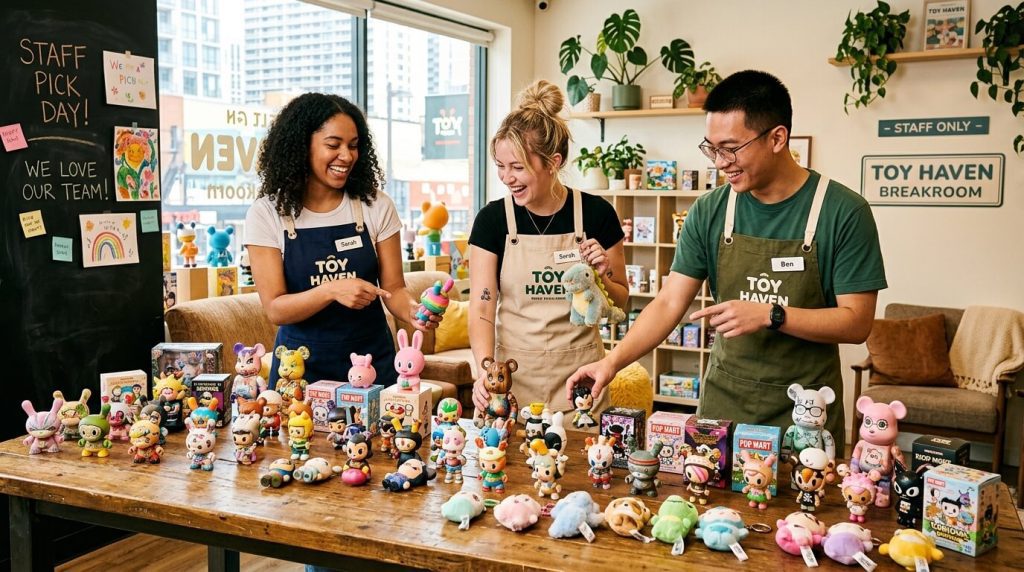
Do not throw these away. Every quarter, host a “Staff Sample Draft.” Line up all the retired display figures on a table. Let your employees take turns picking figures to take home for free, starting with your highest-performing staff member.
This costs you absolutely nothing (the sample was already written off as a marketing expense months ago), but to a Gen Z collector employee, getting to take home an unboxed Pop Mart Dimoo or a cute plush bag charm for free feels like winning the lottery. It builds massive loyalty and team morale.
Perguntas frequentes (FAQ)
Q: Should I let employees open their discounted boxes while on shift?
A: Yes, but strategically. Let them open it behind the register when the store is reasonably busy (not slammed). When customers see an employee genuinely excited about pulling a figure, that authentic enthusiasm is contagious. It acts as live, genuine marketing. However, if they pull a Secret, they must put it away immediately to prevent customer jealousy.
Q: Can employees use their discount to buy gifts for their family?
A: Yes, “bona fide gifting” is generally acceptable. However, the employee must be the one physically making the purchase with their own card. Friends or family members cannot walk into the store and request “Sarah’s employee discount” at the register. The employee must be present.
Q: What do I do if an employee violates the 72-Hour Freeze rule?
A: Enforce the policy immediately. Give a formal written warning for the first offense, and suspend their discount privileges for 30 days. If you do not enforce the rule, your other employees will follow suit, and your customer base will suffer. Consistency is mandatory.
Q: Does KidultsBox offer any specific perks for my staff?
A: When you become a high-volume wholesale partner with KidultsBox, we frequently include promotional items, brand posters, and occasionally unboxed “Sample” figures in large shipments. We highly recommend passing these free promotional items directly to your staff to build their brand knowledge and morale!