



In the brutal retail economy of 2026, selling a physical product is no longer enough. Amazon can deliver a blind box to a customer’s door in 24 hours. The only competitive advantage a brick-and-mortar toy boutique possesses is The Experience. If a customer walks into your store, buys a Pop Mart blind box, and leaves without taking a photo, you have failed at retail marketing.
Every smartphone in your store represents a potential billboard. When a customer posts a photo of your boutique to their Instagram Story or TikTok, they are providing highly targeted, hyper-local User-Generated Content (UGC) to hundreds of their friends in your exact city. This drops your Customer Acquisition Cost (CAC) to zero.
But customers are discerning. They will not take a selfie in front of a messy, poorly lit cardboard display. You must engineer a specific, dedicated “Selfie Trap.” For B2B retail partners sourcing premium inventory from KidultsBox, this comprehensive Visual Merchandising (VMD) playbook breaks down the exact architectural, lighting, and psychological setups required to transform 4 square feet of your store into a viral photo destination.
1. The Psychology of the “Selfie Trap”
To design a successful photo op, you must understand why a “Kidult” collector takes a photo in the first place. It is driven by three psychological needs:
- Status & Scarcity: They want to prove they are in the presence of something rare or expensive (like a massive 1000% Bearbrick or MEGA Space Molly) that they cannot afford to have in their own home.
- Aesthetic Validation: They want to post a photo that makes their social media feed look highly curated, colorful, and trendy (“Dopamine Decor”).
- The “Ita-Bag” Flex: They want a beautiful backdrop to hold up their own customized luxury bag covered in Baby Three Plush Keychains to show off to the community.
Your photo op must service at least one, if not all three, of these desires.
2. The “Macro Anchor” Strategy: Sizing Up
The easiest and most proven photo op in the Art Toy industry relies on scale. The standard blind box is 3 inches tall. To create a visual spectacle, you must provide the exact opposite.
The 1000% Figure as a Museum Piece
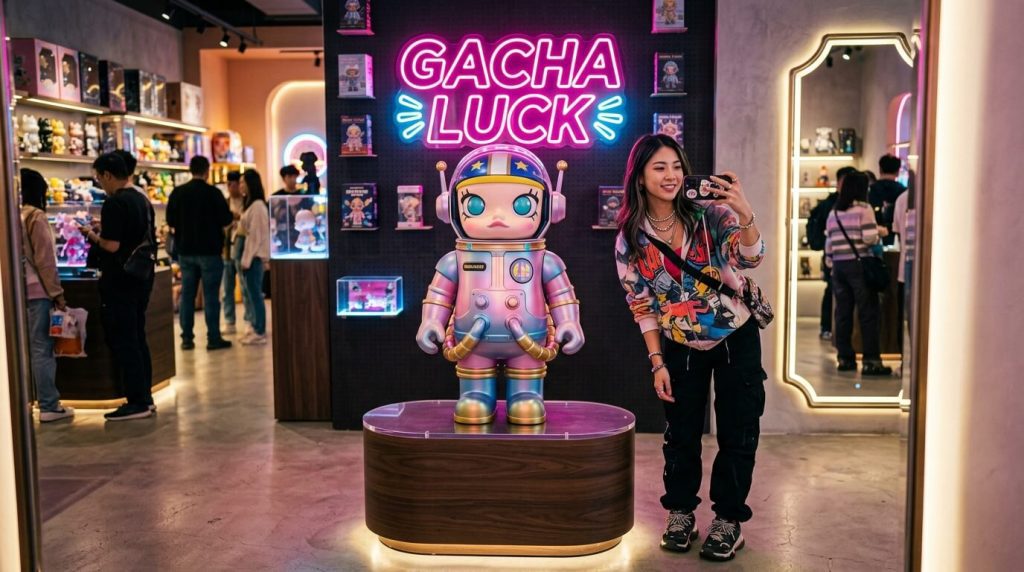
A 1000% figure (roughly 70cm or 2.3 feet tall) is the ultimate retail anchor. You do not put this figure behind glass. You place it on a heavy, branded wooden pedestal directly in the center of your “Photo Zone,” ensuring it is at chest-height.
A execução: Surround the base of the massive figure with custom-cut acrylic neon signs (e.g., your store’s logo or a catchy phrase like “Gacha Good Luck”). Customers will naturally stand next to the giant figure, wrap their arm around it (or hover just near it), and take a photo. Because your neon store logo is positioned directly at the base, every single photo posted online acts as a branded advertisement for your boutique.
3. The “Infinity Mirror” Blind Box Vault
If you cannot afford a massive 1000% figure, you can use an optical illusion to turn your standard 3-inch Pelúcia Kimmon or ShinWoo inventory into a mind-bending photo op.
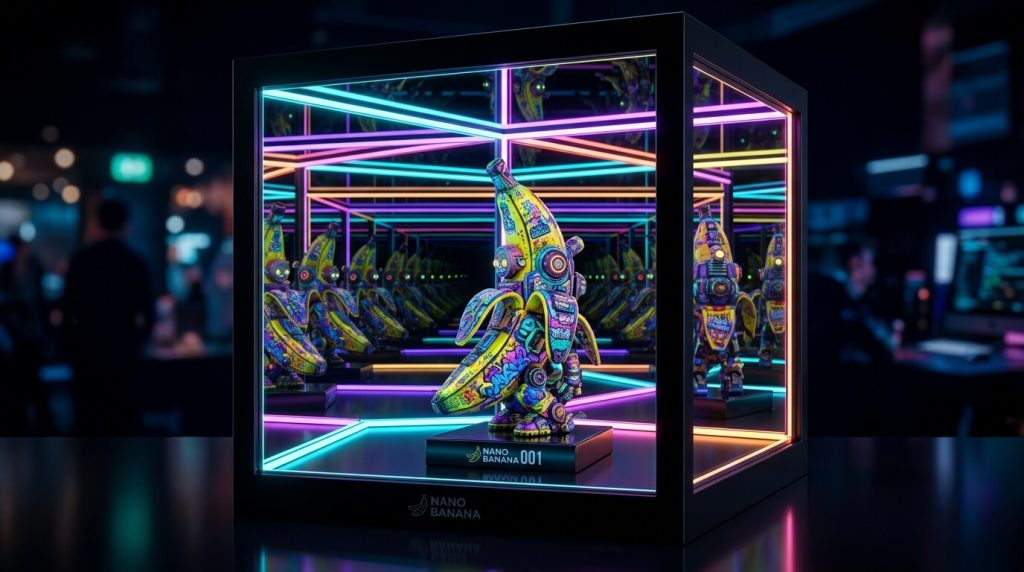
A configuração: Build or purchase a wooden box (roughly 3ft x 3ft). Line the inside back wall, ceiling, and floor with high-quality glass mirrors. The front panel should be a two-way mirror (or half-silvered glass).
A execução: Inside this mirrored box, place just 5 or 6 highly detailed, unboxed designer toys, illuminated by hidden LED strips. When the customer looks into the box, the mirrors reflect the toys and the LEDs infinitely into the distance. It looks like a boundless, glowing matrix of art toys.
When customers hold their phone camera up to the two-way mirror, they capture this incredibly trippy, futuristic “Infinity” effect. It is visually stunning, highly shareable on TikTok, and makes a handful of $15 toys look like a million-dollar art installation.
4. Lighting Engineering: Defeating the “Ugly Shadow”
You can build a $5,000 photo set, but if the lighting makes your customer look tired, old, or shadowy, they will delete the photo and never post it. Women, who make up over 65% of the art toy demographic, are exceptionally conscious of lighting.
The 3-Point Lighting Rule for Retail
- Kill the Overhead Halogens: Direct overhead light casts harsh, dark shadows under the customer’s eyes and nose (often called “raccoon eyes”). Never position your photo op directly under a standard store ceiling light.
- The Built-In Ring Light (Front Fill): Install a professional, diffused 18-inch LED ring light directly into the wall or mounted on a sleek, permanent stand facing the customer. Set the color temperature to 4500K (Neutral White). This provides a flawless, shadow-erasing wash of light over their face, making their skin look perfect. If they look good in the photo, they will post it.
- The Color Wash (Backlight): Use RGB LED strip lights to wash the wall behind the customer in a vibrant neon pink, cyan, or purple. This creates depth and separates the customer from the background, making the photo look like it was shot in a professional studio.
5. The Interactive “Plush Wall” (Tactile Marketing)
A rising trend in Asian retail stores is the Tactile Photo Wall. Instead of painting a wall, you literally cover an entire 4×4 foot section of the wall with soft, furry plush toys.
If you source heavily from the Bebê três de pelúcia series, use your “B-Grade” or damaged-box inventory. Attach hundreds of the fuzzy monster heads directly to the wall.
The Interaction: The wall is incredibly soft. Customers will instinctively lean their face against it, hug it, or bury their hands in it for photos. It screams “Kawaii” and “Healing Energy,” perfectly matching the psychological needs of the “Kidult” demographic. It turns your store into an immersive, sensory playground.
6. Investment vs. Return Matrix
How much should you spend on a photo op? Treat it as your primary marketing budget. Here is a breakdown of potential setups and their ROI.
| Photo Op Strategy | Estimated Setup Cost | Maintenance Level | Expected Social ROI (Virality) |
|---|---|---|---|
| The “Neon Sign & Couch” A plush velvet couch with a custom neon sign (e.g., “Main Character Energy”). | $300 – $600 | Low (Just keep the couch clean). | Medium. Standard aesthetic, good for casual photos and “Outfit of the Day” (OOTD) shots. |
| The 1000% Anchor Figure A massive Pop Mart MEGA figure on a branded pedestal with up-lighting. | $1,500 – $2,500+ | Low (Dusting only). | High. Immediately recognizable status symbol. Draws hardcore collectors into the store. |
| The “Infinity Mirror” Vault Optical illusion box with hidden LEDs and unboxed premium figures. | $800 – $1,200 | High (Glass requires constant cleaning from fingerprints). | Extremo. Highly unique, generates massive video engagement on TikTok. |
| The “Unboxing Stage” A dedicated table with ring light, tripod, and a branded velvet mat. | $100 – $200 | Medium (Requires frequent trash removal of foil wrappers). | Very High. Captures the actual “Dopamine Reaction” of unboxing. Highly authentic UGC. |
7. Monetizing the Photo Op: “Bribing the Algorithm”
Having an Instagrammable spot is useless if customers take the photo but forget to tag your store. You must actively incentivize the “Tag.”
The “Tag & Reward” Protocol:
Place a sleek, clear acrylic sign directly next to the photo op.
“Take a selfie here! Post it to your IG Story or TikTok and tag @[YourStoreName]. Show the cashier to receive a FREE Acrylic Display Box OR $2 off your next Blind Box purchase!”
The Math: Giving away a $1.50 acrylic box in exchange for a highly targeted, local advertisement sent to 500 of their friends is the cheapest, highest-converting Customer Acquisition Cost (CAC) in modern retail. You are literally buying localized social media reach for pennies.
8. Beating Visual Fatigue (The Rotation Rule)
If you build a beautiful photo op, your local customers will take a photo in front of it once. They will not take a photo in front of the exact same wall on their third visit. You will experience Visual Fatigue.
To keep the local UGC machine running, you must rotate the aesthetic of your photo op every 6 to 8 weeks.
- Spring: Lean into pastel colors. Feature the Kimmon Flower series, use warm pink lighting gels, and add faux cherry blossoms to the display.
- October/Fall: Pivot to “Goth-Cute.” Display Penny’s Box Ghost School dolls, switch the lighting to deep purple/UV, and use dark velvet props.
By constantly refreshing the photo op, you give your loyal customers a reason to return to the store and post a new photo, keeping your brand relevant in the local social media algorithm year-round.
Perguntas frequentes (FAQ)
Q: My store is very small (under 500 sq ft). Do I have space for a photo op?
A: You don’t need a massive wall. The “Unboxing Stage” strategy requires only 2×2 feet of counter space. Alternatively, use your storefront window facing the street as a “reverse photo op,” where customers stand outside and use a QR code decal on the glass to trigger an AR (Augmented Reality) filter.
Q: How do I prevent kids from destroying the expensive 1000% display figures?
A: First, use a heavy, wide-base pedestal to prevent tipping. Second, use Museum Wax (QuakeHold) to securely adhere the feet of the figure to the pedestal. Finally, use a velvet stanchion rope to create a 2-foot physical barrier. People can stand behind the rope to take the photo without physically touching the $2,000 asset.
Q: Should I put my store’s URL or handle on the wall?
A: Yes, but make it aesthetic. Do not print a cheap banner. Order a custom Neon LED Sign of your store’s Instagram handle (e.g., “@NeonToys_NYC”). Make sure it is positioned at waist-to-chest height so it appears in the frame of a standard mirror-selfie or portrait shot.
Q: Does KidultsBox supply the 1000% “Anchor” figures for store displays?
A: Yes, our B2B wholesale network provides access to premium, highly sought-after 400% and 1000% scale figures (like MEGA Space Molly). These are sourced specifically for our retail partners to use as high-end visual merchandising assets or to resell to VIP clients. Contact your account manager for current availability.