





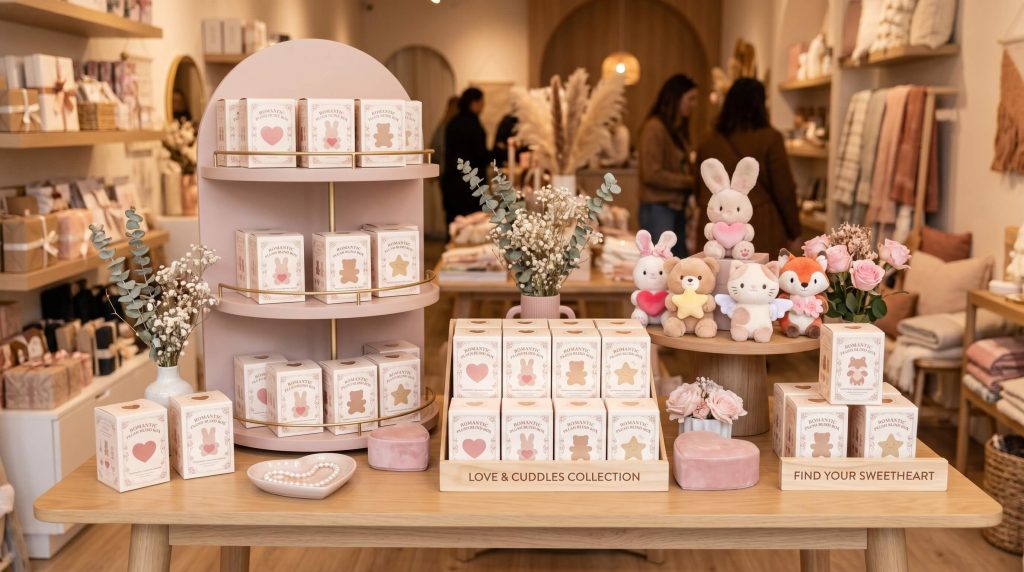
O Série Nommi Amaryllis Sweetheart: Guia de compra das caixas surpresa com pelúcias românticas is for retailers, gift shops, toy resellers, and online sellers who need more than a cute product photo before placing an order. Romantic-themed plush blind boxes can perform well around Valentine’s Day, anniversary gifting, couple-focused displays, and collectible toy shelves, but buyers still need to confirm authenticity, case configuration, packaging condition, landed cost, and reorder timing.
This guide does not assume exact pricing, MOQ, stock status, or factory capability. Instead, it gives you a practical sourcing framework: the exact questions to ask, how to compare quotes on equal terms, which risks to check, and how to size a first order without overcommitting cash to a single seasonal theme.
Why Romantic Plush Blind Boxes Need a Different Buying Lens
A romantic plush blind box series is not purchased the same way as a basic plush toy. The product value often depends on sealed surprise packaging, character appeal, giftability, and the chance of collecting multiple designs. For buyers, that creates three commercial questions worth answering before you request a quote:
- Will the theme fit the selling season? Romantic packaging may sell strongly around Valentine’s Day, White Day, anniversaries, campus gift seasons, or couple-focused promotions — but it can sit flat if you order heavily after the peak window passes.
- Will customers buy more than one? Blind box repeat purchase potential depends on assortment depth, perceived collectibility, and whether buyers want to chase a full set or a specific design.
- Can you protect margin after shipping and packaging damage? Plush items are lightweight but bulky, so dimensional (volume) weight and carton condition can quietly erode the margin a low unit price seemed to promise.
Before requesting a quote, decide whether the series is a seasonal feature, an impulse-buy counter display, a collectible category extension, or a gift bundle item. That single decision changes how you set order quantity, plan display fixtures, and time your reorders.
How Different Buyer Types Should Evaluate the Series
Different buyers should look at the Nommi Amaryllis Sweetheart Series from different angles. A boutique gift shop cares most about shelf presentation; an online reseller cares about sealed-box condition, accurate SKU labeling, and how shipping damage claims are handled. Use the table below to match your channel to the questions and risks that matter most.
| Buyer type | Likely use case | Key buying question | Risk to check |
|---|---|---|---|
| Gift shop | Romantic gift shelf, Valentine’s display, anniversary add-on | Does the packaging look gift-ready without extra wrapping? | Outer box dents or inconsistent retail labels |
| Toy retailer | Collectible plush display alongside other blind boxes | Is the series clearly identifiable for collectors? | Unclear assortment or mixed versions in one shipment |
| Online reseller | Marketplace listing, livestream sales, mystery box bundles | Can the supplier provide accurate product names, images, and carton details? | Customer complaints if boxes arrive opened or crushed |
| Event seller | Pop-up markets, anime events, gift fairs | Can stock arrive before the selling date with time for inspection? | Late delivery, no buffer for replacements |
| Subscription box curator | Romantic or kawaii-themed monthly box | Will the unit size fit the subscription carton? | Higher packing cost if dimensions are not confirmed |
| Wholesale distributor | Supplying smaller retailers | Are case packs, barcode needs, and resale documentation clear? | Ambiguous supply chain or incomplete product identification |
If you also carry broader collectible lines, compare romantic plush demand against other blind box formats. A buyer building a mixed assortment might review a different character such as the Little Monster CUPA – Série “I Am Undefined” – Caixa Surpresa to weigh audience, shelf style, and repeat-purchase potential side by side.
Specifications to Confirm Before You Compare Quotes
Do not compare quotes by unit price alone. For blind box plush, a lower quoted price loses its appeal once case quantity, packaging protection, or product version turns out to be unclear. Ask suppliers to confirm the following in writing before you treat any quote as comparable.
- Official product and series name: Confirm the exact series title as it appears on carton labels and retail listings, so your product page matches what arrives.
- Sealed blind box status: Ask whether each unit is factory-sealed, unopened, and suitable for blind box retail sale.
- Assortment information: Ask whether a case contains random units, a fixed display assortment, or any known design ratio. Do not assume a full set unless it is confirmed.
- Unit and carton dimensions: Use these for shelf planning and freight estimates.
- Gross weight and volume weight: Plush products often trigger dimensional freight charges, especially on air shipment.
- Retail packaging condition standard: Clarify whether minor outer-box marks are acceptable or whether collector-grade packaging is required.
- Product images and labeling: Request clear photos of the retail box, the carton label, and any barcode or SKU information.
- Supply authorization: For branded or IP-related goods, verify that the supplier is permitted to sell the products into your intended market.
A practical decision rule: when two suppliers quote similar unit costs, prioritize the one that can document case pack, carton size, product version, and sealed condition more clearly. Missing detail increases the risk of listing errors, customer disputes, and surprise freight costs.
MOQ, Case Pack, and First-Order Planning
MOQ and case pack matter because blind box sell-through usually depends on display depth. Too few units make the product look weak on shelf; too many tie up cash in a seasonal theme. Since exact MOQ is not provided here, request supplier-specific minimums and plan against realistic scenarios.
As a planning reference, a single boutique might test one strong display first, while a multi-location buyer may split a trial allocation across several stores. The right number depends on foot traffic, seasonality, sales channel, and how likely customers are to buy multiples or chase a set.

Example first-order planning logic
- Single boutique test: Order enough to build a visible, browsable display and allow some early repeat purchases, rather than placing only a few pieces that look like leftovers.
- Online listing test: Hold back enough sealed units to photograph, list, fulfill the first wave of orders, and cover limited exchanges for packaging damage if your store policy allows it.
- Seasonal campaign: Work backward from the selling date and add buffer time for inspection, relabeling, photography, and marketing content.
- Collector audience: Ask whether your customers will want sealed boxes only, full-case purchases, or random single units — your sales format directly affects the quantity you need.
Before you reach out to suppliers: prepare the product questions in the checklist below and send the identical inquiry to each one. Consistent questions make the final comparison far easier and stop you from comparing mismatched quotes.
Pricing, Landed Cost, and Margin Protection
Wholesale buyers often anchor on the quoted unit price, but the real decision should rest on landed cost. Landed cost includes product cost plus domestic handling, international freight where applicable, import duties or taxes where relevant, local delivery, payment fees, packaging supplies, and expected loss from damaged or unsellable units.
Confirm whether a quote is based on EXW, FOB, CIF, DDP, or another trade term if you are importing. If a term is unfamiliar, ask the supplier to spell out what is included and what is not. For legal, customs, tax, and import classification questions, confirm requirements with a qualified logistics or compliance provider for your destination market.
| Cost item | Buyer action | Por que isso é importante |
|---|---|---|
| Unit quote | Request price by quantity tier if available | Helps compare a trial order against a replenishment order |
| Carton dimensions | Ask for length, width, height, and weight | Needed for freight and storage planning |
| Packaging protection | Confirm inner and master carton packing method | Reduces the risk of crushed retail boxes |
| Payment terms | Clarify deposit, balance, platform fees, or bank charges | Affects cash flow and final cost |
| Import charges | Check duties, taxes, and customs documentation | Prevents underestimating landed cost |
| Damage allowance | Plan a small inspection buffer as an example | Protects sellable inventory assumptions |
For example, if two suppliers offer the same unit price but one uses stronger master cartons and provides clear carton measurements, that supplier may support better margin control because freight and damage risk are easier to estimate up front.
Packaging, Quality Checks, and Compliance Cautions
For plush blind boxes, the retail box is part of the product experience. A customer buying a romantic collectible as a gift may reject a crushed box even if the plush inside is perfect. That makes packaging inspection important for both physical stores and e-commerce sellers.
Before approving a bulk order, ask for recent photos or video of the actual goods if available. For larger orders, consider third-party inspection or a structured warehouse receiving check, scaled to the order value and your risk tolerance.

Receiving inspection checklist
- Check master carton condition before opening and photograph any visible damage.
- Confirm the carton label matches the ordered series and quantity.
- Count units by carton and compare against the packing list.
- Confirm blind boxes are sealed and show no signs of being opened or tampered with.
- Inspect a sample of retail boxes for dents, stains, crushed corners, or printing issues.
- Review plush condition only if your selling method allows opened samples; otherwise keep sellable blind boxes sealed.
- Document discrepancies promptly and contact the supplier with photos, counts, and carton references.
Handle compliance carefully. Plush toys may be subject to labeling, age grading, safety, material, and import rules that vary by destination market. Do not assume a product is acceptable for your country simply because it is sold elsewhere. Request available documentation and verify requirements with appropriate compliance support before resale.
Supplier Red Flags and Quote Comparison Mistakes
A romantic plush blind box can look easy to source, but weak supplier communication creates expensive problems. Watch for these red flags before sending payment or committing to a seasonal campaign:
- Unclear product identity: The supplier cannot confirm the exact series name, version, or packaging photos.
- Opened or mixed stock: The supplier cannot confirm sealed blind box condition or whether units come from mixed sources.
- No carton information: Without carton size and weight, freight estimates are unreliable.
- Pressure to pay before documentation: Urgency is not a substitute for product confirmation.
- Unrealistic universal claims: Be cautious about claims of guaranteed rare pulls, guaranteed full sets, or guaranteed compliance offered without documentation.
- Vague after-sales process: Ask how shortages, wrong items, or damaged cartons are handled antes de you order.
Also avoid comparing a single-unit quote from one supplier with a case-pack quote from another. Confirm whether prices are per unit, per display box, per case, or per carton. Misreading the quote format can distort your cost calculation and throw off your reorder plan.
Blind box retail is also evolving with digital and interactive formats. If your store is planning a longer-term collectible strategy, it helps to read about future blind box trends involving phygital toys and AR so you can plan beyond a single seasonal plush release.
Quote Request Checklist and Inquiry Template
Use the same inquiry format with every supplier so you can compare answers side by side. The goal is to remove ambiguity before you calculate landed cost or commit to a launch date.
Hello, we are interested in sourcing the Nommi Amaryllis Sweetheart Series romantic plush blind boxes for retail resale. Please confirm the following:
1. Exact product and series name
2. Whether each unit is sealed and unopened
3. Case pack, MOQ, and available quantity tiers
4. Unit size, carton size, gross weight, and carton quantity
5. Product photos, retail box photos, and master carton label photos
6. Assortment details, if available, and whether a full set is guaranteed or not
7. Packaging method and protection for international or domestic shipping
8. Quoted trade term and which shipping costs are included or excluded
9. Estimated preparation time after payment, stated as an estimate rather than a guarantee
10. Available documentation for product labeling, safety, or import review, if any
11. Process for shortages, wrong items, or damaged cartonsPlease provide the quote in writing with a validity period, payment method, and any important order conditions.
Before you place an order: collect written answers to the checklist above and compare at least the product version, sealed condition, carton data, freight basis, and damage-handling policy. With those details clear, you will be in a far stronger position to request a formal quote and plan a realistic launch or replenishment order.
PERGUNTAS FREQUENTES
What should retailers confirm before buying the Nommi Amaryllis Sweetheart Series?
Retailers should confirm the exact product name, sealed blind box condition, case pack, carton dimensions, packaging condition standard, assortment details if available, and any documentation needed for their resale market.
Is the Nommi Amaryllis Sweetheart Series suitable for seasonal gift displays?
It may be suitable for romantic or gift-focused displays, especially around seasonal campaigns, but buyers should test demand based on their own customer base, timing, and display plan.
How should wholesale buyers compare quotes for plush blind boxes?
Compare the total landed cost, not only the unit price. Include carton size, freight basis, packaging protection, payment fees, import costs if relevant, and expected handling of damaged or incorrect goods.
Can buyers assume every case contains a full set?
No. Buyers should not assume a full set or specific character ratio unless the supplier confirms it in writing. Blind box assortments can vary, and unclear assumptions can lead to customer complaints.
What packaging checks matter most for plush blind boxes?
Check that retail boxes are sealed, clean, and not crushed; verify carton labels and quantities; and document any shipping damage with photos before contacting the supplier.
Final Thoughts
The Nommi Amaryllis Sweetheart Series can be positioned as a romantic plush collectible, a seasonal gift item, or part of a broader blind box assortment. The strongest buying decision comes from clear supplier documentation, realistic order sizing, and careful landed cost comparison.
For commercial buyers, the next step is simple: define your use case, send the same quote questions to each supplier, verify packaging and compliance needs for your market, and hold off on volume until the product version, case pack, and shipping assumptions are confirmed in writing.

