





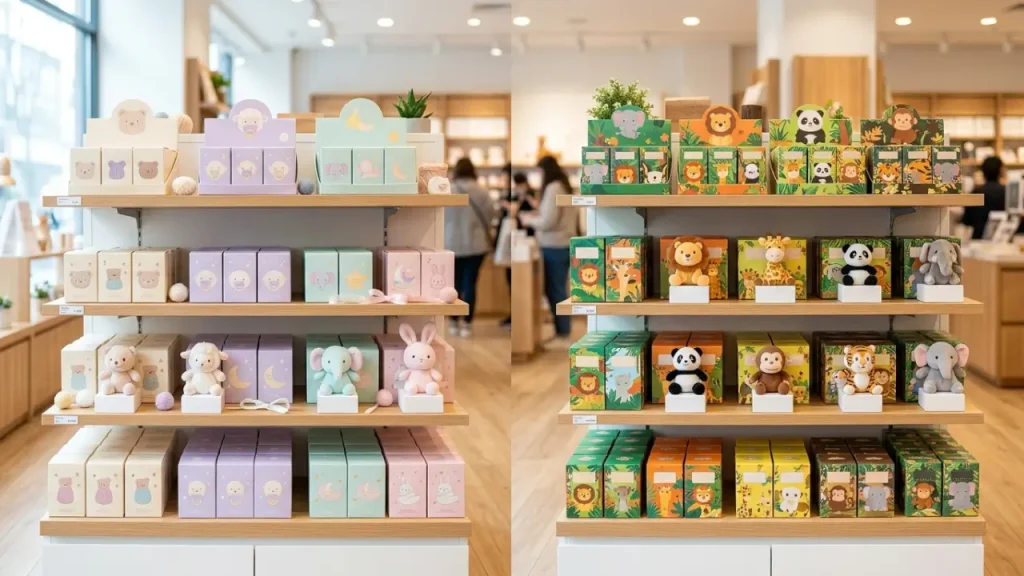
Choosing between two collectible plush lines is never really about which theme looks cuter. Shelf space, your customer’s age profile, gift occasions, case configuration, packaging durability, and replenishment risk all decide whether a series becomes a dependable seller or slow inventory. When the two candidates are the Nommi Baby and Sitting Zoo plush series, the decision needs a buyer’s framework, not a first impression.
Because confirmed dimensions, assortments, case quantities, materials, and wholesale terms are not provided here, this guide does not assume that the two series share the same specifications. Instead, it gives buyers a practical way to check both offers, request comparable quotes, and select the series that fits a particular store.
Which Nommi plush series matches your gift-store customer?
Start with the reason customers walk into the store. A baby-oriented visual theme may suit shoppers looking for soft, comforting, or celebratory gifts, while a zoo theme may have broader animal appeal. That is a merchandising hypothesis, not a substitute for reviewing the actual characters, packaging, and recommended age information.
- Baby boutiques and family gift shops: Review whether Nommi Baby visually complements newborn gifts, nursery accessories, or family occasions. Confirm that the product labeling and intended-user information support the way you plan to present it.
- Animal-themed stores, zoos, and museum shops: Ask whether the Sitting Zoo assortment includes animals that connect naturally with the venue. Do not rely on the series name; request a complete character lineup.
- Trend-led collectible stores: Compare character variation, secret-edition structure, display impact, and the likelihood that customers will want more than one design.
- General gift stores: Favor the series a customer can understand in a few seconds from its packaging, without staff having to open a sample to explain the theme.
- Varejistas online: Check whether the supplier can provide accurate reference images and clear assortment information. Returns and disappointment rise when listing images do not represent scale, color, or the blind-box mechanic clearly.
A useful decision rule is to buy for the customer you already have, not an imagined new audience. If animal products already convert well, Sitting Zoo may be the more coherent test. If soft, nurturing, or character-led gifts are established categories, Baby may merit the first sample review.
Compare the two series at shelf level, not by artwork alone
Request the same documentation for both series and score each against a single scorecard. The names suggest different themes, but you still need confirmed product details before drawing conclusions about size, construction, display behavior, or suitability.
| Decision area | Nommi Baby: what to check | Nommi Sitting Zoo: what to check | Gift-store decision rule |
|---|---|---|---|
| Theme fit | Ask for the full character sheet and packaging views. | Confirm which animals appear in the regular assortment. | Choose the theme that matches proven store categories. |
| Display footprint | Confirm individual box and counter-display dimensions. | Check whether poses create different box depths or display needs. | Measure the intended shelf before approving a case. |
| Giftability | Review whether the presentation feels complete without extra wrapping. | Assess whether animal variety supports birthdays and casual gifts. | Use samples to test recognition from normal viewing distance. |
| Assortment appeal | Compare visible differences among regular designs. | Check whether animal designs are distinct enough to encourage collecting. | Avoid assortments where several designs look interchangeable. |
| Attachment or pose | Confirm the actual format, hanging hardware, and stability. | Verify what “Sitting” means for display and use. | Do not infer functionality from the series title. |
| Materials and finish | Request material declarations and close-up sample images. | Inspect facial features, seams, pile direction, and accessories. | Compare equivalent inspection points across both series. |
| Blind-box structure | Confirm regular designs, possible secret designs, and case logic. | Ask the same questions in writing. | Compare sealed-case terms rather than isolated unit photos. |
| Reorder potential | Consider whether the theme stays relevant beyond one occasion. | Consider whether animal appeal supports year-round placement. | Prefer the line with clearer replenishment data and stable demand signals. |
Retailers comparing other plush constructions may also find this guide to vinyl-face plush versus standard plush blind boxes useful. Construction type can change perceived value, freight efficiency, cleaning expectations, and the quality points that need inspection.
If both Nommi options still look viable, request one documented quotation for each rather than committing right away. A side-by-side quote often reveals differences that promotional photography hides.
How case packs can flip the Baby-versus-Zoo decision
A series that looks right for the store can still be the wrong buy if its ordering structure creates too much inventory. Ask for the MOQ, units per inner pack, units per sealed case, number of regular designs, and whether a sealed case is expected to contain a defined assortment. These terms are different and should not be treated as interchangeable.
For example, a retailer planning a small test might compare one sealed case of Baby with one sealed case of Sitting Zoo, provided the supplier permits that order structure. Record how many sellable units arrive, how many designs are represented, and whether case-level assortment information is documented. These are planning quantities only; actual case configurations must be confirmed with the seller.
- Ask whether the MOQ applies per series, per design, per case, or across the full order.
- Confirm whether loose boxes, mixed cases, and sealed series cases are available.
- Check whether opening a master carton affects the condition or traceability of individual boxes.
- Request the exact regular and secret-edition rules without assuming that every case contains a secret.
- Document whether repeat orders can use the same packaging version and assortment structure.
The distinction between conjuntos de séries fechadas e sortimentos mistos em caixas surpresa matters especially for collectors. A mixed offer may reduce initial commitment, but unclear provenance or assortment logic can make customer communication harder.
Handle real samples before approving either series
Catalog images cannot show seam strength, stuffing consistency, surface marks, odor, loose accessories, face alignment, or crushed retail boxes. Obtain representative samples when practical and agree on what those samples establish. A perfect sample means little if the bulk-order quality standard stays undefined.
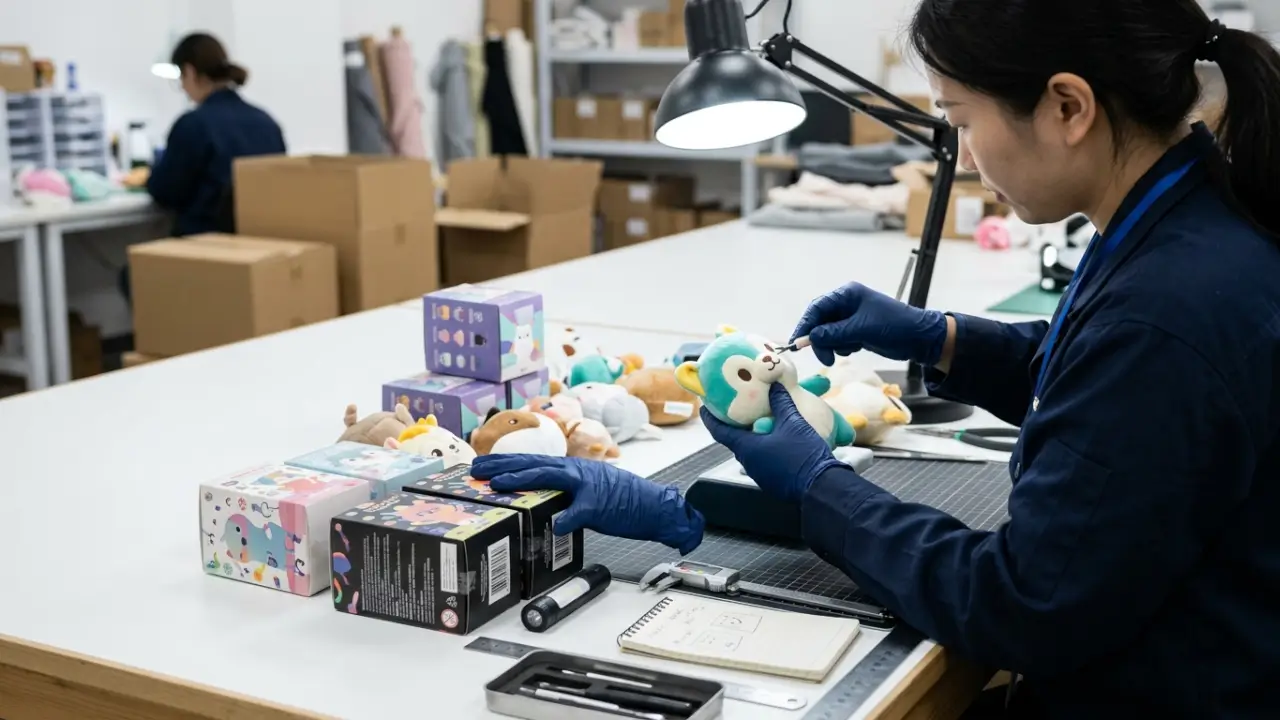
Use the same inspection sequence for Baby and Sitting Zoo:
- Photograph the unopened package. Record dents, scuffs, seal condition, printed warnings, barcode placement, and color consistency.
- Measure the product and package. Compare actual measurements with the quotation or specification sheet.
- Inspect construction. Review seams, embroidery or printed details, attachments, stuffing distribution, surface finish, and pose stability where relevant.
- Test normal handling. Handle the sample gently as a shopper would, without treating an improvised destructive test as evidence of formal compliance.
- Record acceptable variation. Ask how defects, missing pieces, visibly damaged packaging, and incorrect assortments are handled.
Packaging deserves separate attention because a collectible box is part of the sale. Ask about inner protection, master-carton dimensions, carton weight, and measures used to limit crushing or moisture exposure in transit. If gift-ready condition is essential, state that in the inquiry rather than assuming standard export packing will meet your needs.
Also verify applicable labeling, age grading, material, toy-safety, import, and documentation requirements for the destination market. Requirements vary by product classification and jurisdiction. Do not treat a supplier’s general statement as proof that the exact SKU and shipment meet local obligations; request relevant documents and review them appropriately.
Calculate landed cost for plush volume and reorder timing
Unit price is only one part of the Baby-versus-Zoo comparison. Plush products and presentation boxes may occupy substantial carton space relative to their weight, so freight may be affected by volumetric calculations. Ask for packed carton dimensions and gross weight for each quoted configuration before estimating margin.
A practical landed-cost worksheet should include the product total, export or handling charges disclosed by the seller, freight, insurance if used, destination duties and taxes, customs or brokerage costs, local delivery, payment costs, inspection expense, and an allowance for damaged or unsellable packaging. Confirm customs treatment with qualified local resources rather than relying on a generic estimate.

Shipping mode should reflect the test objective. Faster transport may help validate demand or meet a launch date, while slower transport may reduce freight cost but require more inventory planning. Request both the production or order-preparation estimate and the transit estimate, because “lead time” can otherwise hide what is included.
As an example reorder rule, a store might review sales weekly and begin checking replenishment when 40% of its test quantity remains. That threshold is only a planning reference. Adjust it for sales velocity, supplier preparation time, freight mode, holidays, and the risk that the series or packaging version changes.
For another plush-specific sourcing framework, see the Siinono plush blind box retail buying guide. Its evaluation approach helps buyers separate product appeal from operational ordering questions.
When the two quotes simply aren’t comparable
A lower number does not represent a better offer when the quotes cover different case types, shipping terms, packaging standards, or product versions. Normalize every quote to the same unit and record all exclusions.
Warnings that require clarification
- The quotation names “Nommi” but does not identify Baby or Sitting Zoo, the version, or the assortment.
- Photos show retail-ready boxes, but the quote does not confirm whether those boxes are included and unopened.
- The supplier gives a unit price without MOQ, case quantity, carton dimensions, or quote validity.
- “Complete set” and “sealed case” are used as though they mean the same thing without written assortment details.
- A secret design is described as guaranteed without a documented case rule.
- Compliance is described only as “standard” or “safe” without SKU-specific documentation for review.
- Damage handling, quantity discrepancies, and packaging defects have no written process.
- Payment is requested before you receive a clear product specification and commercial invoice details.
Another useful reference is the comparison of Lovely Emma Bunny Alliance versus Bear Alliance, which shows how retailers can compare two closely related plush blind box themes without reducing the decision to character preference.
Inquiry template for both series
Please quote Nommi Baby and Nommi Sitting Zoo separately. For each series, identify the exact version, unit format, regular assortment, secret-edition rules, MOQ, units per inner pack, units per sealed case, and units per master carton.
Please include unit and case pricing, the applicable trade terms, quote validity, packed carton dimensions, gross weight, estimated order-preparation time, packaging method, and available shipping options.
Please also provide product and packaging dimensions, stated materials, labeling images, barcode details, sample terms, available compliance documents for buyer review, and the process for reporting shortages, defects, or transit-damaged retail boxes.
Before paying, build a comparison sheet with one column for Baby and one for Sitting Zoo. Mark every unanswered item rather than filling gaps with assumptions. If you are ready to source, send this specification-based inquiry and request two directly comparable quotations plus sample options. That gives the purchasing decision a documented basis and makes later reorder discussions clearer.
PERGUNTAS FREQUENTES
Is Nommi Baby automatically better for baby gift shops?
No. The theme may appear relevant, but buyers should confirm intended-user information, labeling, packaging, dimensions, and actual customer fit before positioning it beside baby gifts.
Should a gift store buy sealed cases or mixed Nommi boxes?
It depends on test size and customer expectations. Sealed cases may provide clearer assortment logic, while mixed boxes may reduce commitment. Confirm provenance, case configuration, and whether the seller permits mixed ordering.
What information is needed to compare Baby and Sitting Zoo prices?
Compare the exact version, MOQ, case quantity, product and carton dimensions, gross weight, packaging, trade terms, preparation time, freight assumptions, and damage policy. Unit prices alone are insufficient.
How should a retailer test Nommi plush packaging?
Inspect unopened samples for crushing, scuffs, seals, printing, warnings, and barcode placement. Then compare the retail box with the stated specification and ask how packaging defects are handled on bulk orders.
When should a store reorder a Nommi series?
Set a trigger based on weekly sales, remaining units, supplier preparation time, transit time, and seasonal demand. Review availability before reaching the trigger because replenishment and packaging versions may change.
Before choosing Baby or Sitting Zoo
Choose Nommi Baby when its verified presentation, assortment, and customer fit support your gift occasions. Choose Sitting Zoo when its confirmed animal lineup and display format align more naturally with existing demand. If both pass the sample and cost review, a controlled test of each may give better evidence than a large first commitment.
The final decision should rest on comparable specifications, landed cost, packaging condition, documentation, and reorder feasibility—not the series name alone.

