



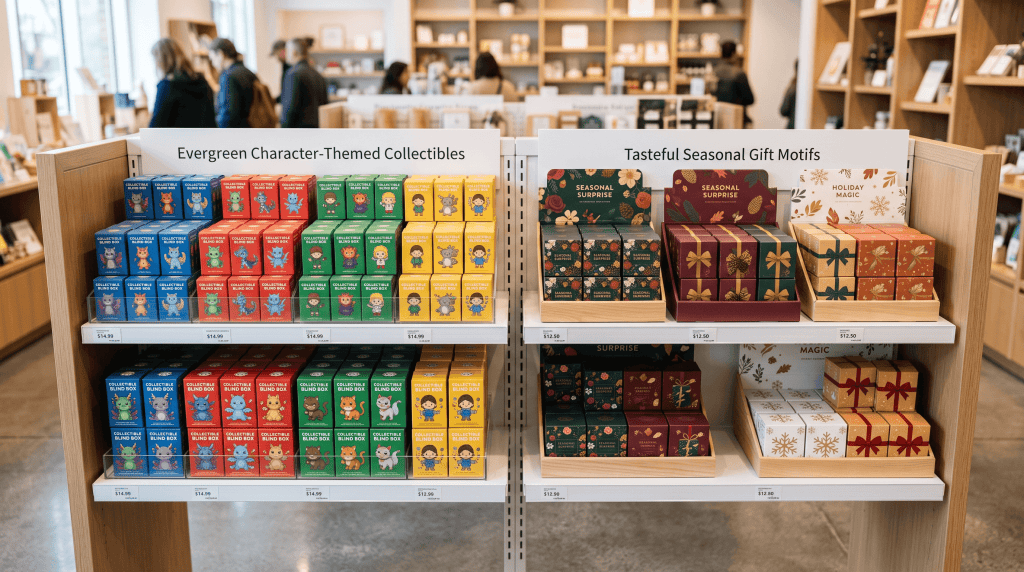
Before you commit budget to a case, the real question is whether the series will still move once the launch buzz fades. That sellable window decides how many cases to order, when to reorder, and how much stock might end up on markdown. Character-led lines can benefit from ongoing collector interest, while seasonal lines often create sharper urgency inside a narrower window.
Neither format automatically lasts longer. The practical answer depends on character recognition, design versatility, occasion timing, case assortment, retail channel, and the supplier’s reorder conditions. Treat “shelf life” as a demand window to plan around, not as a physical product-expiry date.
What Actually Keeps a Series Selling After Launch Day
A long-selling series gives shoppers reasons to buy beyond the release date. For character-led products, that reason may be attachment to the character, completing a set, gifting, or repeat purchases from an established collector audience. For seasonal products, it may be a recurring occasion such as a holiday, a spring gifting period, or a good-luck theme.
Ask these questions before judging shelf life from product photos:
- Is the demand date-bound? A design tied to a specific holiday may lose relevance the day after the event.
- Can the product be displayed year-round? Neutral colors, versatile themes, and recognizable characters may support a wider selling window.
- Does the assortment encourage repeat purchases? Confirm the number of regular designs, any special/secret designs, and the case configuration rather than assuming every case is identical.
- Will your customers recognize the character? A character series with low local awareness may behave more like an untested launch than an evergreen line.
- Can staff explain the product in one sentence? Products that need heavy context are harder to sell once social attention drops off.
Reviewing an individual listing such as the Mega Space Molly 100% Series 3 blind box can help you pin down which specifications, assortment details, and packaging information still need confirmation before committing to a character-led buy.
Match the Series to the Channel That Will Sell It
The channel often matters more than the label on the collection. A specialist collectible shop may sustain character demand through collector communities and repeat visits. A gift shop, lifestyle store, or pop-up may do better with a seasonal theme customers grasp without any prior character knowledge.
- Collectible and anime retailers: Compare character awareness, interest in previous series, display continuity, and the likelihood of set-completion purchases.
- Gift and stationery stores: Favor themes that signal the gifting occasion at a glance and fit your existing price points and display space.
- Интернет-продавцы: Check whether the series can be found through searchable character, format, or occasion terms once launch-day traffic drops.
- Pop-ups and events: A short seasonal window can be acceptable when the event dates and expected footfall are already known.
- Multi-category retailers: Weigh blind boxes against adjacent impulse products. The guide to fridge magnets versus bag charms shows another way to judge how format and everyday utility affect gift demand.
If you serve several channels, split the test instead of making one large assumption. As a planning example, you might allocate a smaller seasonal quantity to event-led locations and a broader character assortment to stores with repeat collector traffic. The actual order still has to follow the available case packs and supplier terms.
A Side-by-Side Scorecard for Your Next Order
Use the table below as a quote and inventory review tool. Score each candidate series using evidence from the product specification, sales history in your own store, and the supplier’s answers.
| Контрольная точка | Character series | Seasonal series | Действия покупателя |
|---|---|---|---|
| Primary demand trigger | Character attachment, collecting, or new-series interest | Holiday, occasion, weather, or gifting moment | Write down why the target customer would buy now and later |
| Likely selling window | Potentially broader, but dependent on sustained recognition | Often concentrated before the relevant occasion | Set a final full-price selling date for planning purposes |
| Reorder flexibility | Useful if ongoing availability can be confirmed | Less valuable when replenishment arrives after the event | Ask whether reorders use the same case configuration |
| Markdown exposure | Can rise when collector attention shifts to another release | Can rise sharply once the season ends | Prepare a sell-through threshold before placing a reorder |
| Display requirements | May need character context or related products | May need coordinated seasonal merchandising | Confirm display-box dimensions and shelf allocation |
| Assortment risk | Some designs may appeal more strongly than others | Highly specific motifs may have limited post-season use | Request the lineup and case assortment information |
| Year-round gifting | Possible when the character and styling fit multiple occasions | Possible only if the theme is broader than one date | Separate evergreen gift designs from date-specific designs |
| Next-season carryover | Not tied to an annual calendar, but trends can shift | Possible when packaging stays relevant and storage is practical | Do not assume leftovers carry over without checking condition and demand |
When comparing character aesthetics, a focused reference such as the Little Monster Cupa buyer guide is useful as a prompt for questions, not as proof that a series will perform the same way in every market.
Before you go further: shortlist one character series and one seasonal series, then request equivalent assortment, carton, packaging, and availability details so you can compare the two on exactly the same basis.
How Case Packs Turn a Short Window Into Dead Stock
MOQ and case quantity can turn an appealing seasonal design into an inventory problem. Keep four figures separate: the supplier’s minimum order requirement, the number of blind boxes per display case, the number of cases per carton, and any requirement to order full cartons. These are different numbers and should never be collapsed into one vague “minimum.”

For planning purposes, say you expect to sell 60 units during an occasion window. One option might require ordering in case multiples that land you at 48 or 72 units. The decision isn’t simply “buy more.” Weigh the cost of the extra units, the odds of selling them after the event, and whether unopened cases could support a later promotion. These numbers are illustrative planning figures, not supplier terms.
For a character series, a larger opening quantity can be easier to justify if you have relevant audience data and replenishment is uncertain. But don’t infer popularity from online attention alone. A comparison such as Have a Seat versus Big Into Energy shows why retailers should evaluate series-level differences instead of treating every release under a recognizable character as interchangeable.
Why Late Freight Can Erase a Seasonal Bargain
A seasonal item that arrives late has fewer full-price selling days, even if its unit quote looks attractive. Ask the supplier to break out product preparation time, dispatch timing, transit estimate, and any time needed for destination customs or local delivery. Build in uncertainty and verify import requirements in your destination market.
Calculate landed cost using the quoted product cost plus applicable freight, insurance if used, duties or taxes, customs-related charges, payment fees, and local delivery. Then add the commercial effect of unsold units. A lower unit quote can produce a higher effective cost once the case pack leaves you with excess post-season inventory.
Set reorder rules before launch. As a planning example, you might review sales after roughly the first quarter of the intended selling window and reorder only if remaining stock can’t cover forecast demand plus a modest buffer. For seasonal stock, the reorder’s expected arrival date still has to leave enough selling days. Character stock may allow a later reorder, but confirm continued availability rather than assume it.
Keep Display Boxes and Gift Appeal Intact in Storage
Blind boxes usually sell in their original packaging, so crushed corners, moisture exposure, faded printing, or damaged display cartons can kill retail appeal even when the item inside is fine. Request packaging dimensions, unit and carton weights, carton configuration, and photos showing individual boxes, display cases, and outer cartons.

Build a receiving check around observable details:
- Count cartons, display cases, and individual units against the packing documents.
- Check outer cartons for compression, punctures, moisture, or resealing.
- Sample units from different carton positions rather than inspecting only the top layer.
- Compare packaging, labels, colors, accessories, and visible finish against the approved specification or sample.
- Record discrepancies with dated photos before distributing stock to stores.
Also confirm age grading, warnings, labeling, material declarations, intellectual property authorization, and any testing or documentation required for your destination market. Requirements vary by product type and jurisdiction, and a product listing alone should not be treated as evidence of compliance.
Spotting a Quote You Can’t Actually Compare
A quote is incomplete when it gives only a unit figure. Red flags include unclear product identity, missing case quantities, substituted packaging, no written validity period, ambiguous inclusion of freight, or reluctance to state which specifications the price covers. A common mistake is comparing a full-case character quote against a mixed seasonal carton without checking the number and assortment of sellable units.
Send the same request to each potential source:
Please quote the specified blind box series and confirm the product version, regular design count, any special-design information, units per display case, cases per carton, minimum order basis, packaging dimensions, carton weight, product preparation estimate, shipping terms, quote validity, and available product or compliance documentation. Please also state whether samples or smaller test quantities can be discussed and whether reorder packaging and assortment are expected to match the first order.
Run these internal checks before approving an order:
- Target customer and retail channel
- Planned launch date and final full-price selling date
- Opening quantity by location
- Case-breaking policy and display requirements
- Landed-cost assumptions and markdown exposure
- Receiving inspection process
- Reorder trigger and latest acceptable arrival date
Ready to compare stock options? Line up the series names, destination, preferred quantity range, required arrival window, and packaging questions before you request a quote. A complete inquiry makes it far easier to see whether a character series or a seasonal series fits your actual selling plan rather than just offering the most eye-catching artwork.
ЧАСТО ЗАДАВАЕМЫЕ ВОПРОСЫ
Do character blind boxes always have a longer shelf life?
No. Character series may sell for longer when recognition and collector interest continue, but weak local awareness or rapidly changing trends can shorten demand. Use your own channel data and series-specific evidence.
Can seasonal blind boxes be carried into the next year?
Possibly, but assess packaging condition, storage cost, design relevance, annual changes, and likely customer demand. Date-specific packaging is generally harder to carry over than a broad seasonal theme.
How should a retailer test a new blind box series?
Start with the smallest commercially workable case configuration available, allocate units to representative locations, and track sell-through by week. Confirm the supplier’s MOQ and case rules instead of assuming individual units are available.
What should be included in a blind box landed-cost comparison?
Include product cost, freight, insurance if applicable, duties or taxes, customs-related charges, payment fees, local delivery, and the expected cost of excess or marked-down inventory.
When should seasonal blind boxes be reordered?
Reorder only when current sales support the quantity and the estimated arrival still leaves enough full-price selling days. Include preparation, transit, customs, and local delivery uncertainty in the decision.
Before You Pick the Longer-Lasting Series
Character series often have the better shot at year-round sales, while seasonal series can create useful urgency and clear gifting relevance. The stronger buy is the one whose case quantity, landed cost, arrival timing, packaging, and demand window fit your channel. Confirm those points in writing, test assumptions with controlled quantities, and set a reorder deadline before launch.