



Deciding what to stock next has become harder now that the mystery-product shelf holds more than another small display figure. New blind box product formats can function as accessories, tactile gifts, display systems or customizable collectibles, and each format creates a different set of costs and operational risks.
Zipper bags, plush pendants, stacking toys and ball-jointed doll figures may all sit in the same category, but they should not be ordered using the same assumptions. Before committing budget, buyers need to check how customers will actually use them, how much shelf space they consume, what can be damaged in transit and whether a full assortment is practical for the store.
Which blind box product formats fit your customers?
Start with the customer use case rather than the character artwork. A format can attract attention online but still underperform if it does not match the store’s price architecture, display space or customer expectations.
| Format | Likely customer use | Retail strength | Specification to confirm | Main risk to review |
|---|---|---|---|---|
| Zipper bag | Small storage, travel organization or decorative carrying | Functional gifting beyond shelf display | Finished dimensions, lining, closure and intended use | Ambiguous product descriptions or weak zipper operation |
| Plush pendant | Bag decoration, key accessory or soft collectible | Portable and visually recognizable | Attachment type, pendant size and surface material | Loose hardware, crushed plush or inconsistent faces |
| Stacking toy | Desk display, interactive arrangement or repeat collecting | Encourages multi-unit purchases when pieces combine | Connection method, balance and compatibility across designs | Unstable stacks or parts that do not align |
| BJD figure | Posing, customization, photography and character collecting | Deeper hobby engagement and accessory potential | Scale, joints, included clothing, eyes, hair and stand | Complex assembly, missing components or unclear scale |
| Traditional display figure | Shelf, desk or cabinet display | Familiar purchase experience | Figure height, base and assortment | Limited differentiation in a crowded range |
| Fridge magnet | Home decoration and small gifting | Compact merchandising footprint | Magnet placement, weight and surface protection | Weak attachment or scratched finishes |
| Bag charm | Wearable personalization | Visible use can support discovery | Clip type, total hanging length and weight | Attachment failure during normal handling |
Gift stores may prioritize plush pendants and zipper bags because their function is immediately understandable. Hobby shops may find BJD figures more suitable when staff can explain scale and customization. Lifestyle retailers with demonstration space can make stacking toys easier to understand. For another small-accessory comparison, review the differences between fridge magnets and bag charms.
Zipper bags need a clear definition before quotation
“Zipper bag” can describe very different products: a miniature functional pouch, a character-shaped coin bag, a soft bag with a zipper compartment, or simply merchandise packed in a resealable pouch. A quote is not useful until both parties are discussing the same construction.
Ask the supplier to provide front, back, interior and scale-reference images. Confirm the outer and usable internal dimensions, main material, lining, zipper type, attachment hardware and whether the item is intended for storage or decoration. If a bag includes small accessories, request a complete component list for every regular design and any hidden design.
- For gift shops: check whether the interior can hold a recognizable everyday item, without implying a use the supplier has not documented.
- For online stores: obtain consistent measurements so product listings do not create size misunderstandings.
- For display planning: compare hanging presentation with countertop cartons and ask whether packaging has a hang tab.
- For quality review: operate the zipper repeatedly on samples and inspect stitching around corners and hardware anchors.
A vague answer such as “small bag” without dimensions, construction photos or intended-use clarification is a warning to pause the comparison.
Plush pendants turn attachment hardware into a key specification
Plush pendants combine the visual appeal of a soft character with hardware that customers may attach to backpacks or handbags. That makes the ring, clip, chain or cord just as important as the plush body. Buyers should document both parts rather than approving a sample from front-facing photography alone.
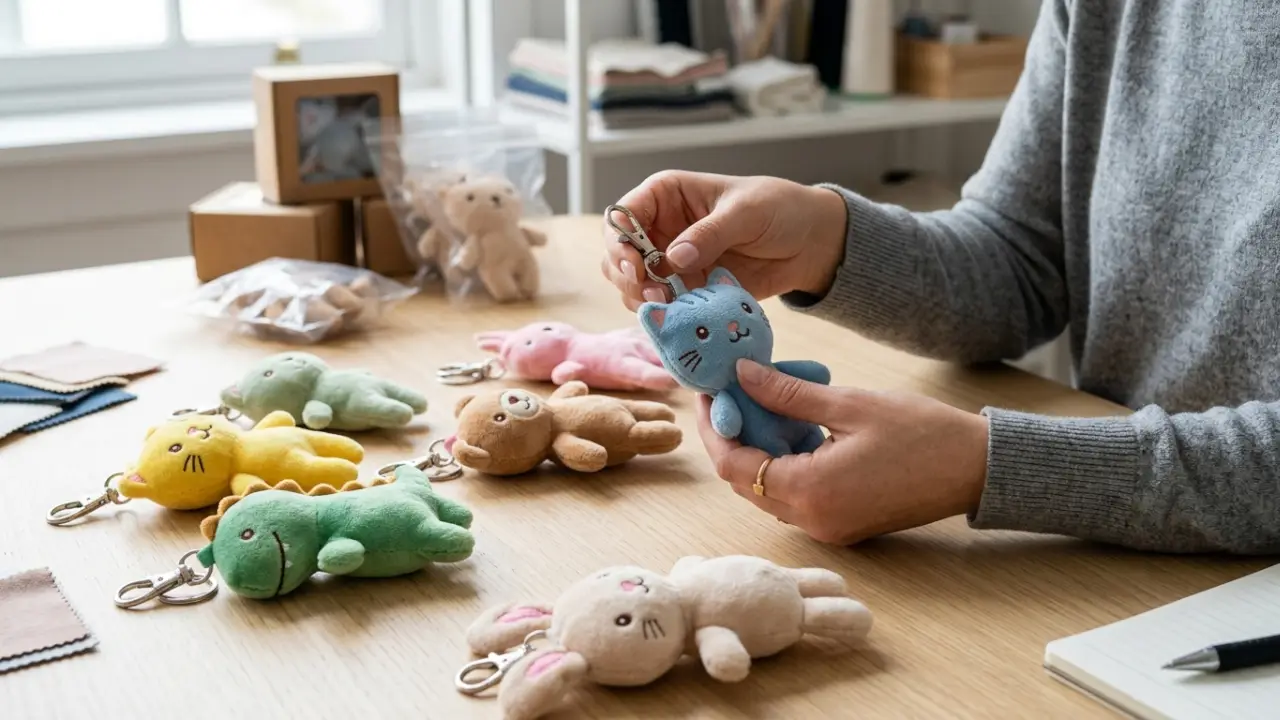
Request the pendant’s body dimensions, total hanging length and approximate weight basis used by the supplier. Review embroidery placement, seam closure, stuffing distribution, surface marks and facial symmetry. Then inspect how the hardware is anchored. A decorative loop that looks acceptable in a display case may behave differently when carried daily.
Assortment is also important. Color and silhouette can influence which designs sell first, leaving slower characters behind. A first planning exercise might allocate an example 60 units across three merchandising locations, then record sales by design once contents become known after purchase. This is not a suggested MOQ; it is a way to judge whether the format deserves a broader reorder.
Retailers comparing soft collectible styles can use this Nommi plush series comparison to identify additional questions about presentation and gift-store fit.
Stacking toys must work as a system, not only as single pieces
A stacking series relies on interaction between designs. Buyers should ask for photographs or video showing multiple regular figures connected, balanced or arranged in the positions advertised. Do not assume every piece stacks in every orientation.
Confirm whether the system uses magnets, pegs, shaped surfaces or simple balance. Ask whether all designs are mutually compatible, whether a base is included and whether the quoted carton configuration provides a useful mix. If one design is essential for stable stacking, its distribution affects the customer experience and the commercial value of a sealed set.
- Test each sample as an individual display object.
- Combine two, three and more pieces as an example stability check.
- Inspect contact points for poor fit, visible gaps or surface rubbing.
- Check whether shelf vibration or light counter contact causes collapse.
- Record the space required for a complete demonstration display.
If stacking is a central selling feature, prepare a small demonstration away from the saleable stock. A physical display explains the mechanism faster than packaging alone. Buyers ready to compare a stacking format with their current figure range can request specifications and carton details before committing to a larger assortment.
BJD blind boxes require scale and component confirmation
BJD figures can introduce more specification complexity than a fixed-pose collectible. “BJD” may be used broadly in product listings, so buyers should ask exactly how the figure is articulated and what arrives inside each box. Scale labels also need context because two figures described with the same nominal scale may differ in proportions.
Confirm assembled height, body material, joint construction, number of articulated areas and whether hands, feet or face parts are removable. Request a design-by-design list covering clothing, shoes, hair or wig, eyes, accessories, display support and any assembly tools. Ask whether hidden designs contain a materially different component set.
Retailers evaluating compact dolls can consult the Sakura 1/12 BJD sourcing guide. For a larger-format reference, the Bonnie 1/6 BJD retail guide highlights why scale should be considered alongside merchandising space and customer expectations.
Compatibility claims deserve special care. Do not advertise that third-party clothing, eyes or accessories will fit unless dimensions or sample testing support that claim. Buyers should also verify age grading, warnings, labeling and other requirements applicable to the destination market rather than assuming that articulation or customization determines the legal product category.
How case packs change the risk of a new-format test
Before discussing unit quantity alone, ask how many blind boxes are in a display case, how many display cases are in a master carton and whether orders are supplied as sealed series sets or mixed units. The distinction affects duplicate risk, merchandising and the ability to explain assortment odds accurately.
As a planning example, a retailer considering 96 units could compare four cases of 24 with eight cases of 12. The total is identical, but the smaller case may allow distribution across more locations, while the larger case could reduce handling. Actual configurations and minimum order requirements must come from the supplier.
Review the assortment structure before setting a test quantity:
- Number of regular designs and whether regular designs are evenly packed
- Whether a hidden design replaces a regular design in a sealed case
- Case quantity, master-carton quantity and ordering increment
- Whether mixed loose boxes have traceable series and batch information
- Whether the supplier can identify sealed status on the quotation
The guide to sealed series sets and mixed blind box assortments provides a useful framework for deciding which configuration better suits a test launch.
Why freight and packaging can reverse an attractive unit-cost comparison
Compare quotes using a consistent landed-cost worksheet, not only the quoted product price. Relevant fields may include product cost, export packaging, freight, insurance where applicable, import duties or taxes, customs or brokerage charges, local delivery and an allowance for damaged or unsaleable units. Buyers should verify tariff treatment and import requirements for their own destination.

Format affects freight differently. Plush pendants and padded zipper bags may occupy more volume than their weight suggests. BJD packaging may need internal trays to keep components organized. Stacking toys may require protection around connection points. Ask for retail-box dimensions, gross and net weight, display-case dimensions and master-carton measurements before comparing transport options.
Packaging review should include blind-box seals, barcode position, printed assortment information, internal protection and master-carton markings. Request pre-shipment photos or agree on an inspection method appropriate to the order. Buyers should independently confirm destination-market requirements for labeling, age grading, warnings, materials and product safety documentation.
Work backward from the required shelf date when discussing production readiness, dispatch and freight. Keep supplier preparation time separate from transit and customs time. For reorder planning, an example trigger could be a review when 40% of test stock remains, adjusted for weekly sell-through and the supplier’s current quoted schedule.
Questions that expose weak blind box format quotes
Quotes become difficult to compare when suppliers omit case structure, measurements, included parts or packaging assumptions. Be cautious when images do not match the written specification, a BJD component list changes between messages, stacking compatibility cannot be demonstrated, or zipper-bag terminology remains unclear.
Send the same request to every candidate so differences are visible:
Please quote the selected blind box series and confirm the exact product format, available ordering increment, units per display case and display cases per master carton. Please state whether the goods are sealed series cases or mixed individual boxes. Include the number of regular designs, hidden-design packing explanation, dimensions and materials for the product, retail box, display case and master carton, plus gross carton weight. For plush pendants, specify attachment hardware and total hanging length. For zipper bags, provide internal and external dimensions and construction images. For stacking toys, explain the connection system and compatibility across designs. For BJD figures, list scale, assembled height, joints and every included component. Please also identify packaging options, sample availability, current preparation estimate, shipping basis and the documents available for buyer review. We will verify import, labeling and compliance requirements for our market.
Before paying, reconcile the quotation, invoice and approved specification. Product name, series, quantity, case configuration and shipping basis should match across documents. A lower unit quote is not necessarily better if it excludes protective packaging, uses mixed loose inventory when sealed cases were expected, or leaves component details unresolved.
Ready to compare these formats? Prepare your target quantity, destination, preferred case configuration and required shelf date, then request a written quote with the format-specific details above. Clear inputs make it easier to compare suppliers on equivalent terms and identify unanswered risks before an order is placed.
ЧАСТО ЗАДАВАЕМЫЕ ВОПРОСЫ
Which blind box format is easiest for a gift store to test?
Plush pendants and small zipper bags may be easy for customers to understand because they combine collecting with a visible use. The right test still depends on case quantity, customer profile, retail price positioning and available display space.
What should retailers confirm about a plush pendant?
Confirm body dimensions, total hanging length, surface material, stuffing, attachment type, hardware anchoring, assortment structure and packaging protection. Samples should be checked from multiple angles rather than only from front-facing images.
How should buyers compare BJD blind box figures?
Compare assembled height, stated scale, articulation method, materials, included clothing and accessories, removable parts, packaging organization and component consistency across designs. Do not assume that figures with the same nominal scale share compatible accessories.
Are sealed cases better than mixed blind boxes?
Sealed cases can make assortment planning and customer communication easier, while mixed boxes may offer quantity flexibility. Buyers should confirm how each option is packed, whether assortment information remains traceable and how duplicates could affect the store.
What information is needed for an accurate wholesale quote?
Provide the product or series, target quantity, destination, preferred sealed or mixed configuration and required shelf date. Ask for case quantities, specifications, packaging dimensions, carton weight, preparation estimate, shipping basis and available compliance documentation.
Before adding a new format to the assortment
Treat each format as a different retail proposition. Zipper bags require precise construction and size definitions, plush pendants depend on secure hardware, stacking toys need system-level testing, and BJD figures demand detailed scale and component checks.
A controlled test is most useful when the buyer records format, case configuration, landed-cost inputs, sell-through by location, damage reasons and customer questions. Those observations provide a stronger basis for reordering than novelty alone.