

You have built the ultimate Art Toy boutique. Your shelves are perfectly aligned, your inventory is sourced from premium distributors like KidultsBox, and you have highly anticipated series like Pop Mart Skullpanda и Малыш-3 ready to sell. You turn on the store lights, step back to admire your Blind Box Wall, and realize you have a catastrophic problem.
You cannot see the artwork on the boxes. The shelves have turned into a wall of blinding, white, reflective mirrors.
The modern blind box relies heavily on premium packaging materials—glossy UV coatings, metallic inks, and holographic foil (mylar) stamping. While these materials look incredible in a photographer’s studio, they are a nightmare in a physical retail environment. Glare (specular reflection) creates optical fatigue, forcing the customer to squint, shift their head, and eventually walk away in frustration. In Visual Merchandising (VMD), glare is a silent conversion killer.
This hardcore optical engineering whitepaper will decode the physics of light reflection, debunk the myth of overhead track lighting, and provide the exact geometric angles and diffuser hardware required to make your foil blind boxes look like glowing, glare-free masterpieces.
1. The Physics of Glare: Why Overhead Lights Fail
To solve the problem, you must understand the fundamental law of reflection in physics: The Angle of Incidence equals the Angle of Reflection.
The Specular Reflection Trap
Most retail stores use ceiling-mounted track lighting pointing straight down (at a 90° or 75° angle relative to the floor) to illuminate their walls.
When a beam of light hits the glossy foil surface of a blind box standing vertically on a shelf, the light bounces off the box at the exact same angle. Because standard shelves are usually between 3 feet and 5.5 feet high (customer eye level), the light hits the box and bounces directly outward into the customer’s eyes. This creates a “Hotspot”—a blinding white glare that completely obscures the printed artwork on the cardboard.
You cannot solve this by making the light dimmer. You can only solve this by changing the geometry of the light source.
2. The Ultimate Solution: The 45-Degree Shelf-Lip Strategy
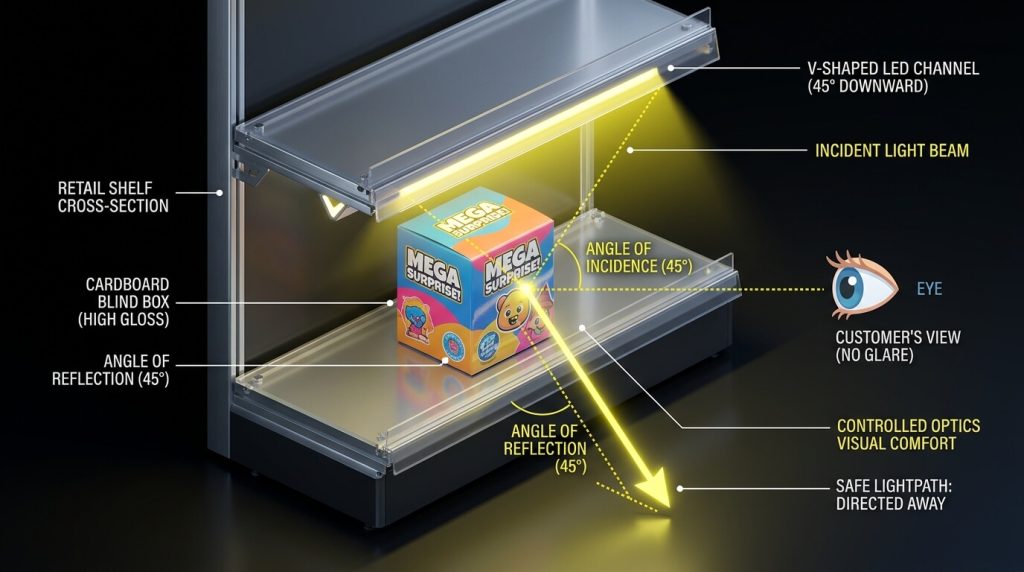
If you cannot light the box from the ceiling without blinding the customer, you must light the box from the shelf itself. The gold standard for art toy VMD is Front-Lip Integrated LED Lighting.
The Geometry of the Setup
Instead of relying on track lights, you run a continuous LED strip along the absolute front edge (the lip) of the shelf directly above the blind boxes you are illuminating.
However, if you point the LED strip straight down, the top of the box will be too bright, and the bottom will be dark. You must angle the light.
- The Aluminum Extrusion: Purchase specialized V-shaped or U-shaped aluminum LED channels with a built-in 45-degree angle.
- The Placement: Mount this angled channel to the underside of the front lip of the upper shelf.
- The Direction: The light is now pointing diagonally downward and backward toward the face of the blind box sitting on the shelf below.
Why This Eliminates Glare
Because the light is originating from just a few inches away and hitting the glossy foil box at a sharp downward 45-degree angle, the reflection bounces sharply downward toward the floor, completely missing the customer’s eye line. The customer sees a perfectly, evenly illuminated box with zero specular glare, allowing the holographic foils to shimmer richly without turning white.
3. Diffusers: The Battle Against “LED Dots”
Fixing the angle is only step one. The second major issue with retail lighting is the LED Diode Reflection. If you use bare LED strips, the highly glossy surface of a Pop Mart box will reflect every single individual LED bulb, making the box look like it is covered in bright white polka dots.
You must diffuse (soften) the light source to create an even “wash” of illumination.
| Diffuser Material Type | Light Transmission % | Glare Reduction Quality | Retail Verdict |
|---|---|---|---|
| Clear Acrylic Cover | 95% | Zero. You will see every LED dot perfectly reflected on the foil box. | Do Not Use. |
| Frosted / Milky Polycarbonate | 70% – 80% | High. Blends the individual diodes into a continuous, glowing “tube” of light. | The Industry Standard. Use this for 90% of your blind box shelving. |
| Silicone “Neon Flex” Diffuser | 50% – 60% | Extreme. Perfect, seamless wash of light. Completely eliminates diode reflection. | Premium Choice. Ideal for highlighting ultra-glossy or pure metallic foil boxes, but requires higher-lumen (brighter) LED strips to compensate for the light lost in the thick silicone. |
| Anti-Glare Louvers (Honeycomb) | 65% | Focuses the beam tightly; prevents light from spilling sideways into the customer’s eyes. | Use on ceiling track lights to pinpoint unboxed “Display Sample” figures without hitting the cardboard boxes behind them. |
4. Lighting Matrix: Material vs. Optical Strategy
As a retailer sourcing from a diverse B2B catalog like KidultsBox, you will encounter different packaging finishes. You must adjust your optical strategy accordingly.
| Packaging Material | Examples & Brands | The Lighting Strategy |
|---|---|---|
| Holographic / Mylar Foil | Cyberpunk themes, Skullpanda, High-End Secrets. | 45° Front-Lip Lighting + High CRI (95+). High Color Rendering Index is mandatory to make the holographic spectrum (rainbow effect) visible without washing it out in white light. |
| High-Gloss UV Lamination | Baby Three Macaron, Cino Dreamland. | Diffused Wash. Milky silicone diffusers are critical here to prevent the “LED Dot” reflection on the shiny cardboard. |
| Matte / Kraft Cardboard | Eco-friendly series, Kimmon Flower, Minimalist designs. | Direct Spotlight (Track Lighting). Matte packaging absorbs light and does not cause glare. You can safely use overhead track lights to punch hard, dramatic light onto these boxes. |
| Translucent Plastic / Acrylic Boxes | Penny’s Box BJD Displays, Confirmed Figure Cases. | Edge Lighting or Backlighting. Do not light from the front. Place an LED strip behind the acrylic case, or under the glass shelf. The light will catch the edges of the acrylic, making the entire case glow without blinding the viewer. |
5. Color Temperature: The “Foil Killer” Mistake
The final pillar of glare reduction is Color Temperature (Kelvin). Holographic foil and metallic inks rely on reflecting a wide spectrum of colors.
The 6000K (Cool Blue) Disaster:
Many retailers buy cheap “Daylight” or “Cool White” LED strips (6000K to 6500K) because they look bright and modern. However, this high color temperature contains a massive spike in the blue-light spectrum. When this intense blue light hits metallic foil or gold stamping on a blind box, it completely washes out the warmth of the gold, turning it into a harsh, reflective silver/white glare.
The Fix: Всегда используйте 4000K (Neutral White) lighting for blind box displays. 4000K perfectly balances warm and cool tones, allowing gold foil to look truly gold, and holographic elements to show their full rainbow spectrum without turning into a blinding white hotspot.
6. Dealing with the “Unboxed Sample” Display
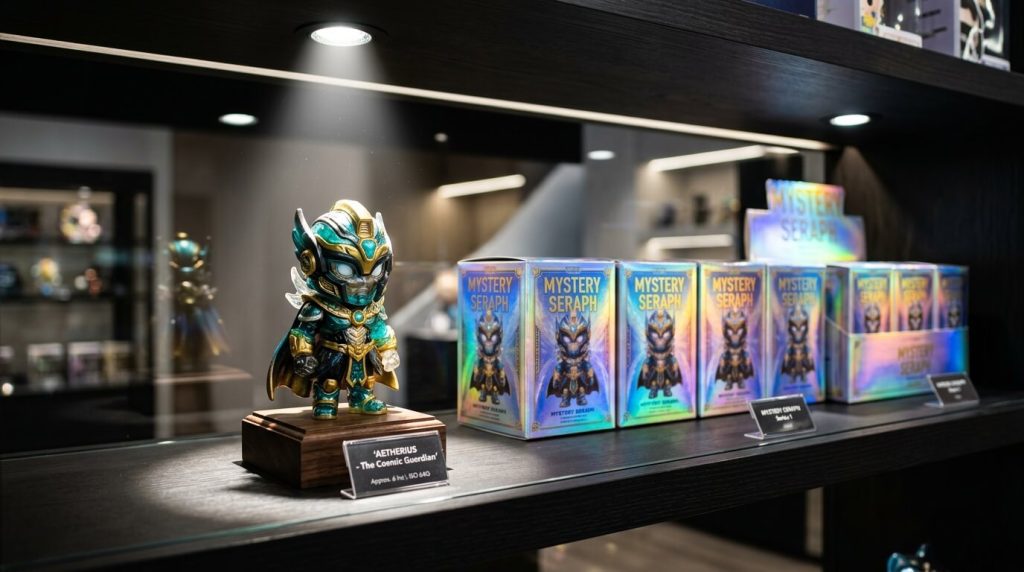
A blind box wall usually features an unboxed, physical vinyl toy standing in front of the sealed cardboard boxes. This creates an optical conflict: The 3D toy needs hard, direct light to show off its sculptural details, but the flat cardboard box behind it needs soft, angled light to avoid glare.
The “Dual-Zone” Lighting Hack:
- Используйте 45-Degree Shelf-Lip LED (with a milky diffuser) to provide the soft, even wash over the cardboard boxes in the back.
- Используйте Ceiling-Mounted Track Light with a Snoot (Honeycomb Grid). The honeycomb grid narrows the beam of light into a tight, 15-degree spotlight. Aim this tight spotlight exactly at the unboxed vinyl figure in the front.
Because the beam is restricted, it hits the 3D toy brilliantly, creating dramatic shadows, but the light does not “spill” onto the cardboard boxes behind it, preserving the zero-glare environment.
Часто задаваемые вопросы (FAQ)
Q: Will putting LED strips only 4 inches away from the blind boxes melt the toys inside?
A: No, provided you use modern LED technology. Unlike old halogen or incandescent bulbs, LEDs produce minimal forward-projected infrared heat. The heat from an LED is dissipated through its back (the aluminum channel acting as a heatsink). The toys inside the cardboard will remain perfectly cool and safe from thermal deformation.
Q: I already installed flat shelves with no front lip. How can I retrofit 45-degree lighting?
A: You can purchase Surface-Mount 45-Degree Aluminum LED Profiles. These are triangular extrusions that you can screw or use heavy-duty double-sided tape to mount directly onto the flat ceiling of the shelf compartment, right near the front edge. They achieve the exact same optical angle without needing a built-in wooden shelf lip.
Q: My store has massive street-facing windows. The sun is causing glare on the boxes. What do I do?
A: Natural sunlight is uncontrollable and highly damaging (UV rays cause PVC yellowing). You cannot fix solar glare with interior LEDs. You must apply a High-VLT (Visible Light Transmission) Anti-Glare Ceramic Tint to your storefront windows. This cuts the harsh solar glare and blocks UV, while still allowing pedestrians to see inside your store clearly.
Q: Do different brands from KidultsBox use different box coatings?
A: Yes. Premium IPs (like Pop Mart Secrets or limited editions) use heavy holographic foil, while eco-conscious or plush lines (like Kimmon) often use matte Kraft paper. This is why the 45-degree diffused shelf-lip strategy is the safest universal choice—it provides glare-free illumination regardless of the box’s lamination style.