




Scaling an art toy retail business eventually introduces a ceiling to volume-based sales. Selling hundreds of $15 blind boxes provides excellent, high-frequency cash flow, but the labor required to process those micro-transactions can bottleneck your growth. To significantly scale gross revenue without increasing foot traffic, independent retailers must transition a portion of their inventory to the luxury segment: $150 to $300+ premium collectibles, such as 400% and 1000% scale figures or high-end resin statues.
Based on retail financial modeling, selling a single $200 collectible yields the same absolute dollar profit as selling 15 standard blind boxes, but with a fraction of the transaction labor. However, luxury inventory introduces severe capital risk and demands a fundamentally different merchandising strategy. In this B2B guide, we will break down how to fund high-ticket inventory, how to merchandise “Anchor Products” to drive overall store sales, and the loss-prevention SOPs required for luxury toys.
The Financial Shift: Turnover vs. Absolute Margin
When transitioning to luxury items, retail buyers must shift their financial mindset. Standard blind boxes are evaluated on Inventory Turnover Ratio (how fast they sell). Luxury items are evaluated on Absolute Dollar Margin.
A $15 blind box with a 50% margin nets you $7.50 in gross profit. It may sell in two days. A $200 premium BJD doll or 400% vinyl figure with a 40% margin nets you $80.00 in gross profit. It may sit on your shelf for 45 days. While the turnover is slower, the sheer weight of the profit justifies the shelf space. The operational secret is recognizing that luxury items serve a dual purpose: they are inventory, but they are also in-store marketing assets.
Merchandising the “Anchor” Product

In retail psychology, massive, highly detailed $200+ figures function as “Anchor Products.” They grab attention from outside the store and draw customers in. A common mistake is placing a 1000% figure right next to the front door.
The Strategic Placement SOP:
- The Deep Cold Zone: As outlined in our guide to retail heat maps and blind box display zones, you must place your most expensive, visually stunning anchor products at the absolute back of the store.
- The Traffic Funnel: A collector will walk into the store specifically to look at the massive $250 figure. By placing it in the back, you force them to walk past 40 linear feet of $15 impulse-buy blind boxes. Even if they cannot afford the $250 item, they will likely purchase a $15 item as a consolation prize. The luxury item acts as a gravitational pull for your entire inventory ecosystem.
White-Glove Service and Loss Prevention
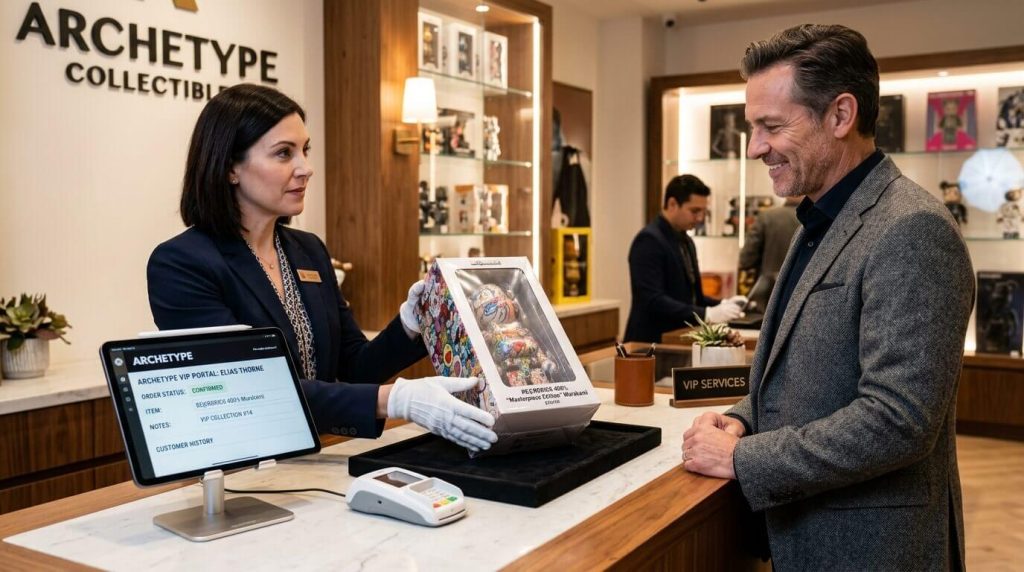
When a customer is spending over $200 on a single collectible, they expect a boutique experience. Furthermore, the retailer cannot afford a single incident of “shrinkage” (theft or damage) on these items.
Strict Handling Protocols:
- Mandatory Acrylic Enclosures: Never leave a $200 unboxed display model on an open shelf. It must be secured inside a heavy-duty, locked clear case. Review our deep-dive on acrylic cases vs. open shelving for high-ticket item security.
- The “Ask to See” Policy: The physical boxes for luxury items should not be accessible to casual browsers. Display the built model, and keep the factory-sealed boxes in the stockroom. When a customer wants to buy, the cashier brings out the pristine box. This guarantees the corners of the cardboard are not crushed by window-shoppers, protecting the item’s BNIB (Brand New In Box) premium value.
Funding Luxury Inventory via CRM Pre-Orders
The greatest barrier to entering the luxury segment is capital tie-up. Ordering five $200 figures locks up $1,000 of your Open-to-Buy (OTB) budget. If they are from an unproven IP, you risk creating a massive dead stock liability.
To eliminate this risk, modern retailers utilize their VIP databases. Before placing a wholesale order for high-ticket items, execute a targeted pre-order campaign. As outlined in our art toy CRM strategy guide, message your top 10% of customers: “We are securing an allocation of the new $200 premium series. VIPs can secure theirs today with a 50% non-refundable deposit.”
If you secure three deposits, you use that cash to fund the wholesale order of five units. You have effectively used Other People’s Money (OPM) to fund your transition into the luxury market, leaving you with two fully paid-off units for shelf display.
The Logistics of Large Scale Inventory
Transitioning to 400% and 1000% scale toys radically alters your freight calculations. Standard 3-inch PVC blind boxes are heavy, but large 1000% figures (even hollow soft vinyl ones) are heavily penalized by logistics carriers due to “volumetric weight” (the sheer amount of physical space the box consumes on an airplane).
Retailers must strictly avoid air-freighting luxury 1000% figures, as the shipping cost can easily wipe out the entire profit margin. These items must be sourced via ocean freight logistics or, ideally, purchased through a B2B supplier that offers domestic US warehouse fulfillment, allowing you to bypass international volumetric shipping penalties entirely.
Retail Strategy Matrix: Volume vs. Luxury
Use this matrix to understand how luxury items balance your overall retail portfolio.
| Метрика | Standard Blind Boxes ($15) | Luxury Collectibles ($200+) |
|---|---|---|
| Primary Retail Function | High-velocity cash flow; daily rent coverage. | Anchor displays; brand elevation; high absolute profit. |
| Целевая аудитория | Casual shoppers, teens, impulse buyers. | High-Net-Worth individuals, hardcore “Whale” collectors. |
| Loss Prevention Priority | Medium (Monitor for grab-and-run theft). | Maximum (Locked acrylic cases, stockroom storage). |
| Purchasing Strategy | Speculative wholesale ordering based on trends. | CRM-driven pre-orders to mitigate capital risk. |
Часто задаваемые вопросы (FAQ)
What happens if a $200 item arrives with a crushed outer box?
For luxury collectibles, the condition of the outer box is highly scrutinized by buyers. A crushed box on a $200 figure destroys its premium MSRP. You must immediately file a claim with your B2B supplier. To salvage the item locally, open it, display the pristine figure in an acrylic case as your “Store Anchor,” and utilize the open-box salvage strategy to eventually sell it to an out-of-box collector at a slight discount.
Do I need to offer financing or payment plans for high-ticket toys?
Yes. Integrating “Buy Now, Pay Later” (BNPL) services like Shop Pay, Affirm, or Afterpay into your POS system is critical for selling $200+ items. Consumers are far more likely to convert on a $200 luxury figure if they can split it into four $50 payments. The merchant (you) gets paid the full amount upfront by the BNPL provider, making it a zero-risk conversion booster.
How many luxury items should I stock in a small boutique?
Follow the 90/10 spatial rule. 90% of your shelf space should remain dedicated to fast-moving, $10-$20 blind boxes and plush items. Only allocate 10% of your visual real estate to luxury anchor items. This ensures you maintain the aesthetic of a premium boutique without starving your store of necessary daily cash flow.
Introducing $200+ collectibles to your inventory is the defining step in establishing your store as a premium destination. If you are preparing to secure your first allocation of high-end 400% figures or premium BJD dolls, leveraging a reliable B2B supplier with domestic inventory is your safest entry point.