

For independent art toy retailers, foot traffic does not automatically equal revenue. If a store experiences high daily visits but suffers from low conversion rates, the issue often lies in visual merchandising and store layout. To transition from guesswork to data-driven operations, modern retailers are utilizing retail heat map technology to track how customers navigate their floor space.
Based on in-store analytics, placing the right blind box series in the wrong zone can suppress sales for even the most popular IPs. In this guide, we will examine how to implement retail heat mapping in a toy store, how to merchandise hot and cold zones effectively, and how to pair your traffic data with your wholesale sourcing strategy to optimize revenue per square foot.
Understanding Retail Heat Mapping Technology

A retail heat map is a visual representation of customer foot traffic and dwell time (how long a shopper stands in one place). Using specialized overhead cameras or Wi-Fi tracking sensors, the software generates a color-coded map of your floor plan: red areas indicate high traffic and engagement, while blue/green areas indicate “cold” zones that shoppers bypass.
For art toy stores, heat maps reveal the true customer journey. They expose whether your Golden Triangle store layout is actually functioning as intended, or if customers are walking past your high-margin DIY room boxes without stopping.
Merchandising Art Toys Based on Traffic Zones
Once you have mapped your store’s traffic flow, you must assign your wholesale inventory to the correct zones based on product psychology and MSRP.
1. The “Hot Zones” (Endcaps and Decompression Zones)
Hot zones typically include the first 10 feet past the entrance (the decompression zone) and the endcaps facing the main aisle. Customers here are actively browsing but have not yet committed to a deep dive into your inventory.
Merchandising Strategy: Stock hot zones with visually striking, fast-moving items. This is the optimal location for newly released foil-bagged series or plush keychain blind boxes. Because these items have a lower price point and high tactile appeal, they serve as excellent “hook” products that transition browsers into active buyers.
2. The “Cold Zones” (Back Corners and Dead Ends)
Every retail space has cold zones where foot traffic naturally drops off. Leaving these areas empty or stocking them with low-tier products creates dead space that generates zero revenue.
Merchandising Strategy: Use “Anchor Products” to force traffic into cold zones. Dedicated collectors will walk to the back of the store to view large-scale 400% or 1000% figures or highly sought-after BJD blind boxes. By placing destination items in the back, you force shoppers to walk past your other merchandise, increasing incidental exposures.
3. The Point of Sale (Checkout Counter)
The checkout counter boasts the highest dwell time in the store, as customers are forced to stand still while waiting to pay.
Merchandising Strategy: This zone must be strictly reserved for high-margin, low-deliberation items. Capitalizing on the psychology of the checkout counter, retailers should utilize small acrylic spinner racks here for plush badges, zipper bags, and low-cost enamel pins. Avoid placing complex, high-ticket items here, as they require too much thought for a last-minute impulse buy.
A/B Testing Your Displays: Connecting Heat Maps to POS Data
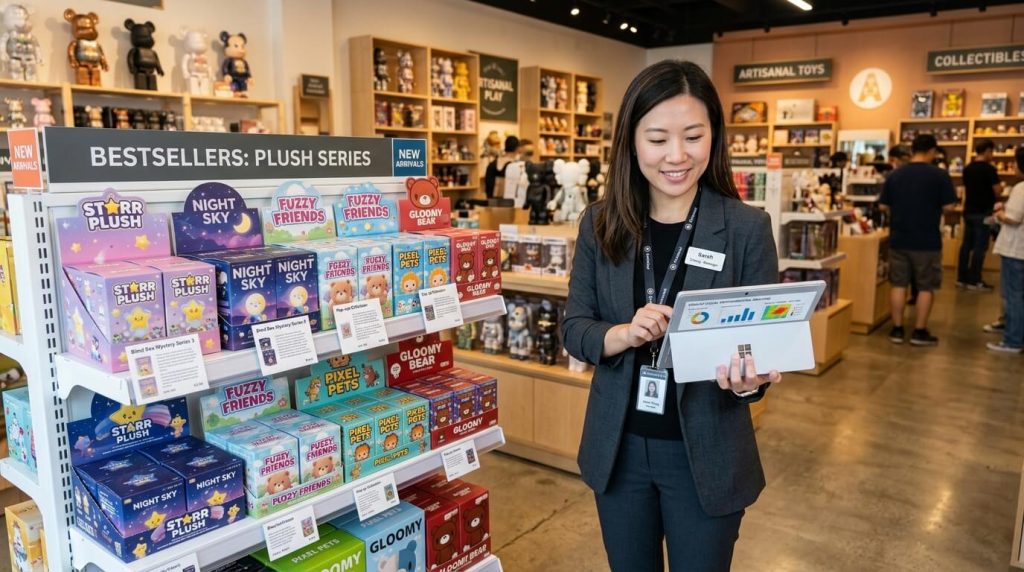
Heat maps only show traffic; they do not show sales. To execute a professional retail strategy, you must cross-reference your heat map data with your blind box POS inventory system.
- High Traffic + Low Sales: If a display sits in a red “hot zone” but POS data shows low sell-through, the merchandising is failing. The product may be priced too high for an impulse buy, or the display may be too cluttered. Solution: Swap the product for a lower-ticket blind box series.
- Low Traffic + High Sales: If a product is hidden in a blue “cold zone” but still moves inventory, it is a destination item. Solution: Leave it there to continue pulling traffic deep into the store, or move it to a hot zone if you intend to liquidate remaining stock quickly.
Inventory Placement Matrix
Use this operational matrix to plan your wholesale purchasing based on your available floor zones.
| Store Zone | Traffic Level | Ideal Product Category | Розничное назначение |
|---|---|---|---|
| Front Endcaps | High (Hot) | New Releases, Plush Keychains | Capture attention, drive initial cart additions. |
| Main Aisle Shelving | Medium (Warm) | Standard PVC Blind Boxes (e.g., Nanci, Emma) | Core revenue generation; volume sales. |
| Back Corners | Low (Cold) | Large Vinyl (400%), Premium BJD | Anchor displays; force traffic deep into the store. |
| Checkout / POS | Длительное время выдержки | Badges, Zipper Bags, Cheap Add-ons | Maximize Average Order Value (AOV) via impulse. |
Часто задаваемые вопросы (FAQ)
Is retail heat mapping software expensive to implement?
Not necessarily. While enterprise-level systems are costly, many modern security camera providers offer basic heat mapping and foot traffic analytics as a built-in software feature or a low-cost monthly add-on. For a small art toy boutique, a two-camera setup is usually sufficient to generate actionable data.
How long should I test a new display location before moving it?
A standard A/B test for a retail display requires at least two weekends of data (approximately 14 days) to account for weekday lulls and weekend traffic spikes. Moving products too frequently prevents you from gathering statistically significant sales data.
How can heat maps help with dead stock?
If you have aging inventory, checking your heat map is the first diagnostic step. If the dead stock is sitting in a cold zone, it is not “dead”; it is just invisible. Before aggressively liquidating unpopular blind boxes at a discount, try migrating the product to an endcap in a hot zone for 7 days. If it still fails to sell, then a clearance discount is warranted.
How should I structure my wholesale orders to match my floor zones?
A balanced wholesale order should physically reflect your floor plan. If 60% of your store consists of main aisle shelving (Warm Zones), 60% of your B2B order should be standard PVC blind boxes. Buyers sourcing through platforms like Kidults Box can easily construct a mixed assortment tailored to their specific floor plan.
Eliminating merchandising blind spots is a practical requirement for surviving in physical retail. For store owners who have optimized their floor plans and need to secure the right anchor items and impulse accessories to match their traffic zones, evaluating our B2B catalog is the next operational step.