





Comparing three similar-looking products by acronym alone is how a retail buyer ends up with stock that does not match the sample. With articulated blind box dolls, the labels SJD, BJD, and MJD may point to differences in posing, durability, packaging, and after-sales risk, but sellers do not always use those terms consistently, so the letters on a listing rarely tell you what physically holds the doll together.
The safest approach is to treat each acronym as the start of a specification check, not as proof of a particular joint system. Ask for body diagrams, movement videos, included-part lists, and packing details before comparing quotations.
Why the SJD, BJD, and MJD Labels Are Not Yet a Usable Specification
BJD commonly refers to a ball-jointed doll, often associated with ball-shaped joints and an internal tensioning system. MJD is frequently used for dolls with mechanical or engineered joints. SJD can be expanded or applied differently by individual sellers, including references to string-jointed construction. None of these labels is reliable enough to purchase against without confirmation.
Ask every supplier to define the acronym in writing and explain what physically connects the head, torso, shoulders, elbows, hips, and knees. A useful answer identifies whether the body uses elastic or string tension, pegs, hinges, an internal frame, or a combination.
- Request: front, back, and side photographs of the unassembled or exposed body structure.
- Confirm: which joints rotate, bend, tilt, or have a fixed range.
- Check: whether tension or joint tightness can be adjusted by the retailer or customer.
- Document: the seller’s definition of SJD, BJD, or MJD on the quotation or specification sheet.
Confirming construction this way also prevents category confusion. A doll with fabric elements, for example, should not automatically be compared with a hybrid vinyl-face plush blind box, because the handling, display, and packaging considerations can be very different.
Turning an SJD, BJD, or MJD Label Into Questions You Can Answer
The following table is a purchasing framework, not a universal technical definition. Use it to convert a seller’s product label into questions that can actually be answered and compared side by side.
| Контрольная точка | SJD listing | BJD listing | MJD listing | Действия покупателя |
|---|---|---|---|---|
| Acronym meaning | May be seller-specific or refer to string-jointed construction | Often means ball-jointed doll | Often means mechanical-jointed doll | Obtain the seller’s written definition |
| Internal connection | Do not assume from the label | May use elastic or string tension | May use pegs, hinges, or an internal frame | Request a body diagram or movement video |
| Pose holding | Depends on tension and joint design | Depends on stringing, joint fit, and balance | Depends on joint tolerances and detents | Ask for unsupported standing and seated demonstrations |
| Техническое обслуживание | Potential restringing or adjustment should be confirmed | Ask whether retensioning is expected or possible | Ask whether joints or frame parts are replaceable | Confirm available instructions and spare-part policy |
| Outfit compatibility | Body measurements matter more than the acronym | Proportions may vary between series | Mechanical bulk can affect sleeve or trouser fit | Request height, shoulder, waist, hip, foot, and head measurements |
| Handling risk | Loose tension or detached parts may be concerns | String tension and small components need review | Forced joints or stress at connection points need review | Ask for handling instructions and a parts inventory |
| Retail demonstration | Movement should be shown without overstretching | Posing can require customer education | Joint direction and limits should be clear | Prepare staff guidance based on the actual sample |
| Quote comparison | Construction must match the quoted sample | Included hands, clothing, and stands can change value | Frame design and accessories can change cost | Compare identical inclusions and case quantities |
A label that sounds more technically advanced is not automatically the better retail choice. The right format is the one that matches your customer’s posing expectations, your shop’s price architecture, and the level of product explanation your staff can provide.
Which Joint Format Fits Your Customer and Your Shelf?
Specialist doll collectors may value body engineering, clothing changes, and posing range. Gift buyers may prioritize character design, a complete outfit, and an easy unboxing experience. Anime and designer-toy retailers may need a product that communicates its appeal quickly from a sealed package.
Segment the purchase by use case before choosing a construction:
- Collector-focused store: prioritize measurements, restringing or adjustment information, alternate hands, and pose range.
- Gift retailer: prioritize presentation, secure accessory packing, clear age grading, and an understandable included-parts list.
- Online seller: prioritize consistent package dimensions, accurate variant information, and product photos that show scale.
- Display-led boutique: test whether the doll stands or sits reliably in the intended display furniture.
- Mixed collectible shop: check whether the doll adds a distinct format rather than duplicating existing small figures.
Physical scale affects shelf planning as much as articulation. Retailers weighing formats can review the merchandising implications of a small 200% figure against a larger 400% display figure before allocating shelf or window space.
Before you request quotes: shortlist the joint formats that fit your customer profile, then ask for one comparable specification sheet for each option rather than collecting price-only quotes.
How Case Packs and Reorders Can Change the Winning Format
Blind-box ordering takes more than an individual unit price. Confirm the number of designs in the series, units per case, whether a sealed case is intended to hold a complete basic assortment, and whether hidden or chase designs affect that arrangement. Do not assume a full case guarantees every pictured design.
MOQ must also be separated from case quantity. A supplier may quote an order minimum in units, cases, or monetary value. Ask whether different doll series or joint formats can be mixed to reach that threshold, and whether sample purchases use the same packaging as commercial stock.
For an example planning comparison, a retailer might model 48 sellable units of each candidate format, provided the actual case packs allow it. Compare:
- number of sealed cases required to reach approximately 48 units;
- duplicate exposure within the documented assortment structure;
- carton volume and chargeable shipping weight;
- number of display samples removed from sellable inventory;
- estimated replacement or customer-service allowance;
- cash tied up until the first reorder decision.
Landed cost should include the product amount, inner and master packaging, freight, insurance where applicable, duties or taxes, customs-related charges, payment costs, inspection expenses, and an allowance for damaged or incomplete units. Verify the import treatment that applies in your destination market rather than relying on a generic estimate.
Ask for both a production or preparation lead time and transit assumptions. A practical reorder trigger can combine sales velocity and replenishment time: for example, if units are selling faster than the documented replenishment window can support, you may need to reorder before stock drops below half the initial quantity. Treat that as a planning reference, not a fixed rule.
Assortment comparisons used for character series can also inform doll buying. The decision logic in this Labubu stocking comparison shows why theme, format, and inventory exposure should be evaluated together.
Inspect the Joints and Packing Before You Accept Doll Stock
A pre-order sample should represent the quoted construction and packaging as closely as possible. Photograph the sample on arrival and record the body type, accessories, outfit pieces, packaging layers, and any instructions. If the commercial order changes, request updated confirmation.
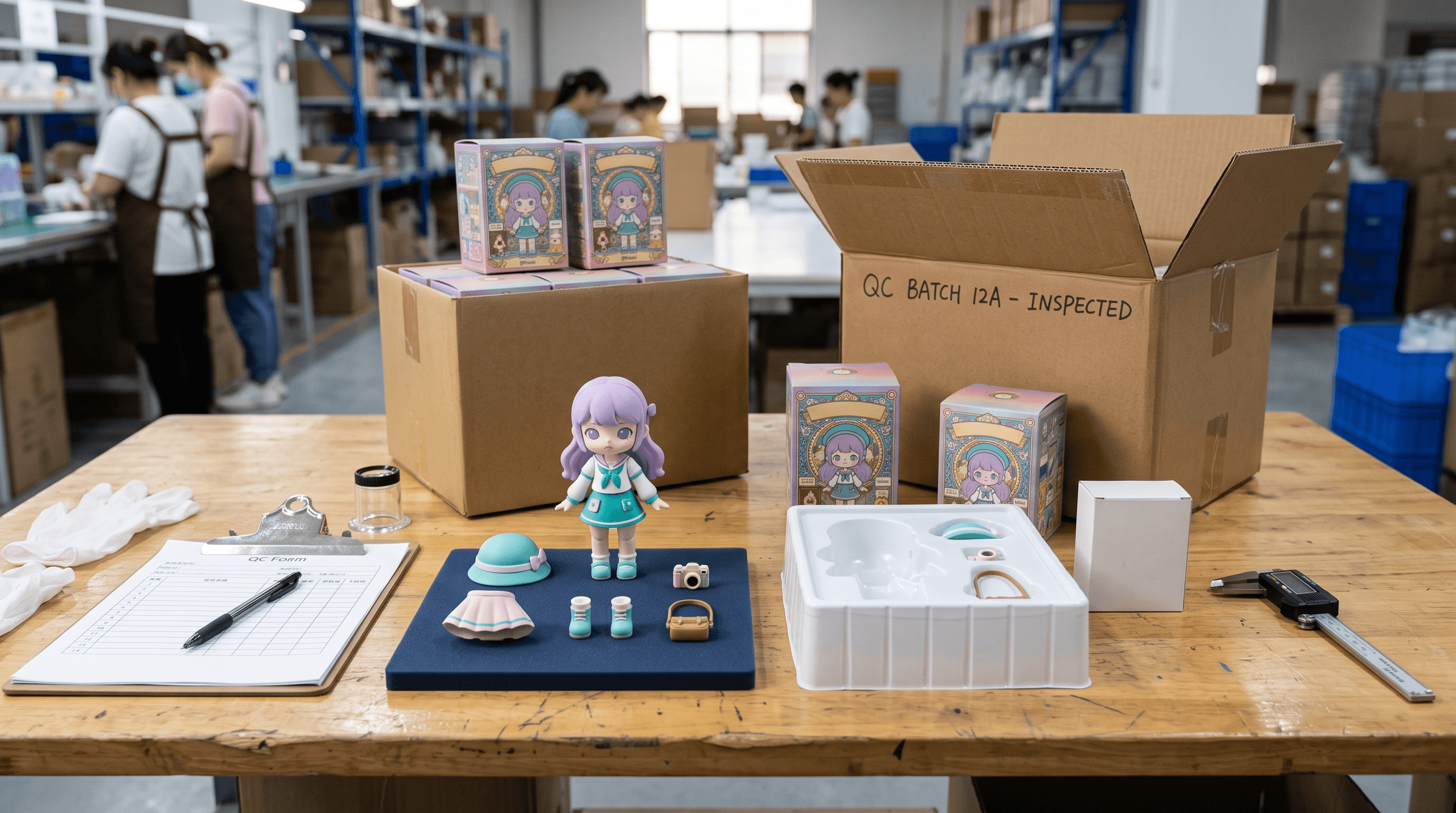
Use a repeatable inspection sequence:
- Outer box: check crushing, punctures, seals, print consistency, and required labeling.
- Inner protection: confirm the head, limbs, accessories, and clothing are restrained without creating pressure marks.
- Parts count: compare every item against the official included-parts list supplied for the order.
- Joint movement: move each joint only in its intended direction and note looseness, excessive resistance, or asymmetry.
- Surface and clothing: check for visible marks, color transfer, unfinished edges, faulty fasteners, and fit.
- Pose test: test a documented standing or seated pose on a level surface without forcing the body.
For an example inspection plan, buyers may examine units from the top, middle, and bottom of several cartons instead of checking only the easiest carton to open. The appropriate inspection level depends on order size, product risk, and the buyer’s quality agreement.
Dolls may include small parts, magnets, coatings, textiles, or removable accessories. Buyers should verify destination-market requirements for age grading, warnings, material documentation, labeling, traceability, and testing. A supplier statement alone may not satisfy an importer or marketplace, so confirm which documents apply to the exact SKU and market.
When SJD, BJD, and MJD Quotes Stop Being Comparable
A low unit price is meaningless if one quotation covers a dressed doll with accessories and another covers a different body, package, or case arrangement. Pause the comparison when photographs do not match the description, the acronym changes between messages, or the seller avoids identifying included components.
Other warning signs include an unexplained switch from sealed cases to loose units, no master-carton information, vague answers about replacement handling, pressure to pay before specifications are confirmed, or compliance documents that do not identify the quoted item. Any one of these does not automatically prove a problem, but each one justifies further verification.
Copyable inquiry template
Please quote the selected SJD, BJD, or MJD blind box doll series and define the joint-system acronym used for this item. Include SKU, body construction, doll height and body measurements, designs per series, units per case, MOQ basis, case assortment method, included clothing and accessories, individual-box and master-carton dimensions, gross weight, sample terms, preparation lead time, shipping term, replacement process, and available product or compliance documents for review. Please also provide current photos or video showing the actual joint movement and commercial packaging.
Compare the returned answers in one spreadsheet and flag every missing field. Do not substitute assumptions from a different series, even when the brand, artwork, or package shape looks similar.
Before paying for stock, request an itemized quote tied to the exact SKU, case pack, joint construction, included parts, packaging version, and shipping term. A comparable written specification is the strongest starting point for negotiating price and planning a responsible first order.
ЧАСТО ЗАДАВАЕМЫЕ ВОПРОСЫ
What is the main difference between SJD, BJD, and MJD blind box dolls?
The intended difference is generally the joint or body construction, but terminology can vary by seller. Buyers should ask for a written definition, body diagram, and movement video for the exact product.
Is a BJD always connected with elastic string?
Traditional BJD construction is often associated with ball joints and internal elastic tension, but a listing label alone is not proof. Confirm the connection method and adjustment process for the quoted SKU.
Which blind box doll type is easiest for general retail?
There is no universal answer. Gift-led stores may favor easy handling and complete presentation, while collector stores may value posing range, measurements, and maintainability. Test a sample with the intended customer and display method.
Should retailers buy a full sealed case?
A sealed case can simplify handling, but buyers should confirm its unit count and assortment logic. Do not assume it contains every standard design or a hidden design unless the supplier documents that arrangement.
What should be included in a wholesale doll quote?
The quote should identify the exact SKU, joint construction, included parts, MOQ basis, case pack, assortment method, packaging dimensions, carton weight, lead-time basis, shipping term, and available documentation.
Before You Place the First Doll Order
Choose between SJD, BJD, and MJD only after translating each label into a verified construction, assortment, packaging, and cost profile. A small sample review and a complete written quote can reveal far more retail risk than the acronym or promotional photography alone.