






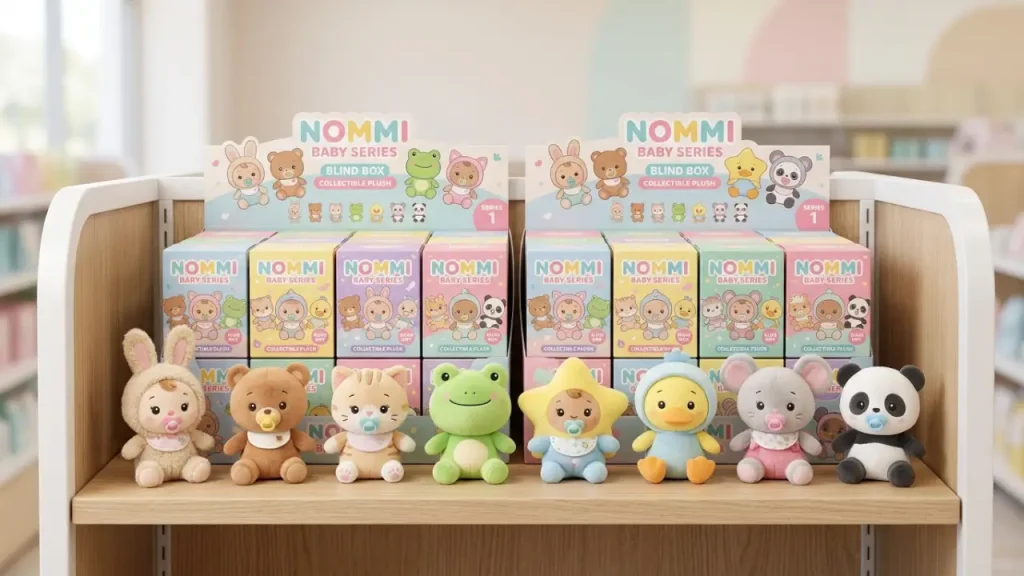
Choosing a plush collectible line is an inventory commitment, not an impulse buy—yet many retailers decide on character photos and unit price alone. The details that actually protect margin sit elsewhere: assortment structure, sealed-case status, packaging condition on arrival, and freight exposure relative to a bulky soft product. A Nommi Baby order rewards buyers who treat it as an inventory project and plan accordingly.
This guide walks through what to confirm before requesting a quote, how to compare order formats, and how to plan a first order without leaning on unsupported assumptions about minimum quantities, availability, or delivery time.
Where the Nommi Baby Series Fits in a Retail Assortment
The likely fit depends on how customers shop in a particular retail environment. A specialist collectible store may position a plush blind box alongside vinyl figures, while a gift shop may compare it with smaller impulse products near the checkout. Online sellers must also consider how the retail box and plush format affect parcel size and damage risk.
Potential buyer situations include:
- ร้านขายของสะสมและร้านงานอดิเรก: Buyers may use the series to broaden a figure-heavy assortment with a softer product format.
- ร้านขายสินค้าอนิเมะและคาวาอี้: The key question is whether the visual style matches the preferences already demonstrated by the store’s audience.
- Gift shops: Buyers should assess gifting appeal, retail-box presentation, and the selling price customers accept for an unknown design.
- ผู้ค้าปลีกออนไลน์: Parcel dimensions, photography, listing clarity, and protection against crushed boxes become especially important.
- Pop-ups and market sellers: A compact test order may be preferable when demand history is limited and storage space is constrained.
Do not assume that every customer buying standard plush will accept the blind-box format. Staff and product listings should explain that the enclosed design is not normally selected individually unless the supplier specifically offers identified or opened units. Retailers weighing plush construction against hybrid collectible formats can also review this comparison of vinyl-face plush versus standard plush blind boxes.
What to Confirm Before You Ask for a Nommi Baby Quote
A useful quote begins with a precise product description. Series names, editions, package revisions, and order formats can be confused when inquiries rely only on a screenshot. Send the supplier the full listing name and reference images, then request written confirmation of the following points.
| จุดประเมิน | คำถามสำหรับผู้จัดหา | ทำไมจึงส่งผลต่อการตัดสินใจซื้อ |
|---|---|---|
| Series identity | What exact Nommi Baby Series edition is included? | Similar names or images can lead to ordering the wrong release. |
| Product format | Is the item fully plush, hybrid construction, or another stated material format? | Construction influences customer expectations, weight, handling, and display. |
| Unit contents | What does one retail box contain, including any accessories or inserts? | The listing description should match what customers receive. |
| โครงสร้างการจัดกลุ่มสินค้า | How many regular designs are stated for the series, and is there a hidden-design mechanism? | This affects display messaging and duplicate expectations. |
| การจัดวางเคส | How many individual blind boxes are packed in one case? | Case quantity determines purchasing increments and inventory exposure. |
| Case status | Is the quote for a sealed original case, loose boxes, or a mixed assortment? | These formats do not carry the same assortment confidence. |
| Packaging condition | Are retail boxes supplied intact, and how are they protected inside the shipping carton? | Collectors may reject crushed, torn, opened, or heavily marked packaging. |
| ความสามารถในการติดตาม | What purchase documentation, product codes, or source information can be provided? | Buyers need a basis for authenticity and receiving checks. |
| Carton data | What are the carton dimensions, gross weight, and number of cases per carton? | These details are required for freight and storage estimates. |
| Destination requirements | What labeling or product documentation is available for review? | Buyers should verify whether the product is suitable for their destination market. |
Ask for current photos of the sellable unit, case, and outer carton when possible. Photographs do not replace written specifications, but they can reveal packaging differences that should be resolved before payment.
Sealed Cases, Loose Boxes, and a Sensible First Order
The quoted minimum order quantity is only one part of order planning. Buyers also need to know the purchasing increment. A supplier might quote by individual box, by full series case, or by shipping carton containing multiple cases. These formats should not be compared as though they were identical.
A sealed case may offer greater confidence in the intended assortment structure, but buyers should still ask whether a complete case is represented as non-repeating and how any hidden design affects that statement. Loose boxes may provide a lower test quantity, yet their assortment history may be less clear. The trade-offs are examined further in this guide to sealed series sets versus mixed blind box assortments.
As a planning example, a retailer considering three cases could allocate one case to an in-store display launch, one to online orders, and one as replenishment inventory. That is an allocation example, not a recommended order quantity. The correct level depends on verified case size, sales history, cash flow, and the ability to reorder.
Before committing, calculate how many weeks of stock the proposed quantity represents. If comparable plush blind boxes sell slowly, a large nominal discount may not compensate for the cost of holding excess inventory.
Why Nommi Baby Orders Need Carton-Level Cost Checks
A low unit quote can become misleading when the product is bulky relative to its selling price. Plush items and protective retail packaging may consume more carton volume than small hard collectibles, making freight allocation an important part of the comparison.
Build an estimated landed cost using:
- product cost per sellable blind box;
- supplier-side packing or handling charges, if any;
- freight to the destination;
- customs duties, taxes, brokerage, and clearance charges where applicable;
- payment or currency-conversion costs;
- an allowance for damaged or commercially unsellable packaging;
- domestic delivery from the port, airport, or warehouse.
Divide the total estimated order cost by the number of saleable units—not merely the number shipped. For example, a buyer comparing two quotes may find that the higher product price includes stronger carton packing or a more efficient case configuration. The decision should rest on comparable delivered assumptions rather than the headline unit price.
Before you send inquiries: when requesting a Nommi Baby Series quote, include the destination country or postal region, preferred order format, and expected quantity range. This gives the supplier a better basis for returning carton data and an appropriate shipping option.
Protecting Plush and Retail Boxes During Transit
Plush can recover from light compression, but collectible packaging may not. Crushed corners, torn seals, moisture exposure, or adhesive residue can turn an otherwise usable item into discounted stock. Buyers should define whether retail-box condition is part of their acceptance standard.
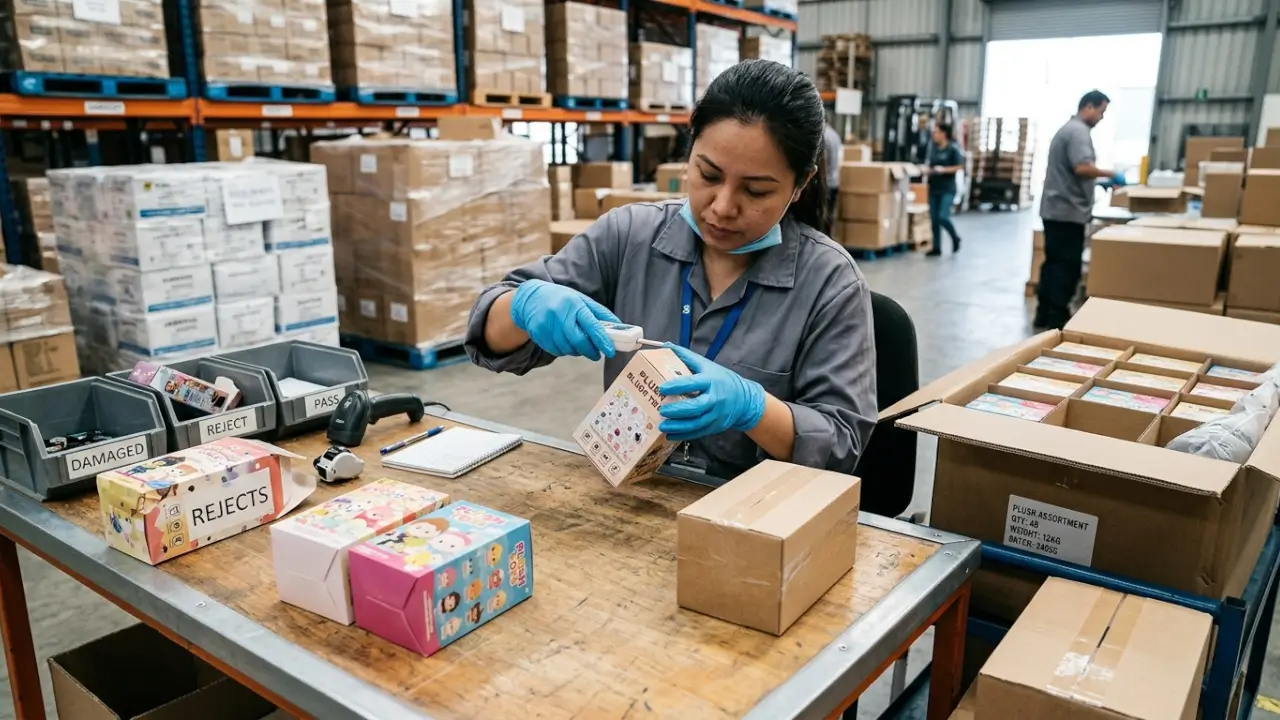
Ask how individual boxes, series cases, and master cartons are packed. Useful checks include carton strength, internal movement, moisture protection, and whether shipping labels are placed only on the outer transport carton. If packaging condition is commercially critical, request pre-shipment photos or discuss an inspection method before the order is finalized.
A receiving check can follow a documented sequence:
- Photograph unopened master cartons and visible transit damage.
- Count cartons, cases, and sellable units against the packing list.
- Sample retail boxes from the top, middle, and bottom of cartons.
- Record crushed corners, broken seals, stains, odor, moisture, or mismatched packaging.
- Keep affected units and shipping materials until any claim process is clarified.
Buyers should also confirm applicable product safety, age grading, labeling, textile, consumer-product, and import requirements for the destination market. Do not treat a supplier’s general statement as proof that every local requirement has been met; request relevant documentation and have it reviewed where necessary.
Timing a First Drop and Setting a Reorder Trigger
Lead time should be separated into stages: supplier preparation, any inspection or consolidation, international transport, customs clearance, and final delivery. Ask whether a quoted timeframe begins at inquiry, payment, order confirmation, or dispatch. Also confirm whether the estimate refers to business days or calendar days.
Do not schedule a launch on the expected arrival date. Build time for customs variability, receiving checks, product photography, listing preparation, pricing, and staff briefing. If the line is intended for a gift-giving event or promotional weekend, work backward from the date stock must be sale-ready rather than the date it merely needs to leave the supplier.
A reorder trigger should account for sales velocity and replenishment uncertainty. As a planning reference, a retailer may review replenishment when 40% to 50% of an initial allocation has sold, rather than waiting until only a few boxes remain. The actual trigger should be adjusted to the confirmed replenishment time and whether the same edition is still orderable.
Monitor sales by channel. A product that moves quickly at pop-ups may perform differently online, especially once parcel shipping is added. Retailers weighing checkout-area gift formats can use this comparison of small gift formats retailers can stock to decide whether plush blind boxes should take the same inventory role.
When a Nommi Baby Quote Is Not Yet Comparable
Two quotes are not comparable until they describe the same edition, order format, quantity, packaging condition, and shipping basis. A vague total may omit freight, taxes, payment charges, or carton-level details needed to estimate landed cost.
Warning signs that require follow-up include:
- the series cannot be identified beyond a shared product photo;
- the supplier changes between “sealed case” and “assorted boxes” without explanation;
- case quantity or carton dimensions are unavailable before freight is quoted;
- the quote does not state whether shipping is included;
- stock or dispatch claims are not confirmed in writing;
- packaging photos show a different edition from the requested item;
- questions about documentation, product codes, or source are repeatedly avoided;
- payment is requested before the order specification is summarized.
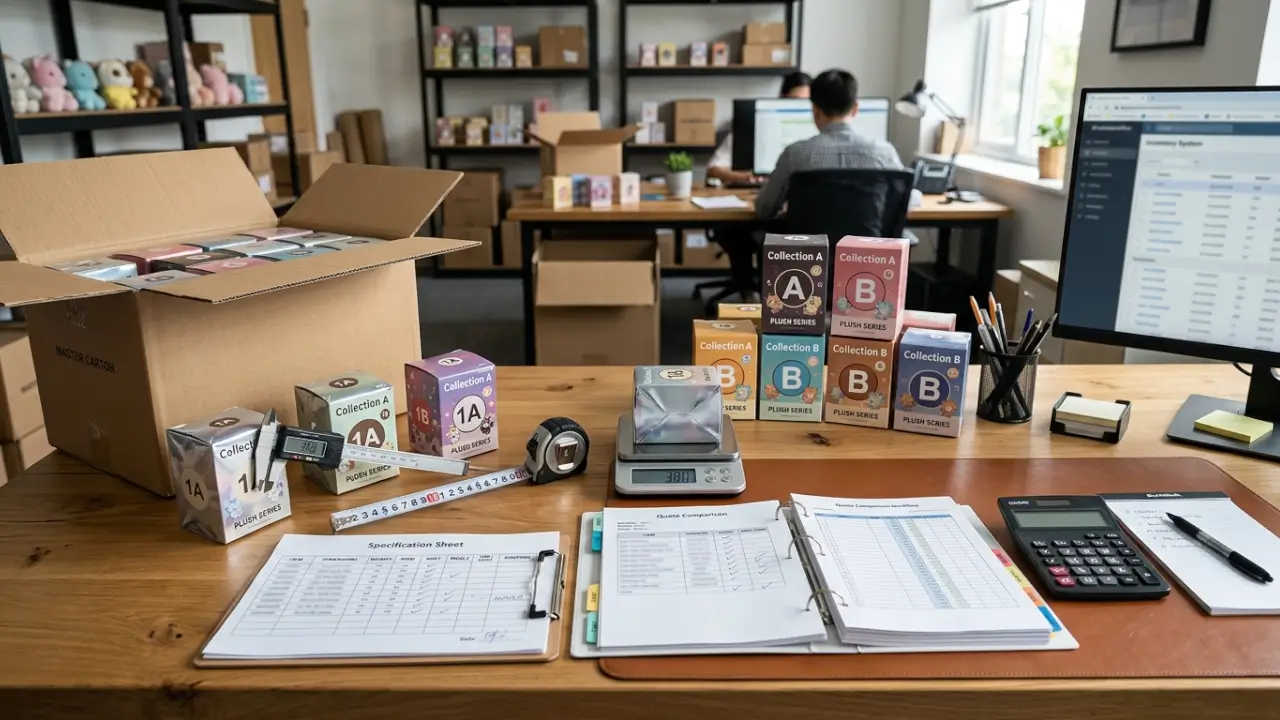
Use a structured inquiry so each supplier answers the same questions:
Hello, please quote the exact Nommi Baby Series shown in the attached reference. Please confirm the full series name, product format, contents per blind box, regular and hidden-design structure, units per sealed case, cases per shipping carton, minimum order format, current packaging photos, carton dimensions and gross weight, preparation-time basis, and available shipping options to [destination]. Please also state whether the quote is for sealed cases or loose boxes, what charges are included, how retail boxes are protected, and what product or labeling documentation is available for review.
Record the answers in a comparison sheet rather than relying on chat history. The same disciplined process appears in this retail buyer’s sourcing guide for another character line, which can help buyers standardize questions across multiple releases.
Before paying for stock, request a written order summary that identifies the exact edition, quantity, case status, unit and total cost, shipping basis, preparation-time basis, carton data, packaging expectations, and agreed documentation. Resolve any inconsistencies before treating the quote as final.
คำถามที่พบบ่อย
Should retailers buy sealed Nommi Baby cases or loose blind boxes?
Sealed cases may provide clearer assortment integrity, while loose boxes may reduce the size of a test order. Buyers should confirm the case configuration, duplicate policy, hidden-design mechanism, and whether the supplier’s quote refers to original sealed cases or repacked units.
What should be included in a Nommi Baby blind box quote?
The quote should identify the exact edition, product format, quantity, case pack, sealed or loose status, unit and total cost, carton dimensions, gross weight, shipping basis, preparation-time basis, packaging method, and available documentation.
How can a retailer estimate landed cost for plush blind boxes?
Add the product cost, packing charges, freight, duties, taxes, brokerage, payment costs, domestic delivery, and a reasonable damage allowance. Divide that estimate by expected saleable units to compare quotes on a consistent basis.
What packaging checks matter most for this series?
Check retail-box seals, corners, surface condition, moisture exposure, inner-case protection, and movement inside the master carton. Buyers should document carton condition during receiving and retain evidence of any damage.
When should a retailer reorder the Nommi Baby Series?
Set a trigger based on actual weekly sales and the confirmed replenishment time. Review the reorder decision before stock becomes scarce, while also confirming that the same edition and order format remain available.
Before You Place the First Order
A well-planned Nommi Baby purchase starts with edition verification and ends with a documented landed-cost and receiving plan. Confirm what is inside each ordering unit, distinguish sealed cases from loose assortments, protect retail packaging, and build launch time around the full delivery process.
The strongest purchasing decision is not necessarily the largest or lowest-priced quote. It is the order whose specifications, costs, risks, and replenishment assumptions are clear enough for the retailer to manage confidently. Draft your questions, request a written order summary, and send the same specification to each supplier before you commit.

