


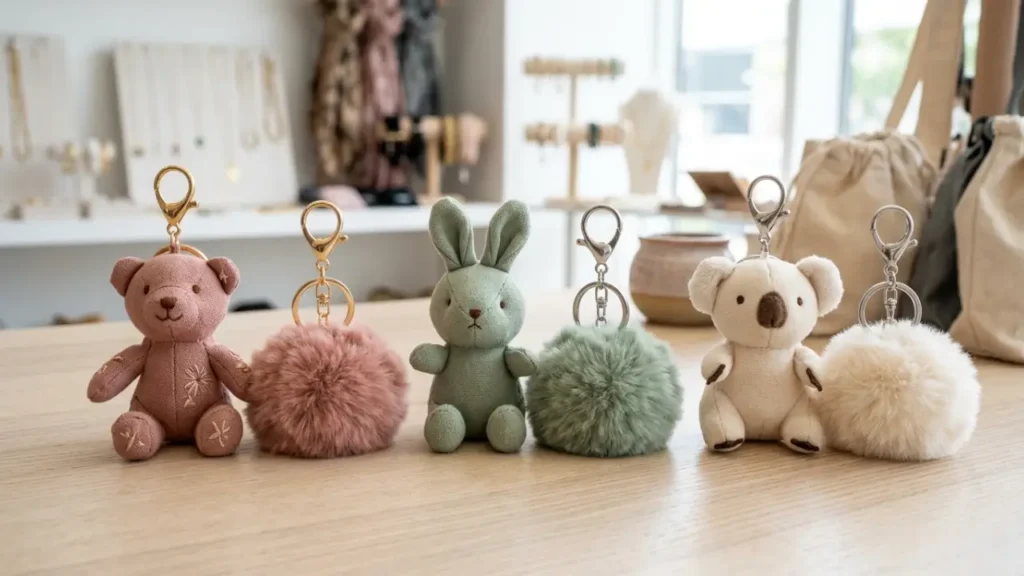
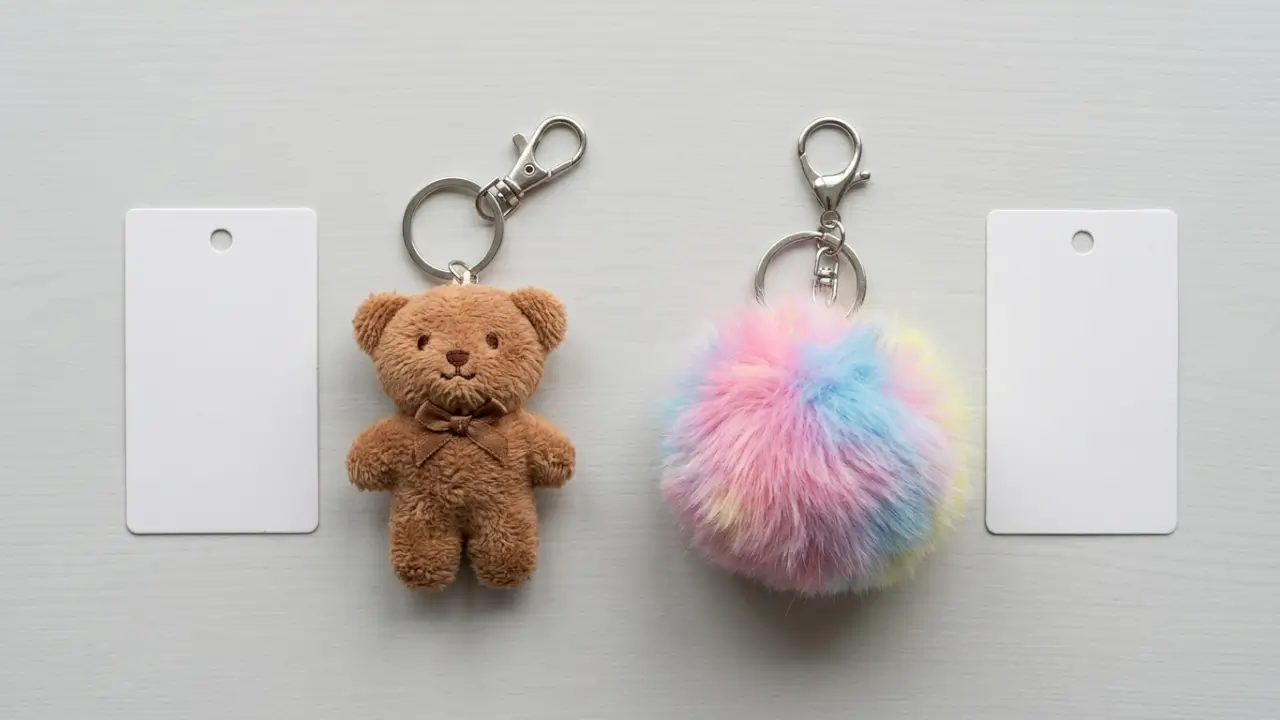
Checkout and counter space is some of the most expensive real estate in a gift store, so a small-accessory decision deserves more than an appealing product photo. A plush pendant may attract character-focused shoppers, while a pom pom keychain may suit customers choosing by color, texture, or gift pairing. Neither format automatically delivers better sales or a lower landed cost.
For this comparison, plush pendant means a small stuffed character or shaped charm intended for attachment to a bag or keys, not jewelry. Supplier terminology varies: confirm the actual attachment and construction rather than ordering by name alone.
When a pom pom keychain fits better than a character plush
Start with the purchase occasion. Does the shopper want a recognizable character, a tactile accessory, or an inexpensive-looking addition that still feels gift-ready? Compare samples beside the products customers already buy.
- Boutiques and handbag retailers: A color-led pom pom assortment may coordinate with bags and seasonal accessories. Check attachment clearance on the handles or loops used in your displays.
- Collectible-focused gift stores: A character plush pendant may support design-led purchases. Confirm whether shoppers select a visible design or receive a randomized blind box.
- General gift shops: Either format may work as an add-on. Favor the sample that presents clearly at checkout without requiring a long explanation.
- Online gift sellers: Evaluate whether photographs can communicate size, pile texture, hardware, and packaging accurately.
A plain pom pom is not automatically a collectible. It needs a reason for repeat purchase, such as coordinated colors or distinct designs. Likewise, a plush character without demonstrated customer interest should not receive a large opening allocation simply because it resembles a trending style.
For display planning beyond these two formats, review small accessories for limited shelf space.
Compare the attachment and shelf footprint, not just the soft shape
Ask both suppliers to quote against the same specification checklist. A small plush body can have oversized hardware, while a compressible pom pom can still require bulky protective packaging.
| Buying criterion | Plush pendant check | Pom pom keychain check | Decision rule |
|---|---|---|---|
| Customer appeal | Character, expression, shape, and design identity | Color, fullness, texture, and styling | Match the purchase motive already visible in your store. |
| ขนาด | Body dimensions, protruding ears, and total hanging length | Uncompressed diameter and total hanging length | Measure the packaged item against actual display spacing. |
| วัสดุ | Outer fabric, filling, embroidery, and applied parts | Fiber composition, core construction, and trim | Require material descriptions rather than relying on photos. |
| เอกสารแนบ | Loop stitching, chain, clasp, or split ring | Core-to-loop connection, clasp, or split ring | Confirm whether it is intended for bag decoration, keys, or both. |
| Appearance consistency | Face placement, shape, seams, and stuffing distribution | Pile density, bald patches, color variation, and shedding | Agree which visible defects make a unit unsuitable for sale. |
| Retail presentation | Hangtag, bag, window pack, or blind box | Hangcard, sleeve, bag, or box | Compare finished retail units, not loose-unit prices alone. |
| Assortment control | Selectable designs or randomized contents | Selectable colors or supplier-set mixes | Get the case breakdown in writing before approving quantities. |
| Freight footprint | Shape protection and carton packing density | Compression tolerance and recovery after unpacking | Use quoted carton dimensions and weights for freight estimates. |
Request close-up photographs of the attachment point and a sample shown beside a measuring tool. Beauty shots rarely reveal whether the hardware rotates freely or whether the hanging loop distorts the product.
If plush characters are the stronger fit, the Nommi plush series comparison for gift stores offers a related assortment-selection discussion; verify each candidate’s actual size and attachment separately.
Build a test assortment around colors, characters, and case packs
Ask whether the minimum order applies per order, design, color, or full case. Then separate the order minimum from the reorder minimum: a manageable mixed opening order is less useful if replenishing one successful color requires buying unwanted stock.
As a planning example, a store testing 48 accessories might allocate 24 units to each format. That split only works if supplier case quantities permit it. If one format requires fixed mixed cases, compare the resulting assortment exposure rather than forcing equal unit counts.
- Request the quantity of each color or design in a case.
- Confirm whether substitutions need written buyer approval.
- Ask whether repeat orders can specify the same shade or design.
- Keep visible-choice accessories separate from blind-box inventory in sales reporting.
For randomized plush pendants, do not assume a sealed case guarantees a complete set or no duplicates. Ask for the documented assortment policy. The Siinono plush blind box buying guide is relevant if you are also evaluating the randomized format.
Before expanding the shortlist: Request one matched specification sheet and sample option for each format. Comparing equivalent retail packs now can prevent an unhelpful price-only decision later.
Why the cheaper keychain quote may cost more on your shelf
Compare costs per sellable retail unit, with the same destination and delivery basis. A loose pom pom quote and a boxed plush quote are not directly comparable: one may require extra labeling, protective packing, or store labor before display.
สูตรการวางแผน: Estimated landed cost per sellable unit equals merchandise, retail preparation, freight, insurance where applicable, destination charges, and nonrecoverable import costs, divided by expected sellable units. Avoid double-counting charges already included in the supplier’s delivery terms.
Use packed carton measurements and gross weight, not product weight alone. Ask whether compression is proposed and test its effect before accepting a smaller shipping carton. A fluffy item that needs extensive reshaping can create receiving labor even if freight appears favorable.
Request separate estimates for preparation, dispatch, and transport. Confirm whether those estimates depend on production, payment approval, or assortment availability. Work backward from your shelf date and include time for receiving checks and any corrective action.
After launch, track units sold by format and variant, alongside display space used. Set reorder triggers from observed sales during the confirmed replenishment interval, plus a buffer suited to your store. Do not reorder the entire opening mix just because one design sells quickly.
Check plush seams and pom pom cores before approving packaging
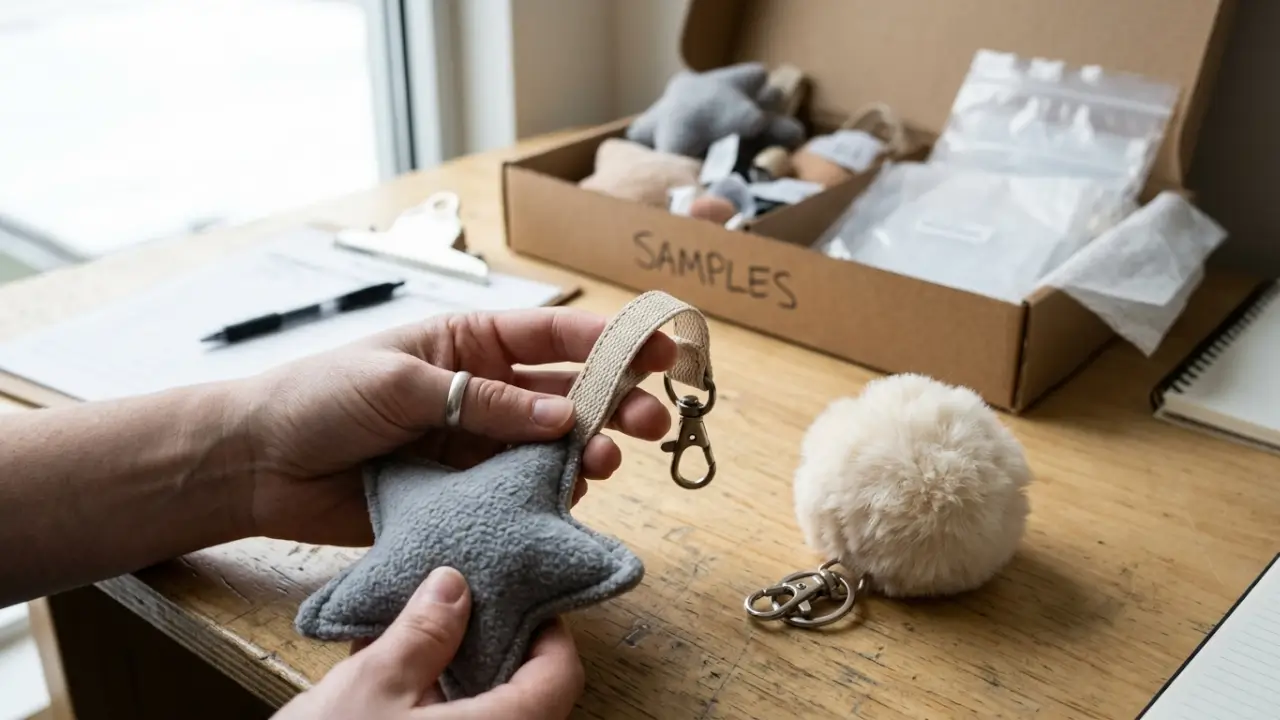
Evaluate samples as both merchandise and handling objects. Inspect the soft body, attachment, and retail pack separately. Informal buyer checks can identify problems, but they do not replace any testing required for the intended product classification and destination.
- Plush pendant: Check seam closure, filling escape, embroidery backing exposure, face alignment, and the stitching securing the hanging loop.
- Pom pom: Check loose fibers, uneven fullness, exposed core areas, pile trapped in hardware, and movement at the core-to-loop joint.
- Both: Inspect sharp edges, clasp operation, surface finish, loose decorative parts, and any unusual odor that needs investigation.
- Packaged samples: Unpack them after a representative packing trial and check crushing, snagging, scuffing, and presentation recovery.
Agree on an approved sample and written defect criteria. Ask how quantity shortages, incorrect variants, and damaged goods must be documented, including the supplier’s claim procedure and evidence requirements.
Confirm fiber composition rather than assuming every pom pom uses the same synthetic material. Where character artwork is involved, request sourcing and authorization information appropriate to the transaction.
Buyers should verify applicable safety, labeling, traceability, and import requirements for the destination market. A collectible description or age label alone does not settle whether an item is regulated as a toy or another product type. Request relevant product-specific documentation and seek qualified advice when classification is unclear.
Turn pendant and pom pom samples into comparable quote requests
Pause if a supplier will not identify materials, changes the quoted hardware without approval, cannot explain case contents, or provides carton information that conflicts with the packing list. A low unit price does not resolve these gaps.
Another common mistake is approving one attractive sample without documenting it. Record photographs, dimensions, hardware details, packaging, and acceptable appearance variation so the order has a clear reference.
Send this inquiry to shortlisted suppliers:
Please quote plush pendants and/or pom pom keychains for a gift-store trial order. Our destination is [market/postcode], target shelf date is [date], and planned quantity is [units by format]. Please confirm dimensions, materials, attachment construction, retail packaging, order and reorder minimums, case assortment, and whether variants are selectable. Include sample terms, packed carton dimensions and gross weight, delivery terms, preparation and transit estimates, and quote validity. Please also explain substitutions, defect claims, and available documentation relevant to the intended market and product use.
Request a written, itemized quote and approve a representative sample before committing to the bulk order. Include photographs of your intended display and specify whether customers need a bag charm, a functioning key holder, or a sealed collectible gift.
คำถามที่พบบ่อย
Is a plush pendant better than a pom pom keychain for gift stores?
A plush pendant may suit character-led purchases, while a pom pom keychain may suit color-coordinated add-ons. Test customer response, display fit, and landed cost rather than assuming one format will sell better.
Are all plush pendants sold as blind boxes?
No. Confirm whether the quoted item offers visible design selection, a fixed assortment, or randomized contents. Do not assume a full case guarantees every design.
What minimum order should a retailer ask for?
Ask for the minimum per order, color, design, and case, plus the reorder minimum. Choose a trial quantity that fits your display capacity and acceptable unsold-stock exposure.
What sample checks matter most for these accessories?
Prioritize attachment security, hardware operation, seams or core integrity, loose fibers, and appearance after unpacking. These buyer checks do not replace applicable safety testing.
How should wholesale quotes be compared?
Compare equivalent specifications and retail packaging using the same delivery basis. Include freight, destination charges, preparation costs, assortment restrictions, and expected sellable units.
Choose the accessory your store can explain and replenish
Select plush pendants when character appeal supports the purchase; select pom poms when color and texture make the stronger gift pairing. If both fit, run a controlled trial. Approve the sample, document the case mix, and expand only after variant-level sales justify the next order.