



You did it. You opened a 150-square-foot mall kiosk. You sourced highly addictive Pop Mart and Baby Three plushies from KidultsBox. You mastered the “Dummy Box” security method. Now, your kiosk is generating $2,000 a day in gross revenue, and mall management just handed you an incredible offer: “We have a vacant 1,200-square-foot inline store next to Sephora. It’s yours if you sign a 5-year lease.”
This is the definitive “Sink or Swim” moment in physical retail. Making the leap from a center-aisle kiosk to a full brick-and-mortar storefront is not just a change in square footage; it is a fundamental transformation of your business model. You are moving from an “Impulse Buy Cart” to a “Destination Boutique.”
Scaling up your space by 10x means scaling your inventory, your payroll, and your legal liabilities by 10x. This hardcore commercial real estate and retail expansion whitepaper will deconstruct the brutal financial math of the inline store, the traps hidden in commercial leases, and the visual merchandising strategies required to prevent your massive new store from looking empty.
1. The Financial Chasm: Kiosk vs. Inline Store Economics
In a kiosk, your primary advantage is low overhead. You pay a few thousand dollars a month, hire two employees, and ride the mall’s organic foot traffic. An inline store strips away that safety net and replaces it with massive Capital Expenditure (CapEx) requirements.
| Financial Metric | The Mall Kiosk (150 sq ft) | The Inline Store (1,200 sq ft) |
|---|---|---|
| Lease Commitment | 1 to 12 months (Low liability). | 3 to 5 Years. You are legally bound to pay hundreds of thousands of dollars, often requiring a Personal Guarantee. |
| Store Build-Out (CapEx) | $3,000 – $5,000 (Acrylic cases, basic LEDs). | $40,000 – $100,000+. Flooring, slatwalls, custom cash wrap, POS systems, security gates, and professional lighting. |
| Average Order Value (AOV) Ceiling | Low. Customers rarely drop $500 while standing in the middle of a walkway. | Massive. A physical store allows you to display 1000% MEGA figures and high-end BJD dolls, driving massive single-ticket sales. |
| Inventory Requirements | $5,000 to keep the cart looking full. | $30,000+. If a 1,200 sq ft store does not have deep, floor-to-ceiling stock, it looks like it’s going out of business. |
The “Destination” Paradigm Shift
A kiosk survives because people physically bump into it. An inline store requires a customer to make a conscious psychological decision to turn their shoulders, cross your threshold, and enter your world. You must give them a reason to enter. You can no longer rely purely on the “Oh, cute toy!” impulse. You must sell Experiential Retail—unboxing stations, neon photo walls, and deep collector lore.
2. Commercial Real Estate Traps: The Lease Negotiation
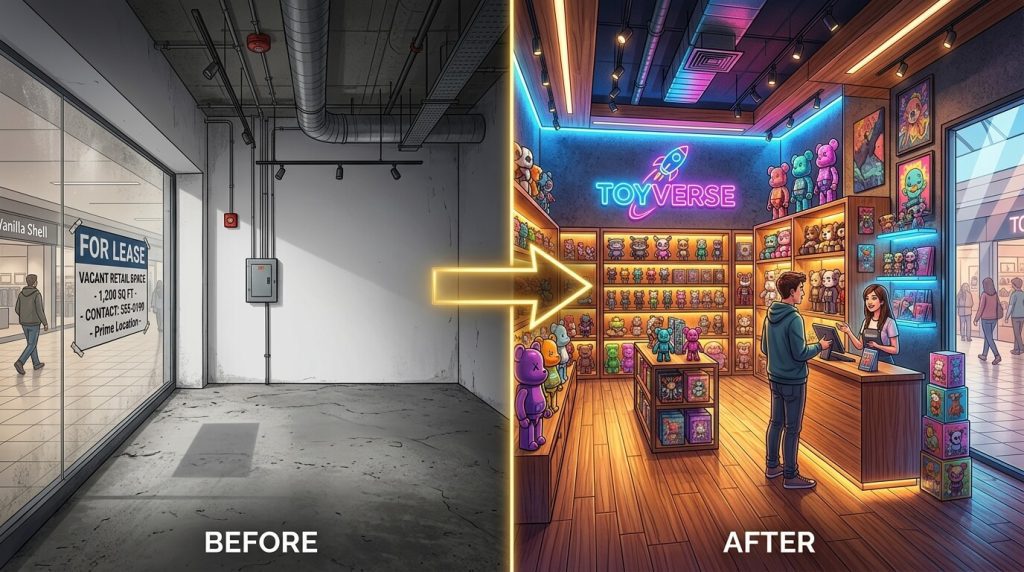
Commercial landlords are apex predators. When transitioning to a permanent store, do not sign their standard lease template. You must negotiate fiercely, ideally with the help of a commercial real estate broker.
A. The “Vanilla Shell” vs. “As-Is” Condition
If the space was previously a shoe store, taking it “As-Is” means you inherit their old, ugly carpets and dim lighting. Demand a Vanilla Shell delivery—meaning the landlord must provide a clean space with freshly painted white walls, a level floor ready for vinyl planking, and a working electrical panel at their expense.
B. The HVAC Death Trap
In many commercial leases, the tenant is responsible for maintaining and repairing the HVAC (Air Conditioning) unit on the roof. If the previous tenant ran a 20-year-old AC unit into the ground and it dies in your first month, you could be hit with a $15,000 replacement bill.
The Fix: Negotiate an HVAC cap (e.g., “Tenant is responsible for standard maintenance up to $500 per year; Landlord covers major replacements”) or demand a written warranty that the HVAC is in good working order.
C. Tenant Improvement (TI) Allowance
You need to build a massive Blind Box Wall. Do not pay for this entirely out of pocket. Demand a TI Allowance. The landlord should offer you cash (e.g., $20 to $40 per square foot) to help build out the store, because your beautiful improvements permanently increase the value of their real estate.
3. The “10x Inventory Rule”: Sourcing to Scale
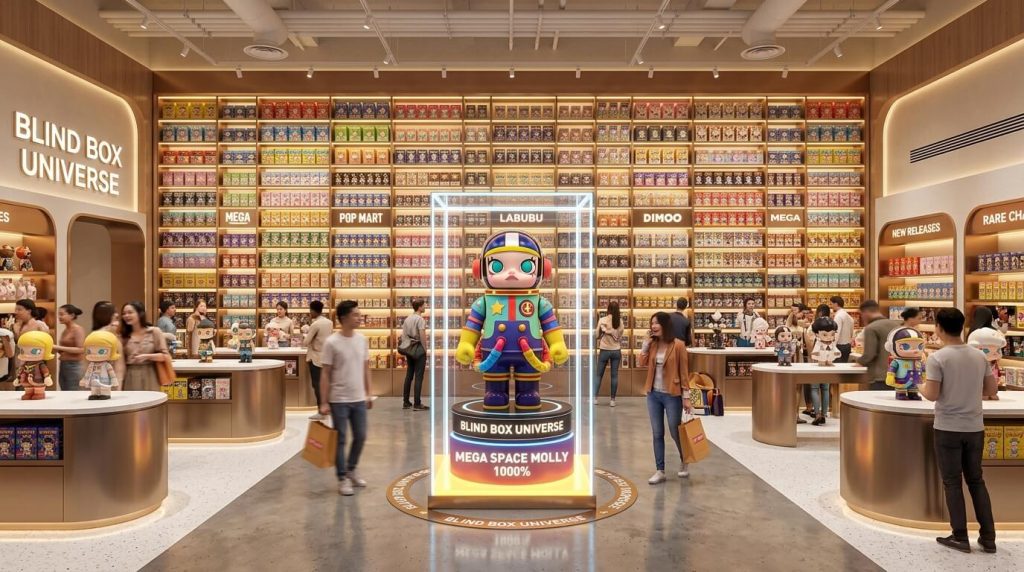
When you ran a kiosk, you probably ordered 5 to 10 Master Cartons a month from KidultsBox. If you put that same amount of inventory into a 1,200-square-foot store, the shelves will be 80% empty. Empty shelves trigger the “Flea Market Effect”—customers subconsciously assume your business is failing and your products are low-quality.
You must practice High-Density Merchandising. But how do you afford 10x the inventory without bankrupting yourself?
The “Facade of Abundance” Strategy:
You do not need to buy 100 different IPs. You need depth in your top 10 IPs.
1. The Wall of Hype: Order massive quantities (20+ End Boxes) of proven, fast-moving items like the Kimmon Plush Series and line the entire back wall with them. Stack them three-deep. Even if you only sell from the front row, the depth creates an overwhelming visual spectacle.
2. The “Big Size” Anchor: A kiosk cannot hold a 70cm 1000% figure securely. Your store can. Order high-ticket items and place them on illuminated pedestals in the center of the store to eat up square footage beautifully and raise the perceived value of the room.
3. The Acrylic Gap-Fillers: Fill lower shelves with high-margin, high-volume accessories like clear acrylic display boxes and plush bag chains. They take up significant space and are essential cross-sells.
4. Spatial Design: Engineering the Customer Journey
Now that you have walls, you must control the flow of traffic. Use the Golden Triangle layout method.
- The Strike Zone (Front Right): 90% of customers turn right when they enter a store. Place your newest, most hyped KidultsBox arrivals here (e.g., the latest Penny’s Box BJD series). This immediately hooks the hardcore collectors.
- The Interactive Core (Center Floor): Do not put tall shelves in the middle; they block sightlines and create theft blind spots. Use low, waist-high “Islands” to display open, unboxed samples. Let customers touch the fluffy textures and see the paint details.
- The Social Anchor (Deep Back): Why should someone walk to the back of your store? Place the Unboxing Station and the Community Trading Board here. By forcing customers to walk to the back to trade their duplicates or film a TikTok, you force them to walk past 100% of your retail merchandise twice.
5. Staffing the Fortress: Loss Prevention & Expertise
A kiosk can be run by one highly energetic person. An inline store requires a coordinated team. The blind spots in a 1,200 sq ft store are massive.
The Greeter & The Guide
Your staff must be split into two roles. One person manages the register and the Unboxing Station (The Guide). The other person MUST be on the floor (The Greeter). The floor staff’s job is to engage every customer who lingers at the blind box wall.
“Are you looking for the Secret figure in that series? I can hold those boxes at the register for you so you don’t have to carry them!”
This is called Aggressive Hospitality. It provides excellent customer service while simultaneously acting as the ultimate anti-theft deterrent, as you physically remove the high-value items from the customer’s hands.
6. The O2O “Grand Opening” Strategy
You cannot quietly open the doors of a massive new store. You must manufacture an event. Leverage the local customer base you built during your kiosk days.
The “VIP Migration” Playbook:
- Two weeks before the store opens, announce on your local Discord and Instagram: “We are graduating! The Kiosk is closing, and the Flagship is opening.”
- Create a Grand Opening Exclusive. Order a massive wholesale shipment of a highly sought-after, previously sold-out series from KidultsBox. Inform your community that the only way to buy this series is by attending the Grand Opening physically.
- Offer a “First 50” incentive. The first 50 people through the door receive a free acrylic display box with any purchase.
When mall management sees a line of 200 people waiting outside your new store on a Saturday morning, you instantly cement your reputation as an “Anchor Tenant,” granting you massive leverage for future lease negotiations.
Frequently Asked Questions (FAQ)
Q: Will my kiosk customers actually follow me to the new store location?
A: Yes, if you communicate it properly. Make sure the new inline store is in the same mall, or at least within a 5-mile radius. Print small “We Are Moving!” business cards and place them in every shopping bag during your final month at the kiosk to ensure 100% awareness.
Q: How do I handle security since I can’t use the “Dummy Box” method for 1,000 different boxes?
A: You can still use the Dummy Box method for your most expensive, high-theft items (like $25+ BJD dolls or premium Pop Marts). For standard $15 boxes on the open floor, you must invest in an EAS (Electronic Article Surveillance) security gate at the front door and place discreet RFID/AM stickers inside the bottom flap of the boxes during inventory processing.
Q: Should I keep the kiosk open while running the new store?
A: If you have the capital and the staffing, a Hub and Spoke model is highly profitable. Keep the new inline store as the “Hub” (for high-end items, trading, and VIPs), and keep the center-aisle kiosk as the “Spoke” (acting as a pure billboard and impulse-buy trap that funnels people to the main store).
Q: Can KidultsBox supply enough inventory to fill a 1,200 sq ft store on Day 1?
A: Absolutely. Transitioning to an inline store means transitioning to Pallet-Level Sourcing. We work with our expanding retail partners to design custom, high-volume DDP sea or air freight shipments, ensuring you have enough Master Cartons to build a breathtaking floor-to-ceiling blind box wall for your Grand Opening.