



The most dangerous myth in the independent retail sector is that launching a successful art toy store requires a $100,000 small business loan to secure a commercial lease and fill a 1,000-square-foot showroom. In a trend-driven industry like blind boxes, operating with massive debt introduces crippling monthly overhead. If a single sourcing cycle misses the mark, the debt payments will drown the business.
Experienced operators do not rely on banks or venture capital; they rely on cash flow velocity. Bootstrapping an art toy business requires starting microscopic, utilizing customer capital to fund wholesale orders, and executing ruthless inventory arbitrage. In this guide, we will break down the multi-phase bootstrapping playbook, how to execute zero-risk pre-orders, and how to scale from a single rented shelf to a full brick-and-mortar boutique using only generated profits.
Phase 1: The Micro-Retail Incubator
Do not sign a commercial lease on Day 1. Your initial goal is not to build a beautiful store; it is to build a high-converting customer database with minimal fixed costs.
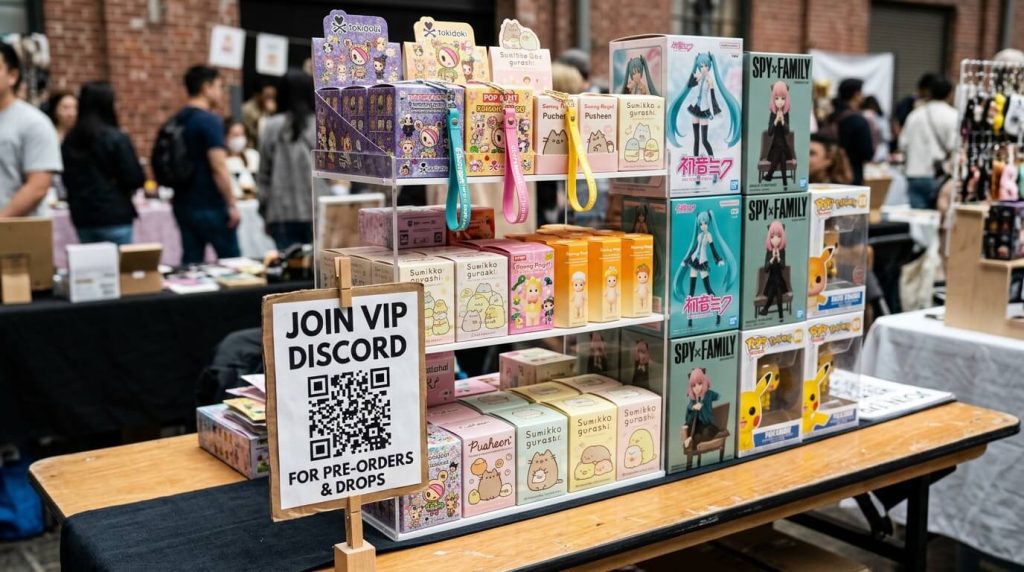
The most capital-efficient entry point is the Rent-a-Shelf or micro-retail model. By leasing a 15×15 inch acrylic cube inside an established boutique or setting up a weekend pop-up tent at local anime conventions, you eliminate utility bills and employee payroll. Your only expenses are the shelf rent and the inventory.
The Data Capture Mandate: Selling a blind box at a pop-up is useless if you don’t capture the customer’s data. Tape a QR code to your rented shelf offering a “Join our VIP Discord for early access to new drops” incentive. Your micro-retail footprint exists solely to funnel local, high-intent buyers into your private community.
Phase 2: Funding Inventory with OPM (Other People’s Money)
Once you have migrated 100 to 200 local collectors into a private Discord server or CRM, you can stop using your own money to buy wholesale inventory. You transition to the “OPM” (Other People’s Money) strategy.
When your B2B supplier announces a highly anticipated upcoming release, you do not guess how many to order. You open a 48-hour pre-order window in your VIP group. Require customers to pay 100% upfront for full, sealed display cases.
The Cash Flow Hack: If your VIPs pre-order 10 display cases at $150 each, you have collected $1,500 in cash. You use that exact $1,500 to purchase a 12-case Master Carton at the wholesale price (e.g., $1,000). You have completely funded the wholesale order using customer capital, locked in $500 in immediate profit, and you own the remaining 2 cases free-and-clear to sell individually at your pop-up or rented shelf for pure 100% margin.
Phase 3: Inventory Arbitrage (Flipping the Chase)
Bootstrapping requires you to extract the maximum possible yield from every Master Carton you purchase. This involves understanding the mathematics of production ratios and chase figures.
If you purchase a 144-unit master carton utilizing your own capital, opening cases to find the 1/144 secret “chase” figure is a legitimate arbitrage strategy for unfunded stores. A highly sought-after chase figure can frequently be flipped on the secondary market (eBay or specialized Facebook groups) for $150 to $300. By liquidating the chase figure immediately, a bootstrapped retailer can instantly recoup 20% to 30% of the entire master carton’s wholesale cost in a single day, drastically lowering the break-even point for the remaining 143 standard boxes.
Phase 4: The Cash Flow Velocity Mix

When you have limited working capital, you cannot afford to have your money sitting on a shelf for three months. You must optimize for “Inventory Turnover Ratio.”
- The “Rent Payers” (High Velocity): 70% of your budget must go toward fast-moving, low-cost impulse items. Foil-bagged plush keychains are the ultimate bootstrapping tool. They cost $4 to $6 wholesale and sell for $12 to $15 within days. The margin is strong, but more importantly, the velocity returns cash to your bank account weekly.
- The “Bank Builders” (High Margin): 30% of your budget is reserved for premium PVC blind boxes or 400% scale vinyl figures. These take longer to sell, but the absolute dollar profit per transaction is significantly higher, allowing you to stockpile cash for your eventual commercial lease deposit.
The Bootstrapper’s Capital Allocation Matrix
Follow this strict financial matrix as you scale your operations from zero to a physical storefront.
| Growth Phase | Primary Sales Channel | Capital Source | Inventory Strategy |
|---|---|---|---|
| Phase 1: Proof of Concept | Rent-a-Shelf / Weekend Pop-ups | Personal Savings ($500 – $1,500) | 100% High-velocity Plush Keychains & Mixed Assortments. |
| Phase 2: The VIP Pivot | Instagram / Private Discord | OPM (Customer Pre-orders) | Full sealed Display Cases; zero personal capital risk. |
| Phase 3: Arbitrage & Scale | Mall Kiosk / Dedicated E-com | Reinvested Cash Flow | Master Cartons; flipping chase figures to lower COGS. |
| Phase 4: Brick & Mortar | Physical Storefront | Accumulated Business Profits | Full catalog curation, utilizing B2B localized warehousing. |
Frequently Asked Questions (FAQ)
What is the biggest mistake bootstrapped retailers make?
Over-ordering a single, unproven IP to hit a factory’s Minimum Order Quantity (MOQ). If the series fails to resonate with your local market, your entire operating budget is trapped in unsellable dead stock. Bootstrappers must source mixed cases from B2B aggregators rather than dealing directly with factories.
How do I handle shipping costs when margins are tight?
International ocean freight kills cash flow because your capital is locked on a boat for 40 days. Bootstrapped retailers should prioritize B2B suppliers with US domestic warehouse fulfillment. Even if the per-unit cost is slightly higher, receiving the inventory in 3 days allows you to sell it and reinvest the cash 10 times faster than waiting for sea freight.
Should I use credit cards to fund wholesale orders?
Only if you have pre-sold the inventory. Utilizing a 30-day billing cycle on a business credit card is a smart cash flow tool *if* the inventory is already claimed via VIP pre-orders. Do not use high-interest credit cards to make speculative bulk purchases.
How long does it take to bootstrap a physical store?
If executed with strict discipline, moving from a single pop-up tent to signing a lease for a small boutique typically takes 12 to 18 months of compounding cash flow and aggressive VIP community building.
Growing a retail business without debt requires treating every dollar of inventory as a fast-moving asset. By leveraging your community to fund master cartons and focusing on high-velocity plush trends, you can scale safely. If you are ready to execute your first mixed-case wholesale order, exploring our local warehouse catalog is the perfect low-risk starting point.