



Retailers evaluating character plush face a common trap: beautiful product photos obscure the operational details that determine profitability. Size variance, fabric quality, uneven character demand, bulky cartons, and unclear assortment terms can turn an attractive line into slow-moving inventory or margin pressure.
This guide walks through the commercial checks needed when sourcing Kimmon plush from the You Are the Protagonist series. It is written for toy stores, gift shops, anime retailers, online sellers, event vendors, and distributors preparing to request quotes or compare supplier offers.
How character plush fits your retail strategy
Before requesting price, clarify what job this plush line will perform. Is it a giftable impulse item near checkout, a collectible display anchor, a fandom-driven SKU, or social media content for new arrivals? The answer changes what you should verify in a quote.
Map the product to a specific use case in your store:
- Collectible toy stores: Does character design align with the art toy and figure lines already moving well? Will plush buyers overlap with your figure collector base or bring new traffic?
- Gift shops: Is the theme broad enough for casual gift buyers, or does it require existing fandom knowledge? Check whether packaging looks gift-ready without extra wrapping.
- Anime and pop culture retailers: Compare customer behavior across plush, badges, dolls, and accessories. Some audiences prefer hard goods; others prioritize softness and huggability.
- Online sellers: Product dimensions, weight, and packaging durability directly affect shipping cost and damage claim rates. Request exact measurements and packaging photos early.
- Event vendors: Evaluate portability, stacking efficiency, and display footprint. Bulky plush can consume booth space quickly.
If your store already carries plush accessories, compare customer response with smaller add-ons like plush badges for anime shops. Smaller plush items often behave differently in pricing structure, basket-building, and shelf allocation.
What to verify about the You Are the Protagonist series before committing budget
The series name suggests story-driven character appeal, but do not assume product details from the title. Confirm whether the offer includes individual units, a fixed set, a blind assortment, or a mixed case pack. This distinction matters for inventory control, margin planning, and customer expectations.
Ask the supplier to specify format clearly: known SKUs give online sellers predictability; mixed assortments can drive discovery for foot-traffic stores.
| Buyer check | Why it matters | Question to ask supplier |
|---|---|---|
| Product dimensions | Affects shelf space, freight volume, and perceived value at retail. | What are confirmed dimensions (height, width, depth) for each style? |
| Material and filling | Influences handfeel, weight, washability, and customer satisfaction. | What fabric type and filling material are used? Can care labels or material descriptions be provided? |
| Assortment format | Determines whether you can control character mix or must accept a fixed ratio. | Is the order sold by specific style, full set, random mix, or preset case assortment? |
| Packaging type | Impacts gift readiness, storage efficiency, and transit damage risk. | Does each plush have individual packaging (bag, box, hangtag)? Are units compressed? |
| Carton specifications | Essential for accurate freight quotes and warehouse receiving. | What are carton quantity (units per carton), carton dimensions (cm or inches), and gross weight? |
| Labeling and documentation | Affects compliance review, customs clearance, and retail display requirements. | What labels, hangtags, certificates, or product information can be provided? |
| Photo accuracy | Prevents mismatch between marketing images and actual delivered goods. | Can you share current production or packed stock photos before shipment? |
| Reorder capability | Critical if the line sells faster than expected. | Can the same assortment be reordered? Will styles or availability change? |
Use this table as a quote comparison checklist. A lower unit price means little if carton data is missing, packaging is unclear, or assortment control is not defined.
Planning assortment depth without overstocking slow characters
Character plush demand is rarely even. One design becomes the favorite; another sits. If the supplier ships a fixed character mix, understand exactly how many units of each style arrive per carton.
For reference, a small retailer might test one case or a limited batch before expanding. A larger retailer may split inventory across locations or reserve stock for online listings. These are planning examples, not prescriptive quantities.
Decision rule: evaluate order quantity by sell-through risk per character, not just unit cost. If a case includes multiple designs, ask whether the mix is balanced or weighted toward certain styles. If you can order by individual character, weigh the cost advantage of full-set purchasing against the flexibility of cherry-picking strong sellers.
Compare plush buyer behavior with figure or doll collectors already in your store. Plush buyers often prioritize softness, size, and gift appeal over sculpt detail and display. If you carry art dolls or BJD lines, the fantasy doll retail guide offers useful contrast for assortment planning.
Why carton-level cost data matters more than unit price
Plush is bulky relative to its unit price. Landed cost can shift dramatically once you factor in carton volume, shipping method, duties, domestic freight, and packaging protection. A unit quote without carton information is incomplete for a buying decision.
Request unit price, case quantity, carton dimensions, gross weight, and packing method in the same quote. Then calculate estimated landed cost per unit, not just product price.
Example logic: Two suppliers quote similar unit prices. Supplier A packs 24 units per carton; Supplier B packs 18. If carton dimensions are similar, Supplier B’s freight cost per unit will be higher. If Supplier B’s cartons are also larger, the gap widens further.
Buyers shipping to different markets should also confirm customs classification, import requirements, and local labeling obligations with logistics or compliance partners before finalizing the order.
If you are preparing a supplier inquiry, gather your preferred quantity range, destination country, sales channel (online, retail, event), and packaging requirements first. A clearer request generates more comparable quotes.
For stores building a character merchandise wall, compare plush economics with accessory products like the Baby Three zipper bag trend. Bag charms and plush may appeal to similar customers but differ sharply in carton efficiency, display method, and freight sensitivity.
Packaging inspection steps that protect gift-ready inventory
Packaging affects more than appearance. It determines whether the plush stays clean, whether hangtags survive transit, and whether the product can be listed online without repackaging.
Request photos of individual packaging and master carton arrangement before placing the order. Check whether plush is compressed, bagged, boxed, or shipped with exposed hangtags. Compression reduces freight volume but may require fluffing time before display. Boxed packaging improves gift readiness but increases carton size.
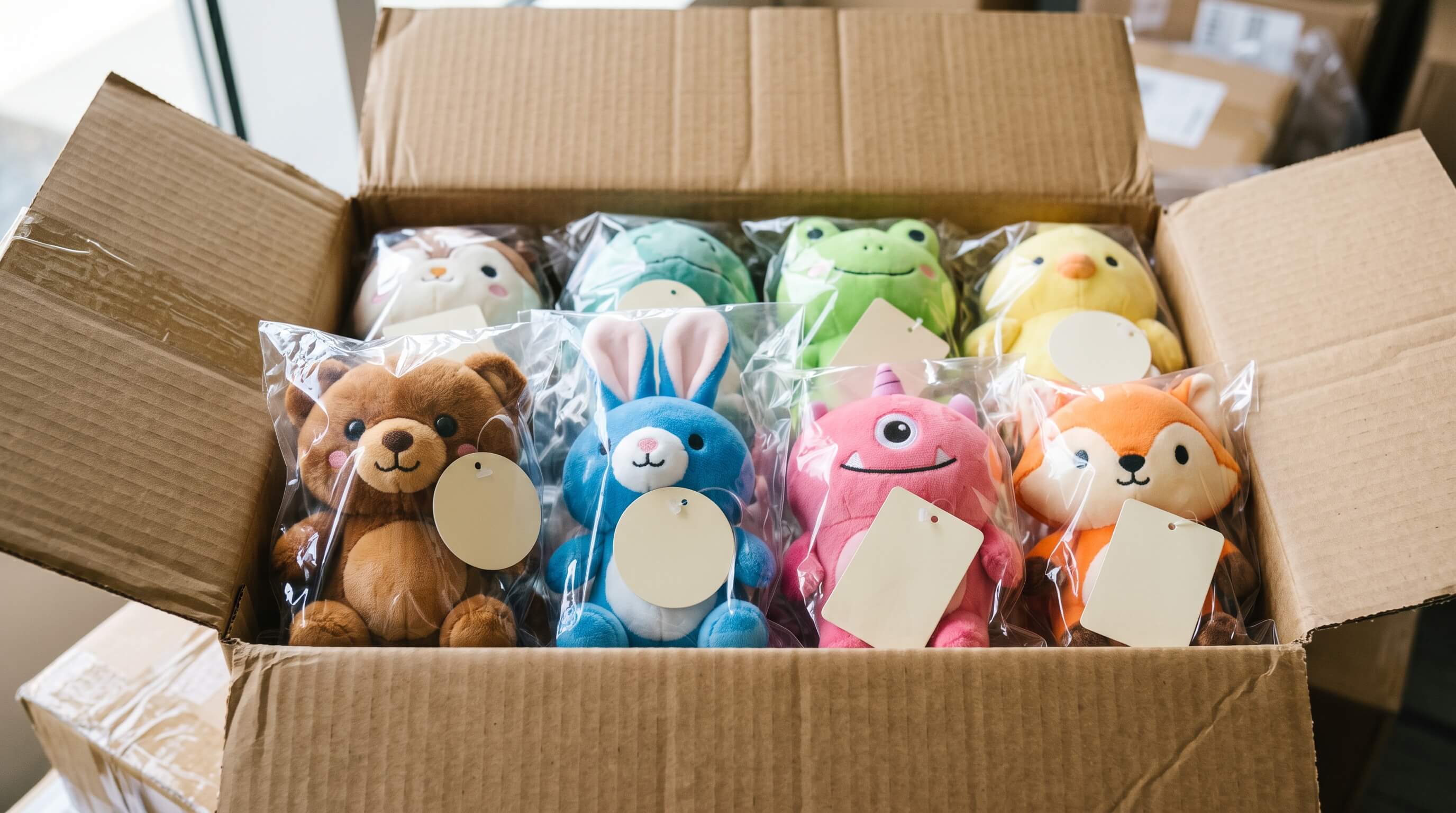
Practical inspection checklist on arrival:
- Count units by style or assortment against the packing list. Document any shortages immediately.
- Inspect a sample of hangtags, labels, and packaging for damage, smudging, or detachment.
- Check seams, embroidery, facial details, and accessories (if included) for defects or loose threads.
- Look for stains, odor, crushed shape, or fabric pilling.
- Photograph carton condition before unpacking if there is visible transit damage.
- Record discrepancies between quoted specifications (size, material, packaging) and delivered goods.
Compliance caution: Plush toys may be subject to safety standards, labeling requirements, age grading, material restrictions, or import regulations depending on the destination market. Verify requirements with qualified compliance resources rather than relying on product photos or marketplace precedent.
When to trigger reorders and how to plan launch timing
Retailers often underestimate the time between quote approval and shelf availability. Even with confirmed stock, account for payment processing, packing confirmation, international freight, customs clearance, domestic delivery, receiving, inspection, photography, and listing.
Set a reorder trigger before the first batch arrives. For example, an online seller might review reorder needs when 50–60% of initial inventory is committed or sold. A physical store may reorder earlier if the plush becomes a display centerpiece and empty shelves reduce visual impact. These are planning references, not prescriptive thresholds.
Ask these timing questions:
- When can current product photos and packing details be confirmed?
- Is the quoted quantity from ready stock, upcoming production, or supplier allocation?
- Can the supplier support repeat orders with the same assortment?
- What happens if one character sells out faster than others? Can partial reorders be placed?
- When should a reorder be confirmed to avoid a gap in availability?
If your store uses themed launch calendars, compare plush timing with other collectible releases. Character figure buyers may accept preorders more readily than plush gift buyers. The Sleepless Grumpipi figure buying guide provides a useful comparison for balancing figure and plush release schedules.
Red flags when comparing Kimmon plush supplier quotes
A supplier does not need to answer every question instantly, but vague or inconsistent responses should slow down the buying decision. The goal is not to reject suppliers prematurely but to identify where more documentation is needed before payment.
- Only beauty photos provided: Request current product, packaging, and carton photos. Marketing renders are not sufficient for operational planning.
- Missing carton data: Freight cannot be estimated without dimensions, weight, and case quantity. Push for specifics.
- Unclear assortment terms: Confirm whether styles are selectable, random, fixed-ratio, or subject to change without notice.
- Vague compliance claims: If compliance is required for your market, ask for documents and verify independently.
- Unit price changes without specification changes: Ask what shifted—quantity, packaging, availability, or freight basis.
- No process for shortage or damage claims: Clarify how issues should be documented and resolved after goods arrive.
- Pressure to order before basic details are confirmed: Do not let urgency override specification review.
For retailers comparing cute collectible categories, review how plush lines differ from romantic or seasonal blind box assortments. The romantic plush blind box buying guide discusses assortment and packaging issues that overlap with character plush planning.
A supplier inquiry template that improves quote quality
A structured inquiry reduces back-and-forth and makes quotes easier to compare. Adapt the template below to your sales channel and destination market.

Sample inquiry template:
Hello, we are evaluating Kimmon plush products from the You Are the Protagonist series for retail purchase. Please provide a quote based on the following:
1. Available product styles and whether styles can be selected individually or are sold as a fixed assortment.
2. Unit price by quantity tier, including any MOQ or case quantity requirements.
3. Product dimensions (height, width, depth), materials description, and individual packaging details (bag, box, hangtag, compression).
4. Carton quantity (units per carton), carton dimensions, and gross weight for freight estimation.
5. Current availability or expected preparation timing. Please state cautiously if not yet confirmed.
6. Photos of current product, packaging, hangtags, and master carton if available.
7. Labeling, certifications, or compliance documentation that can be provided for buyer review.
8. Payment terms, shortage/damage reporting process, and reorder availability if repeat purchase is needed.
After receiving replies, compare them in a spreadsheet. Include columns for unit price, carton quantity, estimated freight cost, destination fees, packaging type, confirmed assortment control, documentation provided, and unanswered questions. This surfaces which quote is truly complete.
Final commercial review before approving payment
Run one final check before committing budget. Confirm the product matches your customer profile, the carton data supports your landed cost estimate, and the packaging works for your selling channel.
If you are ready to source Kimmon You Are the Protagonist plush for retail, prepare your quantity range, destination, preferred assortment format, and packaging requirements before contacting suppliers. A complete inquiry lets you compare quotes on real buying factors—not just product photos and unit price.
FAQ
What should retailers confirm before buying Kimmon plush?
Retailers should confirm product size, material description, assortment format (selectable vs. fixed mix), packaging type, carton quantity, carton dimensions, gross weight, labeling information, and reorder availability before approving a quote.
Is the lowest unit price the best option for character plush?
Not always. Plush is bulky, so carton volume, freight cost, packaging protection, damage risk, and assortment control can significantly change the real landed cost and sell-through risk.
How many Kimmon plush units should a store order first?
There is no universal quantity. Base the first order on budget, supplier MOQ or case quantity, shelf space, expected sell-through rate, and whether you can reorder the same assortment later.
What packaging details matter most for plush retail sales?
Check whether each plush has individual packaging (bag, box, hangtag), whether units are compressed, and whether the packing method keeps products clean and gift-ready during transit.
Do buyers need compliance documents for plush toys?
Requirements depend on the destination market and sales channel. Verify safety standards, labeling requirements, age grading, and import regulations with qualified compliance resources before selling.
Final thoughts
Character appeal may spark interest, but operational details determine profitability. Treat the You Are the Protagonist series as both a collectible product and a logistics item: confirm assortment format, packaging method, carton data, landed cost, and reorder plan before committing to a larger purchase.