




A large character figure can pull customers across the store, but it also eats shelf space, shipping volume, and purchasing budget far faster than a stack of standard blind boxes. Before committing to a MAX UpsetDuck figure, a retailer needs to confirm exactly what the listing includes, how the unit is packed, and whether its landed cost still works for the intended sales channel.
This guide walks through the questions a commercial buyer should resolve before requesting a quote or approving an order. Because dimensions, materials, case quantities, and included accessories are not provided in the listing here, treat each one as a specification to verify in writing rather than an assumption to build an order around.
Where a MAX UpsetDuck Figure Fits in a Retail Assortment
A larger character collectible usually plays a different role from a small impulse-priced blind box. Decide that role before discussing quantity. Otherwise an eye-catching product can quickly become an awkward inventory commitment.
- Designer toy stores: Use the figure as a focal product beside smaller UpsetDuck items or other character-driven collectibles.
- Lojas especializadas em anime e cultura pop: Assess whether the duck character complements the store’s existing cute, expressive, or unconventional designs.
- Gift shops: Confirm whether the packaging looks complete enough for gifting and whether the box communicates the product clearly without staff explanation.
- Vendedores online: Plan for dimensional shipping charges, protective outer packaging, and accurate product photography.
- Event and convention sellers: Consider booth space, transport handling, and the number of large boxes staff can display and restock safely.
Retailers already working within this character universe can also review the Guia de fornecedores da UpSetDuck “Born This Way”. Comparing a MAX-format collectible with a blind-box series helps you decide whether the larger item should stand alone as a hero product or anchor a broader UpsetDuck display.
What to Confirm Before Comparing Unique Charm Duck Quotes
Product names and promotional photographs are not enough for a purchase decision. Ask each supplier for the same specification set, preferably in writing. The phrase “Unique Charm” should also be clarified: do not assume it refers to a separate or detachable accessory unless the supplier confirms that point.
| Especificação | Question to ask | Por que isso afeta o pedido |
|---|---|---|
| Exact product identity | What series name, edition, and product code appear on the retail box? | Prevents comparisons between similar-looking editions or sizes. |
| Figure dimensions | What are the height, width, depth, and packaged dimensions? | Determines shelf fit, carton volume, and fulfillment cost. |
| Material and construction | What materials are used, and are any parts movable or detachable? | Affects handling instructions, perceived value, and inspection points. |
| Included contents | Does the box contain accessories, inserts, cards, stands, or replacement parts? | Missing contents can lead to returns and customer complaints. |
| Embalagem para varejo | Can the supplier provide photographs of every box panel and the internal protection? | Shows labeling, presentation, and protection against movement. |
| Unit and carton weight | What are the net and gross weights? | Needed for freight estimates and warehouse handling. |
| Configuração do gabinete | How many retail units are packed per master carton? | Allows buyers to translate MOQ into actual inventory exposure. |
| Identification details | Are barcodes, batch markings, or other identifiers present? | Supports receiving, listing creation, and inventory control. |
| Order condition | Are units supplied sealed, and what condition standard applies to retail boxes? | Collectors may care about both the figure and its packaging condition. |
Request current, unedited product and packaging photographs rather than relying only on promotional renders. If a quote omits dimensions or carton data, it is not yet ready for a meaningful freight comparison.
Why Large-Format Ducks Need Case-Level Order Planning
MOQ should be evaluated together with units per carton, carton dimensions, and the number of variants you plan to buy. A low-looking unit requirement can still occupy substantial storage space when each retail box is large.
As a planning example, a retailer considering 24 units might divide them among a flagship store, an online fulfillment location, and reserve stock. That quantity is only an illustration, not a stated MOQ. The buyer should then check whether the supplier’s case pack permits that split without leaving partial cartons or forcing a higher order.
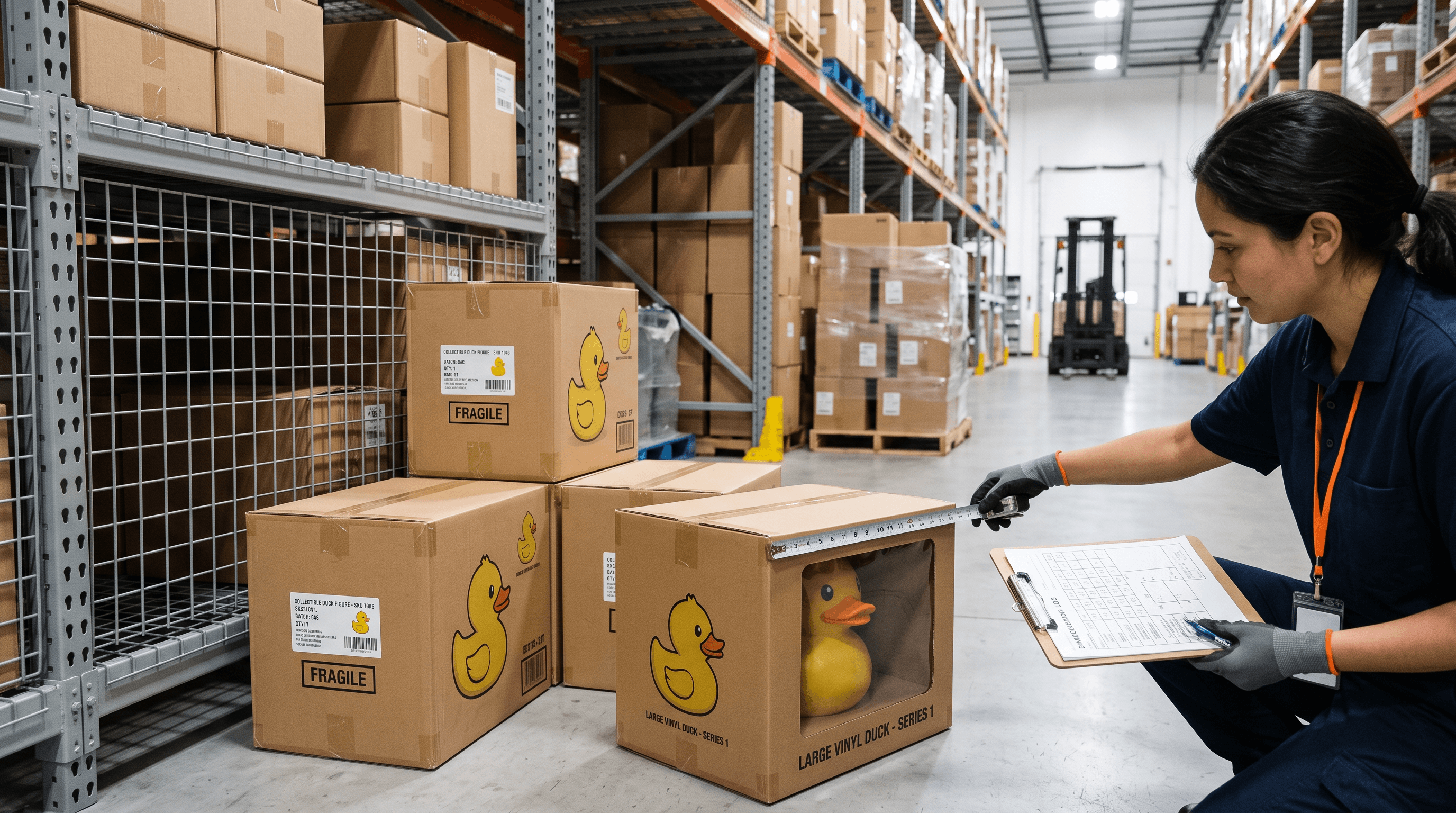
Work through these order-planning questions:
- How many units fit on the intended shelf or display fixture?
- How many master cartons can the receiving and storage area hold?
- Can the supplier quote one trial quantity and one larger reorder quantity?
- Must cartons remain intact, or can quantities be mixed?
- Is the figure one fixed design, or are multiple versions involved?
- How will damaged-box reserves be handled in the stock plan?
For another perspective on inventory exposure in a larger collectible format, compare the planning considerations in the Baby Three Sweet Dream 400% sourcing guide. The lesson is not that two products share identical specifications, but that physical scale changes storage and freight math.
Build a Landed-Cost Model Around Carton Volume
The quoted unit price is only one component of the commercial decision. Calculate a shelf-ready landed cost that includes freight allocation and the costs required to receive, protect, and sell each unit.
A practical model is: product cost + allocated freight + import-related charges + payment costs + inspection or handling + local delivery + protective fulfillment materials. Duties, taxes, and customs treatment depend on the destination and product classification, so verify them with appropriate local professionals or licensed service providers.
Large boxes may be charged according to dimensional weight rather than actual weight. Ask for master-carton dimensions, gross weight, and units per carton before accepting a freight estimate. Then compare quotes on the same delivery term and destination.
As a planning reference, model at least three outcomes: the expected freight allocation, a higher-volume freight outcome, and a delay or surcharge scenario. Avoid fixing a target margin before the delivered cost is understood.
If the MAX UpsetDuck figure is under active consideration, prepare the specification table above and request a written quote based on one destination, one quantity, and one delivery term. That single baseline makes every follow-up comparison much faster.
Protect the Duck, Accessories, and Retail Box in Transit
For collector-oriented products, a perfectly functional figure inside a crushed retail box can still be commercially difficult to sell. Packaging evaluation should therefore cover both product protection and shelf presentation.
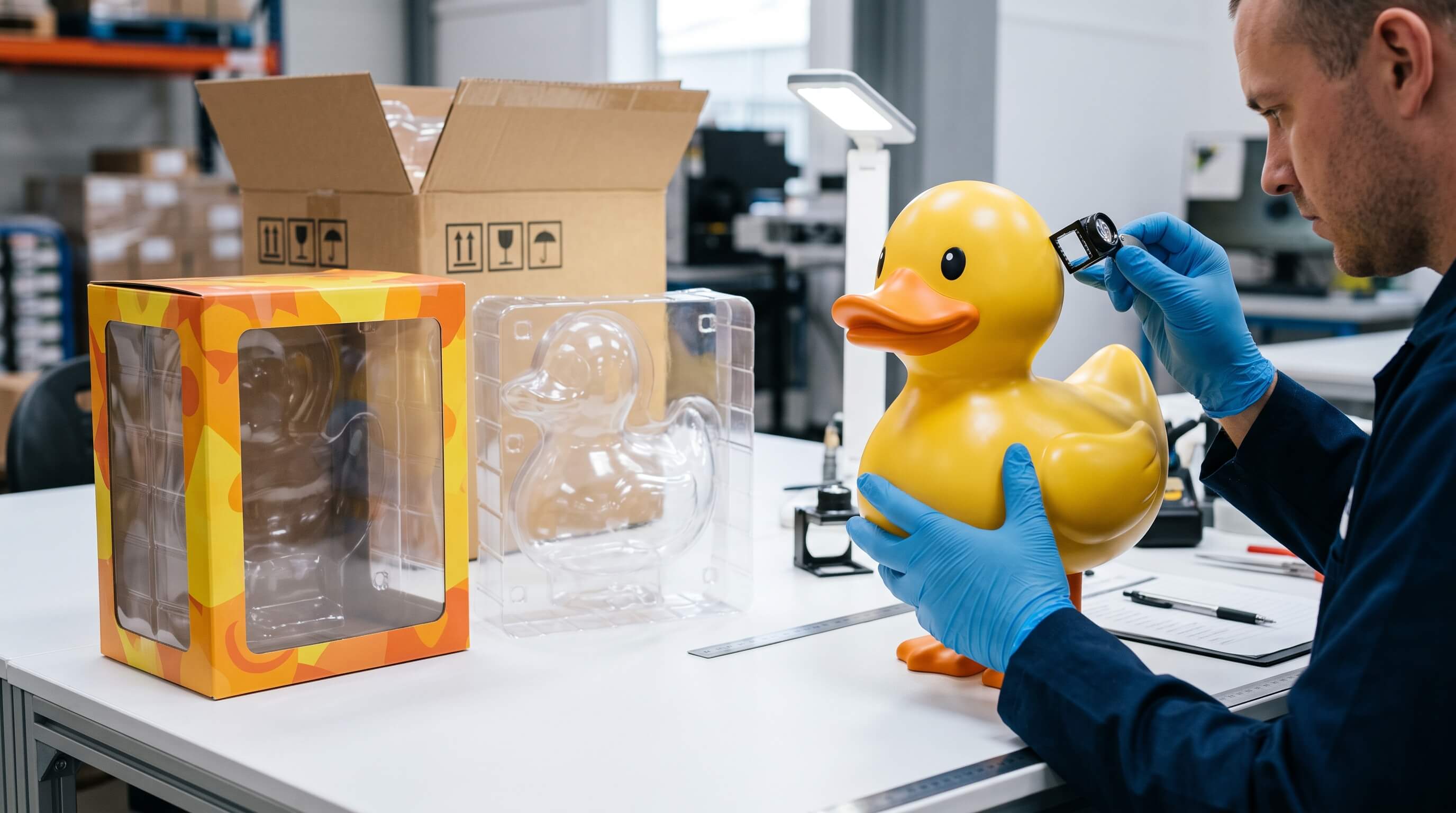
Ask the supplier to show the inner tray or protective structure, accessory compartments, retail-box seals, master-carton arrangement, and any corner or void protection. Where possible, include these checks in a pre-shipment review:
- Compare the figure’s color and visible finish across sampled units.
- Check for obvious scratches, marks, deformation, loose components, or unstable assembly.
- Verify that every confirmed accessory and insert is present.
- Inspect retail boxes for crushing, tears, moisture exposure, and broken seals.
- Match product identifiers and carton markings against the purchase order.
- Photograph inspected units and master cartons before dispatch.
Requirements for labeling, age grading, materials, safety, warnings, and importer information vary by market. Ask for available product documentation and verify destination-market obligations independently. Do not treat a supplier’s general statement as proof that a product meets every requirement in your country.
Time Reorders to the MAX Figure’s Sales Pace
Reorder planning should begin before stock reaches zero, because approval, preparation, international transport, customs processing, and local delivery can each add uncertainty. Ask the supplier to separate production or order-preparation time from transit time instead of presenting one combined estimate.
A simple reorder rule is: average weekly sales × replenishment window + safety stock. For example, if a test allocation sells steadily, you might set a review point after several weeks rather than waiting for the final units to sell. This is planning logic only; the actual threshold should reflect confirmed lead time and observed sales volatility.
Also ask whether a future reorder will carry the same packaging, edition details, unit price basis, and case configuration. If availability is uncertain, avoid advertising indefinite continuity to customers. Online retailers should keep carton measurements in their product records so fulfillment charges can be reassessed when carriers change dimensional rules.
When a MAX UpsetDuck Quote Is Not Yet Comparable
A professional-looking quotation can still hide important gaps. Pause the decision if one supplier quotes per unit while another quotes per carton, if delivery terms differ, or if the product edition is not clearly identified.
Warning signs worth resolving
- The supplier cannot provide consistent product, box, and carton dimensions.
- Photographs show different packaging or editions without explanation.
- The quote does not identify whether freight, local delivery, or import charges are included.
- Case quantity and MOQ are used interchangeably even though they are different.
- Requests for packaging-condition standards or damage procedures receive vague answers.
- Compliance claims are made without identifying the relevant document or destination market.
- Payment is requested before the product identity and order specifications are documented.
Buyers comparing other character-led lines may find useful assortment questions in the Sleepless Grumpipi retail buying guide. For a smaller-format comparison, the Kimmon 200% figure sourcing guide shows how scale shifts assortment and order planning.
Quote request checklist
- Exact product and edition name
- Product code and current packaging photographs
- Figure and retail-box dimensions
- Materials, construction, and confirmed box contents
- MOQ, case quantity, and master-carton measurements
- Unit price basis and quotation validity
- Available delivery terms and destination
- Order-preparation estimate and transit estimate shown separately
- Packaging-condition standard and damage-resolution process
- Available labeling, safety, or material documentation for buyer review
Hello, we are evaluating the MAX UpsetDuck Unique Charm Duck for retail in [destination market]. Please quote [planned quantity] and confirm the exact edition, product dimensions, retail-box dimensions, materials, included contents, MOQ, units per carton, carton size and gross weight. Please also provide current packaging photographs, the delivery term, preparation estimate, payment terms, and available product documentation. Kindly identify anything excluded from the quote.
Before approving an order, request a written quotation with every checklist item completed and compare the resulting landed cost per saleable unit. If carton data, edition identity, or packaging protection remains unclear, resolve those points before payment.
PERGUNTAS FREQUENTES
Is the MAX UpsetDuck figure a blind box?
The title alone does not establish the sales format. Confirm whether it is a fixed-design boxed collectible, a randomized product, or part of a series before listing or ordering it.
What does “Unique Charm” mean for this UpsetDuck product?
Do not assume it means a detachable charm or included accessory. Ask the supplier for a contents list and photographs showing everything inside the retail box.
How should retailers evaluate the MOQ?
Convert the MOQ into master cartons, storage volume, shelf capacity, and total cash exposure. Then ask whether a smaller trial quantity or carton-based reorder is available.
Which measurements are needed for a freight quote?
Request retail-box dimensions and weight, units per master carton, carton dimensions, and carton gross weight. Freight providers may use dimensional weight for bulky shipments.
What should be inspected before shipment?
Check product identity, visible finish, assembly, confirmed accessories, retail-box condition, seals, labels, and carton protection. The inspection scope should be agreed in writing.
How can buyers compare two supplier quotes fairly?
Use the same edition, quantity, destination, delivery term, case configuration, and packaging standard. Add freight and other buyer-side costs to compare landed cost per saleable unit.
Before You Add the Duck to Your Assortment
A large character figure should earn its space through clear customer fit, workable delivered cost, and manageable inventory exposure. Confirm the MAX UpsetDuck figure’s identity, dimensions, contents, packaging, case configuration, and documentation before treating any quotation as complete.
The most useful first order is one built on measurable shelf capacity and a defined review point. Start with documented assumptions, track sales and box-condition issues, and use that evidence to decide whether the product deserves a larger reorder.