


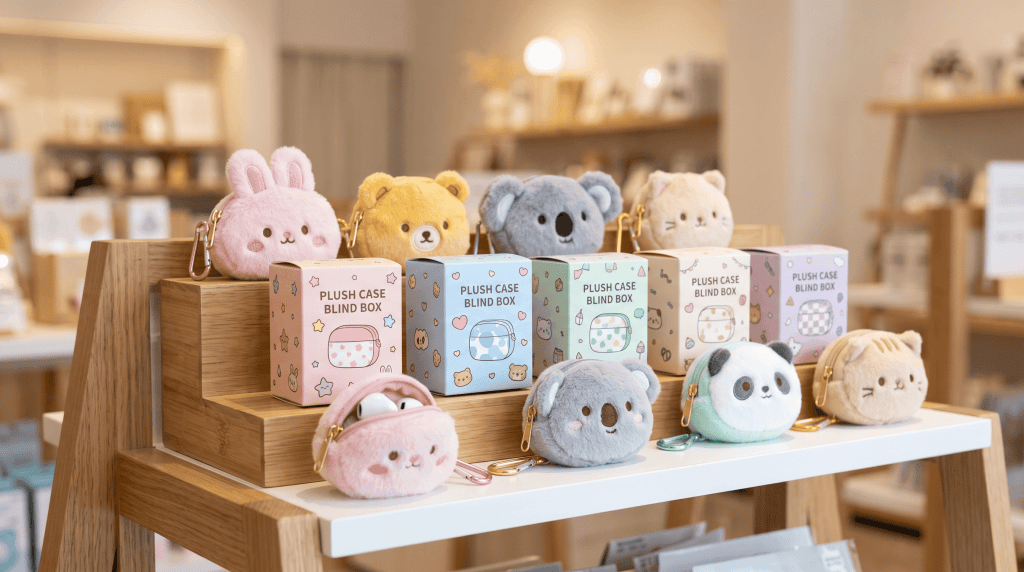
Small accessories can be easy to display but surprisingly difficult to buy well. A product may look appealing in supplier photos while leaving unanswered questions about earphone compatibility, attachment hardware, assortment balance, packaging volume, and actual landed cost. For buyers weighing plush earphone case blind boxes, those details decide whether the line works as a practical gift item or becomes confusing inventory.
This format may suit gift stores, lifestyle boutiques, collectible retailers, pop-culture shops, online sellers, and checkout displays. The buying decision should combine character appeal with functional clarity: customers need to understand what the case holds, while retailers need enough information to price, display, and reorder it confidently.
Where Plush Earphone Case Blind Boxes Fit in a Gift Store
These products occupy a useful position between collectibles and everyday accessories. They can provide a lower-space alternative to larger display figures and may encourage add-on purchases, but only when their purpose is immediately understandable.
Match the product to a specific merchandising role before requesting quantities:
- Checkout add-on: Favor compact retail boxes, clear compatibility wording, and a price tier that complements the main purchase.
- Gift-with-tech display: Merchandise near cables, phone charms, pouches, or other small accessories rather than presenting the item as a conventional plush toy.
- Collectible wall: Confirm the number of regular designs, whether a hidden design exists, and how a sealed case is assorted.
- Online mystery product: Obtain accurate dimensions and permitted product images so customers can understand scale and intended use.
- Character-led assortment: Compare the visual theme with existing inventory. Retailers developing a wider cute or anime-inspired mix may also find the merchandising considerations in this witchy kawaii blind box buying guide useful.
A practical decision rule is to identify the primary reason a shopper would buy the item: character collecting, earphone protection, bag decoration, or gifting. If the supplier cannot explain the functional format clearly, store staff may face the same problem when selling it.
Line Up Every Supplier on the Same Spec Sheet
Do not compare offers using character photos and unit quotations alone. Request the same specification fields from every supplier so differences become visible.
| Ponto de avaliação | O que verificar | Por que isso afeta o pedido |
|---|---|---|
| Case construction | Soft pouch, shaped holder, fitted shell, or decorative outer cover | Determines which earphone charging cases can fit |
| Internal dimensions | Usable length, width, depth, and opening size | Exterior plush dimensions can overstate usable capacity |
| Closure | Zipper, snap, drawstring, flap, or open sleeve | Affects retention, convenience, and snag risk |
| Attachment hardware | Type, material, rotation, opening mechanism, and replaceability | Influences bag attachment and perceived durability |
| Series assortment | Regular designs, hidden design policy, duplicates, and sealed-case composition | Shapes collector expectations and display planning |
| Embalagem para varejo | Box dimensions, internal protection, barcode area, and identification marks | Affects shelf use, carton volume, and stock handling |
| Plush finish | Fabric texture, seam alignment, embroidery, loose fibers, and color consistency | Visible variation can lead to customer complaints |
| Order unit | Single blind box, inner case, master carton, or another unit | Prevents quantity and quote misunderstandings |
| Market documentation | Available product, material, labeling, and test information | Helps buyers review destination-market obligations |
Ask for photos showing the item beside a ruler and with a representative earphone charging case inserted. This is more useful than relying on an exterior dimension alone.
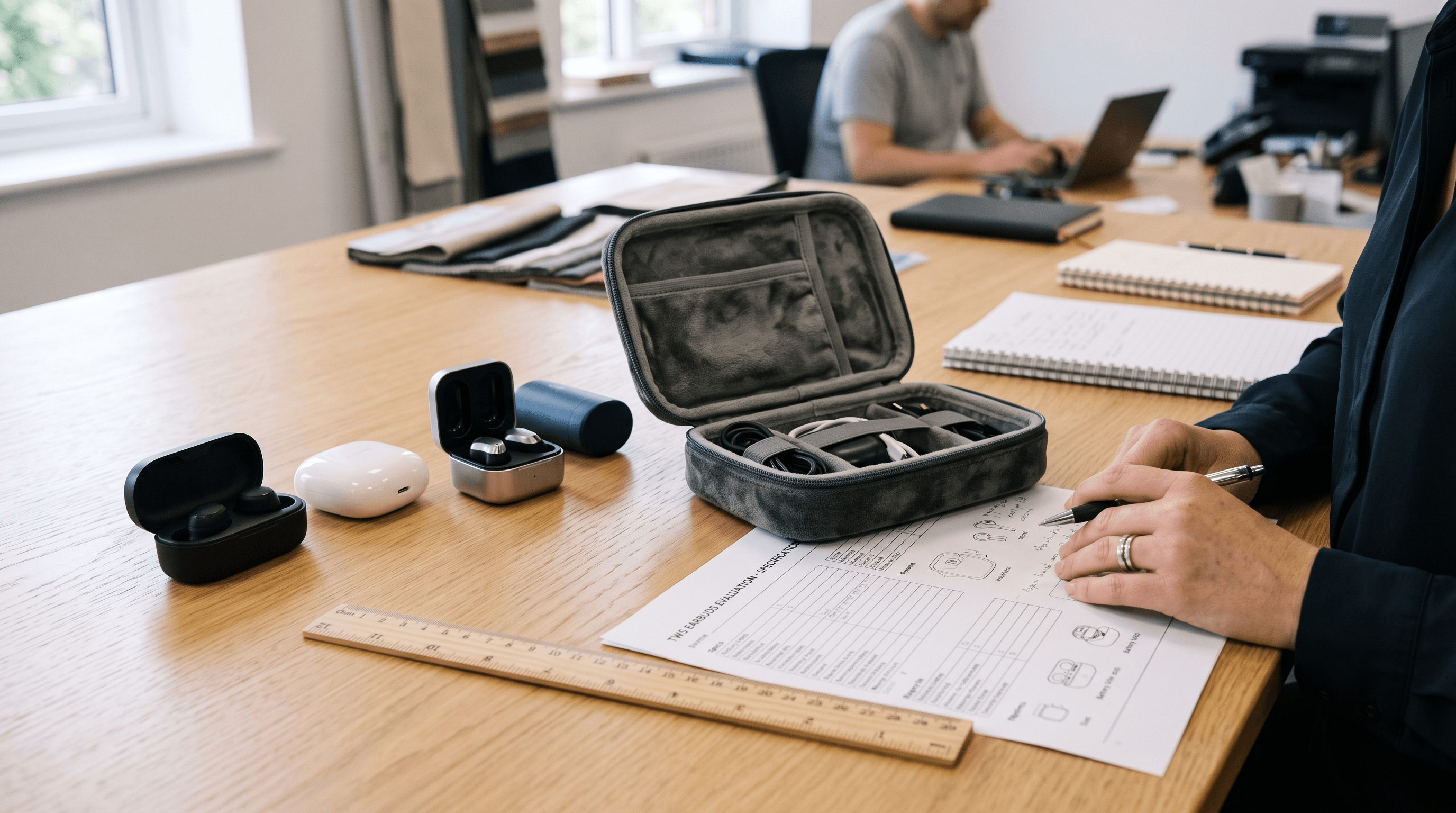
Confirm Earphone Fit Before Treating the Case as Functional
“Earphone case” can describe several different products. Some are fitted to a particular charging-case shape; others are general pouches that may hold earbuds, coins, keys, or small cables. Buyers should not assume universal compatibility.
Questions that reduce fit-related returns
- What are the usable internal dimensions after accounting for lining and padding?
- Is the item designed for a named charging-case shape or sold as a general storage pouch?
- Can the charging port be accessed while the device is inside?
- Does the lid open without removing the earphone case?
- Will decorative ears, tails, or plush layers interfere with hinges or closure?
- Are compatibility statements printed on the retail box or available for the product listing?
When fit is not model-specific, market the item cautiously as a small plush accessory pouch and publish its usable dimensions. Avoid promising compatibility that has not been checked. For a sample review, test several charging-case shapes, open and close the pouch repeatedly, and attach it to the type of bag or key ring customers commonly use.
Why Case Quantity Changes the Economics of Small Accessories
A low unit quotation does not automatically create a low-risk order. Blind boxes may be ordered by individual unit, sealed display case, or master carton, and each level can have a different quantity requirement. Ask the supplier to state the MOQ and packing hierarchy in all three units where applicable.
For planning purposes, imagine a store wants to test 72 pieces. If a display case contains 12 pieces, that would equal six displays. If another offer uses an 8-piece display, the same 72-piece plan would equal nine displays. This is only an assortment example, but it shows why buyers should compare display count, design mix, and shelf capacity rather than unit count alone.
Request answers to these questions:
- Is the MOQ measured per series, per design, per display case, or per carton?
- Can different series or colors be combined to reach an order threshold?
- Is a sealed case guaranteed to contain a stated assortment, or is the composition random?
- Are sample units supplied in final retail packaging?
- How many displays and individual boxes are packed into a master carton?
If you are comparing this format with conventional character collectibles, the order-planning approach in the Guia do comprador de caixas surpresa da Cupa provides additional questions about series structure and retail suitability.
Calculate the Cost per Sellable Earphone Case, Not Just the Quote
The useful comparison is landed cost per sellable unit. Start with the product value, then allocate packaging charges, freight, insurance where applicable, import duties or taxes, customs-related fees, payment costs, and local delivery. Requirements and charges vary by destination, so buyers should verify them with appropriate logistics and customs professionals.
Also account for units that may be unsuitable for sale because of crushed boxes, detached hardware, stains, open seams, or unclear packaging. Do not insert an assumed defect percentage into a purchase decision without evidence; instead, ask how discrepancies are documented and resolved, then inspect an initial order carefully.
Comparison rule: Normalize every quotation to the same trade term, currency, order quantity, packaging level, and destination. A quote excluding freight cannot be compared directly with one that includes delivery to your warehouse.
At this stage, send suppliers the same specification sheet and carton questions. A standardized request makes it much easier to identify whether a price difference comes from product construction, packing density, order volume, or simply missing costs.
Protect Plush Surfaces and Blind-Box Packaging in Transit
Plush surfaces introduce different inspection concerns from hard vinyl figures. Fibers can flatten, pale fabric can show marks, embroidered details can shift, and attachment hardware can press against the product or retail box. Ask how the accessory is positioned inside the blind box and whether metal parts are separated from the plush surface.
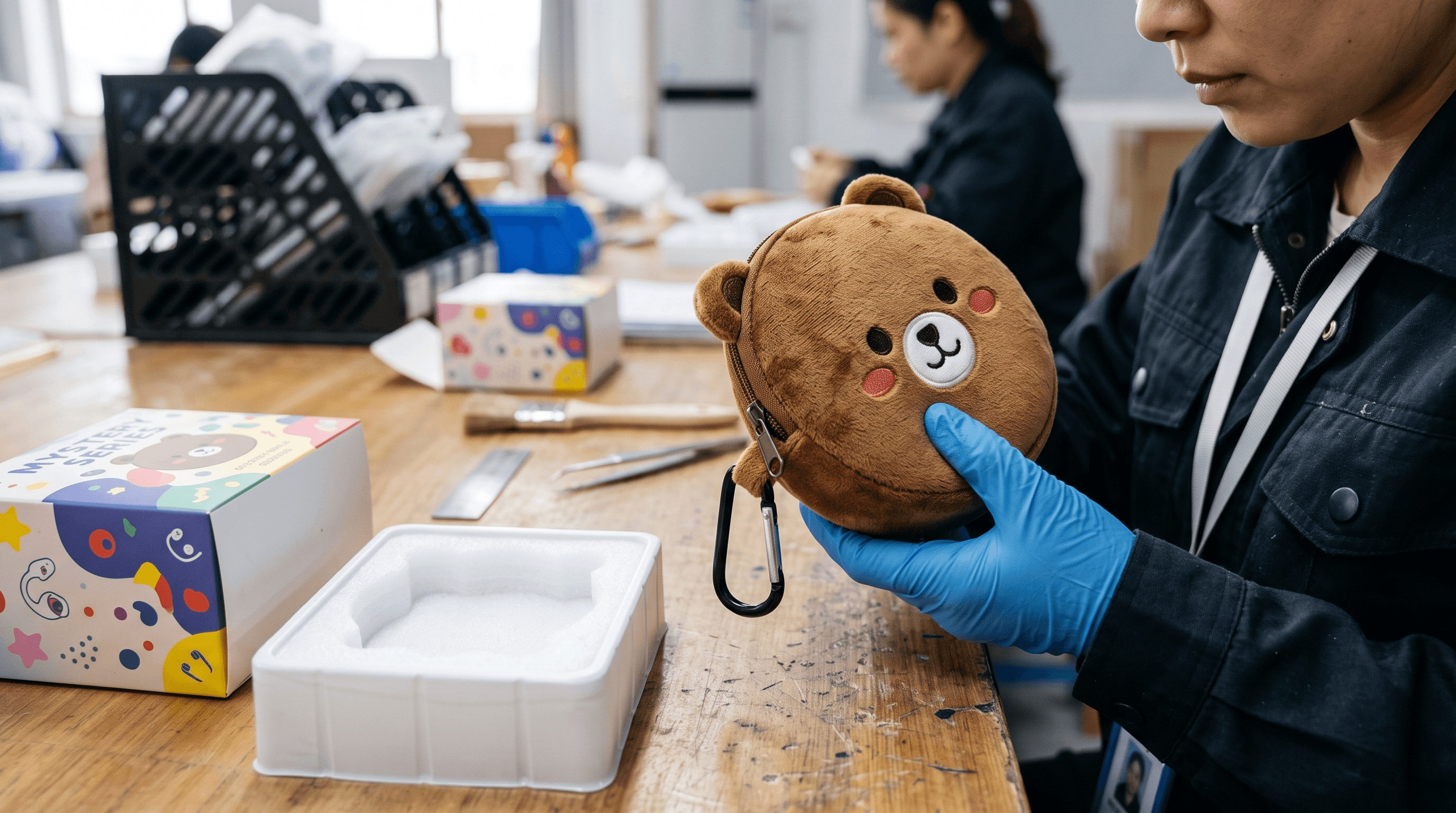
Review a sample and incoming shipment using a repeatable checklist:
- Compare the character, color, dimensions, and hardware with the approved reference.
- Check seams, embroidery, closure alignment, loose threads, and visible adhesive.
- Open and close the zipper, snap, or flap without applying excessive force.
- Test the clip or key ring and check for sharp edges or detached components.
- Inspect retail boxes for crushing, moisture exposure, incorrect labels, or evidence of opening.
- Record issues by carton and photograph both the product and its packing position.
Buyers should also request available material declarations, labeling information, age grading, warning details, and relevant test documentation. Applicable rules depend on product construction, intended age group, claims, and destination market. Verify requirements rather than assuming that a plush appearance or small accessory classification determines compliance.
Build Reorder Timing Around Sales Velocity and Freight Options
Small boxes can still consume substantial carton volume when they contain three-dimensional plush pieces. Request master-carton dimensions, gross weight, net weight, and units per carton before estimating freight. Volumetric weight may matter more than product weight for some transport methods.
Ask for separate estimates for sample preparation, production or order processing, pre-shipment checks, main transit, customs handling, and local delivery. These are planning components, not promised lead times, and each should be confirmed for the intended order.
Use weekly sell-through rather than intuition to set a reorder point. As a planning example, a retailer selling 12 units per week and allowing six weeks for replenishment would need 72 units merely to cover expected demand during that period, before adding a buyer-defined safety allowance. Replace those example numbers with actual sales and confirmed supplier timing.
Gift-led demand may rise around holidays, school events, or promotional weekends. For another perspective on occasion-based merchandising, review the good-luck gift product guide. The key action is to set a final arrival date and work backward instead of placing an order based only on a launch date.
When an Earphone Case Quote Is Not Yet Comparable
Incomplete answers are a bigger warning than a modest price difference. Pause the comparison if a supplier will not define the order unit, provides only exterior dimensions, changes the stated assortment between messages, or cannot show final packaging. Other concerns include pressure to pay before specifications are documented and unexplained substitution of fabrics, hardware, or box formats.
Inquiry template for a usable quotation
Please quote the plush earphone case blind box series for delivery to [city and country]. State the MOQ, pieces per sealed display, displays per master carton, number of regular designs, hidden-design policy, usable internal dimensions, closure type, attachment hardware, retail-box dimensions, carton dimensions and weight, trade term, payment terms, and estimated order-processing timeline. Please also provide sample options, current packaging photos, material and labeling information, available compliance documents, and the process for reporting damaged or nonconforming units.
Before sending the inquiry, add your target quantity, sales channel, intended market, required arrival window, and whether sealed displays are necessary. Do not ask only for the “best price”; ask for a quote that can be evaluated.
Pronto para comparar as opções de fornecimento? Prepare one written specification and request itemized quotations based on the same quantity, destination, packaging format, and compatibility requirements. Review a representative sample before committing to a larger commercial order.
PERGUNTAS FREQUENTES
Are plush earphone case blind boxes universally compatible?
No. Some may be fitted to a particular charging-case shape, while others are general pouches. Buyers should confirm usable internal dimensions, opening size, closure, and any model-specific compatibility before ordering.
What MOQ details should a gift store request?
Ask whether the MOQ applies to individual boxes, sealed displays, designs, series, or master cartons. Also confirm whether different products can be combined and how many units are packed at each level.
How should retailers compare quotations?
Compare the same quantity, currency, trade term, destination, assortment, packaging level, and specification. Include freight, import-related charges, local delivery, and other applicable costs when estimating landed cost.
What should be checked on a sample?
Check usable fit, closure operation, attachment hardware, seams, embroidery, loose fibers, color consistency, retail-box condition, labels, and the way the product is protected inside the box.
Which compliance documents should buyers request?
Request available material, labeling, age-grade, warning, and test information relevant to the product. Buyers should independently verify which safety, import, and labeling rules apply in the destination market.
Before You Place the First Order
Plush earphone cases can add practical variety to a blind-box assortment, but their small size should not lead to a casual purchasing process. Confirm fit, assortment structure, order units, packaging protection, carton data, documentation, and landed-cost assumptions in writing. A controlled sample review and a clearly defined test order provide better evidence for reordering than product photos or an incomplete unit quote.