



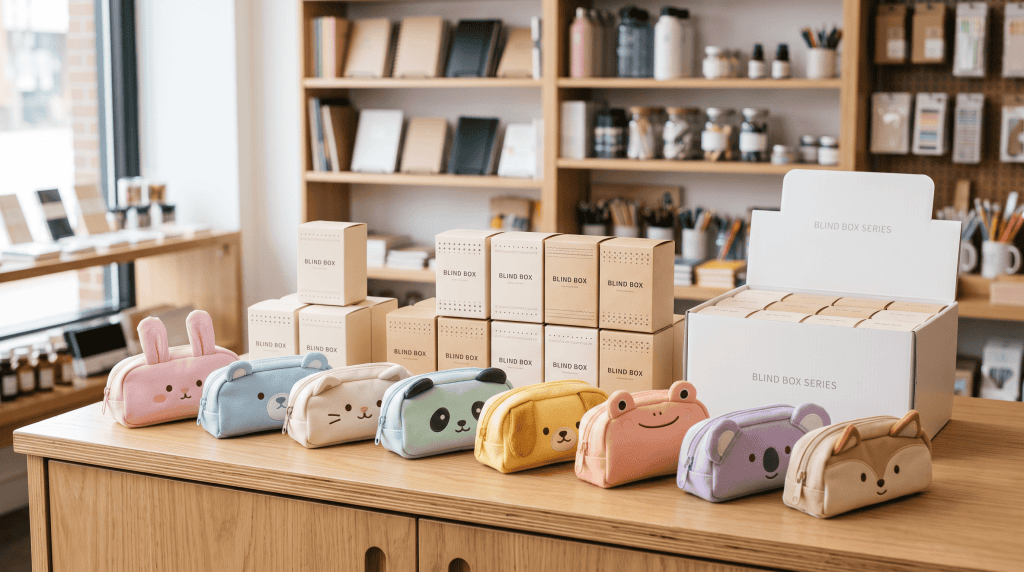
Before a cute mystery-format product earns its shelf space, a retailer has to know whether it will move without piling up duplicate designs, crushed packaging, or slow-selling stock. When sourcing wholesale blind box pen cases, the artwork is only one part of the decision. Buyers also need to confirm what is randomized, how the assortment is packed, whether the cases arrive retail-ready, and what the complete landed cost looks like.
This category may suit stationery stores, gift shops, anime and character retailers, bookstores, lifestyle boutiques, and online sellers building affordable add-on ranges. The following framework helps buyers compare offers without assuming that two visually similar pen case series share the same specifications or commercial risk.
Where Wholesale Blind Box Pen Cases Fit in a Retail Assortment
Start by deciding what job the product should perform. A stationery shop may position pen cases beside notebooks and writing tools, while a collectible retailer may sell them as functional character merchandise. Gift stores may use them as compact impulse purchases or additions to themed bundles.
Ask these questions before evaluating a series:
- Who is the intended shopper? School-age users, students, office workers, character collectors, or gift buyers may value different sizes and designs.
- Is the mystery mechanic clear? Confirm whether the entire pen case design is concealed, whether colors alone vary, and whether any rare or secret style is part of the assortment.
- Does the product complement existing stock? Compare its visual theme with notebooks, pens, desk accessories, plush items, or figures already carried.
- Can staff explain it quickly? Shoppers should be able to understand what is random, what one purchase contains, and whether the pictured designs represent possibilities rather than guaranteed contents.
Character-focused retailers can also compare how functional stationery behaves against purely collectible merchandise. For example, the audience considerations in this witchy kawaii buying guide for anime retailers can help buyers think about theme fit, even though the product format differs.
Compare the Pen Case, Mystery Pack, and Display Carton Separately
A useful quote should describe three layers: the pen case itself, its individual blind packaging, and the outer case or display carton. Attractive product photography may not reveal zipper construction, usable capacity, packaging dimensions, or assortment structure.
| Ponto de avaliação | What to request or confirm | Commercial reason |
|---|---|---|
| Pen case dimensions | External dimensions and, if available, usable internal space | Determines whether common pens, markers, or small accessories fit |
| Body material | Material composition and surface finish | Affects feel, cleaning expectations, weight, and product description accuracy |
| Closure | Zipper type, pull design, opening range, and compartment count | Helps identify usability and inspection points |
| Variedade de designs | Number of regular designs and any special design rules | Supports duplicate-risk and display planning |
| Blind packaging | Box, bag, sleeve, insert, and sealing method | Shows whether customers can inspect or identify contents before purchase |
| Configuração do gabinete | Units per inner or master carton and assortment method | Enables quantity and freight comparisons |
| Retail identification | Barcode availability, item coding, and variant handling | Affects checkout, inventory tracking, and online listing setup |
| Detalhes da embalagem | Carton dimensions, gross weight, and packing method | Needed to estimate freight and storage requirements |
Do not assume that a “full set” means one of every design. Ask whether a sealed display carton is fixed, random, or only statistically assorted. If the supplier cannot explain the packing logic, calculate inventory risk using the most conservative assumption.
Use Case-Pack Math to Control Duplicate and Sell-Through Risk
MOQ and case quantity are different measures. MOQ is the minimum quantity accepted for an order, while case quantity describes how units are physically packed. Buyers should ask whether the minimum applies per series, per design, per carton, or across mixed products.
As a planning example, a retailer considering 72 units might compare three allocations: 72 units in one series, 36 units across two themes, or a smaller test allocation if mixed ordering is available. These are planning quantities, not suggested supplier minimums. The right choice depends on traffic, customer overlap, available display space, and the ability to reorder.
For each option, document:
- The number of sealed display cartons and loose units.
- The expected design mix, if the assortment is disclosed.
- The maximum inventory exposure to one visual theme.
- The sales level that would trigger a reorder review.
- How remaining duplicates could be bundled or merchandised without misrepresenting them.
A first order should test more than customer interest. It should also test packaging resilience, staff understanding, online listing clarity, and whether the carton configuration works with the store’s shelving. Buyers comparing the broader economics of mystery assortments may find the decision logic in this Labubu retail stocking comparison useful for thinking about range concentration versus variety.
Why Carton Volume Can Change the Real Cost of Cute Stationery
The unit quote does not show the complete cost of placing a pen case on the shelf. Lightweight textile or soft-sided products can still occupy substantial carton volume, while rigid individual boxes may limit compression. Request carton dimensions and weight before comparing offers.

A buyer-side landed-cost worksheet can include the quoted goods value, individual and display packaging, freight, insurance where applicable, customs duties or taxes, customs brokerage, payment charges, inspection costs, domestic delivery, and an allowance for damaged or unsellable units. Buyers should verify tariff treatment and import requirements with qualified parties for their destination market.
When comparing two quotes, normalize them to the same basis. Check whether both include identical pen case specifications, the same packaging layers, the same quantity, comparable trade terms, and the same delivery point. A lower unit price may not remain lower after bulky cartons, relabeling, or replacement packaging are considered.
Before narrowing the shortlist, ask each supplier for a carton-level quotation and place the figures in one comparison sheet. This makes missing freight and packaging data easier to spot.
Protect Zippers, Shape, and Mystery Packaging Before Launch
Quality inspection should cover both function and presentation. A usable pen case can still become unsellable if the blind box is crushed, opened, incorrectly labeled, or marked in a way that reveals the hidden design.
Build a sample or pre-shipment review around these checkpoints:
- Compare dimensions, colors, material, printed artwork, and included components with the approved reference.
- Open and close zippers repeatedly on sampled units; check for catching, separation, loose pulls, or restricted openings.
- Inspect seams, edges, lining, compartments, surface marks, odors, and loose threads where relevant.
- Check that individual packages are sealed consistently and do not disclose the variant unintentionally.
- Review display boxes and master cartons for protection against crushing and movement.
- Count units and compare assortment coding with the packing list.
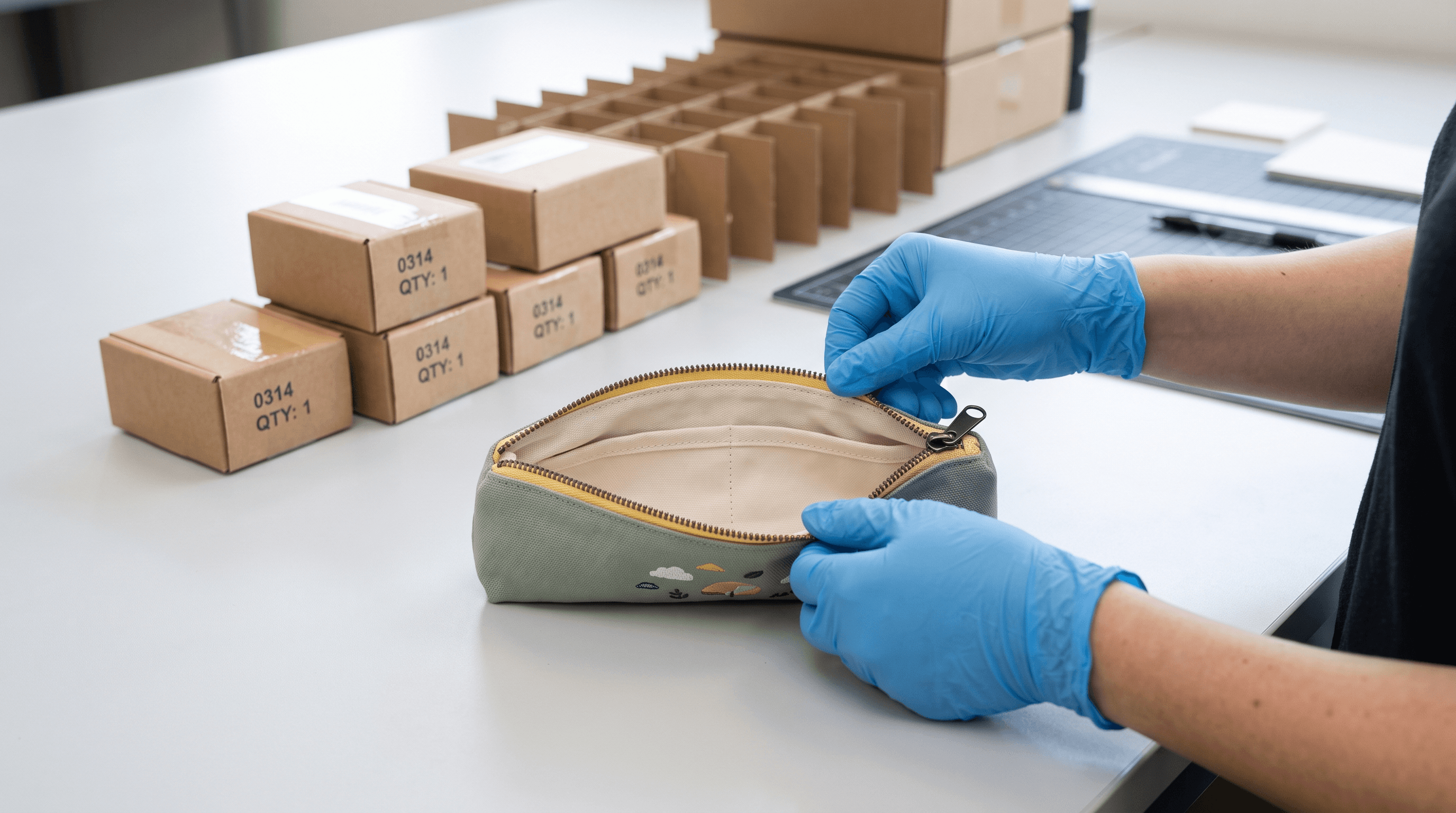
Compliance cannot be judged from appearance. Buyers should confirm applicable material, chemical, labeling, age-grading, packaging, intellectual-property, and product-safety requirements for the intended destination and sales channel. Request relevant documentation when required, but do not treat a vague statement such as “compliant quality” as a substitute for identifiable records and market-specific review.
When a Pen Case Quote Is Not Yet Comparable
Incomplete quotes create false savings. A supplier response should be treated as provisional when it omits case quantity, carton measurements, material details, packaging configuration, or the basis of the quoted delivery terms.
Watch for these practical warning signs:
- Product photos are provided, but no written specification identifies dimensions or materials.
- The seller uses “set,” “case,” and “carton” interchangeably without defining unit counts.
- The design assortment is described as balanced, but no packing method is documented.
- A special or secret design is promoted without explaining whether its inclusion is random or guaranteed.
- Artwork, character ownership, or resale authorization questions receive unclear answers.
- Packaging or carton details change after freight is discussed.
- The quoted lead-time language does not distinguish production preparation, dispatch, and transit.
- Pressure to pay replaces clear answers to specification or documentation questions.
Another common mistake is choosing only by character appeal. A themed series can attract attention but still be difficult to merchandise if the case is too large for the fixture, variant coding is confusing, or individual packages arrive damaged. The structured product evaluation approach in the Guia do comprador de caixas surpresa da Cupa offers an additional reference for reviewing collectible-style assortments.
Send a Pen Case Inquiry That Produces an Itemized Answer
A precise inquiry reduces back-and-forth and makes supplier responses easier to compare. Include the destination, intended quantity range, preferred packaging format, sales channel, and any deadline that affects the buying decision. Ask suppliers to state what is confirmed and what remains subject to final specification.
Wholesale inquiry template
Please quote the selected blind box pen case series for delivery to [city and country]. Our initial planning quantity is [quantity or range]. Please confirm pen case dimensions, material, closure and compartments; all regular and special variants; assortment method; units per display box and master carton; MOQ basis; individual packaging; barcode or item-code options; carton dimensions and gross weight; quotation terms; payment terms; sample options; production or preparation estimate; and shipping options. Please also identify available product, labeling, and compliance documentation relevant to [destination market].
Request photos of the individual package, opened display carton, carton marks, zipper area, interior, and any labels—not only styled front views. If a deadline matters, work backward from the required shelf date and allow time for specification approval, sampling or inspection where used, transport, customs processing, receiving, photography, and listing preparation. Exact timing should be confirmed for the specific order rather than inferred from a previous shipment.
Ready to compare offers? Send the same specification and quantity assumptions to each shortlisted source, request an itemized quote, and hold the order until the assortment, carton configuration, packaging, documentation, and delivery basis are recorded in writing.
PERGUNTAS FREQUENTES
What should buyers confirm before ordering wholesale blind box pen cases?
Confirm dimensions, material, closure, compartments, design count, randomization method, individual packaging, case quantity, carton measurements, MOQ basis, labeling, and quotation terms. Requirements for the destination market should also be reviewed.
Does one display carton contain a complete set?
Not necessarily. A carton may be fixed, randomly assorted, or statistically mixed. Buyers should request the written packing rule and avoid advertising a complete set unless that configuration is specifically confirmed.
How should a retailer plan a first pen case order?
Use store traffic, display capacity, audience fit, case quantity, and reorder feasibility to set a test quantity. Limit exposure to one theme and establish a sales checkpoint for reviewing replenishment.
Which costs belong in a landed-cost comparison?
Include goods, packaging, freight, insurance where applicable, duties or taxes, brokerage, payment charges, inspection, domestic delivery, and an allowance for damaged or unsellable units.
What quality points matter most for blind box pen cases?
Inspect zipper function, seams, lining, dimensions, print consistency, surface condition, package seals, hidden-variant integrity, unit counts, display boxes, and master-carton protection.
Before You Commit Shelf Space
Cute styling may earn the first look, but repeatable retail performance depends on clear assortment rules, usable construction, intact mystery packaging, and predictable carton economics. Compare written specifications rather than images alone, calculate costs at carton level, verify destination-market obligations, and use a controlled opening order to gather real sell-through and defect data before expanding the range.