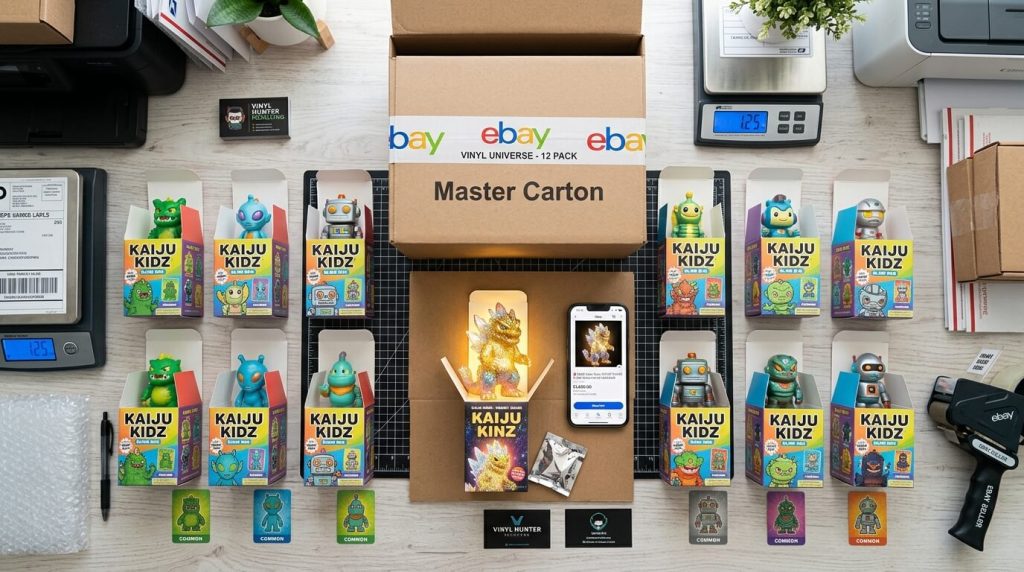





Committing a first order to one character series or spreading it across several designs is one of the earliest decisions a blind box buyer faces—and it quietly sets your inventory risk, display effort, customer appeal, and how easily you can reorder what actually sells. A sealed series set concentrates the order in one theme; a mixed assortment spreads it. Neither is automatically safer.
More variety is not the same as a better order. The right structure depends on your retail format, customer base, available cash, display space, case-pack rules, and ability to reorder specific products. Before comparing quotes, pin down exactly what the supplier means by “sealed set,” “case,” “mixed assortment,” and “assorted quantity”—because those words often hide different pack structures.
Start With the Retail Job the Assortment Has to Do
A sealed series set may suit a retailer building a focused launch around one character, theme, or collection. A mixed assortment may be more useful for a gift shop, multi-brand store, online bundle, or discovery display where customers benefit from visible variety.
- Specialty collectible stores: A defined series can create a clearer merchandising story and encourage customers to collect within one theme.
- Gift and lifestyle retailers: A mixed assortment can give shoppers more choice when they are buying for someone else.
- Online sellers: A mixed product pool may support bundles, themed landing pages, or tests across several customer segments, but product-page accuracy becomes more important.
- Seasonal or event-led sellers: A focused series can simplify campaign planning, while a mixed order may reduce dependence on one theme.
- New retailers: A smaller planning test across selected products may provide more information than committing heavily to a single series.
Ask one practical question first: Do customers come to this sales channel looking for a particular collection, or are they mainly browsing for an affordable surprise gift? The answer should guide the assortment structure before you compare unit prices.
What “Sealed Series” and “Mixed” Must Mean on a Wholesale Quote
Terminology can make two quotes appear comparable when they are not. “Sealed series” might refer to an unopened retail box, a case containing a defined number of boxes, or a complete assortment of designs. “Mixed” might mean several designs from one series, several different series, or a supplier-selected combination.
Request the commercial definition in writing. A useful specification check includes:
| Quote point | What to confirm | Why it matters |
|---|---|---|
| Series identity | Exact product name, edition, and design range | Prevents a general product label from hiding different themes or versions |
| Set meaning | Whether the set is a complete design assortment, sealed retail boxes, or another configuration | Determines collectability and expected customer experience |
| Mixed definition | Which products, series, colors, or characters may be included | Shows whether the buyer can control the assortment |
| Quantity basis | Units per inner pack, case, carton, or order | Allows accurate inventory and freight calculations |
| Allocation method | Fixed quantities, buyer-selected quantities, or supplier-selected quantities | Changes assortment risk and quote comparability |
| Replacement policy | What happens if an item is unavailable or the requested mix cannot be supplied | Reduces surprises after payment or order confirmation |
| Packaging condition | Individual retail packaging, outer cartons, protective inserts, and labeling | Supports display planning and damage-risk assessment |
For product-specific context, buyers can review the Little Monster CUPA I Am Undefined series and see how a defined product line may fit a focused assortment strategy.
When a Sealed Series Set Gives You Tighter Inventory Control
A sealed series set is easier to plan when the merchandising story matters. You can build a display around one recognizable collection, prepare consistent product descriptions, and set a clearer buying objective for the first order.
It may also be easier to evaluate sell-through because the products share a common theme. If the series performs well, the reorder conversation can focus on the same product family. If it performs poorly, however, more of your inventory exposure is concentrated in one creative direction.
Before choosing a sealed set, check:
- Whether your customers already recognize or understand the theme.
- Whether the full set requires a quantity that is realistic for your store size.
- Whether each design can be sold separately if customers do not want to collect the entire series.
- Whether the supplier can identify the series and set composition on the quotation and packing documents.
- Whether your display can make the collection look intentional rather than like excess stock.
For a retailer testing collectible demand, a sealed series can be a sensible planning reference, but do not assume that a complete set guarantees equal demand for every design. Ask how designs are allocated and whether the order is sold only as a set or also in other pack configurations.
If you are comparing focused product lines, a resource like this CUPA blind box sourcing guide can help you turn product interest into specific quote questions rather than relying only on product images.
Why a Mixed Assortment Spreads Your Theme Risk
A mixed blind box assortment spreads the order across more than one design, series, or product type. That can make a display feel broader and give shoppers different price points, visual styles, or gifting directions. It is particularly useful when you are still learning which themes attract local customers.
The trade-off is reduced control. A supplier-selected mix may include quantities that do not match your preferred display, customer profile, or online listings. If the assortment crosses product formats, packaging dimensions and shelf presentation may also vary.
Ask for a sample allocation format before approving the order. For planning purposes, a buyer might compare:
- Focused test: one series or product family with a defined quantity.
- Balanced test: several selected series with similar planned quantities.
- Open mix: a supplier-selected assortment with agreed boundaries but no guaranteed design split.
These are planning models, not standard industry pack rules. The actual order should state the permitted products, quantity range, substitution rules, and whether you must accept the supplier’s final allocation.

Mixed buying becomes more useful when the store has several display zones or when the online shop can organize products by theme. It becomes riskier when customers expect a complete collection, when every item needs a separate listing, or when the supplier cannot provide a reliable packing list before dispatch.
Compare Cost Per Sellable Unit, Not Just the Quoted Unit Price
The lower unit price may not create the lower purchasing cost once freight, packaging losses, slow-moving designs, and handling are considered. Compare each option on a consistent basis.
| Cost or planning factor | Sealed series question | Mixed assortment question |
|---|---|---|
| Product cost | Is the price based on a complete set, retail box, inner pack, or case? | Does the price change with the selected mix or supplier allocation? |
| Freight basis | How many cartons and how much volume does the defined set create? | Do different product formats create inefficient carton utilization? |
| Display cost | Can one display structure support the full series? | Will multiple formats require more shelf, storage, or listing work? |
| Slow-stock exposure | Could one unpopular design hold back the set’s sell-through? | Can unwanted products be separated, bundled, or promoted? |
| Reorder efficiency | Can the same series be reordered in a consistent pack? | Can strong sellers be reordered without taking more weak items? |
| Inbound checking | Is it easy to verify the expected set composition? | Can staff quickly check mixed quantities against the packing list? |
For a simple landed-cost comparison, estimate product cost plus applicable freight, import charges, payment fees, inspection or handling costs, and an expected damage or shortage allowance. Confirm customs treatment, taxes, labeling rules, and any product-specific requirements with the relevant authorities or your customs adviser in the destination market.
How MOQ, Case Packs, and Reorders Can Flip the Better Choice
MOQ is not only a supplier requirement; it is an inventory decision. A sealed set may have a fixed order structure, while a mixed assortment may appear flexible but still be limited by case packs, series-level minimums, or substitution conditions.
Include these questions in the quote:
- What is the minimum order by SKU, series, case, and total order?
- Can quantities be combined across series to meet a minimum?
- Are case quantities fixed, and can cartons be split?
- Is the stated quantity an ordered quantity or an approximate allocation?
- Can best-selling designs be reordered independently?
- What information is needed to confirm a repeat order?
Set a reorder trigger based on actual sales and remaining stock rather than on a supplier’s suggested quantity. As a planning example, a retailer may review sales weekly and open a reorder discussion once remaining sellable stock covers only the expected purchasing and inbound cycle. The correct threshold depends on demand, budget, supplier confirmation, and shipping conditions.
Inspect Retail Packaging and Set Composition Before the Carton Ships
Packaging affects both customer perception and receiving labor. Sealed series sets should be checked for consistent retail presentation and clear set identification. Mixed cartons need an accurate breakdown so staff can verify what arrived without opening every retail package unnecessarily.
Ask the supplier to confirm:
- How individual blind boxes are protected inside inner cartons and outer cartons.
- Whether cartons are marked with product, quantity, and purchase-order information.
- How crushed corners, water exposure, missing units, or visibly damaged retail packaging should be documented.
- Whether product images and descriptions match the supplied edition and packaging.
- Whether any destination-market labeling, language, age guidance, material disclosure, or consumer-safety obligation applies.
Do not treat a photograph, sample, or verbal description as a complete quality specification. Confirm the inspection method, acceptable condition, shortage-reporting window, and evidence required for a claim before placing the order.

For buyers weighing product formats as well as assortment structures, the guide to vinyl-face plush versus standard plush blind boxes shows why material and format differences should be separated from simple design variety when evaluating a wholesale order.
Red Flags That Make a Blind Box Quote Hard to Compare
Several warning signs indicate that a quote needs clarification rather than immediate approval:
- The supplier uses “sealed,” “complete,” or “mixed” without defining the pack structure.
- The quote has a unit price but no case quantity, carton quantity, or shipping basis.
- A mixed assortment is described as “random” without boundaries on the products or series included.
- Substitutions are allowed but you are not told when or how they will be communicated.
- The product name, edition, images, and packing list use inconsistent descriptions.
- The supplier cannot explain how shortages or damaged retail packaging should be reported.
- You are pushed to order a larger quantity before demand, display capacity, and reorder options are understood.
A quote is not fully comparable until product identity, quantity basis, packaging, freight assumptions, and substitution rules are aligned. If one supplier prices a sealed case and another prices individual boxes inside a mixed carton, calculate both on the same sellable-unit and landed-cost basis.
Send a Quote Request That Produces a Usable Comparison
Instead of asking only for a price list, send a structured inquiry. This reduces follow-up and makes supplier responses easier to compare.
Please quote the following blind box options for wholesale review:
- Product or series name and edition:
- Preferred format: defined sealed set, fixed mixed assortment, or supplier-selected mix:
- Target quantity for an initial planning comparison:
- Units per inner pack and outer carton:
- MOQ by SKU, series, case, and total order:
- Available assortment breakdown or permitted substitutions:
- Individual and outer packaging details:
- Product, carton, and shipping dimensions or weight:
- Quote validity and payment terms:
- Estimated production or preparation window to confirm:
- Shipping options and information needed for a landed-cost estimate:
- Shortage, damage, and discrepancy-reporting procedure:
Before paying, compare the responses line by line. If a supplier cannot confirm an item yet, mark it as “to be confirmed” rather than filling the gap with an assumption.
When you are ready to weigh a focused series against a broader purchase plan, prepare your preferred quantities and destination details and request a written wholesale quotation. The strongest decision is usually the one you can explain in terms of sellable units, display fit, landed cost, and reorder control—not simply the lowest headline price.
FAQ
Is a sealed series set better than a mixed blind box assortment?
Neither is universally better. A sealed series may suit focused merchandising and collection-led customers, while a mixed assortment may spread theme exposure and provide broader browsing choice. Compare set composition, quantity rules, landed cost, and reorder flexibility against your sales channel.
What should “sealed set” mean in a wholesale quote?
Ask the supplier to define whether it means an unopened retail box, a case of retail boxes, or a complete design assortment. The quote should state the exact product, quantity, and composition rather than relying on the word “sealed.”
How can buyers compare mixed assortment quotes fairly?
Request the possible products, quantity range, substitution rules, case pack, and shipping basis. Then compare the options by total landed cost, sellable units, expected display space, and the level of control you have over the final mix.
Does a mixed assortment always reduce inventory risk?
No. It can reduce dependence on one theme, but an uncontrolled mix may create unwanted designs, inconsistent packaging, or difficult reorders. Set boundaries for the assortment and confirm whether strong sellers can be reordered separately.
What quality checks should be completed before accepting a blind box shipment?
Check carton count, product identity, quantity by SKU or series, retail packaging condition, visible damage, and consistency with the approved quote or packing list. Confirm the supplier’s discrepancy-reporting procedure before the order is placed.
Make the First Order Easy to Measure
Choose the assortment structure that matches the buying job, not the format that sounds most complete. Confirm what the supplier means by sealed and mixed, calculate landed cost on the same basis, plan around case quantities, and document the acceptable product and packaging condition. A measured first order gives you better evidence for the next purchase than an oversized assortment built on unclear assumptions.