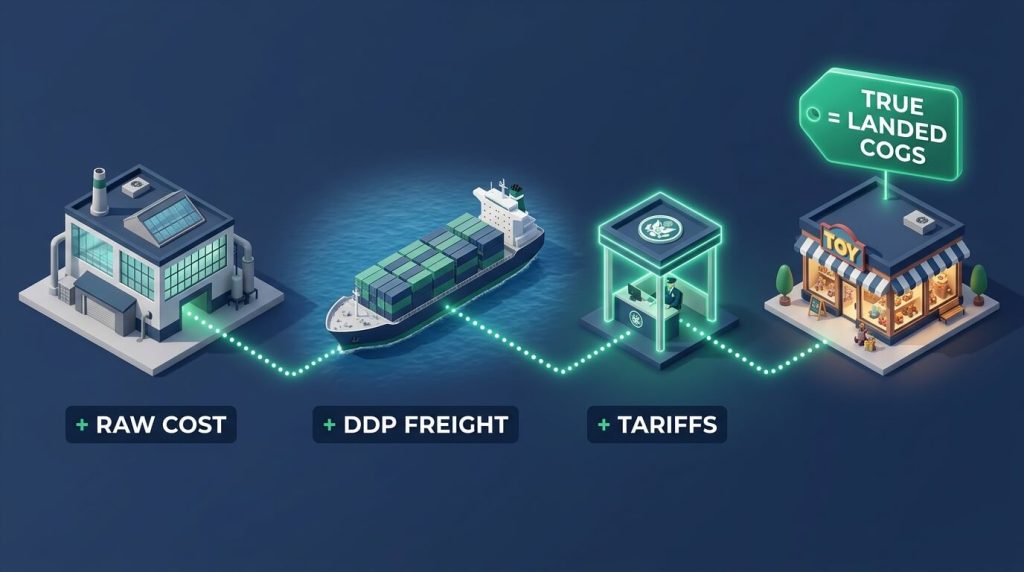




In the art toy retail sector, many independent store owners obsess over a single financial metric: Gross Margin Percentage. They assume that if a $15 blind box costs $7 wholesale (yielding a ~53% margin), the business is inherently profitable. This is a fatal financial blind spot. Gross margin tells you what you earn on a single transaction, but it completely ignores how long your capital was trapped on the shelf to earn it.
To scale a profitable retail operation, B2B buyers must evaluate inventory using GMROI (Gross Margin Return on Investment). This metric measures how much gross profit you earn for every single dollar invested in inventory over a year. In this advanced financial guide, we will break down the GMROI formula, explain the tension between margin and turnover, and outline operational strategies to drastically increase your store’s capital efficiency.
The Margin vs. Turnover Trap

The core concept of GMROI is balancing profitability with velocity. Retailers must realize that inventory is simply cash sitting on a shelf. If it sits too long, it loses value and prevents you from buying newer, faster-moving trends.
The GMROI Formula:
GMROI = Total Gross Margin ($) / Average Inventory Cost ($)
A GMROI of 1.0 means you break even (you earn $1 for every $1 invested). A healthy art toy store should aim for a GMROI between 2.5 and 4.0 (earning $2.50 to $4.00 for every $1 invested in inventory annually).
Let’s look at a practical blind box example:
- Item A (Premium BJD Doll): Costs you $15, sells for $30 (50% Margin). But it takes 6 months to sell. You invest $15 and earn $15 in gross profit over half a year.
- Item B (Plush Keychain): Costs you $5, sells for $10 (50% Margin). But you sell 6 of them in a single month. In 6 months, that original $5 investment has turned over 36 times, generating $180 in gross profit.
While both items have the exact same 50% gross margin, the plush keychain has a GMROI that is exponentially higher. This is why high-turnover impulse items are the financial lifeblood of a retail store.
Operational Strategies to Boost Your GMROI
If your store’s GMROI is sitting below 2.0, you are bleeding capital efficiency. You can only improve GMROI by doing two things: increasing your gross margin dollars (the numerator) or decreasing your average inventory cost (the denominator).
1. Ruthless Dead Stock Liquidation
Holding onto aging inventory destroys your GMROI denominator. If you have 200 boxes of an unpopular series that haven’t sold in 90 days, that is $1,000 of “Average Inventory Cost” generating $0 in gross margin. You must flush it out.
As detailed in our guide on using dump bins and “Lucky Bags” for clearance, liquidating dead stock at break-even (or even a slight loss) immediately shrinks your average inventory holding cost, artificially boosting your overall store GMROI and freeing up cash to buy faster-moving series.
2. The “Infinite GMROI” Hack: CRM Pre-Orders
The most sophisticated retailers use their VIP CRM databases to achieve near-infinite GMROI on high-ticket items. If you collect 100% payment upfront from your VIP collectors for a master carton ก่อน you place the wholesale order, your “Average Inventory Cost” for that transaction is exactly $0.00. Because the denominator is zero, the GMROI is mathematically infinite. Utilizing Other People’s Money (OPM) to fund master carton purchases is the ultimate retail scaling tactic.
Categorizing Inventory by Financial Yield
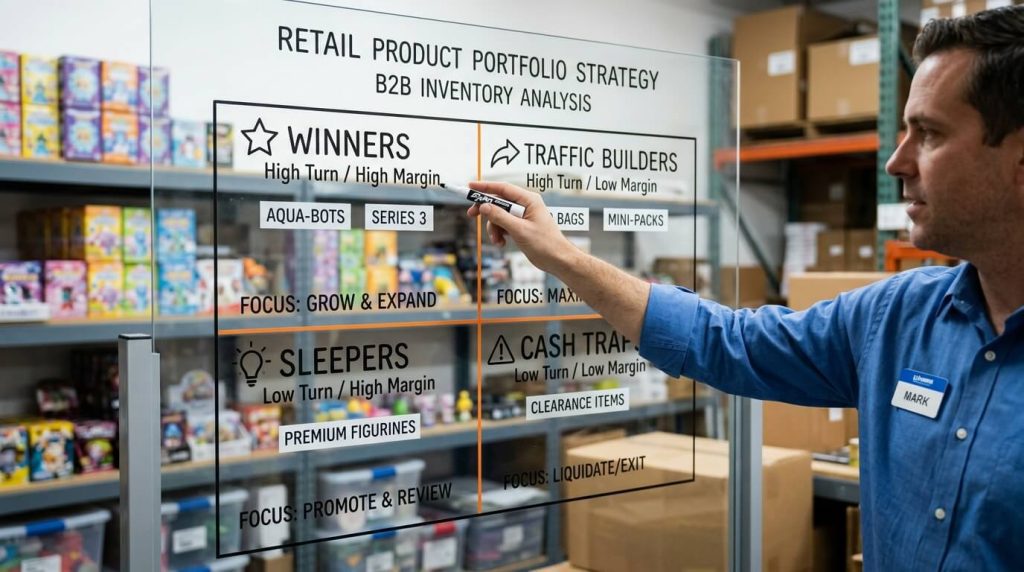
Not every item needs a massive GMROI. A balanced store uses different inventory categories for different financial objectives. You must curate your store layout and visual merchandising to reflect these financial tiers.
- Traffic Drivers (High Turn, Lower Margin): Items like countertop blind box accessories or highly viral trends. You might accept a slightly lower margin to ensure they sell out in days. They produce a high GMROI strictly through velocity.
- Margin Builders (Steady Turn, Solid Margin): The core of your business. Standard 3-inch PVC blind boxes (e.g., Nanci, Kimmon). They provide predictable, steady GMROI month over month.
- Brand Anchors (Low Turn, High Margin): Large $200+ 400% luxury art toys. These have a terrible GMROI because they sit on shelves for months, tying up capital. However, they elevate the store’s aesthetic and draw foot traffic. They are treated as a marketing expense rather than a pure cash-flow driver.
The “SDE” Connection: Why GMROI Matters for Store Valuation
GMROI is not just a daily operational metric; it dictates the exit value of your entire business. If you ever plan to sell your store, buyers will scrutinize your inventory efficiency.
As outlined in our guide on valuing an art toy retail business, a buyer will apply a heavy discount to a store with a massive, slow-moving inventory (low GMROI). Conversely, a store with a lean backroom and a blistering GMROI proves to the buyer that the inventory is highly liquid and desirable, allowing the seller to demand a top-tier valuation multiplier.
Retail Action Matrix: Managing the GMROI Quadrants
Use this quadrant matrix to evaluate every SKU in your POS system at the end of the month.
| Quadrant | Characteristics | Retail Action Required |
|---|---|---|
| The Winners | High Margin & High Turnover | Protect at all costs. Double your order volume. Source via คลังสินค้าภายในประเทศสหรัฐอเมริกา to prevent stockouts. |
| The Traffic Builders | Low Margin & High Turnover | Accept the lower margin. Keep them at the checkout counter to maximize foot traffic and cross-selling. |
| The Sleepers | High Margin & Low Turnover | Move to “Hot Zones” in the store to increase visibility. If turnover doesn’t improve, halt reordering. |
| The Cash Traps | Low Margin & Low Turnover | Liquidate immediately. Toss into a dump bin, recover the cash, and delete the SKU from your catalog. |
คำถามที่พบบ่อย (FAQ)
How often should I calculate GMROI?
While enterprise retailers track it daily, independent art toy stores should pull an inventory report from their POS system and calculate GMROI on a quarterly basis (every 3 months). This provides enough time to account for seasonal spikes without letting dead stock fester for too long.
Does offering a discount lower my GMROI?
It lowers the numerator (Gross Margin), but it usually speeds up the turnover, which shrinks the denominator (Average Inventory Cost). Often, putting a slow-moving item on a 20% sale will actually increase its GMROI because it converts dead shelf space back into liquid cash much faster.
Is GMROI the same as Inventory Turnover?
No. Inventory turnover only measures how many times you sell out and restock a product over a year. It ignores profitability. You could have an incredibly high inventory turnover by selling blind boxes at a loss, but you would quickly go bankrupt. GMROI combines turnover speed with the actual profit margin earned.
How can wholesale lead times affect my GMROI?
If you wait 45 days for ocean freight, that inventory is technically “owned” but unsellable during transit, dragging down your capital efficiency. Sourcing from a B2B supplier with localized warehousing significantly boosts your GMROI because the time between paying for the goods and putting them on the retail shelf is compressed to just a few days.
Optimizing your Gross Margin Return on Investment is the difference between surviving and scaling in the art toy sector. If your GMROI analysis shows you need to pivot toward high-velocity, high-margin inventory, exploring a curated wholesale catalog of proven best-sellers is your next strategic move.