



A cute character can win attention at the shelf, but a bulky carton, a weak attachment, or a mismatched assortment can quietly erode the margin that justified the buy. Deciding which plush pendant blind boxes to stock in an anime store means balancing collector appeal against everyday wearability and workable order economics.
The right pick depends on your customers and selling channel, so this guide compares buying profiles instead of naming an unsupported “winning” series. Use it to shortlist formats, inspect samples, and request comparable quotes before committing shelf space and cash.
Which plush pendant blind boxes fit your selling channel?
Start with how shoppers will discover and use the item. A convention customer may want something immediately attachable to a bag; an online collector may care more about character details and intact packaging. Ask whether your audience buys recognizable anime characters, original designer characters, or both.
Do not assume an anime-styled design is licensed merchandise. If a named franchise drives the purchase, confirm the exact rights holder, product identity, and documentation appropriate to your supply route and market.
| สถานการณ์การขายปลีก | Format to shortlist | Evidence to request | Decision rule |
|---|---|---|---|
| Small-store checkout display | Compact pendant in a small retail box | Box dimensions and display footprint | Choose only if the display fits without hiding adjacent merchandise. |
| Anime convention booth | Lightweight charm with an easy-to-use clasp | Finished weight and attachment sample | Test attachment to common bag straps before ordering. |
| Online anime merchandise store | Distinctive silhouette with consistent presentation | Actual sample photos and authorized image-use terms | Prioritize products you can describe and photograph accurately. |
| Franchise-focused retailer | Character-specific licensed pendant series | Licensing and sourcing evidence | Do not substitute visual resemblance for verified product identity. |
| Gift-oriented shop | Soft-touch plush with protective retail packaging | Fabric, finishing, and box samples | Reject visible glue, loose seams, or easily crushed gift boxes. |
| Collector-led specialty store | Clearly documented assortment | Variant list and written case-composition terms | Advertise set completion only when the supplier explicitly supports it. |
For adjacent product categories, weigh the attachment-based appeal against other functional anime collectibles for gift shops. A pendant should earn its place through customer fit, not simply because it is another blind box.
How to judge a plush pendant beyond its character photo
Request a sample of the exact quoted SKU, not merely a similar plush item. Record the plush body dimensions separately from the overall hanging length, including chain, loop, or clasp. These measurements affect bag use, display height, and listing accuracy.

Inspect the attachment where it joins the plush. A strong-looking clasp does not compensate for a poorly secured fabric loop. Compare the following points across samples:
- Hardware operation: Open and close the clasp repeatedly; check for sticking, sharp edges, and awkward openings.
- Seam finishing: Look around ears, limbs, stuffing closures, and attachment points for gaps or loose threads.
- Face consistency: Compare embroidery, printed features, and symmetry with the approved product reference.
- Fabric behavior: Check visible shedding, surface snagging, and transfer onto light-colored material as preliminary observations.
- Shape recovery: Remove the sample from its packaging and check whether compression leaves persistent distortion.
These are buyer screening checks, not substitutes for applicable laboratory testing. Ask for the material specification and any relevant test documentation tied to the exact product. If detachable accessories are present, investigate their suitability for the intended age group.
For web sales, also review how blind box selection changes for online anime stores; hidden size and attachment details can become avoidable customer-service issues.
Build a test order around sealed cases, not wish-list quantities
MOQ, display-box quantity, and master-carton quantity are different constraints. Ask whether the minimum applies per design series, per SKU, or across the entire order. Then confirm whether mixed-series cartons are permitted and whether they change packing or freight charges.
Blind-box randomness also needs written clarification. Does a sealed case contain an indicated assortment, permit duplicates, or allow a special variant to replace a standard one? Do not infer guaranteed completion from the number of boxes in a display.
As a planning example, a retailer comparing two series might assign one sealed case to each rather than spreading the same budget across many loose units. This makes sales and defect tracking easier, but only works if the supplier’s actual minimums and case terms permit it.
- Reserve a documented sample or display unit and include its cost in the launch budget.
- Track sales by series and batch, not just under one generic blind-box SKU.
- Record customer interest in characters without promising specific contents.
- Define the sell-through evidence needed before increasing the next order.
If cash is tight, apply the broader planning approach in blind box buying for stores with limited budgets to weigh this category against other uses of the same purchasing budget.
Shortlist first: Ask a prospective supplier for sample options and case specifications for the few series that fit your channel before requesting a large mixed assortment.
Why lightweight plush still needs a carton-level cost check
Low product weight does not necessarily mean low freight cost. Boxed plush can occupy substantial space, and carriers may charge using dimensional weight. Request packed carton dimensions, gross weight, units per carton, and the quoted shipping terms before comparing unit prices.
สูตรการวางแผน: Estimated landed cost per saleable unit equals product cost plus applicable freight, insurance, duties, clearance, and handling charges, divided by expected saleable units. Treat taxes according to whether they are recoverable in your business; verify the treatment with an appropriate adviser.
For online sales, add outbound packaging, fulfillment, payment fees, and a realistic returns allowance separately. A low purchase price can be misleading when the box requires a larger shipping parcel or arrives unsuitable for gifting.
Ask suppliers to separate product preparation, dispatch, transport, and expected clearance stages. For convention orders, work backward from the event and include receiving, inspection, and packing time. The guide to small collectibles for anime convention sellers can help assess transport and booth-space trade-offs.
Set reorders using observed sales and the currently confirmed replenishment interval, with a buffer matched to demand uncertainty. Reconfirm availability before depending on another batch; a strong first launch does not establish future supply.
Protect sealed boxes without overlooking pendant safety
Ask how retail boxes are protected inside the master carton: movement control, corner protection, moisture precautions, and resistance to crushing all deserve review. Request photos of the packed carton, not only the attractive display box.
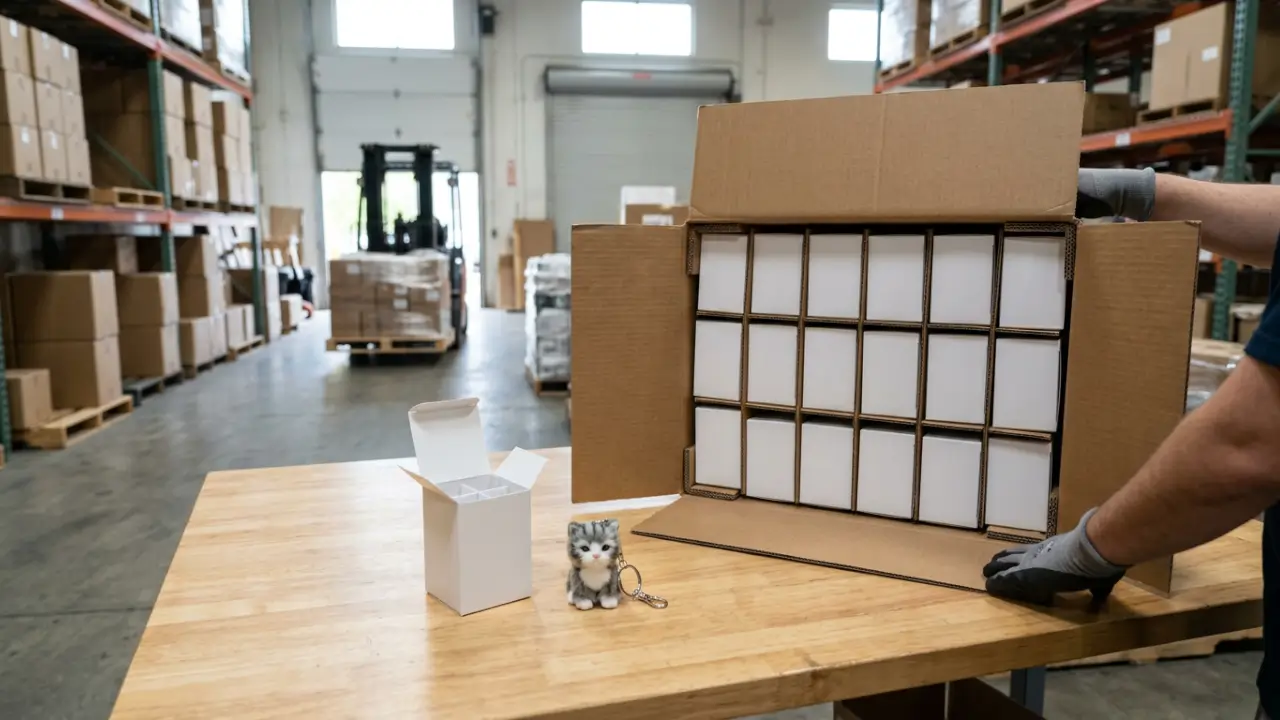
At receiving, inspect a documented sample across different cartons. Photograph outer-carton damage before unpacking, count sealed units, and record crushed boxes, broken seals, staining, odor, and attachment defects separately. Agree in advance on the evidence and reporting window required for a damage or quality claim.
Do not open every unit intended for sealed resale. Separate destructive sample inspection from external checks of sale stock, and document which units were opened. Confirm whether damaged packaging and defective contents are treated differently under the supplier’s written terms.
Buyers should verify destination-market requirements for classification, age grading, small parts, materials, warnings, traceability, and importer labeling. Describing an item as a collectible does not automatically remove toy-safety obligations. Confirm that documentation identifies the relevant SKU and materials rather than an unrelated product family.
What to send before accepting a plush pendant quote
A useful inquiry makes suppliers answer the same questions. Include your selling channel and destination so that packaging and delivery discussions reflect the actual order.
Please quote the following plush pendant series for retail sale in [destination market]. Our channel is [store/online/convention], with a target receiving window of [window] and a planned test quantity of [quantity]. Please confirm exact SKU and assortment, plush dimensions and overall hanging length, materials, attachment type, MOQ, display and master-carton quantities, duplicate or special-variant rules, sample options, carton dimensions and gross weight, shipping terms, preparation and transit estimates, packaging protection, relevant product documentation, and written damage/defect claim terms. Please identify substitutions or exclusions separately.
Pause if a supplier cannot reconcile the sample with the quoted SKU, labels every case a “complete set” without composition terms, or supplies compliance paperwork that does not match the item. Treat undocumented franchise claims, changing carton quantities, and vague freight inclusions as unresolved risks—not minor administrative gaps.
Before committing funds, request a written, itemized quote and sample review for your shortlist. Confirm the case structure, landed-cost assumptions, product documentation, and acceptance criteria in the order record. If an answer changes the economics or legality of resale, resolve it before payment.
คำถามที่พบบ่อย
Which plush pendant blind boxes are best for a small anime store?
Shortlist compact series that fit your customers, shelf space, and test-order budget. Compare actual samples, case quantities, attachment quality, and landed cost rather than choosing from promotional photos alone.
Does a sealed case guarantee every character?
Not necessarily. Ask for written case-composition terms covering duplicates, standard variants, and special-variant substitutions. Only advertise a complete set when those terms support the claim.
What is the difference between a plush pendant and a plush keychain?
Supplier terminology varies. A pendant may use a fabric loop, chain, clasp, or key ring. Confirm the actual hardware, opening size, overall length, and intended use instead of relying on the name.
ผู้ค้าปลีกควรเปรียบเทียบราคาขายส่งอย่างไร?
Compare the same SKU, case quantity, packaging specification, and shipping terms. Include freight and applicable import charges, then check whether samples, damaged units, and claim handling are addressed.
What documentation should buyers request for anime characters?
Request evidence supporting product authenticity and licensing claims, plus applicable safety and labeling documentation for the exact item. Verify requirements for your destination market and supply route before resale.
Before you place that first pendant order
Choose the series that passes three practical tests: your customers want the design, the sample supports the intended use, and the packed order works financially. Keep a written sample reference and order specification so the first delivery—and any reorder—can be checked against the same standard.