



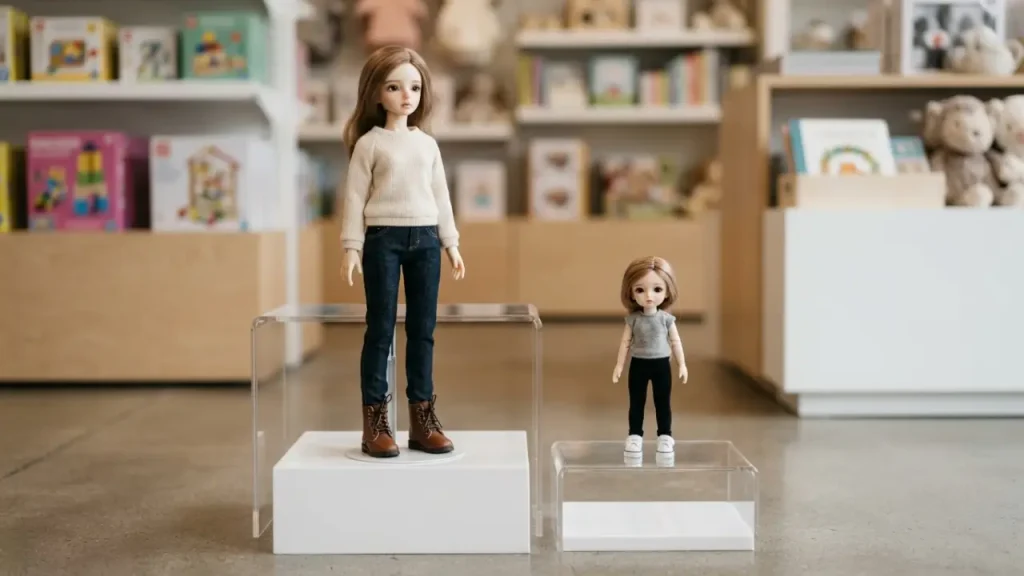
Shelf capacity, packaging volume, and the price a customer expects to pay can all shift the moment a retailer moves between doll scales. Deciding between a 1/6 and a 1/12 ball-jointed doll therefore needs to go beyond which doll looks larger in a product photo. Buyers must examine exact dimensions, display requirements, case configuration, freight exposure, accessories, and how clearly the scale can be communicated at the point of sale.
This matters to specialty toy stores, collectible retailers, gift shops, online sellers, and convention vendors. The right choice depends on where the dolls will be displayed, how customers shop, and how much inventory the business can test without overcommitting.
Read the Spec Sheet, Not the Scale Label
A scale label is useful for categorization, but it should not replace a specification sheet. Doll proportions, head size, footwear, hairstyles, ears, hats, and display stands can make two products carrying the same nominal scale occupy different amounts of space.
Ask the supplier for the assembled doll height, maximum width and depth, packaged dimensions, and gross packaged weight. Confirm whether the listed height includes shoes, hair ornaments, animal ears, or a stand. These details affect shelf spacing, photography, storage, and shipping calculations.
| Buying factor | 1/6 format: typical decision impact | 1/12 format: typical decision impact | What to confirm |
|---|---|---|---|
| Physical presence | Usually creates a stronger individual display focal point | Usually supports denser group displays | Exact assembled height, width, and depth |
| Shelf capacity | Fewer units may fit per shelf | More units may fit in the same footprint | Retail box dimensions and display orientation |
| Accessory visibility | Details may be easier to demonstrate from a distance | Small details may need close-up photography | Included parts and their dimensions |
| Packaging volume | Larger cartons may increase storage and freight exposure | Smaller boxes may allow denser carton packing | Units per carton and master-carton measurements |
| Display furniture | May require taller risers or wider spacing | May work with compact tiered displays | Standing stability and stand inclusion |
| Customer handling | Larger components may be easier to show in person | Small removable parts can require closer supervision | Part list, intended age labeling, and warnings |
| Online presentation | Scale may appear clearer in lifestyle images | Reference objects may be needed to show size | Approved product images and measurement diagrams |
| Accessory compatibility | Requires accessories matched to the specific body | Miniature accessories still need fit confirmation | Body measurements and connector dimensions |
Which Scale Fits Your Store and Customer Mission?
A collectible specialist may use 1/6 dolls as visually prominent products supported by outfits, furniture, or display accessories. A compact gift store may prefer 1/12 dolls because more designs can potentially be presented in limited space. Online-only sellers must weigh the visual appeal of a larger doll against parcel dimensions and protection requirements.
- Specialty collectible stores: compare articulation, customization potential, replacement parts, and accessory compatibility.
- Gift and lifestyle shops: prioritize understandable packaging, manageable shelf depth, and a clear gifting proposition.
- Blind box retailers: examine assortment structure, secret variants, sealed-case configuration, and duplicate risk.
- Online sellers: calculate packed parcel size and prepare images that make scale immediately understandable.
- Event vendors: consider transport volume, setup time, theft exposure, and whether display samples are needed.
Write down the intended selling environment before requesting quotes. “One shelf with a maximum depth of 30 cm” is more useful purchasing information than simply saying that a small doll is preferred.
Build a Shelf Plan Before Choosing the Larger Doll
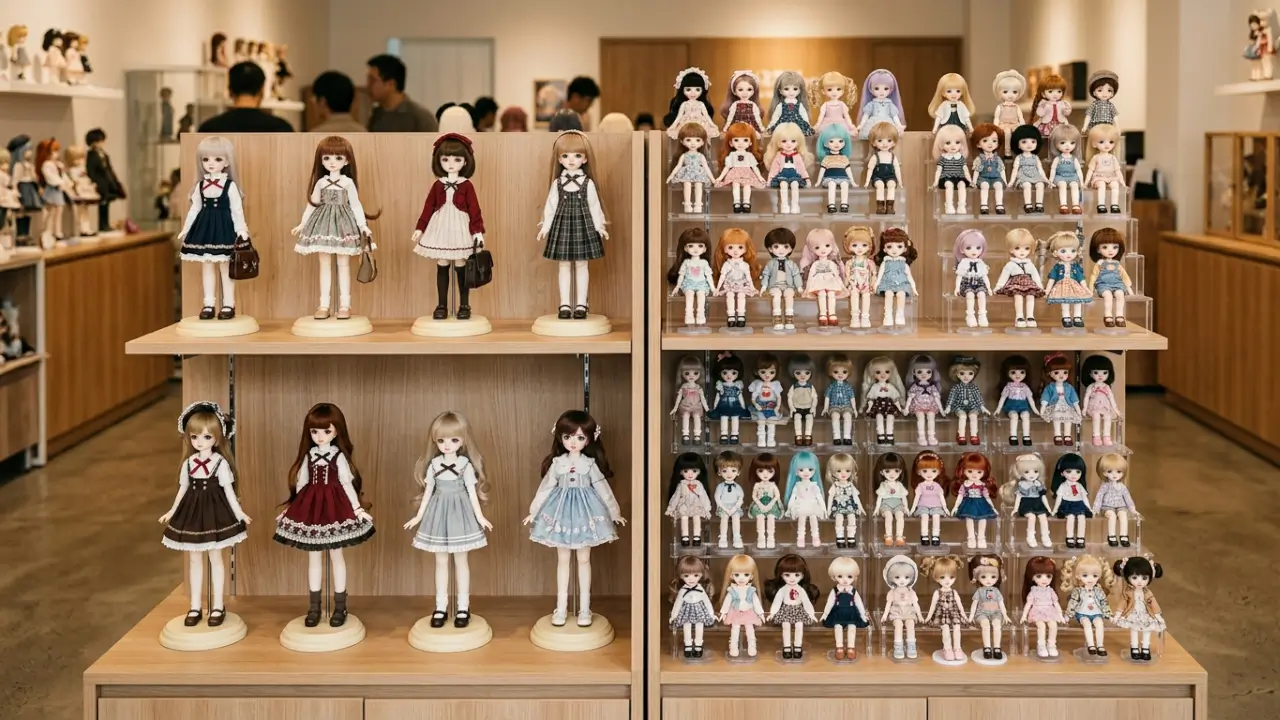
A 1/6 doll may command attention, but fewer facings can reduce the visible assortment. A 1/12 range can offer more character choice per shelf, although a crowded display may make individual designs difficult to understand. Test both formats with paper footprints cut to the packaged dimensions rather than the unboxed doll.
As a planning example, a buyer might compare 12 smaller boxed units arranged across two tiers with six larger units occupying the same fixture. This is not a recommended order quantity; it is a way to evaluate whether assortment breadth or individual product presence matters more for that location.
Also reserve space for a display sample if customers cannot see the assembled doll through the package. For online merchandising, photograph the doll beside a neutral size reference such as a coin or ruler, and show the full contents without implying that props are included.
Retailers evaluating named series can compare how scale changes the presentation by reviewing the Sakura 1/12 BJD buying guide alongside the Bonnie 1/6 BJD sourcing guide. Use those pages as category research, then request current specifications for any product under consideration.
How Case Packs Change the Risk of a BJD Test Order
MOQ and case quantity are not interchangeable. A supplier may quote an order minimum while also packing products in fixed inner boxes or master cartons. Ask whether the minimum applies per series, per design, per sealed case, or across multiple eligible products.
For blind box BJDs, confirm whether a case is factory sealed and whether the regular designs are arranged according to a defined assortment. Do not assume that ordering a certain number of boxes prevents duplicates or guarantees a secret design. Buyers deciding between intact cases and flexible assortments may also consult this guide to sealed series sets versus mixed blind box assortments.
Use a test-order plan with measurable goals. For example, allocate units across one retail shelf, one online listing, and a small replacement reserve, then monitor sales by design or series. Set a reorder trigger based on remaining weeks of cover rather than waiting until the last unit sells.
Before comparing offers, request the case quantity, carton dimensions, assortment method, and packaged unit weight in the same message. This produces a more useful comparison than collecting unit prices alone.
Why Larger Packaging Can Distort the Landed-Cost Comparison
The lower quoted unit price is not automatically the lower-cost purchase. Freight may be influenced by carton volume as well as physical weight, and a larger retail box can also consume more warehouse and shelf space. Import charges, payment fees, inspection expenses, local delivery, and damaged-unit allowances may further affect landed cost.
Build a comparison worksheet using the same cost boundary for each quote:
- Product cost for the planned quantity.
- Retail packaging and any optional outer protection.
- Freight to the same named destination.
- Estimated customs duties, taxes, brokerage, and destination charges.
- Inspection or sample-review costs.
- Local fulfillment materials and delivery costs.
- A documented allowance for damage, missing parts, or unsellable packaging.
Buyers should verify tariff classification, taxes, customs procedures, and import requirements for their own destination. A supplier can provide product information, but the importer remains responsible for confirming the applicable local rules.
Lead time also affects cost. Ask separately about sample preparation, production or order processing, dispatch, and transit. Confirm when the timing estimate begins—after payment, artwork approval, or another milestone—and leave room for inspection and customs delays when setting a launch date.
Protect Joints, Face Paint, and Small Parts in Transit
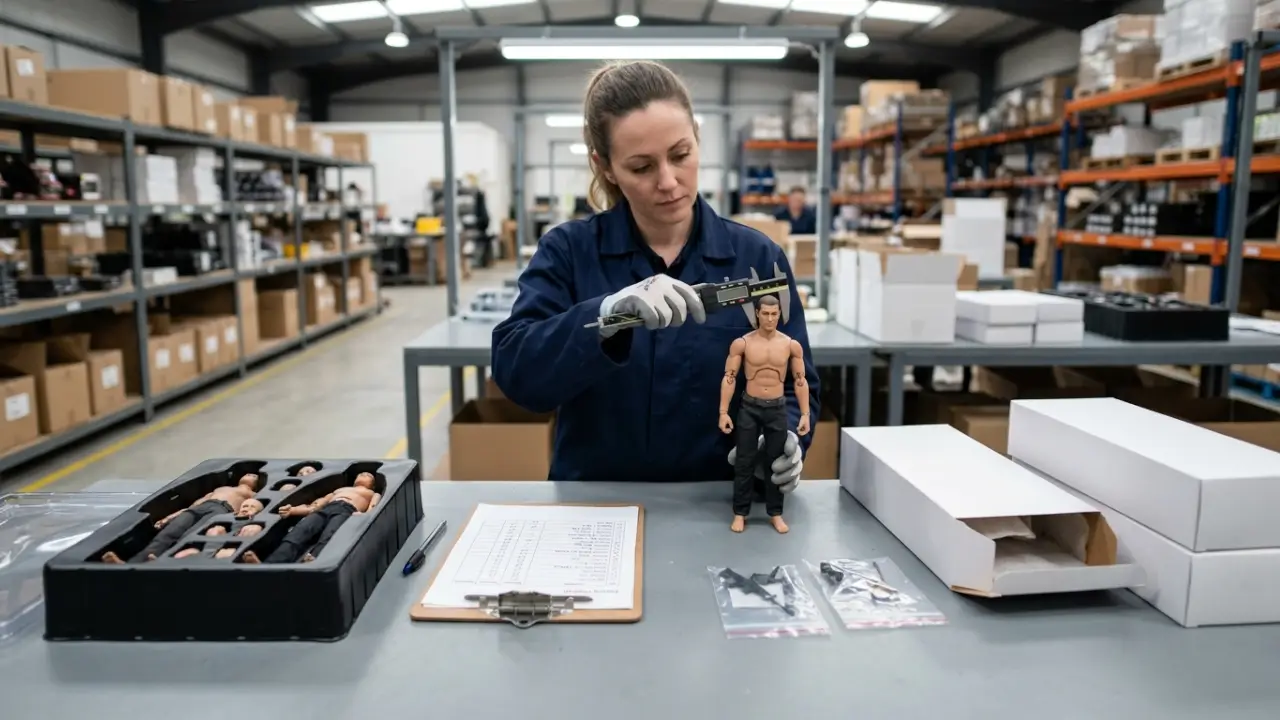
BJD quality review should cover more than whether the doll arrives intact. Ask how the head, limbs, hands, outfit, and loose accessories are restrained inside the retail package. Movement during transit can create rubbing, paint transfer, bent decorations, or pressure on articulated joints.
Request a sample or representative product information before a larger commitment when practical. Review the following points:
- Joint movement and whether the doll can hold intended poses.
- Surface consistency, face printing or paint placement, and visible marks.
- Secure attachment of hair, ears, hands, footwear, and decorative parts.
- Completeness of the outfit, accessories, stand, and printed materials.
- Retail-box condition, seals, internal trays, and protection against movement.
- Consistency between the physical contents and the listing images.
Ask for material composition, intended-age information, warning labels, traceability markings, and available compliance documentation relevant to the destination market. Requirements differ by jurisdiction and product classification, so buyers should have documentation reviewed against their own legal and marketplace obligations rather than treating a general statement as universal approval.
The Luluya BJD retail buying guide provides another series-specific reference for questions that may arise when evaluating a BJD blind box.
When Two BJD Quotes Are Not Actually Comparable
A quote is incomplete if it lists only a product name, scale, quantity, and unit price. Differences in included accessories, packaging, assortment structure, freight terms, and replacement procedures can make apparently similar offers materially different.
Watch for red flags such as scale labels without dimensions, unclear case contents, stock photos that do not show the package, unexplained changes in material descriptions, or pressure to pay before specifications are documented. Another warning sign is a supplier answering questions about the doll while ignoring questions about carton packing or product identification.
Send the same request format to each potential source:
Please quote the specified 1/6 or 1/12 BJD series and confirm: assembled doll dimensions; retail-box dimensions and weight; material description; included outfit, accessories, and stand; articulation details; MOQ; units per inner case and master carton; sealed-case assortment; carton dimensions and gross weight; packaging protection; available product and compliance documents; quote validity; payment terms; estimated order-processing timeline; shipping term; and the process for reporting missing, incorrect, or transit-damaged items. Please identify any detail that varies by character.
Record answers in a side-by-side sheet and mark unconfirmed fields rather than filling them with assumptions. A more complete quote may be safer to evaluate even when its headline unit price is not the lowest.
Ready to narrow the order? Prepare the target scale, destination, sales channel, estimated test quantity, preferred case format, and required documentation before requesting a formal quote. If a 1/6 series is under consideration, the Bonnie BJD retail sourcing guide can help frame additional product-specific questions.
FAQ
Is every 1/6 BJD the same height?
No. The scale is a category reference, but proportions, head size, footwear, ears, hairstyles, and stands can change the overall dimensions. Always request assembled and packaged measurements.
Does a 1/12 BJD always cost less to ship?
Not necessarily. Smaller packaging may reduce volume, but freight depends on carton packing, shipment size, chargeable weight, route, and shipping terms. Compare landed cost using actual carton data.
Which BJD scale is better for a small retail store?
1/12 may support more units in limited space, while 1/6 may provide stronger visual presence with fewer facings. Build a shelf plan using retail-box dimensions before deciding.
Should blind box BJD buyers order sealed cases?
Sealed cases can preserve the supplier’s stated assortment structure, but buyers should not assume they eliminate duplicates or guarantee secret designs. Confirm the exact case configuration in writing.
What should a wholesale BJD quote include?
It should identify the scale, dimensions, materials, included parts, packaging, MOQ, case quantity, carton data, assortment method, shipping terms, estimated processing timeline, documentation, and issue-reporting process.
Choose the Scale That Works After the Unboxing
The commercial difference between 1/6 and 1/12 extends from the shelf to the shipping carton. Larger dolls may create stronger focal displays, while smaller dolls may make broader assortments and compact merchandising easier. Neither advantage is universal.
Base the decision on verified dimensions, a realistic display plan, complete case information, landed-cost estimates, and documented quality requirements. That approach turns a scale preference into a defensible purchasing decision.